
 Worksheets
Q1 Topic 2
Total questions: 49
Worksheet time: 2hrs 59mins

Which element is this?
Nickel
Neon
Sodium
Nitrogen

Name this element.
Neon
Magnesium
Sodium
Manganese

How many valence electrons?
2
3
4
5

What is the atomic number of this element?
17
18
35
35.453
Horizontal (SIDE TO SIDE) rows on the periodic table are
groups
periods
The period number tells you the number of
protons
energy levels
valence electrons
What is the oxidation number of nitrogen?
+3
-1
-2
-3
What happens to barium when it ionizes?
It gains 2 electrons.
It loses 2 electrons.
It gains 1 electron
It loses 1 electron.
Nonmetals ________ electrons to ionize.
gain
lose
don't change
create
Elements that lose electrons are called _________
cations and metals
cations and nonmetals
anions and metals
anions and nonmetals
What is the correct formula for aluminum chloride?
AlCl3
Al3Cl
AlCl2
AlCl
What is the correct formula for lithium nitride?
LiN3
Li2N
Li3N
LiN
What is the correct formula for magnesium oxide?
MgO
Mg2O3
Mg2O
MgO2
What is the correct formula for Sodium sulfide?
NaS2
NaS
Na2S3
Na2S
Sodium phosphide's formula
(a)
Magnesium Fluoride's formula
(a)
the name of Li2S
(a)
The compound formula when aluminum and selenium combine
(a)
How many atoms of iodine are in 1 mole of iodine?
63.55
They all contain the same number of molecules
How many molecules are there in 5.5 moles potassium chloride?
4.08 x 10⁻²⁴
3.31 x 1024
33.11
0.98
How many molecules are in 2.5 mol of acetaminophen?
What is the molar mass of Cl2?
17 g/mol
35.5 g/mo;
71.0 g/mol
89 g/mol
What is the molar mass of the diatomic element nitrogen?
7 g/mol
14 g/mol
28 g/mol
Calculate the molar mass of Cu2O.
37 g/mol
45 g/mol
79.5 g/mol
143 g/mol
Calculate the molar mass for Al(OH)3
78.0 g/mol
72 g/mol
28 g/mol
25 g/mol
Q1. Which kinds of substances are held together by intermolecular forces?
Metallic substances
Ionic substances
Molecules (covalent) in solid and liquid phases
Molecules (covalent) in gas phase
Intermolecular forces _________________
hold 2 different molecules together
connect cations and anions
hold 2 nonmetals together in a molecule
hold 2 different metals together
Which kind of IMF is strongest?
hydrogen bonding
dipole-dipole
London dispersion forces
induced-dipole induced-dipole
Which compound would dissociate when dissolved in water?
SiCl4
C6H12O6
H2
MgBr2
How many ions are formed when Al2O3 dissociated ?
3
4
5
2
What is the name of a compound that separates into ions that conduct electricity in water?
covalent
electrolytes
IMF
metals
NaCl
KMnO4
AgClO3
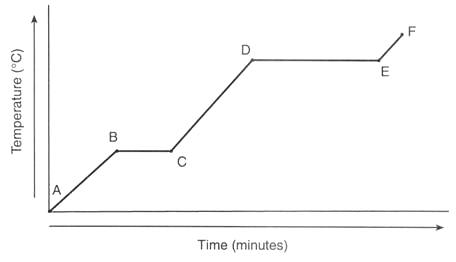
Between which points is the temperature of the substance remaining constant?
A-B only
A-B, C-D, and E-F
B-C only
B-C and D-E

Which letter indicates where water is in both the solid and liquid phase at the same time?
A
B
C
D
E

In which region(s) of the heating curve would water be a liquid and a gas at the same time?
A
B
C
D
E
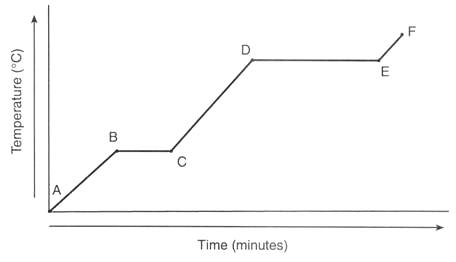
How many states of matter are present during line segment BC?
One
Two
Three
Depends on the temperature

Three containers with the same amount of the same material are shown below. Which container has the substance with the highest amount of energy?
The container on the left
The middle container
The container on the right
All have an equal amount of energy
Three containers with the same amount of the same material are shown below. Which container has the substance with the lowest amount of energy?
The container on the left
The middle container
The container on the right
All have an equal amount of energy
Which statement best describes what happens when heat is added to a substance?
Energy moves out of the substance causing the molecules to slow down.
Energy moves out of the substance causing the molecules to speed up.
Energy moves into the substance causing the molecules to slow down.
Energy moves into the substance causing the molecules to speed up.
Covalent bonds are the forces
within molecules
between molecules
Which group of elements obeys the octet rule without ionizing?
noble gas
halogens
lanthanides
transition metals
How many valence electrons are in an atom of iodine?
7
17
53
127

