
 Worksheets
Dynamic Planet TJSO
Total questions: 175
Worksheet time: 4hrs 56mins

What do geologists notice about the rocks along the sea floor?
They get older as they get farther away from mid ocean ridges
They get thicker closer to continents
Density is impossible to measure
Youngest parts of the crust are along the continents

The point on Earth's surface directly above the focus of an earthquake
Juan de fuca plate
Focus
Seismic wave
Epicenter
What is the "driving force" behind plate tectonics?
the cooling of the Earth's crust
gravitational pull of the moon
convection currents in the Earth's mantle
the Earth's magnetic field
All of the following islands would be considered a "volcanic island arc" except
indonesia
phillipines
japan
hawaii
all of the following were evidences presented by Wegener to prove his continental drift hypothesis except
continental puzzle
matching fossils
seafloor spreading
ancient climates
what was the name given by wegener to the last known supercontinent?
gondwanaland
eurasia
pangea
mega africa
most earthquakes are caused by
meteorite impacts
fracking
stress that builds up along plate boundaries
atomic bomb testing


What do geologists notice about the rocks along the sea floor?
They get older as they get farther away from mid ocean ridges
They get thicker closer to continents
Density is impossible to measure
Youngest parts of the crust are along the continents
The point on Earth's surface directly above the focus of an earthquake
Juan de fuca plate
Focus
Seismic wave
Epicenter
What is the "driving force" behind plate tectonics?
the cooling of the Earth's crust
gravitational pull of the moon
convection currents in the Earth's mantle
the Earth's magnetic field
All of the following islands would be considered a "volcanic island arc" except
indonesia
phillipines
japan
hawaii
all of the following were evidences presented by Wegener to prove his continental drift hypothesis except
continental puzzle
matching fossils
seafloor spreading
ancient climates
what was the name given by wegener to the last known supercontinent?
gondwanaland
eurasia
pangea
mega africa
most earthquakes are caused by
meteorite impacts
fracking
stress that builds up along plate boundaries
atomic bomb testing
The type of plate boundary where two plates come together is a .....
Convergent Boundary
Divergent Boundary
Transform Boundary
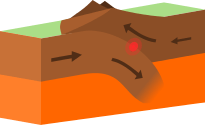
What type of plate boundary is this?
Transform
Divergent
Convergent

What type of event will occur at this boundary?
Earthquake
Volcano Eruption
Mountain Building
A divergent boundary occurs when plates ....
Pull apart
Come together
Slide past each other
Which of the following is the name of the ancient supercontinent formed 280 Million Years ago.
Pangaea
Gondwanda
Laurasia
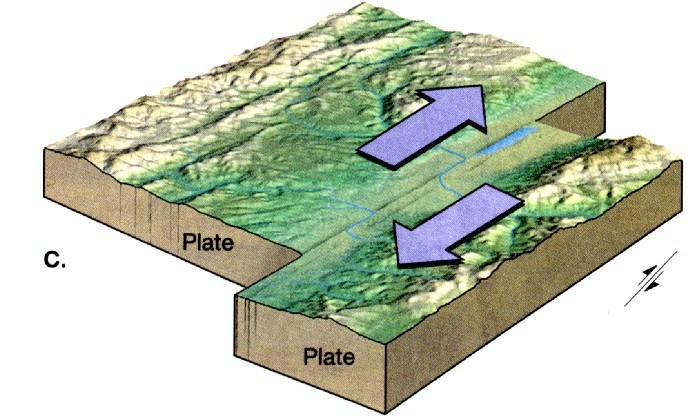
What type of plate boundary is this?
Transform
Convergent
Divergent
The theory that says Earth's continents once made up an ancient supercontinent, and have been drifting apart ever since, is called the theory of...
Pangea
Plate Tectonics
Natural Selection
Oceanic Trenches are formed by _______ plate boundaries
Convergent
Transform
Divergent
Volcanic Islands can from from magma which is pushed up at a __________ plate boundary
Divergent
Convergent
Transform
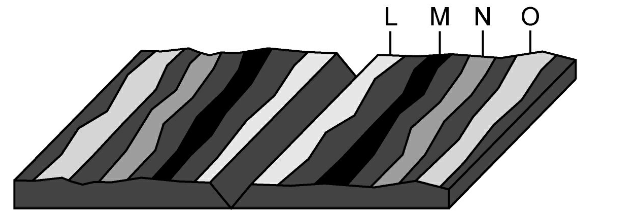
Where would the oldest rock be found?
L
M
N
O
How is it possible for new crust to be formed without increasing the surface area of the Earth?
Crust is destroyed at the same time it is created at a different location
New crust is underwater where it sinks
New crust breaks more easily than old crust
Mountains are created when....
Two continental plates collide
Two oceanic plates pull apart
An oceanic plate subducts under a continental Plate
Two continental plates pull apart
The Great Rift Valley in Africa and the Mid-Ocean Ridge were all created by this boundary
Divergent
Convergent
Transform
What are the two types of crust
continental and oceanic
lithosphere and athenosphere
lower and upper
The Himalayas in Asia are an example of what type of plate boundary?
divergent
continental-continental convergent
oceanic-continental convergent
transform
When an oceanic plate and a continental plate collide, which one will subduct?
oceanic, because it is more dense
continental, because it is more dense
oceanic, because it is less dense
continental, because it is less dense

What is the name of the plate boundary that slides past each other?
Divergent
Convergent
Transform
What would you be most likely to find at a convergent boundary between two pieces of oceanic crust?
Mountains
Rift Valley
Mid-Ocean Ridge
Volcanic Island Arc
What would you be most likely to find at a divergent boundary between two pieces of continental crust?
Mid-Ocean Ridge
Mountain
Rift Valley
Island Arc

Name this boundary
Convergent
Divergent
Transform
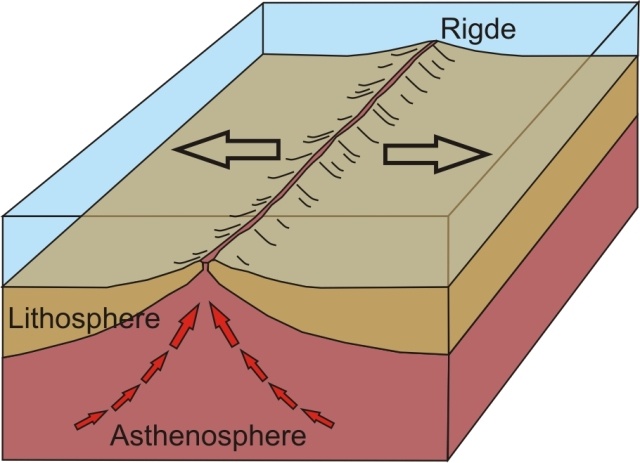
What kind of plate boundary is shown here?
divergent
convergent
transform

What kind of plate boundary is shown here?
divergent
convergent
transform

What kind of plate boundary is shown here?
divergent
convergent
transform
What geologic feature/event you be most likely to find at a transform boundary?
Earthquakes
Volcanoes
Mountains
Rift Valleys
What geologic feature/event would you most likely to find at a convergent boundary between two pieces of continental crust?
Volcano
Mountain
Rift Valley
Island Arc

Where would the youngest rock be found?
L
M
N
O

What type of convergent plate boundary is shown?
Oceanic-Continental
Continental-Continental
Oceanic-Oceanic
Plate Tectonics
Plate tectonics is a scientific theory that explains the movement of the Earth's lithosphere, which is divided into several large and small plates. These plates float on the semi-fluid asthenosphere beneath them. The theory of plate tectonics suggests that the Earth's lithosphere is broken into pieces that move and interact with each other, resulting in various geological phenomena.
Types of Plate Boundaries
There are three main types of plate boundaries: divergent boundaries, convergent boundaries, and transform boundaries. Divergent boundaries occur when two plates move away from each other, creating new crust as magma rises to fill the gap. Convergent boundaries occur when two plates collide, leading to the formation of mountains, volcanic activity, and subduction zones. Transform boundaries occur when two plates slide past each other horizontally, causing earthquakes.
Plate Tectonics and Earthquakes
Plate tectonics and earthquakes are closely related. Most earthquakes occur along plate boundaries, where the movement and interaction of plates cause stress and strain to build up. When the stress exceeds the strength of the rocks, it is released in the form of an earthquake. The majority of earthquakes happen along convergent and transform boundaries, where the plates are actively moving and interacting.
What does plate tectonics explain?
The movement of the Earth's atmosphere
The movement of the Earth's lithosphere
The formation of mountains
The composition of the Earth's core
How are plate tectonics and earthquakes related?
Plate tectonics cause earthquakes
Plate tectonics and earthquakes have no relation
Earthquakes cause plate tectonics
Plate tectonics and earthquakes are closely related
What are the three main types of plate boundaries?
Divergent boundaries, convergent boundaries, and transform boundaries
Oceanic boundaries, continental boundaries, and transform boundaries
Subduction boundaries, collision boundaries, and transform boundaries
Trench boundaries, rift boundaries, and transform boundaries
What is the main location where most earthquakes occur?
Volcanoes
Mountains
Plate boundaries
Ocean trenches


How did the Himalaya Mountains form?
Erosion
Convection
Glacial movements
Colliding tectonic plates
The removal and transport of surface material by wind and water is called
seismicity
tectonics
erosion
vulcanism
Volcanoes occur at tectonic plate boundaries that are
colliding
slipping past one another
separating from one another
both colliding and separating from one another
90% of all earthquakes and volcanoes on Earth occur
in the Atlantic Ocean
in the United States
around the Ring of Fire
during a full moon


40 % Sand
50% Silt
10% Clay
Clay
Clay Loam
Silt Loam
Sandy Loam

35 % Sand
15% Silt
50% Clay
Clay Loam
Sandy Loam
Silt Loam
Clay
Which type of wave produced by an earthquake is the most destructive?
P waves
Destructive Waves
S Waves
Oceanic Waves
Earthquakes
Earthquakes are natural disasters that can cause significant damage and loss of life. It is important to understand the safety measures, prediction methods, and causes of earthquakes to mitigate their impact.
Earthquake Safety Measures: To protect ourselves during an earthquake, it is crucial to follow certain safety measures. These include finding a safe place to take cover, such as under a sturdy table or against an interior wall. It is also important to stay away from windows, heavy furniture, and other objects that may pose a risk of falling. Additionally, having an emergency kit with essential supplies and creating an emergency plan can help ensure our safety during and after an earthquake.
Earthquake Prediction: While scientists have made significant progress in understanding earthquakes, accurately predicting them remains a challenge. However, certain indicators such as foreshocks, ground deformation, and changes in groundwater levels can provide some warning signs. Advanced technologies and monitoring systems are being developed to improve earthquake prediction and provide timely alerts to affected areas.
Causes of Earthquakes: Earthquakes are primarily caused by the movement of tectonic plates, which make up the Earth's crust. When these plates collide, slide past each other, or separate, it can result in seismic activity. The release of accumulated stress along fault lines leads to the shaking and vibrations that we experience during an earthquake. Other causes of earthquakes include volcanic activity, landslides, and human-induced activities such as mining and reservoir-induced seismicity.
What is the main challenge in earthquake prediction?
Understanding the causes of earthquakes
Developing accurate prediction models
Monitoring seismic activity
Analyzing historical earthquake data
What is the primary cause of earthquakes?
Volcanic eruptions
Movement of tectonic plates
Meteorite impacts
Underground explosions
What is the importance of following earthquake safety measures?
To protect ourselves during an earthquake
To prevent earthquakes from occurring
To study the effects of earthquakes
To build earthquake-resistant structures
What are the potential consequences of earthquakes?
A. Destruction of infrastructure
B. Loss of human lives
C. Displacement of people
D. Increase in wildlife population
Earthquake Waves
Earthquakes are natural phenomena that occur when there is a sudden release of energy in the Earth's crust. This release of energy creates seismic waves that travel through the Earth and can cause significant damage. There are different types of earthquake waves, including P waves and S waves.
P waves, also known as primary waves, are the fastest seismic waves and are the first to be detected during an earthquake. They travel through solids, liquids, and gases, and cause the ground to move back and forth in the same direction as the wave. S waves, on the other hand, are slower than P waves and can only travel through solids. They cause the ground to move up and down or side to side, perpendicular to the direction of the wave.
Measuring earthquake waves is crucial for understanding and predicting earthquakes. Scientists use seismographs to measure the amplitude and frequency of seismic waves. The amplitude of a wave represents the energy released during an earthquake, while the frequency indicates the number of waves that pass a given point in a certain amount of time. By analyzing these measurements, scientists can determine the magnitude and intensity of an earthquake, which helps in assessing the potential damage it may cause.
In conclusion, earthquake waves are a result of the release of energy during an earthquake. P waves and S waves are the two main types of seismic waves, each with its own characteristics. Measuring these waves using seismographs provides valuable information about the magnitude and intensity of an earthquake, aiding in earthquake prediction and preparedness efforts.
What is the importance of measuring earthquake waves?
To understand and predict earthquakes
To study the effects of earthquakes on buildings
To analyze the geological structure of earthquake-prone areas
To measure the intensity of earthquakes
What causes earthquakes?
Volcanic eruptions
Tectonic plate movements
Hurricanes
Tsunamis
Which type of waves are slower than P waves and can only travel through solids?
S waves
P waves
Surface waves
Love waves
What do scientists use seismographs to measure?
Amplitude and frequency of seismic waves
Temperature and pressure of the Earth's core
Density and composition of the Earth's crust
Speed and direction of ocean currents
Earth Layers
Tectonic Plates:
The Earth's lithosphere is divided into several large and small plates called tectonic plates. These plates are constantly moving, albeit very slowly, and interact with each other at their boundaries. The movement of tectonic plates is responsible for various geological phenomena such as earthquakes, volcanic activity, and the formation of mountain ranges.
Crust:
The crust is the outermost layer of the Earth and is composed of solid rock. It is the thinnest layer, ranging from about 5 to 70 kilometers in thickness. The crust is divided into two types: continental crust, which forms the continents and is thicker but less dense, and oceanic crust, which forms the ocean floor and is thinner but more dense.
Mantle:
The mantle is the layer beneath the crust and extends to a depth of about 2,900 kilometers. It is composed of solid rock, but due to the high temperature and pressure, it behaves like a plastic material. The mantle is divided into two parts: the upper mantle and the lower mantle. The upper mantle is more rigid, while the lower mantle is more fluid-like.
What is the mantle and how is it divided?
The mantle is the outermost layer of the Earth.
The mantle is the layer between the crust and the core.
The mantle is the layer above the crust.
The mantle is the layer below the core.
What geological phenomena are caused by tectonic plates?
Earthquakes and volcanic activity
Hurricanes and tornadoes
Floods and landslides
Droughts and wildfires
What are the two types of crust in the Earth's layers?
Continental and oceanic crust
Mantle and core
Lithosphere and asthenosphere
Outer and inner core
Plate Tectonics
Plate tectonics is a scientific theory that explains the movement of the Earth's lithosphere, which is divided into several large and small plates. These plates float on the semi-fluid asthenosphere beneath them. The theory of plate tectonics suggests that the Earth's lithosphere is broken into pieces that move and interact with each other, resulting in various geological phenomena.
Types of Plate Boundaries
There are three main types of plate boundaries: divergent boundaries, convergent boundaries, and transform boundaries. Divergent boundaries occur when two plates move away from each other, creating new crust as magma rises to fill the gap. Convergent boundaries occur when two plates collide, leading to the formation of mountains, volcanic activity, and subduction zones. Transform boundaries occur when two plates slide past each other horizontally, causing earthquakes.
Plate Tectonics and Earthquakes
Plate tectonics and earthquakes are closely related. Most earthquakes occur along plate boundaries, where the movement and interaction of plates cause stress and strain to build up. When the stress exceeds the strength of the rocks, it is released in the form of an earthquake. The majority of earthquakes happen along convergent and transform boundaries, where the plates are actively moving and interacting.
What does plate tectonics explain?
The movement of the Earth's atmosphere
The movement of the Earth's lithosphere
The formation of mountains
The composition of the Earth's core
How are plate tectonics and earthquakes related?
Plate tectonics cause earthquakes
Plate tectonics and earthquakes have no relation
Earthquakes cause plate tectonics
Plate tectonics and earthquakes are closely related
What are the three main types of plate boundaries?
Divergent boundaries, convergent boundaries, and transform boundaries
Oceanic boundaries, continental boundaries, and transform boundaries
Subduction boundaries, collision boundaries, and transform boundaries
Trench boundaries, rift boundaries, and transform boundaries
What is the main location where most earthquakes occur?
Volcanoes
Mountains
Plate boundaries
Ocean trenches
How did the Himalaya Mountains form?
Erosion
Convection
Glacial movements
Colliding tectonic plates
The removal and transport of surface material by wind and water is called
seismicity
tectonics
erosion
vulcanism
Volcanoes occur at tectonic plate boundaries that are
colliding
slipping past one another
separating from one another
both colliding and separating from one another
90% of all earthquakes and volcanoes on Earth occur
in the Atlantic Ocean
in the United States
around the Ring of Fire
during a full moon
40 % Sand
50% Silt
10% Clay
Clay
Clay Loam
Silt Loam
Sandy Loam
35 % Sand
15% Silt
50% Clay
Clay Loam
Sandy Loam
Silt Loam
Clay
Which type of wave produced by an earthquake is the most destructive?
P waves
Destructive Waves
S Waves
Oceanic Waves
Earthquakes
Earthquakes are natural disasters that can cause significant damage and loss of life. It is important to understand the safety measures, prediction methods, and causes of earthquakes to mitigate their impact.
Earthquake Safety Measures: To protect ourselves during an earthquake, it is crucial to follow certain safety measures. These include finding a safe place to take cover, such as under a sturdy table or against an interior wall. It is also important to stay away from windows, heavy furniture, and other objects that may pose a risk of falling. Additionally, having an emergency kit with essential supplies and creating an emergency plan can help ensure our safety during and after an earthquake.
Earthquake Prediction: While scientists have made significant progress in understanding earthquakes, accurately predicting them remains a challenge. However, certain indicators such as foreshocks, ground deformation, and changes in groundwater levels can provide some warning signs. Advanced technologies and monitoring systems are being developed to improve earthquake prediction and provide timely alerts to affected areas.
Causes of Earthquakes: Earthquakes are primarily caused by the movement of tectonic plates, which make up the Earth's crust. When these plates collide, slide past each other, or separate, it can result in seismic activity. The release of accumulated stress along fault lines leads to the shaking and vibrations that we experience during an earthquake. Other causes of earthquakes include volcanic activity, landslides, and human-induced activities such as mining and reservoir-induced seismicity.
What is the main challenge in earthquake prediction?
Understanding the causes of earthquakes
Developing accurate prediction models
Monitoring seismic activity
Analyzing historical earthquake data
What is the primary cause of earthquakes?
Volcanic eruptions
Movement of tectonic plates
Meteorite impacts
Underground explosions
What is the importance of following earthquake safety measures?
To protect ourselves during an earthquake
To prevent earthquakes from occurring
To study the effects of earthquakes
To build earthquake-resistant structures
What are the potential consequences of earthquakes?
A. Destruction of infrastructure
B. Loss of human lives
C. Displacement of people
D. Increase in wildlife population
Earthquake Waves
Earthquakes are natural phenomena that occur when there is a sudden release of energy in the Earth's crust. This release of energy creates seismic waves that travel through the Earth and can cause significant damage. There are different types of earthquake waves, including P waves and S waves.
P waves, also known as primary waves, are the fastest seismic waves and are the first to be detected during an earthquake. They travel through solids, liquids, and gases, and cause the ground to move back and forth in the same direction as the wave. S waves, on the other hand, are slower than P waves and can only travel through solids. They cause the ground to move up and down or side to side, perpendicular to the direction of the wave.
Measuring earthquake waves is crucial for understanding and predicting earthquakes. Scientists use seismographs to measure the amplitude and frequency of seismic waves. The amplitude of a wave represents the energy released during an earthquake, while the frequency indicates the number of waves that pass a given point in a certain amount of time. By analyzing these measurements, scientists can determine the magnitude and intensity of an earthquake, which helps in assessing the potential damage it may cause.
In conclusion, earthquake waves are a result of the release of energy during an earthquake. P waves and S waves are the two main types of seismic waves, each with its own characteristics. Measuring these waves using seismographs provides valuable information about the magnitude and intensity of an earthquake, aiding in earthquake prediction and preparedness efforts.
What is the importance of measuring earthquake waves?
To understand and predict earthquakes
To study the effects of earthquakes on buildings
To analyze the geological structure of earthquake-prone areas
To measure the intensity of earthquakes
What causes earthquakes?
Volcanic eruptions
Tectonic plate movements
Hurricanes
Tsunamis
Which type of waves are slower than P waves and can only travel through solids?
S waves
P waves
Surface waves
Love waves
What do scientists use seismographs to measure?
Amplitude and frequency of seismic waves
Temperature and pressure of the Earth's core
Density and composition of the Earth's crust
Speed and direction of ocean currents
Earth Layers
Tectonic Plates:
The Earth's lithosphere is divided into several large and small plates called tectonic plates. These plates are constantly moving, albeit very slowly, and interact with each other at their boundaries. The movement of tectonic plates is responsible for various geological phenomena such as earthquakes, volcanic activity, and the formation of mountain ranges.
Crust:
The crust is the outermost layer of the Earth and is composed of solid rock. It is the thinnest layer, ranging from about 5 to 70 kilometers in thickness. The crust is divided into two types: continental crust, which forms the continents and is thicker but less dense, and oceanic crust, which forms the ocean floor and is thinner but more dense.
Mantle:
The mantle is the layer beneath the crust and extends to a depth of about 2,900 kilometers. It is composed of solid rock, but due to the high temperature and pressure, it behaves like a plastic material. The mantle is divided into two parts: the upper mantle and the lower mantle. The upper mantle is more rigid, while the lower mantle is more fluid-like.
What is the mantle and how is it divided?
The mantle is the outermost layer of the Earth.
The mantle is the layer between the crust and the core.
The mantle is the layer above the crust.
The mantle is the layer below the core.
What geological phenomena are caused by tectonic plates?
Earthquakes and volcanic activity
Hurricanes and tornadoes
Floods and landslides
Droughts and wildfires
What are the two types of crust in the Earth's layers?
Continental and oceanic crust
Mantle and core
Lithosphere and asthenosphere
Outer and inner core

