
 Worksheets
Force and Motion Review
Total questions: 61
Worksheet time: 52mins
What is the definition of a force?
an action and reaction
a push or pull
Velocity and speed
Potential and kinetic energy
Potential Energy
Stored energy
Kinetic energy
energy of an object in motion
Speed
how fast an object is moving
Velocity
how fast an object is moving and the direction
Which of the following is an example of speed
A car moving
A car going 20 mph south
A cat running 5 mph
A cat running 5 mph north
Newton's 1st law
An object at rest stays at rest, an object in motion stays in motion unless a force acts upon it.
Newton's 2nd law
The more mass an object has, the more force that is needed to make it accelerate.
Newton's 3rd law
Every action has an equal and opposite reaction.
A force to move something towards you
Pull
Push
Gravity
Spring
A force that attracts a body towards the center of the earth
magnetism
spring
push
gravity
Newton's 1st law of motion is also referred to as...
Inertia
Newton's 1st law
nothing
Newton's 2nd law
When trying to find the force what equation do you use?
Acceleration = Force/Mass
Force = Mass x Acceleration
When trying to find acceleration, what equation do you use?
Acceleration = Force/Mass
Force = Mass x Acceleration
The location or place of an object.
Position
Reference Point
Push
Dimension
A force that moves an object away from another object.
Gravity
Push
Pull
Motion
Speed in a specific direction
Velocity
Motion
Speed
Acceleration
When two forces acting upon each other are equal in size preventing motion.
Push
Motion
Unbalanced Forces
Balanced Forces
Change of position over time, an objects distance and direction from a reference point.
Speed
Acceleration
Motion
Relative Motion
Push or a pull
Force
Gravity
Speed
Motion
Force that moves an object closer to another object.
Pull
Force
Push
Motion
When two forces acting upon each other are not equal in size causing motion.
Unbalanced forces
Balanced forces
Motion
Net force
The resistance of an object to a change in the speed or direction of its motion.
Inertia
Friction
Gravity
Force
Overall force acting on an object when all of the forces on it are combined.
Balanced force
Contact force
Net force
Force
A force that resists motion when 2 surfaces rub together.
Friction
Gravity
Force
Balanced force


|

Match the word with the correct definition.
Friction
A force that resists (slows down or stops) the motion of two surfaces sliding across one another
Gravity
The force that causes objects with mass to attract to one another
Pull
A force that when applied, moves an object towards you
Push
A force that, when applied, moves an object away from you
Motion
A change in position of an object
Which of the following is an example of friction?
An apple falling from the tree.
A ball slowing down on carpet.
A person seeing themselves in the mirror.
person pushing a door.
A student plays several sports including soccer, baseball, and bowling. Her teacher says throwing the bowling ball requires the most force. Why is this true?
The bowling ball has the most mass.
The bowling ball has holes in it.
The bowling ball has to be held in her hand.
The balls all require the same amount of force.

Look at the picture of the child on a swing.
When a student stands behind and pushes the child, the swing will —
move downward
not move
move in circles
move foward.
What is a force?
the PUSH or PULL on an object
The MOTION an object creates
The objects HITTING one another
Going REALLY FAST
A ____ force is the sum of forces felt by an object.
sum
net
strong
balanced

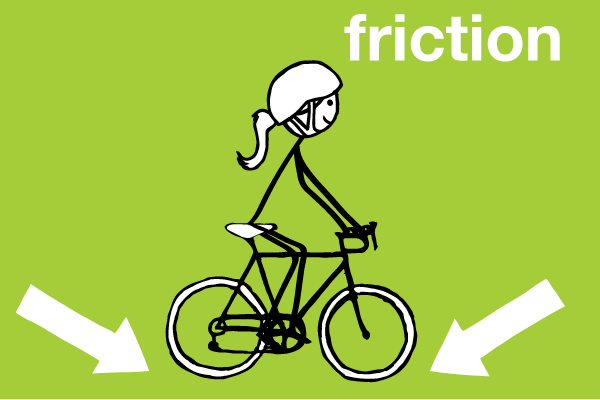
What is Friction?
How much something weighs
When 2 objects slide against each other
How fast something is going
What are EQUAL forces acting on an object in opposite directions that do not change the object's motion?
Friction
Weight
Balanced Forces
Unbalanced Forces
Is a force that pulls objects toward each other and down to the ground
Force
Friction
Gravity
weight

This is an example of _____ because the object WILL move.
Unbalanced Forces
Balanced Forces
Neither

What are 3 ways to describe MOTION? (Unbalance force causes this)
Gravity, Magnetism, Friction
Speed, Direction, Position
Rough, Smooth, Lubricants
The moon orbiting the Earth at a constant speed.
Balanced Force
Unbalanced Force
A lamp sitting on a table.
Balanced Force
Unbalanced Force
A car accelerating around a mountain curve.
Balanced Force
Unbalanced Force
A book sitting on a shelf.
Balanced Force
Unbalanced Force
A rocket lifting off the launch pad.
Balanced Force
Unbalanced Force

The archer above shoots an arrow toward a target. Which object has the GREATEST kinetic energy?
target
archer
bow
arrow
The energy related to the motion of an object is called-
potential energy
kinetic energy
electrical energy
chemical energy

At what point does the cart have the most potential energy?
A
B
C
D

At what point does the cart have the most kinetic energy?
A
B
C
D

