
 Worksheets
Plate Tectonics Practice
Total questions: 40
Worksheet time: 20mins
Name
Class
Date
1.
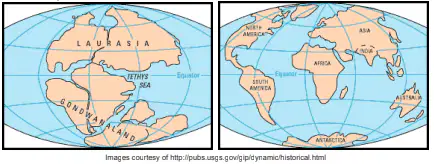
What physical process changed the geological area and composition of the Earth's oceans shown in the two pictures?
a)
gravity
b)
plate tectonics
c)
volcanic eruptions
d)
deposition
2.
What is the theory of continental drift?
a)
The continents have been moving closer together and then farther apart throughout Earth's history.
b)
The continents were once connected, broke apart, and moved to the current locations.
c)
The continents have slowly moved into their current positions and will now switch directions and begin moving back together.
d)
The continents once moved, but now are in a fixed position.
3.
What are the pieces of Earth's crust called?
a)
continents.
b)
tectonic plates.
c)
geologic plates.
d)
continental drifts
4.
Which of the following is true about Earth's crust?
a)
Earth's crust is divided into several large plates that move relative to each other.
b)
Earth's crust is a mass of rock that moves as a single unit.
c)
Earth's crust is divided into several large plates that do not move relative to each other.
d)
Earth's crust is a single mass of rock that doesn't move.
5.
Earth's tectonic plates
a)
are constantly in motion
b)
move only once
c)
do not move
d)
move only up and down
6.
What is the giant supercontinent that existed early in Earth's history?
a)
Pangaea
b)
Paleozoic
c)
Mesozoic
d)
Massaria
7.
The scientific theory of plate tectonics states that the Earth's crust is composed of many plates, or slabs of rock. Interactions of these plates have created different landforms, or geologic features. Which of the following statements provides evidence for this theory?
a)
A large earthquake off the coast of Japan creates a wave that is over 20 feet high.
b)
Fossils are found at the top of the Himalayan mountains.
c)
The city of Pompeii is perfectly preserved under volcanic ash following the eruption of Mount Vesuvius.
d)
An iceberg buckles the hull of the Titanic and allows water to enter between the steel plates.
8.
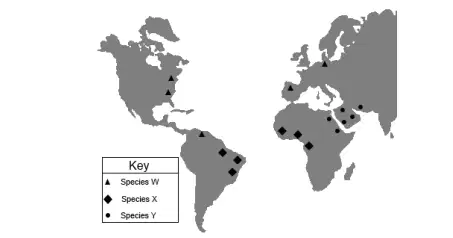
The symbols found on the map indicate where fossils have been found in the same layer of sediment. Each symbol represents fossil locations of a particular species. What do the locations of the fossils suggest?
a)
Similar fossil types are never found on different continents.
b)
Each continent has completely unique plant and animal life.
c)
The continents were once connected to each other.
d)
The continents' locations have remained constant throughout time.
9.
Which of the following provides the most evidence for the theory of plate tectonics?
a)
the coloring of city moths
b)
the spreading of the sea floor
c)
the changing of the seasons
d)
the location of our state
10.

Two hundred and twenty-five million years ago, all of today's continents were part of a single continent. The map below shows the positions of the continents. There is a significant amount of evidence that can be used to support the theory that a supercontinent existed. Which of the following shows how the map shows evidence for the existence of a supercontinent?
a)
All of the continents had identical climate conditions in the past.
b)
None of the continents had similar climates to each other in the past.
c)
The continents' shapes fit together well, and some continents have the same fossils.
d)
The continents' shapes do not fit together well, and each continent has completely different fossils.
11.
What do we call the place where two pieces of the Earth's crust meet?
a)
front
b)
boundary
c)
collision
d)
corner
12.
Which of the following is a process that causes the pieces of Earth's crust to move?
a)
convection
b)
landslides
c)
prevailing winds
d)
ocean waves
13.
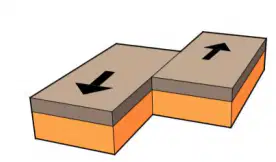
Which type of boundary has pieces of crust sliding past each other horizontally?
a)
convergent
b)
divergent
c)
transform
14.
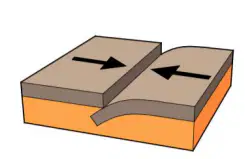
Which type of boundary has pieces of crust moving toward each other?
a)
convergent
b)
divergent
c)
transform
15.
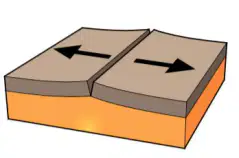
Which type of boundary has pieces of crust moving away from each other?
a)
convergent
b)
divergent
c)
transform
16.
What type of boundary would most likely have one tectonic plate being forced down below another tectonic plate?
a)
convergent boundary
b)
divergent boundary
c)
transform boundary
17.
Which type of landform is most likely at a convergent boundary?
a)
valley
b)
mountain
c)
canyon
18.
What kind of geologic event happens often at transform boundaries?
a)
volcanoes
b)
landslides
c)
earthquakes
19.
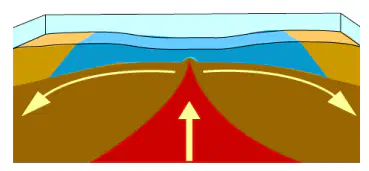
What term best describes the geologic event that is taking place in this picture?
a)
weathering
b)
seafloor spreading
c)
plate convergence
d)
erosion
20.
What is the movement of oceanic crust due to magma coming out at a mid ocean ridge?
a)
oceanic subduction
b)
sea convergence
c)
seafloor spreading
21.
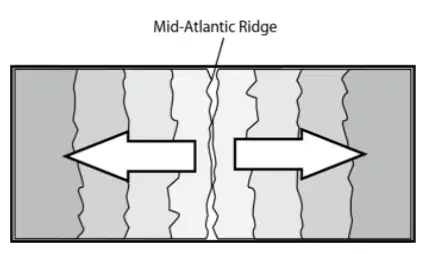
Where would you find the oldest oceanic crust?
a)
closest to the mid ocean ridge
b)
furthest from the mid ocean ridge
22.
What type of boundary is the Mid-Atlantic ridge?
a)
convergent
b)
divergent
c)
transform
23.
Which model would be best for showing continental drift?
a)
A student makes a boat (the "continent") floating in a bucket of water (the "ocean").
b)
A student makes puzzle pieces (the "continents") that fit together and then get separated.
c)
A student makes a pile of sand (the "continent") which is then blown by a fan to another location.
24.
How are trilobite fossils found all over the world?
a)
trilobites could swim across the ocean
b)
the continents were once all together and moved apart taking the trilobite fossils all over the world
c)
dinosaurs dragged their fossils to many parts of the world
d)
scientists scattered the fossils after they found them
25.
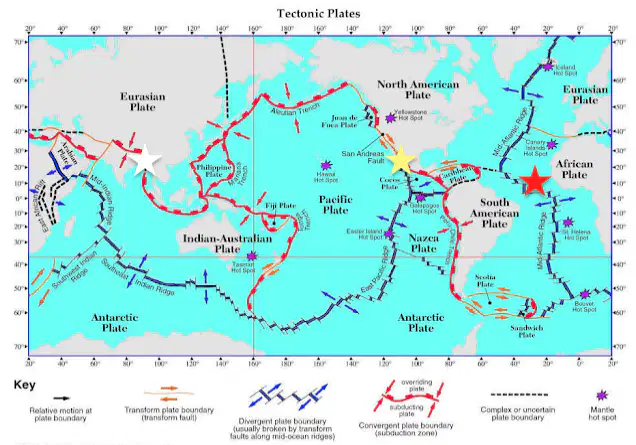
Which star shows that a mid-ocean ridge is likely to be found at that boundary?
a)
the white star
b)
the yellow star
c)
the red star
26.

Scientists have found ancient rock formations dating to the late Proterozoic eon in South America. The location is indicated by the green circle. Scientists have also found rock formations made out of the same type of rock and from the same eon. According to the plate tectonics theory, where is the second formation most likely found?
a)
Location 1
b)
Location 2
c)
Location 3
d)
Location 4
27.

Using the map below, which statement would NOT be true?
a)
The plate boundaries seem to fit together like large puzzle pieces.
b)
The plate boundaries on Earth go through both land and oceans.
c)
Each plate has only one type of boundary.
28.
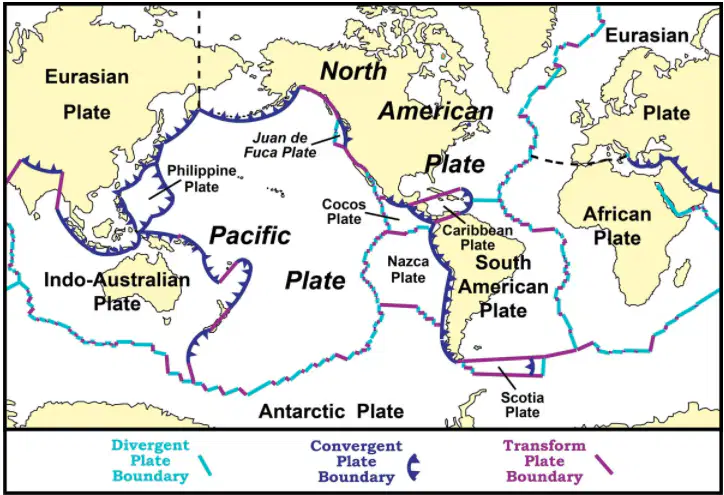
Using the map below and your knowledge of plate tectonics, decide which statement below would be true?
a)
New crust would form at the boundary between the Pacific Plate and the Nazca Plate.
b)
New crust would form at the boundary between the Nazca Plate and the South American Plate.
c)
New crust would form at BOTH of those boundaries.
29.
A submarine comes across an area of the sea where there is a large rift in the crust along with rock that has built up around it. What has this submarine likely discovered?
a)
an ocean trench
b)
an earthquake
c)
a mid-ocean ridge
d)
an underground river
30.
It usually takes many years for the processes of weathering, erosion, and deposition by the movement of water, ice, and wind to break apart and move pieces of the Earth's surface to new locations, creating new landforms. In general, what can move pieces of Earth's surface and create new landforms very rapidly?
a)
rise and fall of the tides
b)
catastrophic events
c)
changing of the seasons
d)
annual snowfall patterns
31.
"A rupture in the Earth's surface rapidly releases large amounts of gas and ash into the atmosphere. During this process, molten rock is deposited on the Earth's surface." Fill in the blanks: The sentences above are describing a _________________________ which is considered a catastrophic event because it causes _____________________ changes to the earth.
a)
landslide; rapid
b)
weathering event; slow
c)
volcanic eruption; rapid
d)
asteroid impact; rapid
32.
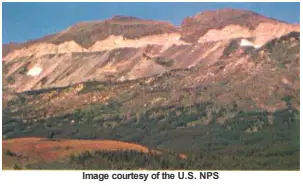
Over the past several million years, the peaks of a mountain have been gradually worn down. If not for the process of _______ carrying small bits of sediment away, the peaks above might be 1,000 meters taller.
a)
deposition
b)
erosion
c)
plate tectonics
d)
seafloor spreading
33.
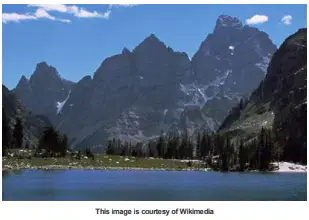
What change would an observer most likely see if he could look at mountains again after 9 million years?
a)
The mountains would be steeper than they are today.
b)
The mountains would be taller than they are today.
c)
The mountains would be less steep and more rounded.
d)
The mountains would be exactly the same.
34.
Most of the changes that the Earth has undergone over its 4.5-billion-year existence have been due to
a)
burning of fossil fuels
b)
natural processes
c)
human processes
d)
urbanization
35.
Which of the following events would change Earth's surface the fastest?
a)
continental drift
b)
an earthquake
c)
climate change
d)
global sea level rising
36.
Which of the following is true about processes that shape the Earth?
a)
All processes that shape the Earth begin and end in a person's lifetime.
b)
Although there are many different processes that shape the Earth, none of the processes can be observed by humans.
c)
Some processes that shape the Earth are happening so slowly they cannot be easily detected in a human's lifetime.
d)
Only one process shapes the Earth in a way that humans can notice.
37.
Categorize the geologic process as “slow” or “rapid” based on the rate at which it typically occurs: deposition
a)
Slow
b)
Rapid
38.
Categorize the geologic process as “slow” or “rapid” based on the rate at which it typically occurs: continental drift
a)
Slow
b)
Rapid
39.
Categorize the geologic process as “slow” or “rapid” based on the rate at which it typically occurs: earthquake
a)
Slow
b)
Rapid
40.
Today, some mountain ranges are rising due to tectonic plates colliding, and earthquakes are sometimes caused by tectonic plates sliding against each other. During Earth's past-
a)
mountains were rising, but there were no earthquakes
b)
there were earthquakes, but no mountains were rising
c)
the tectonic plates were not moving
d)
similar tectonic movements were occurring
100 %

