wayground logo

Free Printable Worksheets

Font size

S
M
L
XL
Worksheets

Cowan Physical Science Semester Review UST

Total questions: 201

Worksheet time: 6hrs 31mins

Name
Class
Date
1.

Which one of Newton's laws is shown

a)

3rd law

b)

2nd law

c)

1st law

2.

What does this picture represent

a)

Force,magnetism,acceleration

b)

Force, money, Apples

c)

Force, Mass, Acceleration

d)

Funny, monkeys, Arrive

3.

Which one of Newton's laws are displayed

a)

2nd law

b)

1st law

c)

3rd law

4.

Which of Newton's laws is shown

a)

1st law

b)

3rd law

c)

2nd law

5.

This is Newton's 3rd law

a)

True

b)

False

6.

This is Newton's 2nd law

a)

True

b)

False

7.

An object in motion will stay in motion and an object at rest will stay at rest unless acted upon by an outside force. Which law does this describe

a)

2nd law

b)

1st law

c)

3rd law

8.

If there is a big mass, it would need a stronger force to accelerate it. Which law does this describe?

a)

3rd law

b)

1st law

c)

2nd law

9.

What force slows objects down and keeps them from moving?

a)

Acceleration

b)

Gravity

c)

Friction

d)

Net Force

10.

When there is a change in motion?

a)

When forces are balanced

b)

When the forces are unbalanced

c)

Whe forces are equal

d)

Never

11.

What is the unit for FORCE?

a)

N (Newtons)

b)

lbs (pounds)

c)

g (grams)

d)

m/s (meters per second)

12.

What minimal force must be exerted by a mother to lift her 5kg baby?

a)

0 N

b)

5 N

c)

49 N

d)

10 N

13.

In the district finals, Vanessa kicks the 0.600 kg soccer ball with a force of 80 N. How much does she accelerate the ball?

a)

122 m/s/s

b)

50 m/s/s

c)

133 m/s/s

d)

48 m/s/s

14.

A 68 kg runner exerts a force of 59 N. What is the acceleration of the runner?

a)

9.8 m/s/s

b)

5 m/s/s

c)

1.968 m/s/s

d)

0.868 m/s/s

15.

A crate is dragged across an ice covered lake. The box accelerates at 0.08 m/s/s and s pulled by a 47 N force. What is the mass of the crate?

a)

587.5 kg

b)

642.8 kg

c)

58.75 kg

d)

98.81 kg

16.

3 women push a stalled car. Each woman pushes with a force of 425 N. What is the mass of the car if it accelerates at 0.85 m/s/s?

a)

2500 kg

b)

1500 kg

c)

900 kg

d)

425 kg

17.

A tennis ball with a mass of 0.1 kg is accelerated at a rate of 164 m/s when hit by a professional tennis player. What force does the racket exert on the ball?

a)

15.3 N

b)

16.4 N

c)

25 N

d)

13.3 N

18.

Mr. Candler jumps off a table on to the floor. When he hits the floor, he decelerates at -45 m/s/s and his weight is 1100 N, What TOTAL force does the floor exert on Mr. Candler's legs.

a)

-49500 N

b)

49500 N

c)

6151 N

d)

5161 N

19.

When 2 teams are in a tug of war game, and neither team is winning, what is the net force?

a)

100 N

b)

0 N

c)

50 N

d)

2 N

20.

Billy runs 400 meters to Andy's house, turns around, and runs 400 meters back home. What is Billy's distance?

a)

0 meters

b)

400 meters

c)

800 meters

d)

1600 meters

21.

Billy runs 400 meters to Andy's house, turns around, and runs 400 meters back home. What is Billy's displacement?

a)

0 meters

b)

400 meters

c)

800 meters

d)

1600 meters

22.

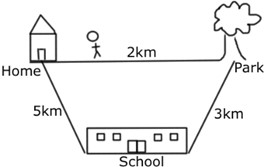
Jerry walked from home to school, then from the school to the park. What is his total displacement?

a)

2 km

b)

5 km

c)

8 km

d)

10 km

23.

Jerry walked from home to school, then from the school to the park. What is his total distance?

a)

2 km

b)

5 km

c)

8 km

d)

10 km

24.

The change in an objects position from the final position to initial position.

a)

displacement

b)

distance

c)

motion

d)

reference point

25.

Two people walk across a parking lot. Their paths are shown in the image. Who traveled with a larger displacement?

a)

Person A

b)

Person B

c)

They both had the same displacement.

26.
David walks 3 km north, and then turns east and walks 4 km. What is the distance?
a)
7 km
b)
3 km
c)
4 km
d)
1 km
27.
Ronaldo runs across a soccer field, moving 10 meters north, then 8 meters west. His displacement would be:
a)
10.2 m, NW
b)
12.8 m, NW
c)
15.4 m, NW
d)
18.0 m, NW
28.
Because displacement has a magnitude and direction it is called a ______. 
a)
distance
b)
vector
c)
arrow
d)
length
29.

Which of the following is correct?

a)

Initial Position = -2 m

Final Position = 0 m

Distance = 14 m

Displacement = 2 m

b)

Initial Position = 0 m

Final Position = -2 m

Distance = 14 m

Displacement = -2 m

c)

Initial Position = -2 m

Final Position = 0 m

Distance = -2 m

Displacement = -2 m

d)

Initial Position = -2 m

Final Position = 0 m

Distance = 14 m

Displacement = 14 m

e)

None are correct.

30.

Which of the following is correct?

a)

Initial Position = -5 m

Final Position = -5 m

Distance = 22 m

Displacement = 0 m

b)

Initial Position = -5 m

Final Position = -5 m

Distance = 0 m

Displacement = 22 m

c)

Initial Position = -5 m

Final Position = 6 m

Distance = 22 m

Displacement = 0 m

d)

Initial Position = -5 m

Final Position = 6 m

Distance = 0 m

Displacement = 22 m

31.

David walks 3 km north, and then turns east and walks 4 km. What is the displacement?

a)

1 km

b)

3 km

c)

4 km

d)

5 km

32.

What distance did the creature travel?

a)

23 m

b)

9 m

c)

-9 m

d)

-23 m

33.

____________- A quantity that has only a magnitude (number or value)

a)

Scalar

b)

Vector

34.

____________- A quantity that has both a magnitude and a direction

a)

Scalar

b)

Vector

35.

Scalar =

a)

A quantity that has only a magnitude (number or value)

b)

A quantity that has both a magnitude and a direction.

36.

Vector =

a)

A quantity that has only a magnitude (number or value)

b)

A quantity that has both a magnitude and a direction.

37.

5 meters (Scalar or Vector?)

a)

Scalar

b)

Vector

38.

30 meters/ second East (Scalar or Vector?)

a)

Scalar

b)

Vector

39.

20 degrees Celsius (Scalar or Vector?)

a)

Scalar

b)

Vector

40.

4000 calories (Scalar or Vector?)

a)

Scalar

b)

Vector

41.

-10 centimeters (Scalar or Vector?)

a)

Scalar

b)

Vector

42.

60 miles north (Scalar or Vector?)

a)

Scalar

b)

Vector

43.
What is speed?
a)
how far you go
b)
how much distance is covered over a period of time
c)
how fast you accelerate
d)
the change in the location of a object
44.
What is the formula to calculate speed?
a)
S = t/d
b)
S = d/t
c)
S = d x t
d)
S = t x d
45.
The rate at which velocity changes is called
a)
speed
b)
direction
c)
acceleration
d)
motion
46.
When you know both the speed and direction of an object's motion, you know the
a)
average speed of the object
b)
acceleration of the object
c)
distance the object has traveled
d)
velocity of the object
47.

What is the speed of a car travelling 50m in 4s?

a)

200 m/s

b)

12.5 m/s

c)

12.5 m

d)

200m

48.

How far does a lorry move if it is travelling at 12m/s for 180s?

a)

2160 m

b)

0.06 m

c)

15 m

d)

21.6 m

49.

How long does it take a car to travel 40m at 12m/s?

a)

4.8 s

b)

480 s

c)

3.33 s

d)

33.3 s

50.

Mrs. Bearden drives 50 miles. What does Mrs. Bearden need to figure out her speed?

a)

The type of car she drives

b)

Her heart rate as she drives

c)

The time she has driven

d)

The direction she was going

51.
What is the speed of an object that travels 60 meters in 4 seconds?
a)
240 m/s
b)
15 m/s
c)
0.067 m/s
d)
15 mph
52.
The unit for speed is:
a)
m/s
b)
s
c)
m
d)
km
53.
Sarah backstrokes at an average speed of 8 meters per second. How long will it take her to complete a 200-meter race?
a)
0.04 s
b)
1600 s
c)
50 s
d)
25 s
54.
Shona cycles at an average speed of 8km/h. How far has she travelled if she cycles for 4 hours?
a)
55km
b)
32km
c)
43km
d)
32miles
55.
A runners races in the 100 meter dash.  It takes her 10 seconds to finish.  What is her average speed?
a)
10 m/s
b)
1000 m/s
c)
100 seconds
d)
10 seconds
56.
What is velocity?
a)
the quickness of an object
b)
the location of an object
c)
acceleration
d)
speed in a specific direction
57.

Speed is distance / time. Use the speed equation to solve the following problem... Janet walks 250 meters in 30 minutes. What is her speed in meters per minute?

a)

8.3 meters/ minute

b)

250 meters/ minute

c)

30 meters/ minute

d)

10.2 meters/ minute

58.

Bill drove 54 miles in 45 minutes. How fast was he traveling in miles/ minute?

a)

1.2 miles/ minute

b)

55 miles per hour

c)

1.2 mph

d)

44 miles/ second

59.

velocity equals displacement/ time. What is the velocity of a person who took the curviest roads possible to travel all the way west to Los Angeles (2000 miles) and it took them 72 hours to get there?

(velocity= displacement/ time)

a)

27.8 miles/ hour

b)

55 miles/ hour

c)

144000 miles/ hour

d)

.036 miles/ hour

60.

Which of these is considered a measurement of speed?

a)

55 miles per hour west

b)

55 miles per hour

61.

which of these would be considered a measurement of velocity?

a)

100 miles/ hour

b)

100 miles/ hour south

62.

Are distance and displacement the same thing?

a)

yes they mean the same thing

b)

No distance is the measurement of how far something has traveled and displacement is the measure of how far it ended up from the beginning point

63.

After watching all the slides in this lesson: what is the velocity of a car travelling from Hagerstown to Washington DC (528 miles) if it takes 8.5 hours to get there?

a)

62.1 miles per hour

b)

62.1 miles per hour east

64.
What are the positively charged particles in an atom?
a)
Protons
b)
Neutrons
c)
Electrons
65.
Electrons have what charge?
a)
Negative
b)
Positive
c)
Neutral
 (No Charge)
66.
Neutrons have what charge?
a)
Negative
b)
Positive
c)
Neutral
 (No Charge)
67.
The nucleus of an atom is made up of...
a)
Protons and Neutrons
b)
Neutrons and Electrons
c)
Protons and Electrons
68.
A(n) ____________________ is a pure substance made of a single type of atom and cannot be broken down.
a)
Element
b)
Compound
c)
Molecule
d)
Mixture
69.
What does the ATOMIC MASS tell us about an atom?
a)
Protons + Neutrons
b)
Protons + Electrons
c)
Neutrons + Electrons
70.

Subatomic particles with a negative charge

a)

Electrons

b)

Neutrons

c)

Protons

d)

Quarks

71.
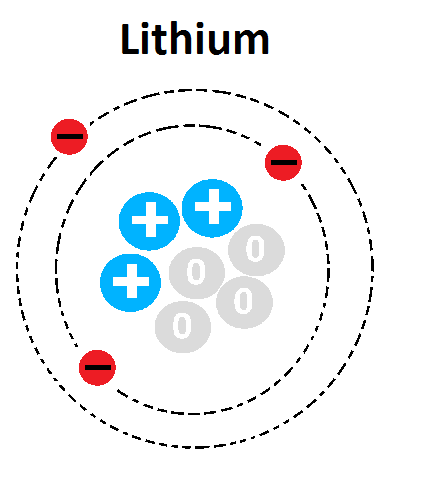
What is the atomic number of this atom?
a)
1
b)
3
c)
4
d)
7
72.

Isotopes of an element have a different number of...

a)

Protons

b)

Neutrons

c)

Electrons

d)

Mass

73.
A carbon isotope consists of 6 protons, 6 electrons and 8 neutrons.  What is the mass number for this isotope?
a)
12
b)
14
c)
6
d)
8
74.

What charge does an atom have when it GAINS electrons?

a)

Positive

b)

Negative

c)

Neutral

75.

What does it change in an ion?

a)

The number of electrons

b)

The number of protons

c)

The number of neutrons

76.

What does it change in an ion?

a)

The number of electrons

b)

The number of protons

c)

The number of neutrons

77.
What is the atomic mass of the pictured isotope?
a)
2
b)
4
c)
6
d)
Hehehehe
78.
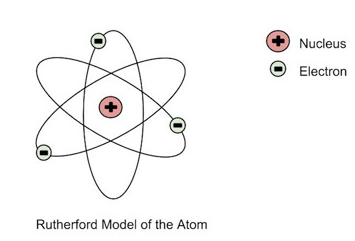
Which model is this?
a)
Thomson Model
b)
Cloud Model
c)
Bohr Model
d)
Rutherford Model
79.

Which of the following is/are conclusions based on Rutherford’s gold foil experiment?

a)

Atom is mostly empty space

b)

The nucleus is positively charged

c)

The atom has a small dense nucleus

d)

All answers are correct

80.
Subatomic particles with a positive charge
a)
neutrons
b)
atomic mass
c)
protons
d)
isotopes
81.
A tiny but very dense, positively charged portion of the atom that holds most of the atomic mass
a)
Electron Shells
b)
Orbitals
c)
Electron Cloud
d)
Nucleus
82.
Discovered the electron within the atom
a)
Thomson
b)
Chadwick 
c)
Schrodinger & Heisenberg
d)
Dalton
83.
Discovered the nucleus of the atom through the Gold Foil Experiment
a)
Rutherford
b)
Chadwick
c)
Thomson
d)
Dalton
84.

Calculation used to find the number of neutrons in an atom

a)

Mass Number - Atomic Number

b)

Atomic Number - Atomic Mass

c)

Atomic Mass - Electrons

d)

none of these

85.
What subatomic particles are located in the electron cloud?
a)
quarks
b)
protons
c)
electrons
d)
neutrons
86.
Which is an electron?
a)
A
b)
B
c)
C
87.
Which item on this element square is the chemical symbol?
a)
Copper
b)
29
c)
Cu
d)
63.546
88.
What is the number of protons that the element in this image contain?
a)
14
b)
7
c)
15
d)
18
89.
An atom of the element with atomic number 6 always has _____.
a)
six protons in its nucleus
b)
an atomic mass of six
c)
more than six neutrons
d)
six electron clouds
90.
What are subatomic particles? 
a)
the nucleus 
b)
electron cloud
c)
positive charge
d)
electrons, protons, and neutrons
91.
How many protons does an atom with an atomic number of 28 and a mass number of 40 have?
a)
28
b)
68
c)
12
d)
40
92.
The following element has _______________ neutrons.
a)
15
b)
16
c)
31
d)
46
93.
Subatomic particles that are neutral in charge
a)
Neutrons
b)
Protons
c)
Nucleus 
d)
Electrons
94.
Discovered the nucleus of the atom through the Gold Foil Experiment
a)
Rutherford
b)
Chadwick
c)
Thomson
d)
Dalton
95.
Discovered the electron within the atom
a)
Thomson
b)
Chadwick 
c)
Schrodinger & Heisenberg
d)
Dalton
96.
Discovered the neutron within the atom
a)
Democritus
b)
Thomson
c)
Rutherford
d)
Chadwick
97.
Believed that atoms of the same element are identical to each other
a)
Bohr
b)
Rutherford
c)
Dalton
d)
Thomson
98.
Most of the volume an atom is made of this
a)
the nucleus
b)
the protons
c)
the neutrons
d)
empty space
99.
The best images of atoms look fuzzy because of their 
a)
small size 
b)
constant motion
c)
fast-moving electrons
d)
thunder and lightning
100.
The atom's mass is determined by the number of 
a)
protons and neutrons
b)
protons and electrons
c)
neutrons and electrons
101.
What scientist is best known for his "Plum Pudding" model of the atom?
a)
J.J. Thomson
b)
Ernest Rutherford
c)
John Dalton
d)
Democritus
102.
What contribution did John Dalton make to atomic theory? 
a)
He discovered that every atom was positively charged. 
b)
He discovered that every element consisted of one type of atom that couldn't be divided. 
c)
He discovered that atoms had nuclei. 
d)
He discovered that atoms could be divided into smaller parts. 
103.
Rutherford's gold foil experiment provided evidence that...
a)
negative and positive charges are spread evenly throughout the atom.
b)
alpha particles have a positive charge.
c)
gold is not a dense as previously thought.
d)
there is a dense positively charged nucleus at the center of an atom.
104.
Who discovered the nucleus using the gold foil experiment?
a)
Democritus
b)
Robert Millikan
c)
James Chadwick
d)
Ernest Rutherford
105.
He discovered the electron using cathode ray tube experiment.
a)
Joseph Thomson
b)
John Dalton
c)
Ernest Rutherford
d)
Robert Millikan
106.
He first measured the mass and charge of an electron using the oil drop experiment.
a)
Joseph Thomson
b)
Robert Millikan
c)
John Dalton
d)
Niels Bohr
107.
How did Thomson build upon Dalton's model? 
a)
His model was the same.
b)
He put electrons in orbitals.
c)
He discovered the nucleus.
d)
He discovere subatomic particles (electron).
108.

Proposed that electrons move around the nucleus in specific layers, or shells.

a)

Bohr

b)

Rutherford

c)

Chadwick

d)

Thomson

109.

Who discovered electrons?

a)

Rutherford

b)

Bohr

c)

J.J. Thompson

d)

Democritus

110.
Ernest Rutherford discovered that the atom was mostly _________________ and has a _______________ charged nucleus.
a)
empty space, positively
b)
empty space, negatively
c)
full of protons, positively
d)
full of neutrons, negatively
111.

Within Dalton's Atomic Theory, he had proposed...

a)

Atoms were the smallest particles that existed and could be divisible

b)

Atoms were the smallest particles that existed and were round

c)

Atoms were the smallest particles that existed and could not be divisible

112.

Which experiment was performed by J. J. Thomson in 1897?

a)
Oil Drop Experiment
b)
Gold Foil Experiment
c)
Wave  Experiment
d)
Cathode Ray Experiment
113.
Which subatomic particle was discovered as a result of the cathode ray experiment?
a)
proton
b)
neutron
c)
electron
d)
nucleus
114.
Who performed the Gold Foil Experiment?
a)
J. J. Thomson
b)
Ernest Rutherford
c)
Neils Bohr
d)
John Dalton
115.
Which of the following were outcomes of the Gold Foil Experiment?  
a)
Electrons occupy different energy levels orbiting the nucleus.
b)
Electrons are negatively charged subatomic particles.
c)
Electrons orbit the empty space around the dense positive nucleus.
d)
Electrons move in wave patterns around the nucleus
116.
Which subatomic particle was discovered by James Chadwick?
a)
proton
b)
neutron
c)
electron
d)
quark
117.

What was the expected result in Rutherford's experiment when alpha particles bombarded a thin layer of Au atoms?

a)

alpha particles would be stopped by the Au atoms

b)

alpha particles would go straight through the Au foil

c)

alpha particles would explode when contacting the Au foil

d)

alpha particles would be heavily deflected by the Au atoms

118.

When particles were deflected in the gold foil experiment, what was the interpretation?

a)

atoms exist

b)

Au is magic

c)

atoms have dense cores

d)

atoms are indivisible

119.

How many neutrons are in an atom of carbon-14?

a)

6

b)

8

c)

10

d)

14

120.

How many protons does this isotope of titanium have?

a)

22

b)

26

c)

48

d)

70

121.

How many electrons are in an atom that has an atomic number of 34, an atomic mass of 74 and a charge of -2?

a)

2

b)

34

c)

36

d)

40

122.

Write the hyphen notation for the isotope that has 39 protons and 50 neutrons.

a)

Yttrium-11

b)

Tin-39

c)

Tin-89

d)

Yttrium-89

123.
What is the name of the pictured isotope?
a)
Carbon-12
b)
Carbon-13
c)
Carbon-14
d)
Carbon-15
124.

Which atom contains exactly 7 protons?

a)

sulfur - 32 (S)

b)

phosphorus-32 (P)

c)

oxygen-15 (O)

d)

nitrogen-15 (N)

125.

Which atom contains exactly 15 protons?

a)

sulfur - 32 (S)

b)

phosphorus-32 (P)

c)

oxygen-15 (O)

d)

nitrogen-15 (N)

126.

As an Na atom forms an Na+ ion, the number of protons in its nucleus

a)

Decreases

b)

Remains the Same

c)

Increases

127.

The two atoms will always have the same atomic number if they have the same

a)

Number of neutrons

b)

Number of protons

c)

Number of nucleons

d)

Mass number

128.

An ion with 11 protons, 12 neutrons, and a charge of 1+ has an atomic number of

a)

10

b)

11

c)

12

d)

13

129.

A particle of matter contains 8 protons, 8 neutrons, and 8 electrons. This particle must be a

a)

positively charged oxygen ion

b)

neutral nitrogen atom

c)

positively charged nitrogen ion

d)

neutral oxygen atom

130.

A particle of matter contains 6 protons, 7 neutrons, and 6 electrons. This particle must be a

a)

positively charged carbon ion

b)

neutral nitrogen atom

c)

positively charged nitrogen ion

d)

neutral carbon atom

131.

An atom of helium-4 (He) differs from an atom of lithium-7 (Li), in that an atom of helium-4 has

a)

one more neutron

b)

one more proton

c)

two less neutrons

d)

two less protons

132.

How many neutrons are in the given atom?

a)

92

b)

143

c)

235

d)

327

133.

What is the mass number of bromine?

a)

35

b)

45

c)

80

d)

79.904

134.

How does Carbon-12 and Carbon-14 differ?

a)

# of protons

b)

Mass #

c)

# of neutrons

d)

Mass # and # of neutrons

135.

If aluminum loses 3 electrons, what will the charge be?

a)

+

b)

-

c)

+3

d)

-3

136.

Which of the following is an ion?

a)

O-16

b)

O-18

c)

Carbon-12

d)

O-2

137.

An ion is:

a)

An atom that has gained or lost electrons

b)

An atom that has gained or lost neutrons

c)

An atom that has gained or lost protons

d)

An atom that is neutrally charged

138.

An isotope is:

a)

An atom that has gained or lost electrons

b)

An atom that has gained or lost neutrons

c)

An atom that has gained or lost protons

d)

An atom that is neutrally charged

139.
Ca+ is an example of a(n)
a)
Positive ion
b)
Negative ion
c)
Isotope
d)
Neutral Atom
140.
If an atom has more electrons than protons, it is a(n)
a)
Positive ion
b)
Negative ion
c)
Isotope
d)
Neutral atom
141.
What charge does an atom have if it LOSES an electron? 
a)
Positive (+)
b)
Negative (-)
142.
A negative ion is a 
a)
cation
b)
anion
143.
What is the number of protons?
a)
34
b)
16
c)
18
d)
S
144.
What is the number of neutrons?
a)
34
b)
79
c)
45
d)
35
145.

Write the ion notation for an atom of Chlorine with 12 electrons

a)

Cl5-

b)

Cl5+

c)

Cl7-

d)

Cl8-

146.

How many P, E, and N does an ion of S3+ have?

a)

P=15 E=12 N=16

b)

P=16 E=13 N=16

c)

P=16 E=19 N=32

d)

P=16 E=48 N =16

147.

How many P, E and N does an ion of F4- have?

a)

P=9 E=13 N=9

b)

P=8 E=5 N=10

c)

P=9 E=13 N=10

d)

P=8 E=13 N=11

148.

What is the name of group number 1?

a)

halogens

b)

noble gases

c)

alkali metals

d)

alkaline earth metals

149.

What is the name of group number 2?

a)

transition metals

b)

halogens

c)

metaloids

d)

alkaline earth metals

150.

where are the metaloids found

a)

far left, vertical

b)

stair step/diagonal

c)

far right horizontal

d)

at the bottom

151.

What group number are the halogens found?

a)

18 (8A)

b)

1

c)

2

d)

17 (7A)

152.

A grouping of elements based on similar chemical properties, arranged by columns in the periodic table; also known as a group

a)

family

b)

period

c)

row

d)

isotope

153.

A row on the Periodic Table of Elements

a)

family

b)

period

c)

row

d)

isotope

154.

Which class of elements are malleable, ductile, shiny when clean and polished, good conductors of heat and electricity, and reacts with acids to form hydrogen gas?

a)

metals

b)

nonmetals

c)

metalloids

d)

ions

155.

What is the term of an atom that will lose electron(s) and have a positive change?

a)

cation

b)

anion

c)

electronegativity

d)

ionic radius

156.

What does malleable mean?

a)

able to be hammered or rolled into sheets

b)

will break easily

c)

able to be pulled into a wire

d)

is shiny

157.

Which is a property of metals?

a)

Malleable

b)

Good insulator

c)

Used in food

d)

Brittle

158.
If a material can easily be drawn into the shape of a wire, it is
a)
Ductile
b)
Magnetic
c)
Malleable
d)
Reactive
159.

Vanadium (V) is a good conductor, malleable and ductile. What type of element is vanadium?

a)

Metal

b)

Nonmetal

c)

Metalloid

d)

Superconductor

160.

Silicon is a semiconductor and has properties of both metals and nonmetals. What type of element is Silicon?

a)

Metal

b)

Nonmetal

c)

Metalloid

d)

Superconductor

161.
All of these properties describe metals except...
a)
malleable
b)
conductors
c)
brittle 
d)
shiny
162.
Which element is a metalloid?
a)
Titanium
b)
Selenium
c)
Potassium
d)
Polonium
163.

Which elements are to the right of the zig zag?

a)

metals

b)

nonmetals

c)

metalloids

d)

superconductors

164.

Which is an example of a metalloid?

a)

Boron

b)

Aluminum

c)

Chlorine

d)

Sodium

165.

Which elements are found along the zig-zag line?

a)

metals

b)

nonmetals

c)

metalloids

d)

superconductors

166.

True or False?

Most of the elements on the Periodic Table are metals?

a)

true

b)

false

167.

This is the term used for a metal that is able to be hammered out or pressed

a)

Malleable

b)

Ductile

c)

Conductive

d)

Shiny

168.
If a material can easily be drawn into the shape of a wire, it is
a)
Ductile
b)
Magnetic
c)
Malleable
d)
Reactive
169.
Which of these is a property of metals?
a)
It's malleable
b)
It can't conduct electricity
c)
They are used in food
d)
It's very brittle
170.
A substance that is dull, brittle, and a nonconductor would be classified as a
a)
metal
b)
nonnmetal
c)
metalloid
d)
metallica
171.

Heat and electricity flow through me

a)

Malleable

b)

Ductile

c)

Luster

d)

Conductor

172.

Which of the following is a physical characteristic of a nonmetal?

a)

texture

b)

malleable

c)

brittle

d)

semi-conductor

173.
One property of a nonmetals is that it is a good conductor of electricity?
a)
true
b)
false
174.
An element has properties of both metals and nonmetals. Where would it be found in the periodic table? 
a)
To the right 
b)
To the left 
c)
on the zig zag line
175.

Which category does this belong in?

a)

Metal

b)

Nonmetal

c)

Metalloid

176.

Which category does this belong in?

a)

Metal

b)

Nonmetal

c)

Metalloid

177.

Which elements are colored red?

a)

nonmetals

b)

metals

c)

metalloids

178.

Copper can be pressed and folded to make statues like the statue of liberty, ______.

a)

therefore copper is malleable

b)

therefore copper is ductile

c)

therefore copper is shiny

d)

therefore copper is a conductor

179.

Sulfur, a nonmetal, is considered:

a)

malleable

b)

brittle

c)

ductile

d)

a good conductor

180.
Which elements are found on the left to middle of The Periodic Table? 
a)
Metals
b)
Nonmetals
c)
Metalloids
d)
Candles
181.
Which elements are found on the right side of The Periodic Table?
a)
Metals
b)
Nonmetals
c)
Metalloids
d)
Water
182.

Newton's Law of Inertia (first law) describes the motion of-

a)
Objects at rest only
b)
Objects in motion only
c)
Objects at rest and objects that are in motion
d)

Objects that accelerate

183.
Which one of Newton’s Laws of Motion best explains why the dishes do not move when the table cloth is removed?
a)

Law of Inertia

b)

Law of Acceleration

c)

Law of Action-Reaction

d)

Law of Gravitation

184.
Which law best explains why the coin sitting on top of the ring falls directly into the jar below because it wants to remain at rest?
a)

Law of Inertia

b)

Law of Acceleration

c)

Law of Action - Reaction

d)

Law of Gravitation

185.
Which law best explains why people remain in motion when a car crashes, if they are not wearing a seat belt?
a)

Law of Inertia

b)

Law of Acceleration

c)

Law of Action - Reaction

d)

Law of Gravitation

186.

Newton's Third Law is also known as the Law of _______

a)

Inertia

b)

Acceleration

c)

Action - Reaction

d)

Gravitation

187.
Pushing a child on a swing is easier than pushing an adult on the same swing, because the adult has more inertia.
a)
Newton's 1st Law
b)
Newton's 2nd Law
c)
Newton's 3rd Law
188.
This person bought coffee and put it on the seat next to them. If they stopped quickly and the coffee spilled which law would that represent?
a)
Newton's 1st Law
b)
Newton's 2nd Law
c)
Newton's 3rd Law
189.
When you step on a Lego. You push on the Lego and the Lego pushes back on you.
a)
Newton's 1st Law
b)
Newton's 2nd Law
c)
Newton's 3rd Law
190.
"An object in motion (or at rest) will to stay in motion (or at rest) until an outside force acts upon it."
a)
Newton's 1st Law
b)
Newton's 2nd Law
c)
Newton's 3rd Law
d)
Newton's 4th Law
191.
Force = Mass x Acceleration
a)
Newton's 1st Law
b)
Newton's 2nd Law
c)
Newton's 3rd Law
d)
Newton's 4th Law
192.
"For every action, there is an equal and opposite reaction."
a)
Newton's 1st Law
b)
Newton's 2nd Law
c)
Newton's 3rd Law
d)
Newton's 4th Law
193.
Which law explains why when you put a book on a table the table pushes on the book
a)
3rd law
b)
4th law
c)
1st law
d)
2nd law
194.
What is the difference between mass and weight?
a)
mass is how much matter is in an object, and weight is the gravitational pull on that object
b)
mass and weight are the same
c)
weight affects how much mass is in an object
d)
weight is determined by how many atoms make up an object
195.
A person steps out of the boat and onto the dock.  As the person moves forward onto the dock, the boat moves backward.  Which statement best describes the backward motion of the boat as the person steps forward?
a)
For every action there is an equal and opposite reaction.
b)
Every mass exerts a force on every other mass.
c)
An object at rest tends to stay at rest.
d)
Friction opposes the motion of an object.
196.
When the forces on an object are "balanced", the object is...
a)
Moving quickly
b)
Moving slowly
c)
At rest
d)
Falling
197.
How do you change an object's motion?
a)
By applying and unbalanced force
b)
By applying a balanced force
198.
What is the force necessary to accelerate a 1785 kg car at a rate of 50 m/s/s?
a)
89,250 N
b)
35.7 N
c)
98.8 N
d)
75,620 N
199.
The Free Fall acceleration for Earth is or g equals what...?
a)
9.8 m/s/s
b)
10 m/s/s
c)
98 m/s/s
d)
2 m/s/s
200.
A(n) __________ is a push or pull.
a)
newton
b)
acceleration
c)
force
d)
momentum
201.
F=MA
An object of mass 10 kg is accelerated upward at 2 m/s2.  What force is required? 

a)
20 N
b)
2 N
c)
5 N
d)
0 N