
 Worksheets
Macroeconomics Final Study Guide
Total questions: 94
Worksheet time: 53mins
Labor productivity growth can be attributed to:
improvement in technological process.
a decline in university attendance.
an increase in population growth.
a decline in the physical capital per worker.
The most important driver for economic growth appears to be:
increases in physical capital.
increases in human capital.
technological progress.
Jeff Gordon.
Which of the following will NOT increase the productivity of labor?
technological improvements
an increase in the capital stock
improvements in education
an increase in the size of the labor force
Workers today are more productive than workers in the past because:
workers now are physically stronger on average.
workers now have more physical capital embodying better technology to work with.
more workers now working with the same number of machines than in the past.
they are paid more.
Diminishing returns to physical capital means that when the amount of human capital per worker and the state of technology are held fixed, each increase in the amount of physical capital per worker leads to:
a smaller increase in the marginal product of labor.
a decrease in the total amount of output produced.
negative marginal product .
a constant amount of total output.
In the long run, an increase in savings will generally:
reduce the rate of economic growth.
leave the rate of economic growth unchanged.
increase the rate of economic growth.
increase consumption simultaneously.
Economies with higher growth rates tend to be those that have:
large amounts of natural resources.
a stable government that protects property rights.
high levels of government regulation.
a large defense budget.
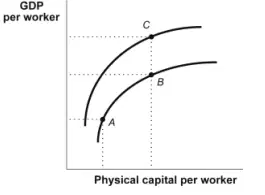
(Figure: Productivity) An improvement in technology with everything else remaining unchanged is shown on the diagram as:
a movement from B to A.
a movement from A to B.
a movement from B to C.
a movement from A to C.
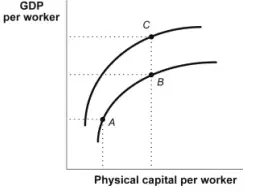
(Figure: Productivity) An increase in physical capital per worker with everything else remaining unchanged is shown on the diagram as:
a movement from B to C.
a movement from A to C.
a movement from A to B.
a movement from B to A.
When tracking economic growth, why do economists prefer real GDP per capita over: a. real GDP?
(a)
When tracking economic growth, why do economists prefer real GDP per capita over: b. nominal GDP per capita?
(a)
Many impoverished nations struggle with diseases like malaria. How would a reduction or the elimination of malaria contribute to long-run economic growth?
(a)
Country A and B have both have a Real per capita GDP of $100 today. For the next 70 years Country A has a 2% growth rate and Country B has a 5% growth rate. At the end of 70 years, what is the gap in Real per capita GDP between the two countries?
(a)
According to the wealth effect, when prices decrease, the purchasing power of assets:
decreases and consumer spending decreases.
increases and consumer spending decreases.
decreases and consumer spending increases.
increases and consumer spending increases.
According to the interest rate effect, an increase in the price level causes people to:
increase their money holdings, which increases interest rates and decreases investment spending.
decrease their money holdings, which increases interest rates and decreases investment spending.
increase their money holdings, which decreases interest rates and decreases investment spending.
decrease their money holdings, which decreases interest rates and increases investment spending.
Suppose that the stock market crashes. Which of the following is most likely to occur?
the aggregate demand curve shifts to the right
the aggregate demand curve shifts to the left
a movement up the aggregate demand curve
a movement down the aggregate demand curve
Which of the following factors cannot shift the aggregate demand curve?
changes in expectations
changes in wealth
changes in stock market indices
changes in the price level
The aggregate demand curve would shift to the left for all the following reasons EXCEPT:
a fall in consumers' wealth.
a decrease in the amount of money in circulation.
more pessimistic consumer expectations.
lower labor productivity.
If the Fed decreases the quantity of money in circulation:
interest rates decrease, investment increases, and the aggregate demand curve shifts to the right.
interest rates decrease, investment decreases, and the aggregate demand curve shifts to the left.
interest rates increase, investment decreases, and the aggregate demand curve shifts to the left.
interest rates increase, investment decreases, and the aggregate demand curve shifts to the right.
Which of the following would likely cause the short-run aggregate supply curve to shift to the left?
a decrease in consumer spending
a decrease in the price of imported oil
an increase in the price of imported oil
an increase in consumer spending
A rise in labor productivity will most likely result in:
an increase in aggregate demand.
a decrease in aggregate demand.
a decrease in aggregate supply.
an increase in aggregate supply.
The long-run aggregate supply curve is vertical because in the long run:
technological progress outpaces raises in nominal wages.
all factors of production increase.
the price of labor is flexible, while the price of physical capital is fixed.
all prices are flexible.
Inflationary and recessionary gaps are closed by self-correcting adjustments that shift:
the SRAS curve.
the AD curve.
the LRAS curve
both the SRAS curve and the LRAS curve
A recessionary gap is when:
potential output is below aggregate output.
potential output is receding.
aggregate output is below potential output.
aggregate output is above potential output.
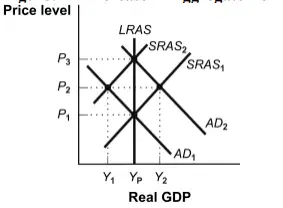
(Figure: An Increase in Aggregate Demand) The short-run equilibrium at Y2 and P2:
creates pressure for nominal wages to fall as workers seek to restore lost purchasing power.
creates pressure for prices to fall, since real GDP exceeds the potential real GDP.
results in a recessionary gap.
results in an inflationary gap.
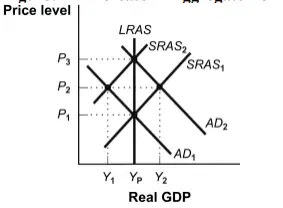
(Figure: An Increase in Aggregate Demand) Because of the pressures existing at the short-run equilibrium at Y2 and P2:
the SRAS will shift to the right.
the SRAS curve will shift to the left
unemployment will decrease.
LRAS will shift to the right.
If the economy is in a recessionary gap, then:
the economy will remain in a recession forever without any kind of government intervention.
nominal wages will fall and SRAS will shift to the right until the economy is at full employment.
AD will shift to the right and prices of goods will rise until the economy goes back to producing potential output.
nominal wages will rise and SRAS will shift to the left and the economy will eventually restore itself.
If there is an inflationary gap, which of the following accurately describes the adjustment to long-run equilibrium?
Nominal wages fall, and the aggregate demand curve shifts left until the economy reaches long-run equilibrium.
Nominal wages rise, and the aggregate demand curve shifts right until the economy reaches long-run equilibrium.
Nominal wages fall, and the short-run aggregate supply curve shifts right until the economy reaches long-run equilibrium.
Nominal wages rise, and the short-run aggregate supply curve shifts left until the economy reaches long-run equilibrium.
When a person makes price comparisons among products, money is being used as a(n):
unit of account.
expander of economic activity
medium of exchange.
checkable deposit.
When we purchase a meal, money is playing the role of:
medium of exchange.
unit of account.
barter token.
store of value.
Which of the following is considered to be money?
Google stock
bonds
credit cards
checking account deposits
Money whose value derives entirely from its official status as a means of exchange is known as:
commodity money.
commodity-backed money.
fiat money.
bank reserves
Which of the following financial assets belongs to M2 but not to M1?
a savings account
a checkable deposit
currency
travelers' checks
Probably the most important feature of deposit insurance is that it:
is paid for by the federal government.
costs so little to buy the policies to keep your money safe.
protects the economy against bank runs.
ensures that banks will always make a profit.
To _______ the money supply, the Federal Reserve could ________.
increase; decrease the money multiplier
decrease; lower the reserve requirements
increase; conduct open-market purchases
decrease; lower the discount rate
Suppose the reserve ratio is 20%. If Sam deposits $500 into his checking account, his bank alone can increase loans by:
$500.
$2,500.
$100.
$400.
If it looks like a bank won't meet the Federal Reserve Bank's reserve requirement, normally it will first turn to the:
other member banks and borrow money at the federal funds rate.
Federal Reserve and borrow money at the discount rate.
open market and borrow money there.
Congress to borrow funds.
If the Federal Reserve conducts an open-market purchase:
bank reserves decrease and the money supply decreases.
bank reserves increase and the money supply increases.
bank reserves decrease and the money supply increases.
bank reserves increase and the money supply decreases.
When the Federal Reserve decreases bank's reserves through an open-market operation:
deposits increase, currency in circulation increases, and the monetary base remains the same.
the monetary base decreases, the money multiplier decreases, and the money supply increases
loans increase, the federal funds rate rises, and the discount rate rises
the monetary base decreases, loans decrease, and the money supply decreases.
Suppose your grandma sends you $100 for your birthday and you deposit that $100 in your checking account at the local bank. The reserve ratio is 10%. Based upon this deposit, the bank's excess reserves have increased by _____, and if the bank lends these new excess reserves, the money supply could eventually grow by as much as _____.
$90; $1,000
$100; $900
$90; $900
$100; $1,000
Using gold or silver as an example, what is the difference between commodity money and commodity-backed money?
(a)
Using gold or silver as an example, what is the difference between commodity money and commodity-backed money?
increased the demand for money.
decreased the demand for money.
increased the demand for credit card transactions but had no impact on the demand for money
decreased the demand for credit card transactions but had no impact on the demand for money.
A decrease in the demand for money would result from:
an increase in income.
an increase in real GDP.
a decrease in the price level.
an increase in nominal GDP.
If inflation increases from 2% to 5%, the money demand curve will:
Remain constant
Remain constant, but the quantity of money demanded will decrease
Shift to the left
Shift to the right
The Federal Reserve affects interest rates by:
setting them with regulations.
open market operations that shift the money demand curve.
open market operations that shift the money supply curve.
changing tax rates.
If the Federal Reserve wants to lower the interest rate, it will:
decrease the money supply.
increase the money supply.
keep the money supply unchanged.
mandate a lower interest rate.
If the target rate of interest is higher than the current equilibrium interest rate, the Federal Reserve will:
sell Treasury bills in the open market, increase the supply of money, and lower the interest rate to the target rate.
buy Treasury bills in the open market, increase the supply of money, and lower the interest rate to the target rate.
sell Treasury bills in the open market, decrease the supply of money, and raise the interest rate to the target rate.
buy Treasury bills in the open market, decrease the supply of money, and raise the interest rate to the target rate.
A rise in interest rates due to a decrease in the money supply will _______ AD.
Reduce
not change
increase
decrease aggregate supply in the short run but increase immediately the level of
To close a recessionary gap using monetary policy, the Federal Reserve should ________ the money supply to ________ investment and consumer spending and shift the aggregate demand curve to the ________.
increase; increase; left
decrease; decrease; left
increase; increase; right
decrease; decrease; right
What is the goal of expansionary monetary policy, and how does it work in the short run? Explain all the steps in the process. Start with the initial action by the Fed and end with the change to AD.
(a)
The government saves when it:
has a balanced budget.
has a budget deficit.
has a budget surplus
borrows by selling bonds.
In an open economy, total investment spending is equal to:
national savings plus net capital inflow.
private savings plus national savings plus net capital inflow
private savings plus net capital inflow.
national savings minus private savings minus net capital inflow.
Net capital inflow is equal to:
GDP plus exports minus imports
the growth in capital stock minus investment spending.
foreign direct investment.
the total inflow of foreign funds minus the total outflow of domestic funds.
Assume that I = Sprivate + Sgovernment + (IM – X). Furthermore, let's say that imports are equal to exports. Given this situation, which of the following is true?
Private saving plus government savings exceed investment.
Private savings exceed investment.
Private savings plus government saving are less than investment
Private savings plus government saving are equal to investment.
A relatively low saving rate affects productivity growth by:
depriving investment spending of the funds needed to increase the physical capital.
promoting consumption spending and depriving investment in human capital of the funds needed for tuition.
reducing the tax base and preventing the government from providing public goods.
stimulating imports and increasing the trade deficit.
If private savings increase:
the demand for loanable funds will increase, interest rates will increase, and the amount of borrowing will increase.
the demand for loanable funds will decrease, interest rates will decrease, and the amount of borrowing will decrease.
the supply of loanable funds will increase, interest rates will decrease, and the amount of borrowing will increase.
the supply of loanable funds will decrease, interest rates will increase, and the amount of borrowing will decrease.
A business will want to borrow to undertake an investment project when the rate of return on that project is:
lower than the interest rate.
higher than the interest rate
higher than the exchange rate.
equal to the inflation rate.
The supply of loanable funds is _____ sloping because _____ respond to lower interest rates by _____ their quantity supplied of loanable funds.
upward; savers; increasing
upward; borrowers; decreasing
upward; savers; decreasing
downward; borrowers; increasing
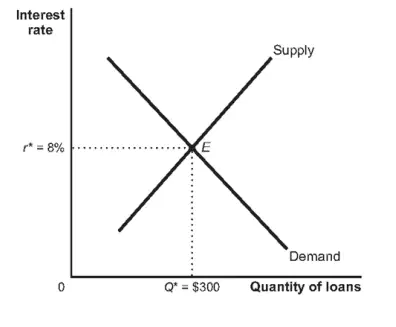
(Figure: The Market for Loanable Funds II) If the interest rate is higher than ______ in this loanable funds market, the quantity supplied of loanable funds will _______ the quantity of loanable funds demanded.
8%; be greater than
8%; be less than
8%; equal
10%; be less than
(Figure: The Market for Loanable Funds II) An increase in government borrowing will shift the demand for loanable funds to the:
left and increase the interest rate.
left and decrease the interest rate.
right and increase the interest rate.
right and decrease the interest rate.
(Figure: The Market for Loanable Funds II) An increase in savings by the private sector will shift the supply of loanable funds to the:
left and increase the interest rate.
right and decrease the interest rate.
right and increase the interest rate.
left and decrease the interest rate.
(Figure: The Market for Loanable Funds II) Other things being equal, an increase in taxes on savings and investment income will:
shift demand to the right and increase the interest rate.
shift demand to the left and decrease the interest rate.
shift supply to the right and decrease the interest rate.
shift supply to the left and increase the interest rate.
Crowding out is a phenomenon:
in which an increase in the government's budget surplus decreases overall investment spending.
where overproduction in the goods market leads to a sharp drop in the aggregate price level.
where an increase in the government's budget deficit causes overall investment spending to fall.
where an increase in imports causes the overall domestic production to fall.
Suppose the marginal propensity to consume is equal to 0.9 and investment spending increases by $50 billion. Assuming no taxes and no trade, by how much will real GDP change?
$450 billion increase
$90 billion increase
$500 billion increase
$500 billion decrease
An increase in the MPC
increases the multiplier
shifts the autonomous investment line upward.
decreases the multiplier.
shifts the autonomous investment line downward.
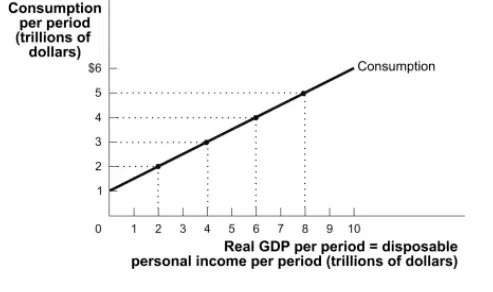
. (Figure: Consumption and Real GDP) The slope of the consumption function is called the:
marginal propensity to save
average propensity to consume.
marginal propensity to consume.
marginal consumption increment.
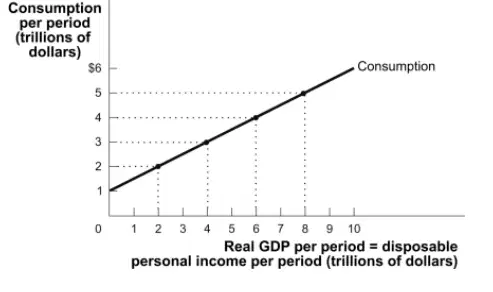
(Figure: Consumption and Real GDP) The marginal propensity to consume in this example is:
0.
0.5.
1.0.
2.0.
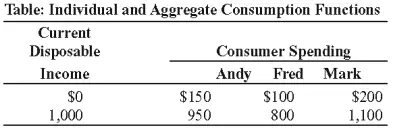
(Table: Individual and Aggregate Consumption Functions) Which of the following represents Fred's individual consumption function?
C = 100 + 0.7YD.
C = 100 + 0.5YD.
C = 150 + 0.8YD.
C = 0.80YD.
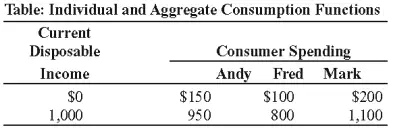
. (Table: Individual and Aggregate Consumption Functions) The marginal propensity to consume in the aggregate consumption function is: (Hint: the aggregate will be the average of the 3 consumers)
0.5.
0.7.
0.8.
0.9.
An increase in the wealth of households, all other things unchanged, will result in _______ the aggregate consumption function.
no effect on
an upward shift in
a downward shift of
a movement to the right along
If overall inventories rise in a month because of unplanned inventory investment, one can conclude that:
the economy is slowing down.
sales were more than had been forecast.
inventory investment is negative.
the accelerator principle was contradicted.
Which of the following will cause a decrease in unplanned inventory investment?
an increase in interest rates
an unexpected increase in consumer spending
an increase in the growth rate of real GDP
a sudden decrease in consumer wealth
If GDP is greater than planned aggregate spending, then:
unplanned inventory investment is negative.
GDP will fall.
the economy is in equilibrium.
GDP will rise.
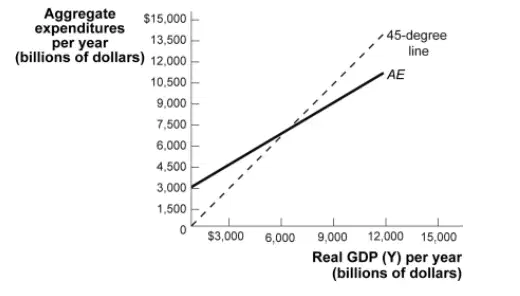
(Figure: Aggregate Expenditures and Real GDP) At a real GDP of $9,000 billion:
planned investment spending is less than overall investment spending.
planned investment spending equals overall investment spending
planned investment spending is greater than overall investment spending
there will be no unplanned investment spending.
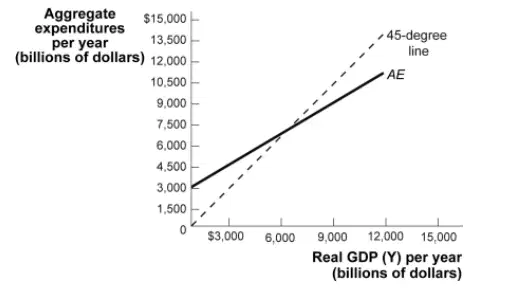
(Figure: Aggregate Expenditures and Real GDP) If the level of real GDP equals $9,000 billion and there are no changes in the consumption function or in planned investment, then real GDP will ________in the next period.
rise
remain unchanged
fall
fall, but only if there is an offsetting change in autonomous consumption
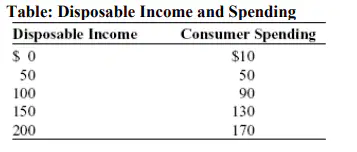
(Table: Disposable Income and Spending) Using the accompanying table, calculate the marginal propensity to consume (MPC). Use this MPC to compute the spending multiplier.
(a)
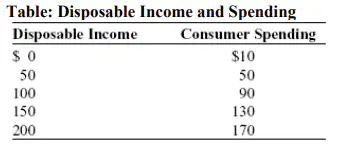
(Table: Disposable Income and Spending) Use the data in the accompanying table to develop a linear equation of the consumption function. Use this consumption function to forecast the amount of consumption spending that would occur if disposable income were equal to $500.
(a)
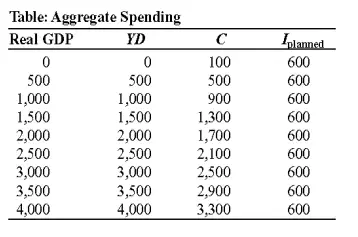
(Table: Real GDP) Suppose the economy has no government spending and no foreign trade. With no taxes and transfers, real GDP is equal to disposable income (YD). The data in the accompanying table show consumption spending (C) and planned investment (Iplanned). a. What is the MPC in this economy?
(a)
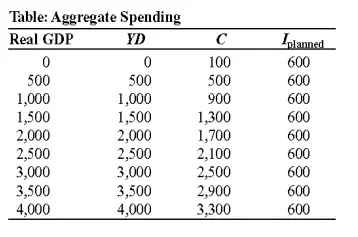
(Table: Real GDP) Suppose the economy has no government spending and no foreign trade. With no taxes and transfers, real GDP is equal to disposable income (YD). The data in the accompanying table show consumption spending (C) and planned investment (Iplanned). b. At what level of real GDP will the economy find its income–expenditure equilibrium? Graph the AE curve and the 45 degree line.
(a)
Which of the following is a government transfer?
wages paid to U.S. senators
purchases of tanks for the army
Social Security payments to retired auto workers
payments to contractors for repairs on interstate highways
Which of the following is NOT an example of government purchases of goods and services?
a federal prosecutor's salary in a lawsuit against Halliburton
new pavement for interstate highway I-95
a surgeon's bill reimbursed under the Medicare program
equipping U.S. air marshals with electroshock weapons
Consumer spending will fall if:
government transfers rise.
the government raises tax rates.
the government lowers tax rates.
government transfers rise or tax rates are lowered.
Suppose the economy is in a recessionary gap. To move equilibrium aggregate output closer to the level of potential output, the best fiscal policy option is to:
decrease government purchases.
decrease taxes.
decrease government transfers.
increase real interest rates.
If the current level of real GDP lies above potential GDP, then an appropriate fiscal policy would be to _____, which will shift the AD curve to the _____.
decrease government purchases; right.
increase government purchases; left.
decrease government purchases; left.
raise tax rates; right.
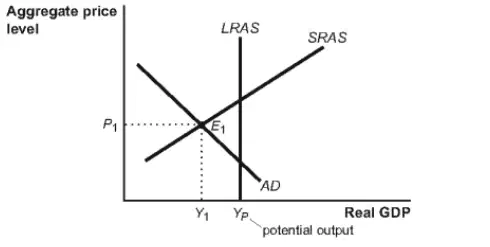
(Figure: Short- and Long-Run Equilibrium) Using the accompanying figure, which of the following would be the appropriate response of the government upon viewing the state of the economy?
Expand aggregate demand by increasing taxes to close the inflationary gap.
Reduce aggregate demand by cutting taxes to close the inflationary gap.
Expand aggregate demand by cutting taxes to close the recessionary gap.
Reduce aggregate demand by increasing taxes to close the recessionary gap.
A reduction in government transfers ________, therefore shifting the aggregate demand curve to the ________.
increases labor costs to companies, increasing investment; left
decreases government purchases of goods and services, decreasing consumption; right
increases the marginal propensity to save, decreasing consumption; right
decreases disposable income and consumption; left
To close a recessionary gap by employing fiscal policy, the government could:
increase national savings so that the interest rate falls.
lower the annual income exempt from paying the personal income tax.
lower the corporate income tax rate.
lower the amount of unemployment insurance benefits.
If the marginal propensity to consume is 0.9, then the tax multiplier will be:
impossible to determine.
greater than 10.
less than 10.
zero, because there is no multiplier effect from taxes.
If the MPC is 0.8 and government transfers decrease by $50 million, then equilibrium GDP will decrease by:
$40 million.
$50 million
$200 million.
$250 million.
Automatic stabilizers are government spending and taxation changes that:
cause fiscal policy to be expansionary when the economy contracts.
cause fiscal policy to be contractionary when the economy contracts.
cause fiscal policy to be neutral when the economy contracts.
cause fiscal policy to be ineffective when the economy contracts.
The national debt _______ in years in which the federal government incurs a _______.
falls; deficit
rises; surplus
stays the same; surplus
rises; deficit
Implicit liabilities refer to the promises made by the government, such as:
aid to foreign countries.
building roads and bridges.
Social Security and Medicare payments.
contributions to the National Endowment for the Arts.
. Suppose that real GDP is $1,500 and potential GDP is $1,200, while the marginal propensity to consume is 0.8. If the government is going to engage in government spending and impose no taxes, what specific fiscal policy action should policy makers take? (Answer is $ amount.)
(a)
An example of an automatic stabilizer that works when the economy contracts is:
a rise in tax receipts.
a fall in government purchases.
a discretionary decrease in government purchases.
a rise in government transfers as more people receive unemployment insurance benefits.

