
 Worksheets
BIOL-1240 Excretory System Ch 41
Total questions: 28
Worksheet time: 15mins
Excretory systems maintain homoestasis through all of the following except:
adjusting the concentrations of various substances in body fluids
removing excess water from the body.
elimination
the production of urine.
All of the above
Which of the following is considered to be a nitrogenous waste of animals?
feces
carbon dioxide
ammonia
water
sugars
How do terrestrial
animals prevent toxic accumulation of ammonia in their tissues?
They use ammonia in other metabolic processes.
They convert ammonia to less toxic forms.
They vent eliminate ammonia across the body wall.
They eliminate ammonia rather than excrete it.
Animals do not produce ammonia.
Which of the following is not an advantage of uric acid excretion in terrestrial animals?
Uric acid can be excreted as a paste, thereby conserving water.
Uric acid is not toxic and can be safely stored.
Uric acid can stored in the eggs of animals without harm to the embryos.
Uric acid is soluble in water and can be easily excreted.
Uric acid can be excreted along with feces in some animals.
Osmoconformers would most likely be found in:
estuaries
coastal zones that receive freshwater
freshwater
terrestrial habitats
open ocean waters
An animal adapted to life in a coastal environment where fresh water enters the ocean:
would have excretory structures to remove excess salt.
would have excretory structures to remove excess water.
would drink large amounts of water.
would likely be an osmoregulator.
More than one of the above.
The major function of the protonephridia in the flatworm is to
conserve water.
conserve salts,
eliminate waste materials such as ammonia and urea.
eliminate excess water.
regulate the pH of the gastrovascular cavity.
The main difference between protonephridia and metanephridia is:
protonephridia are involved in osmoregulation, while metanephridia are involved in excretion.
protonephridia consist of blind flame cells, while metanephridia consist of tubules open at both ends.
protonephridia are involved in excretion, while metanephridia are involved in osmoregulation.
protonephridia consist of tubules open at both ends, while metanephridia consist of blind flame cells.
None of the above
Metanephridial organs are common in:
mollusks
flatworms
cnidarians
sponges
insects
In contrast to the excretory system of annelids, the excretory system of insects:
has many openings on the body wall.
contains flame cells.
is not connected to the gut.
produces uric acid that is excreted from the rectum.
relies on diffusion across the body wall.
Which of the following statements about the Malpighian tubules is false?
Water and some solutes are transported into the Malpighian tubules via active transport.
The Malpighian tubules empty into the gut of the insect.
Water, some salts, and other solutes are reabsorbed into the hemolymph in the rectum.
The excretory system of an insect may contain up to several hundred Malpighian tubules.
The blind ends of the Malpighian tubules are bathed in hemolymph.
The main point of entry of water into the blood of freshwater fishes is through:
the skin
the gills
the mouth
the anus
the eyes
Marine cartilaginous fishes overcome water loss to their environments by:
having specialized chloride cells in their gills that prevent water loss.
having specialized chloride cells in their gills that continuously excrete salts
storing urea in their body fluids, which causes them to be hypertonic to seawater
producing very small quantities of urine.
drinking large quantities of freshwater.
in mammals except:
All of the following contribute to the maintenance of homeostasis
sweat glands
the digestive system.
lungs.
specialized gill cells
the kidney.
The outermost region of the kidney is called the:
adventitia
mucosa.
pelvis.
cortex.
medulla.
The renal medulla contains the:
renal pyramids
Bowman's capsules
distal convoluted tubules
glomeruli
proximal convoluted tubules
The ureters connect:
the bladder to the body exterior
the kidney to the bladder
the bladder to the urethra
the kidney to the body exterior
the kidney to the urethra
What is the significance of having specialized epithelium and smooth muscle in the urinary bladder?
It helps reabsorb water.
It helps reabsorb salts.
It permits the diffusion of gases
It is capable of shrinkage and stretching
It protects the bladder from nitrogenous wastes
The _____________is shorter in females than is in males, which explains the greater likelihood of developing bladder infections in _________.
ureter; females
ureter; males
renal papilla; females
urethra; males
urethra; females
Trace the flow of urine through the following structures
1) bladder
2) renal papilla
3) ureter
4) renal pelvis
5) urethra
4 -> 2 -> 5 -> 1 -> 3
1 -> 2 -> 4 -> 3 -> 5
2 -> 4 -> 3 -> 1 -> 5
2 -> 1 -> 4 -> 3 -> 5
4 -> 1 -> 2 -> 3 -> 5
Which portion of the renal tubule empties directly into the collecting duct?
Bowman's capsule
distal convoluted tubule
proximal convoluted tubule
descending loop of Henle
ascending loop of Henle
___________________directly deliver blood to the glomeruli.
Afferent arterioles
Efferent arterioles
Peritubular capillaries
Renal arteries
Renal venules
Which is the correct sequence of structures through which the filtrate would pass?
Bowman's capsule
proximal convoluted tubule
descending loop of Henle
ascending loop of Henle
distal convoluted tubule
Simple epithelial cells of the renal tubule have abundant__________________________to increase the surface area for reabsorption and numerous______________to provide energy for actively transporting materials.
microvilli; mitochondria
cilia; mitochondria
microvilli; Golgi complexes
cilia;, Golgi complexes
cilia; capillaries
Which of the following is only partially reabsorbed in the proximal convoluted tubule?
glucose
amino acids
sodium ions
vitamins
nutrients
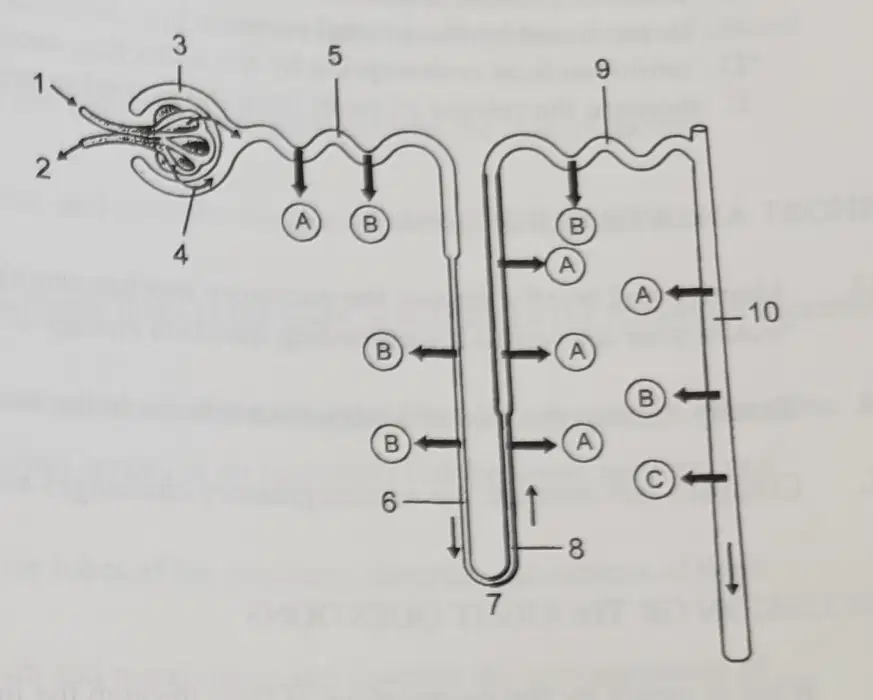
Reabsorption of water occurs at
labeled:
3 and 9
5 and 8
6 and 10
8 and 10
only 10
What is the function of antidiuretic hormone?
It increases the permeability of the collecting ducts to sodium so more is reabsorbed
It causes a high volume of less concentrated urine to be produced.
It increases aldosterone secretion.
It decreases renin secretion
It increases the permeability of the collecting ducts to water so more is reabsorbed.
Which of the following would increase the production of a highly diluted urine?
decreased secretion of aldosterone
increased salt in the diet
decreased blood pressure
increased secretion of antidiuretic hormone
increased sweat production

