Wayground logo

Free Printable Worksheets

Font size

S
M
L
XL
Worksheets

Earth's Structure & Changes TEST Review

Total questions: 50

Worksheet time: 50mins

Name
Class
Date
1.
Which layer of Earth is characterized by rock that is plastic, or soft enough to flow?
a)
asthenosphere
b)
crust
c)
lithosphere
d)
inner core
2.
The solid, outer layer of the Earth that consists of the crust and the rigid upper part of the mantle
a)
Lithosphere
b)
Mesosphere
c)
Mantle
d)
Crust
3.
Temperature _____________________ as you go deeper into the earth.
a)
increases
b)
decreases
c)
goes up and down depending on the layer
d)
stays the same
4.
Pressure ______________________ as you go deeper into the Earth
a)
increases
b)
decreases 
c)
goes up or down depending on the layer
d)
stays the same
5.

The lithosphere combines what two layers?

a)

Athenosphere & Crust

b)

Crust & Upper Mantle

c)

Mantel & Asthenosphere

6.

Which layer of earth is molten (liquid metal)?

a)

inner core

b)

outer core

c)

crust

d)

lithosphere

7.
Which layer of Earth is solid and why?
a)
The inner core is solid because of movement of the outer core.
b)
The inner core is solid because of the freezing temperatures.
c)
The inner core is solid because of the extreme pressure from the other layers.
d)
The outer core is solid because of the extreme pressure from the other layers.
8.
Which layers make up the mantle?
a)
crust, inner core, outer core
b)
mesosphere, asthenosphere, part of lithosphere
c)
bottom part of the mantle
d)
crust only
9.
Which layer is plastic and has the consistency of silly putty allowing movement?
a)
asthenosphere
b)
lithosphere
c)
mesosphere
d)
crust
10.
Which of Earth's layers is made of SOLID iron and nickel?
a)
crust 
b)
mantle
c)
outer core
d)
inner core
11.

How are the materials of the Earths core different from those of the crust (in general)?

a)

They are harder

b)

They are more dense

c)

They are older

d)

They are darker in color

12.

What is the thinnest layer of the Earth?

a)

Mantle

b)

inner core

c)

outer core

d)

crust

13.
Which of the following causes Earth's tectonic plates to move?
a)
Energy from the Sun
b)
Magnetic Pole Reversal
c)
Convection currents in the mantle
d)
Faults in Mountain Ranges
14.
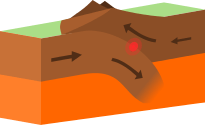
What type of event will occur at this boundary?
a)
Earthquake
b)
Volcano Eruption
c)
Tornado
d)
Mountain Building
15.
What type of plate boundary is this?
a)
Plate
b)
Divergent
c)
Convergent
d)
Transform
16.
A divergent boundary occurs when plates ....
a)
Pull apart
b)
Come together
c)
Slide past each other
d)
subducting
17.

Which of the following is the name of the ancient supercontinent formed 280 Million Years ago.

a)

Pangea

b)

Gondwanda

c)

Laurasia

d)

Neverland

18.
What geologic feature/event would you most likely to find at a divergent boundary between two pieces of oceanic crust?
a)
Rift Valley
b)
Mid-Ocean Ridge
c)
Island Arc
d)
Flat land
19.
What geologic feature/event would you most likely to find at a convergent boundary between two pieces of continental crust?
a)
Volcano
b)
Mountain
c)
Rift
d)
Island Arc
20.
Which piece of evidence did Wegener use to prove continental drift?
a)
The shape of the continents
b)
Similar fossils found on separate continents
c)
Tree fossils found in odd places
d)
All of the above
21.
As you travel from the inner core to the crust, how would temperature, pressure and density of the material change?
a)
The would all increase
b)
The would all decrease.
c)
Nothing, the layers are made of the same material throughout
d)
Temperature would decrease, but pressure and density would increase
22.
Which of the following changes would end Earth's tectonic activity?
a)
Earth's crust becomes a cooler solid
b)
Earth's mantles becomes a warmer semiliquid
c)
Earth's mantle becomes cooler and solid.
d)
Earth's outer core becomes warmer
23.
This theory states that Earth's  plates move on top of the mantle at a slow and constant rate due to convection currents
a)
plate tectonics
b)
continental drift
c)
seafloor spreading
d)
pangaea
24.

What occurs when two plates come together and the denser plate is forced under and back into the mantle?

a)

reduction

b)

conduction

c)

subduction

d)

convection

25.

Earthquakes and volcanoes are most likely found in which locations?

a)

at plate boundaries

b)

evenly distributed over the Earth

c)

in the middle of continents

d)

in the middle of plates

26.

When an oceanic plate and a continental plate collide, which one will subduct and why?

a)

oceanic because it is more dense

b)

continental because it is more dense

c)

oceanic because it is less dense

d)

continental because it is more dense

27.
A Plate Boundary where two plates move toward each other is called
a)
Convergent Boundary
b)
Divergent Boundary
c)
Transform Boundary
d)
Subduction
28.
Divergent Plate movement can create
a)
Convection Currents
b)
Conduction
c)
Mountains
d)
Rifts and ocean ridges
29.
Name the boundary
a)
convergent boundary
b)
divergent boundary
c)
transform boundary
d)
sergent boundary
30.
Name the boundary
a)
convergent boundary
b)
divergent boundary
c)
transform boundary
d)
sergent boundary
31.
Why was Alfred Wegner's theory of Continental Drift not immediately accepted by scientists?
a)
there was no mechanism to explain how Continental Drift happened.
b)
The theory of Continental Drift was immediately accepted by the scientific community.
c)
there was no evidence to support his theory.
d)
Scientists did not think it was possible for the Continents to move.
32.
Which of the following is NOT evidence to support the theory of plate tectonics?
a)
Fossils
b)
Mountains
c)
Glaciers
d)
Sand Erosion
33.
What new feature forms at a convergent plate boundary where two continental plates collide?
a)
mid-ocean ridge
b)
trench
c)
mountain range
d)
none of these features form
34.

Which layer of Earth is a liquid?

a)

Crust

b)

Mantle

c)

Outer core

d)

Inner core

35.

Oceanic crust is __________ than continental crust

a)

denser

b)

thicker

c)

older

d)

more felsic

36.

How did the Himalayas form?

a)

They are volcanic mountains that formed at a subduction zone.

b)

They formed along a divergent boundary beneath an ancient ocean.

c)

They formed when the Indian plate collided with the Asian plate

37.

Where do most earthquakes and volcanic eruptions occur?

a)

In the center of tectonic plates

b)

Along the boundaries between tectonic plates.

c)

Anywhere on Earth. There is no pattern.

38.

Saying you are older than your sister is an example of?

a)

Absolute age dating

b)

Relative age dating

c)

Fossils

d)

Radioactive dating

39.

What does absolute age tell us about a rock layer or fossil?

a)

The 'exact' age of a fossil determined by radiometric dating

b)

The relative age of a fossil determined by radiometric dating

c)

Younger rock layers sit on top of older rock layers

d)

Older rock layers sit on top of younger rock layers

40.
According to the law of superposition, which layer is the youngest?
a)
A
b)
B
c)
C
41.

The Era when humans first appeared was...

a)

Mesozoic

b)

Cenozoic

c)

Paleozoic

d)

Precambrian

42.

Which is the most recent era of time- the one that we are currently in?

a)

Cenozoic

b)

Mesozoic

c)

Paleozoic

d)

Precambrian

43.

Which era lasted the longest in Earth's history?

a)

Cenozoic

b)

Mesozoic

c)

Paleozoic

d)

Precambrian

44.

If you have 500 grams of a radioactive isotope with a half-life of 100 years, how much of the isotope will you have left after 100 years?

a)

500 grams

b)

250 grams

c)

125 grams

d)

62.5 grams

45.

If you have 100 grams of a radioactive isotope with a half-life of 10 years, how much of the isotope will you have left after 20 years?

a)

100 grams

b)

50 grams

c)

25 grams

d)

12.5 grams

46.

Which of the following organizes the divisions of geologic time from longest to shortest?

a)

eons, eras, periods, epochs

b)

epochs, periods, eras, eons

c)

periods, eons, epochs, eras

d)

eras, epochs, eons, periods

47.

The FIRST living organisms on Earth were _______.

a)

prokaryotic cells (without a nucleus)

b)

eukaryotic cells (with a nucleus)

c)

plants & fungi

d)

simple animals with soft bodies

48.

What type of event usually marks the end of an Era

a)

A Mass Extinction

b)

A Supernova

c)

An earthquake

d)

A Volcanic Eruption

49.

What are the four eras in order from OLDEST to NEWEST?

a)

Pre-Cambrian, Paleozoic, Mesozoic, Cenozoic

b)

Pre-Cambrian, Mesozoic, Paleozoic, Cenozoic

c)

Cenozoic, Mesozoic, Paleozoic, Pre-Cambrian

d)

Mesozoic, Pre-Cambrian, Cenozoic, Paleozoic

50.

The dinosaurs and reptiles were dominant in which Era?

a)

Precambrian

b)

Mesozoic

c)

Paleozoic

d)

Cenozoic