
 Worksheets
Transportation in Supply Chain Quiz
Total questions: 40
Worksheet time: 20mins
The movement of product from one location to another as it makes its way from the beginning of a supply chain to the customer's hands is referred to as
transportation
retailing
distribution
manufacturing
Transportation plays a key role in every supply chain because
products are normally produced and consumed in the same location
products are rarely produced and consumed in the same location
the cost of transportation is inconsequential
transportation is not a factor in determining profitability
The key players in any transportation that takes place within a supply chain are
the shipper and the receiver
the shipper and the supplier
the shipper and the manufacturer
the shipper and the carrier
Investment decisions regarding the transportation infrastructure (rails, locomotives, trucks, airplanes, etc.) are the primary concern of
the shipper
the supplier
the manufacturer
the carrier
Which of the following uses transportation to minimize the total cost (transportation, inventory, information, and facility) while providing an appropriate level of responsiveness to the customer?
The shipper
The supplier
The manufacturer
The carrier
________ carriers offer a very fast and fairly expensive mode of transportation for cargo.
Air
Truck
Rail
Water
________ carriers typically move commodities over large distances at lower costs per unit shipped.
Air
Truck
Rail
Package
________ carriers are the preferred mode of transport for online businesses such as Amazon.com and Dell, as well as for companies such as W.W. Grainger and McMaster-Carr that send small packages to customers.
Air
Package
Rail
Water
Which mode of transportation is the least expensive?
Air
Truck
Rail
Water
Which mode of transportation is the dominant form of domestic freight transportation?
Air
Truck
Rail
Water
Which mode of transportation is used primarily for petroleum and natural gas?
Air
Truck
Water
Pipeline
In almost all countries, roads, seaports, airports, rail and canals have this in common.
They were built and/or managed by the government
They are located near the water
They are the source of most of the tax revenue for municipalities
They are staffed by foreign nationals
Which of these statements about use fees for a highway is best?
A flat rate results in lower use by most individuals
A flat rate results in higher use by most individuals
A flat rate has no impact on use by most individuals
A fee based on congestion results in higher use by most individuals
Which transportation network design option has the elimination of intermediate warehouses and its simplicity of operation and coordination as its major advantage?
Direct shipping network
Direct shipping with milk runs
All shipments via central DC
Shipping via DC using milk runs

Which transportation network design is pictured?
Direct shipping network
Direct shipping via decentralized DCs
All shipments via central DC
Milk runs to multiple buyer locations
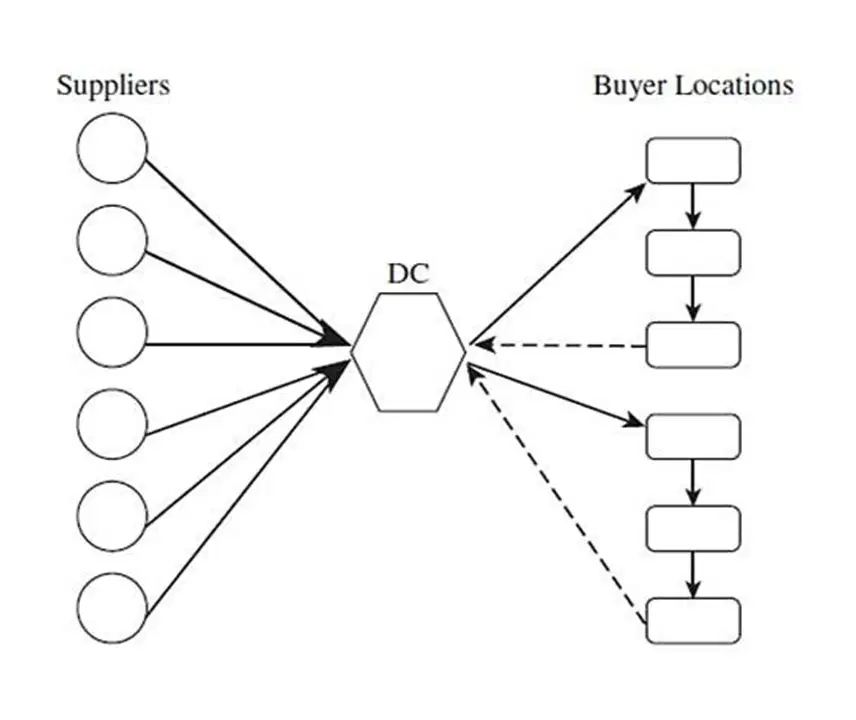
Which transportation network design is pictured?
Direct shipping network
All shipments via intermediate transit point
Milk runs from a central DC
Distributed milk runs by multiple suppliers
Which transportation network design option establishes an extra layer between suppliers and retailers to store inventory and to serve as a transfer location?
Direct shipping network
Direct shipping with milk runs
All shipments via central DC
Direct shipping
Which transportation network design option uses a combination of milk runs, shipping via DC, shipping via intermediate DC with storage, and direct shipping with milk runs to reduce the cost and improve responsiveness of the supply chain?
Direct shipping network
Direct shipping with milk runs
Shipping via DC using milk runs
Tailored network
Cheaper modes of transport typically have
shorter lead times and smaller minimum shipment quantities
shorter lead times and larger minimum shipment quantities
longer lead times and smaller minimum shipment quantities
longer lead times and larger minimum shipment quantities
The most important operational decision related to transportation in a supply chain is
minimizing cost of transportation
maximizing profitability of the supply chain
reducing the level of cycle inventory
the routing and scheduling of deliveries
The Mumbai dabbawalas deliver
bottled water
home-cooked lunches
prayer beads
letters and legal documents
The Mumbai dabbawalas perform
a forward logistics function
a reverse logistics function
both a forward and a reverse logistics function
neither a forward nor a reverse logistics function
At a train station where lines intersect, the Mumbai dabbawalas perform
a forward logistics function
a reverse logistics function
a milk run
a cross-dock function
The Mumbai dabbawalas have a transportation network that takes advantage of
a low uncertainty of demand
temporal aggregation of demand
use of transportation resources when they are underutilized
both low uncertainty and temporal aggregation of demand and also use of transportation resources while they are underutilized
The total amount paid to various carriers for transporting products to customers is
transportation cost
inventory cost
facility cost
processing cost
The cost of holding inventory incurred by the shipper's supply chain network is
transportation cost
inventory cost
facility cost
processing cost
The cost of various facilities in the shipper's supply chain network is
transportation cost
inventory cost
facility cost
processing cost
The cost of loading/unloading orders, as well as other processing costs associated with transportation, is considered
transportation cost
inventory cost
facility cost
processing cost
Temporal aggregation
is the process of combining orders across multiple locations
increases a firm's responsiveness
decreases transportation costs because of economies of scale
is purely a theoretical concept; no practical business examples of this exist
Serving a high density of customers at a long distance is best done using
an LTL carrier
a cross dock distribution center with milk runs
a package carrier
a private fleet with milk runs
Serving a low density of customers at a long distance is best done using
an LTL carrier
a cross dock distribution center with milk runs
a package carrier
a private fleet with milk runs
Serving a high density of customers at a short distance is best done using
an LTL carrier
a cross dock distribution center with milk runs
a package carrier
a private fleet with milk runs
Serving a medium density of customers at a medium distance is best done using
an LTL carrier
a cross dock distribution center with milk runs
a package carrier
a private fleet with milk runs
Serving a medium density of customers at a short distance is best done using
an LTL carrier
third party milk runs
a package carrier
a private fleet with milk runs
It is best to disaggregate all inventories and use an inexpensive mode of transportation for replenishment when you have a
high-value product and high demand
high-value product and low demand
low-value product and high demand
low-value product and low demand
A shrewd supply chain manager would aggregate only safety inventory and use an inexpensive mode of transportation for replenishing cycle inventory if she is dealing with a
high-value product and high demand
high-value product and low demand
low-value product and high demand
low-value product and low demand
The skillful supply chain manager declared she would not only disaggregate cycle inventory, but she would also aggregate safety inventory and use an inexpensive mode of transportation for replenishing cycle inventory and fast mode when using safety inventory for her product that had
high value and high demand
high value and low demand
low value and high demand
low value and low demand
Managers should ensure that a firm's transportation strategy
involves cost minimization
involves profit maximization
supports its competitive strategy
is separate from competitive strategy
Ignoring uncertainty in demand encourages a greater use of
expensive but flexible transportation modes
inexpensive and inflexible transportation modes
inexpensive and flexible transportation modes
expensive and inflexible transportation modes
Inexpensive and inflexible transportation modes tend to
perform poorly.
perform well when plans change.
perform well when everything goes as planned.
work the best in all situations.

