wayground logo

Free Printable Worksheets

Font size

S
M
L
XL
Worksheets

Midterm Review Quizizz

Total questions: 109

Worksheet time: 18hrs 10mins

Name
Class
Date
1.

It is the science that studies matter and its motion.

a)

Physics

b)

Chemistry

c)

Biology

d)

Psychology

2.
A possible explanation to a problem that has not yet been tested. 
a)
data
b)
theory
c)
hypothesis
d)
fact
3.
This part of the experiment serves as a basis of comparison; the one variable being tested has been omitted. 
a)
experimental group
b)
control group
c)
data
d)
variables
4.
This variable in an experiment is the one being deliberately changed by the scientist. 
a)
dependent variable
b)
independent variable
c)
data
d)
control group
5.
An experiment is performed on plants to see how different liquids affect plant growth. Each plant in the experiment is given a different liquid; water, apple juice, or milk. Each plant has the same amount of soil, sunlight, and listens to the same music. In this investigation, the independent variable is ...
a)
The type of plant
b)
The amount of sunlight
c)
The type of music
d)
The type of liquid
6.
The summary at the end of an experiment that explains the results. 
a)
conclusion
b)
procedures
c)
materials
d)
responding variable
7.
Testing a hypothesis often involves a(n):
a)
answer
b)
experiment
c)
problem
d)
safety check
8.
A student wants to test the effects of type of exercise on heart rate.  What is the dependent variable?
a)
heart rate
b)
type of exercise
c)
amount of exercise
d)
time of day exercise occurs
9.

How many significant figures does this measurement have?  

9.340 kg


(a)  

10.

How many significant figures does this measurement have?  

250 m

(a)  

11.

How many significant figures does this measurement have?  

75,000.0 mm

(a)  

12.

Round 0.0529 to 1 significant figure.


(a)  

13.

Round 890.6319 to 3 significant figures.


(a)  

14.

What is 78.5 rounded to one significant figure?

a)

79

b)

78.5

c)

70

d)

80

15.

What is 0.658 rounded to 1 significant figure?

a)

0

b)

0.66

c)

0.7

d)

0.658

16.
How many significant figures will be in the answer to the following question:
7.62 x 6.98 x 3.2645
a)
1
b)
2
c)
3
d)
4
17.

7.8 x 5.501

a)

42.9078

b)

42.908

c)

42.91

d)

42.9

e)

42

18.

5.40 x 7.90

a)

42.66

b)

42.7

c)

43

d)

40

19.

In division and multiplication, the answer should have the same number of significant figures as the

a)

number in the calculation with the fewest significant figures.

b)

number in the calculation with the most significant figures.

c)

average number of significant figures in the calculation.

d)

total number of significant figures in the calculation.

20.
Calculate 12.34 + 1.234 + 0.1234 and give your answer with the appropriate number of significant figures.
a)
13.6974
b)
13.697
c)
13.70
d)
13.7
21.

How would you write 0.0005 in scientific notation?

a)

50 x 10-5

b)

5 x 10⁻⁴

c)

5 x 10³

d)

.5 x 103

22.

How do you write 8.317 x 10⁶ in standard form?

(a)  

23.

Which of the following numbers is written in scientific notation?

a)

20.35 x 10⁴

b)

.2035 x 104

c)

2035 4

d)

2.035 x10⁴

24.

Express the following in scientific notation:


.000457

a)

457 x 106

b)

457 x 10-6

c)

4.57 x10⁴

d)

4.57 x 10⁻⁴

25.
What is velocity?
a)
The total distance traveled by an object
b)
The distance from start to end, including the direction
c)
How fast an object travels
d)
The speed at which an object travels plus its direction
26.
A dolphin can swim 1.85 km/h. How are far does the dolphin travel after 0.6 hours?
a)
0.63 km
b)
1.1 km
c)
2.5 km
d)
3.7 km
27.

A trucker drives with an average velocity of 27 m/s towards the east on a perfectly straight highway. What will the trucker's displacement be after 2 minutes?

a)

97 m; east

b)

190 m; east

c)

1600 m; east

d)

3200 m; east

28.
What is acceleration?
a)
It is the displacement.
b)
It is the velocity.
c)
It is the rate of change of the displacement.
d)
It is the rate of change of the velocity.
29.
What happens to an object's motion when the velocity is positive and the acceleration is negative?
a)
The object slows down.
b)
The object speeds up.
c)
The object remains at a constant velocity.
d)
The object remains at rest.
30.

The slope on a position vs time graph represents

a)

displacement

b)

velocity

c)

acceleration

d)

cannot be determined

31.
The SI unit for acceleration is
a)
mph
b)
ft/sec2
c)
m/s2
32.
A negative acceleration means that your object is _____. 
a)
Going to Wal-mart 
b)
running for president 
c)
speeding up 
d)
slowing down 
33.
A car travels 30 miles/hr for 3 hours, calculate the distance it will travel
a)
90 miles
b)
10 miles
c)
600 miles
d)
90 km
34.
A car traveling in a northeasterly direction at a rate of 50 km/h represents which of the following?
a)
speed
b)
velocity
c)
acceleration
d)
deceleration
35.
Find the velocity of a truck that travels 75 miles north in 2.5 hours.
a)
187.5 mph north
b)
30 mph north
c)
300 mph north
d)
200 mph north
36.
If a boomerang is thrown 20 m in a straight line and returns exactly to the spot it was thrown what is its displacement?
a)
20m
b)
40m
c)
0m
d)
-20m
37.
A meteoroid changed velocity from 1 km/s to 1.8 km/s in 0.03 seconds. What is the acceleration of the meteoroid?
a)
60.000 km/s2
b)
26.667 km/s2
c)
33.333 km/s2
d)
11.333 km/s2
38.

If Luke leaves his home and goes to the mall and travels 20 miles, what is his distance and his displacement?

a)

Distance and displacement are 20 miles.

b)

Distance is 20 miles, displacement 0 miles.

c)

Distance 40 miles, displacement 40 miles.

d)

Distance 40 miles, displacement 0 miles.

39.

If Luke leaves his home and goes to the mall and travels 20 miles, then goes back home 20 miles. What is his distance and his displacement?

a)

Distance and displacement are 20 miles.

b)

Distance is 20 miles, displacement 0 miles.

c)

Distance 40 miles, displacement 40 miles.

d)

Distance 40 miles, displacement 0 miles.

40.

Mr. Gerlinger travels 30 miles east to school. He then goes 20 miles west to fill up at a gas station on the way home. What is his distance? His displacement?

a)

Distance 10 miles, displacement 10 miles.

b)

Distance 30 miles, displacement 50 miles.

c)

Distance 50 miles, displacement 10 miles.

d)

Distance 50 miles, displacement 50 miles.

41.
a)
1st
b)
2nd
c)
3rd
42.
"For every action, there is an equal and opposite reaction."
a)
Newton's 1st Law
b)
Newton's 2nd Law
c)
Newton's 3rd Law
d)
Newton's 4th Law
43.
Force = Mass x Acceleration
a)
Newton's 1st Law
b)
Newton's 2nd Law
c)
Newton's 3rd Law
d)
Newton's 4th Law
44.
"An object in motion (or at rest) will to stay in motion (or at rest) until an outside force acts upon it."
a)
Newton's 1st Law
b)
Newton's 2nd Law
c)
Newton's 3rd Law
d)
Newton's 4th Law
45.
The tendency of an object to resist changes in its motion is...
a)
inertia
b)
force
c)
acceleration
d)
velocity
46.
Any push or pull on an object.
a)
force
b)
velocity 
c)
inertia
d)
momentum
47.
The force that opposes motion between two surfaces in contact with each other.
a)
inertia
b)
friction
c)
momentum
d)
gravity
48.
The force of attraction between all matter.
a)
inertia
b)
friction
c)
net force
d)
gravity
49.
When all the forces on an object are equal and opposite, & the net force is zero, that's...
a)
balanced forces
b)
unbalanced forces
c)
terminal velocity
d)
reaction forces
50.
What is speed?
a)
how far you go
b)
how much distance is covered over a period of time
c)
how fast you accelerate
d)
the change in the location of a object
51.
What is velocity?
a)
the quickness of an object
b)
the location of an object
c)
acceleration
d)
speed in a specific direction
52.
A runners races in the 100 meter dash.  It takes her 10 seconds to finish.  What is her average speed?
a)
10 m/s
b)
1000 m/s
c)
100 seconds
d)
10 seconds
53.
F=MA
An object of mass 10 kg is accelerated upward at 2 m/s2.  What force is required? 
a)
20 N
b)
2 N
c)
5 N
d)
0 N
54.
A 20 kg bike accelerates at 10 m/s2.  what was the force?
a)
25 Newtons
b)
20 Newtons
c)
200 Newtons
d)
10 Newtons
55.
If a force of 26 N is exerted on two balls, one with a mass of 0.52 kg and the other with a mass of 0.78 kg, which ball will have the greater acceleration?  (F=ma)
a)
The one with a mass of .78 kg will have the greatest acceleration.
b)
The one with a mass of .52 kg will have the greatest acceleration.
c)
They will both accelerate at the same rate.
56.
45 m/s2 is the... 
a)
Mass
b)
Force 
c)
Acceleration
d)
weight
57.
If a 10 kilogram object accelerates suddenly at 15 m/s^2, how much force was applied to the object?
a)
150 Newtons
b)
15 Newtons
c)
150 kilograms
d)
100 kilograms
58.
What is the formula for force?
a)
F=M/A
b)
F=A/M
c)
F=M*A
d)
F=M*F
59.
Why is person B having a hard time moving down the hill?
a)
Person B has more friction than person A.
b)
Person B has the same friction as person A.
c)
Person B is out of shape.
d)
Person B has less friction has person A.
60.
If an object is stationary (not moving) the forces acting upon it are _____________
a)
unbalanced
b)
weak
c)
balanced
d)
Hulk Smash!
61.
In a tug of war, when one team is pulling with a force of 100 N and the other at 80 N. What is the net force?
a)
20 N
b)
80 N
c)
100 N
d)
180 N
62.
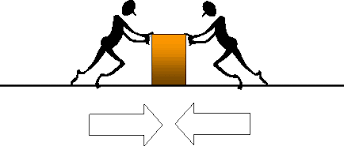
What is the net force?
a)
17 N Right
b)
3 N Right
c)
3 N Left
d)
17 N Left
63.
What is the net force?
a)
5000 N right
b)
4000 N right
c)
40 N left
d)
4000 N left
64.
What is the definition of "weight"?
a)
measure of the force of gravity on your body
b)
the time it takes to get on a ride 
c)
the amount of matter in an object
d)
the size of an object
65.
A measure of how much matter an object has is--
a)
weight
b)
gravity
c)
mass
d)
volume
66.

On which celestial object (outer space) would your mass be the greatest?

a)

Earth

b)

Jupiter

c)

Sun

d)

Your mass doesn't change on different celestial objects
67.
As an object's mass increases, its gravitational pull will ____________.
a)
decrease
b)
increase
c)
stay the same
d)
get weaker
68.
If an object has more mass, then it will
a)
weigh more.
b)
weigh less.
c)
weigh the same as an object with less mass.
d)
always have more volume than an object with less mass.
69.
Why would you weigh less on the moon compared to Earth?
a)
less air
b)
less sunlight
c)
more gravitational pull
d)
less gravitational pull
70.
Two factors effecting the magnitude of the force of gravity between 2 objects are...
a)
mass and distance 
b)
mass and matter
c)
distance and weight 
d)
weight and mass
71.
Friction is a force that acts in an ___________ direction of movement.
a)
similar
b)
opposite
c)
parallel
d)
west
72.
Rougher surfaces have ...
a)
greater friction
b)
less friction
c)
the same level of friction
73.

Normal force is

a)

Always opposite the weight

b)

Always parallel and down the incline

c)

Always perpendicular to the surface

d)

It depends on the direction of motion

74.
With unbalanced forces, the object will move in the direction of the _______ force.
a)
larger 
b)
smaller 
c)
equal 
75.

The initial horizontal velocity of a projectile is ____ its final horizontal velocity.

a)

less than

b)

equal to

c)

greater than

76.

If two projectiles are launched at two different heights, 2m and 10m, which one will reach the ground first?

a)

2m

b)

10m

c)

they both will hit the ground at the same time

77.

Which hits the ground first if they start at the same height: a dropped ball or a ball launched with a

horizontal velocity?

a)

the launched ball

b)

the dropped ball

c)

they both hit at the same time

78.

The path followed by a projectile is also known as its

a)

trajectory

b)

range

c)

height

d)

vertical displacement

79.

Once a projectile is launched, what is the only force that affects its motion?

a)

mass

b)

friction

c)

inertia

d)

gravity

80.

Which of the following would NOT be considered a projectile?

a)

A cannonball fired towards a distant castle.

b)

A cannonball rolling down a slope.

c)

A cannonball fired straight outward from a castle wall.

d)

A cannonball after it rolls off the edge of a cliff.

81.
The more mass an object has, the faster it will fall.
a)
True
b)
False
82.

If 2 objects are exerting forces on each other, but neither object is moving, then those forces are ______ in size and _______ in direction.

a)

equal

opposite

b)

larger

same

c)

equal

some other way

83.

Force is a _____ __ _____ one object exerts on another object.

a)

tug of war

b)

give and take

c)

push or pull

84.

What is the formula for calculating force?

a)

F = mv

b)

F = ma

c)

V = d/t

d)

a = v/t

85.

What unit is used to measure force?

a)

Kilograms (kg)

b)

Newtons (N)

c)

Pascals (P)

d)

Nanometers (nm)

86.

Acceleration due to gravity is different for all objects. It depends on their mass. (Assume that there is no air resistance.)

True or False?

a)

True

b)

False

87.

According to Newton's 2nd Law:

A net force acting on an object causes the object to ________ in the direction of the force.

a)

move

b)

accelerate

c)

go

d)

slow down

88.

What is the name of the force that is acting toward the center of a curve or circular path?

a)

centripetal

b)

gravity

c)

inertia

89.
What happens to the centripetal force exerted on an object if you triple the velocity?
a)
it increases to 3X
b)
it decreases to 6X
c)
it increases to 6X
d)
it increases to 9X
90.
Calculate the centripetal force required to make a 5 kg ball move 4 m/s in a circle with a radius of 2 m.
a)
10 N
b)
20 N
c)
30 N
d)
40  N
91.

Centripetal force is...

a)

the inward force acting on a body moving at constant speed in a circle

b)

the outwards force acting on a body moving at constant speed in a circle

92.
A horse gallops around a circular arena.  The centripetal force on the horse is ___.
a)
directed outward
b)
tension
c)
directed toward the center of the arena
d)
9.8 N
93.

A ball is moving at constant speed around the circle. Which letter represents the acceleration of the ball?

a)

A

b)

B

c)

C

d)

D

e)

Nonsense. The ball can't be accelerating while moving at a constant speed.

94.
Which of the following depict the speed of the blowing ball?
a)
A
b)
B
c)
C
d)
D
95.
Which statement is true about an object that is traveling in uniform circular motion?
a)
The speed of the object varies.
b)
The net force on the object is directed toward the center of the circular path.
c)
The direction of the object's velocity is constant.
d)
The net force on the object is directed away from the center of the circular path.
96.
Centripetal acceleration always points
a)
in the direction of the object's motion
b)
in the opposite direction of the object's motion
c)
towards the center of the circle
d)
towards the outside of the circle
97.
Which of the following is the unit for centripetal force?
a)
J
b)
m/s2
c)
kg⋅m/s
d)
N
98.
Is it possible for an object moving with a constant speed to accelerate?  Explain. 
A) No, if the speed is constant then the acceleration is equal to zero.  B) No, an object can accelerate only if there is a net force acting on it.  
C) Yes, although the speed is constant, the direction of the velocity can be changing.
 
D) Yes, if an object is moving it can experience acceleration 
a)
A
b)
B
c)
C
d)
D
99.

A 10kg car travels at a constant speed of 20.0 m/s around a horizontal circular track. Which diagram correctly represent the direction of the car's velocity (v) and the direction of the centripetal force (Fc) acting on the car at a particular moment?

a)
b)
c)
d)
100.
How much work is being done with 200 N of force over 426 meters?
a)
85,200 J
b)
45,620 J
c)
90,480 J
d)
62,329 J
101.
If 150 Joules of work is needed to move a box 10 meters, what force was used? 
a)
1500 N
b)
15 N
c)
1.5 N
d)
150 N
102.
Work is done when a weightlifter holds a barbell still above his head.
a)
True
b)
False
103.

You push against the back of your friends car that is stuck. You push and be become very tired, but the car does not move. Did you do work?

a)

Yes, work was done

b)

No, work wasn't done

104.
The amount of work done in a certain amount of time is known as 
a)
work
b)
effort force
c)
resistance force 
d)
power
105.

If you increase your work and decrease your time, you will have

a)

more power

b)

less power

c)

same amount of power

d)

power rating can not be determined

106.

If you have the same work as someone, but in less time

a)

You are more powerful

b)

You are less powerful

c)

You have the same power

107.
How much work is done in holding a 15 N sack of potatoes while waiting in line at the grocery store for 3 minutes?
a)
15 J
b)
45 J
c)
0 J
d)
5 J
108.
The unit used to measure power is the 
a)
Watt
b)
Newton
c)
Joule
d)
Newton*meter
109.
If 68 W of power is produced in 18 seconds, how much work is done?
a)
1,224 J
b)
0.264 J
c)
3.77 J
d)
12.24 J