

wayground logo

Free Printable Worksheets

Font size

S
M
L
XL
Worksheets

Standard 8 & 9 Review

Total questions: 36

Worksheet time: 18mins

Name
Class
Date
1.

These characteristics describe what Compromise?

  1. - Missouri Slave State

  2. -Maine Free State

  3. - 36/30 line determines free and slave states

a)
Missouri Agreement
b)

Treaty of Guadalupe Hidalgo

c)
Missouri Compromise
d)

Slavery Pact

2.

Bleeding Kansas is an example of what idea failing?

a)
Manifest Destiny
b)
Nullification
c)
Secession
d)
Popular sovereignty
3.

Which compromise attempted to keep the balance of power between states in the territory acquired after the Mexican-American War?

a)
Compromise of 1870
b)
Compromise of 1860
c)
Compromise of 1820
d)
Compromise of 1850
4.

What was the main argument that the Confederacy had in the Civil War and the reason for secession?

a)
Preservation of the Union and abolition of slavery
b)
Disagreement over tariffs and taxation
c)
Defense of states' rights and preservation of slavery
d)
Economic differences between the North and the South
5.

Which President fulfilled Manifest Destiny by annexing Oregon?

a)
James K. Polk
b)
George Washington
c)
Thomas Jefferson
d)
Abraham Lincoln
6.

Which event ultimately led to the south seceding and starting the Civil War?

a)
The Dred Scott Decision
b)
The election of Abraham Lincoln as President of the United States in 1860.
c)
The Emancipation Proclamation
d)
The Compromise of 1850
7.

Who was john Brown and what was he known for?

a)
John Brown was a renowned artist known for his paintings.
b)
John Brown was an American abolitionist known for leading the raid on Harpers Ferry in 1859.
c)
John Brown was a famous inventor known for creating the light bulb.
d)
John Brown was a Confederate general known for his leadership in the Civil War.
8.

What did the Supreme Court rule in Scott v. Sanford?

a)
African Americans, whether enslaved or free, were considered citizens and had the same rights as white citizens.
b)
African Americans, whether enslaved or free, were not considered citizens and therefore had no rights under the Constitution.
c)
The Supreme Court ruled that African Americans were only considered citizens if they were free.
d)
The Supreme Court ruled that African Americans were considered citizens but had limited rights under the Constitution.
9.

Which of the following is an example of Sectionalism?

a)
The divide between the North and the South in the United States
b)
The divide between different political parties in a nation
c)
The divide between urban and rural areas in a country
d)
The divide between the East and the West in the United States
10.

What was James K. Polk's presidency about?

a)
Expanding the territory of the United States
b)
Promoting isolationism
c)
Implementing strict immigration policies
d)
Reducing the size of the United States
11.

What does Economic Disparity mean during the Civil War?

a)

Equal distribution of wealth and resources among North & South

b)

A small difference in wealth and resources between North & South

c)
Complete absence of wealth and resources during the Civil War
d)

Significant gap in wealth and resources between North & South

12.

What was Lincoln's reasoning for suspending the Writ of Habeas Corpus?

a)
To suppress free speech
b)
To maintain order and prevent Confederate sympathizers from aiding the enemy.
c)
To establish a dictatorship
d)
To protect the rights of Confederate sympathizers
13.

Which of Lincoln's speeches did he address the need to help the South rebuild after the war?

a)
Second Inaugural Address
b)
First Inaugural Address
c)
Emancipation Proclamation
d)
Gettysburg Address
14.

Which key figure led the Confederate Army during the Civil War?

a)
Robert E. Lee
b)
Thomas Jefferson
c)
Abraham Lincoln
d)
Ulysses S. Grant
15.

Where did Robert E. Lee surrender to Ulysses S. Grant, ending the Civil War?

a)
Gettysburg
b)
Antietam
c)
Vicksburg
d)
Appomattox Court House
16.

Why was the Battle of Gettysburg significant?

a)
It was a turning point in the American Civil War and marked the first major defeat for the Confederate Army.
b)
It was a victory for the Confederate Army.
c)
It had no effect on the outcome of the American Civil War.
d)
It was a minor skirmish with no significant impact.
17.

This document, released by Lincoln, was an official statement that freed slaves in rebelling states

a)
Declaration of Independence
b)
Bill of Rights
c)
Magna Carta
d)
Emancipation Proclamation
18.

How was the victory at the Battle of Vicksburg significant?

a)
It gave the Union control of the Mississippi River and split the Confederacy in two.
b)
It led to the surrender of the Union army and a major Confederate victory.
c)
It resulted in a stalemate between the Union and Confederacy.
d)
It had no significant impact on the outcome of the Civil War.
19.

Why is the Battle of Antietam significant?

a)
It was a battle that resulted in a decisive victory for the Confederacy.
b)
It was a battle fought between the Union and Confederate forces in World War II.
c)
It was a minor skirmish with little impact on the outcome of the Civil War.
d)

It was the bloodiest single-day battle in American history and upon the victory, Lincoln issued the Emancipation Proclamation

20.

What is the importance of Fort Sumter during the Civil War?

a)
It was where the Emancipation Proclamation was signed.
b)
It was the site of the first battle of the Civil War.
c)
It was a major supply base for the Confederate Army.
d)
It was the location of the final battle of the Civil War.
21.

How did General Sherman secure a victory in the Battle of Atlanta?

a)
By launching a surprise attack on the Confederate forces
b)
By outnumbering the Confederate forces
c)
By implementing a strategy of flanking and outmaneuvering the Confederate forces, cutting off their supply lines and communication, and eventually forcing them to abandon the city.
d)
By negotiating a peaceful surrender with the Confederate forces
22.

Which battle was a turning point (East) in the Civil War?
a)
Battle of Gettysburg
b)
Battle of Vicksburg
c)
Battle of Bull Run
d)
Battle of Antietam
23.

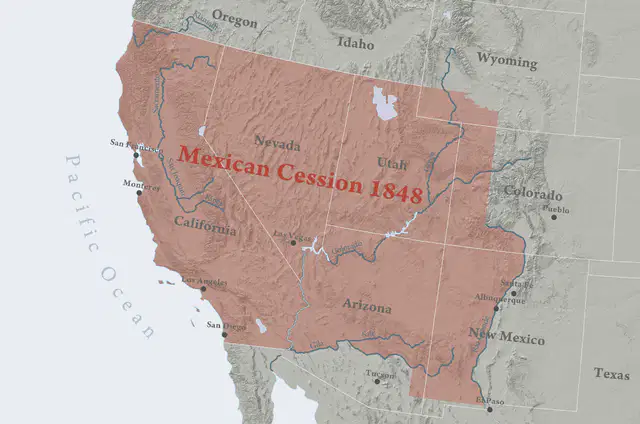
What conflict did the United States gain this territory from?

a)

Vietnam War

b)
The American Civil War
c)
The Spanish-American War
d)
The Mexican-American War
24.

What is the reasoning for having three separate branches of government?

a)

To ensure that one branch does not become too powerful

b)
To create unnecessary bureaucracy
c)
To make the government more efficient
d)
To prevent the concentration of power
25.

What was the purpose of the Great Compromise?

a)
To create a bicameral legislature that would satisfy both the large and small states.
b)
To create a unicameral legislature with equal representation for all states
c)
To abolish slavery in the United States
d)
To establish a monarchy in the United States
26.

President Polk annexed which two states in the 1840's?

a)
Texas and Oregon
b)
Louisiana and Mississippi
c)
New Mexico and Arizona
d)
California and Nevada
27.

From which country did the U.S acquire Oregon from?

a)
Russia
b)
Spain
c)

Great Britain

d)
France
28.

Why did Lincoln want to help rebuild the South?

a)
To establish a stronger federal government
b)
To preserve the Union and promote national unity
c)
To gain political support from Southern states
d)
To punish the South for seceding
29.

What was a direct of Lincoln winning the election of 1860?

a)
Emancipation Proclamation
b)
Passage of the 13th Amendment
c)
Formation of the Republican Party
d)
Secession of Southern states
30.

The U.S gained control of which three after the Louisiana Purchase?

a)

California

b)

Gulf Coast

c)

Port of New Orleans

d)

New York

e)

Mississippi River

31.

What was the effect of John Brown's raid at Harpers Ferry?

a)
It heightened tensions between the North and South and is considered a catalyst for the American Civil War.
b)
It led to the abolition of slavery in the United States.
c)
It resulted in the formation of the Confederate States of America.
d)
It had no significant impact on the tensions between the North and South.
32.

What two things did Washington warn us about in his farewell address?

a)
Political parties and foreign alliances
b)
Military intervention and technological advancements
c)
Social media and climate change
d)
Economic inequality and religious extremism
33.

What were the South's two main disadvantages during the Civil War?

a)
Inefficient transportation system and lack of morale
b)
Inferior weaponry and lack of strategic alliances
c)
Inadequate military leadership and lack of popular support
d)

Lower population and a lack of infrastructure

34.

What rights did the Alien and Sedition Acts violate?

a)
Right to privacy and freedom of movement
b)
Right to bear arms and freedom of religion
c)
Freedom of speech and press, as well as due process
d)
Right to a fair trial and freedom of assembly
35.

How did manifest Destiny encourage Westward Expansion in the U.S?

a)
By advocating for the division of the United States into smaller territories
b)
By promoting isolationism
c)

By promoting the belief in the divine mission of the United States to expand its territory to the Pacific

d)
By discouraging westward migration
36.

Who was the President of the Confederacy in the Civil War?

a)
Ulysses S. Grant
b)
George Washington
c)
Jefferson Davis
d)
Abraham Lincoln