
 Worksheets
PHY203 Exam 3
Total questions: 60
Worksheet time: 32mins

Which path allows charge to flow?
A
B
C
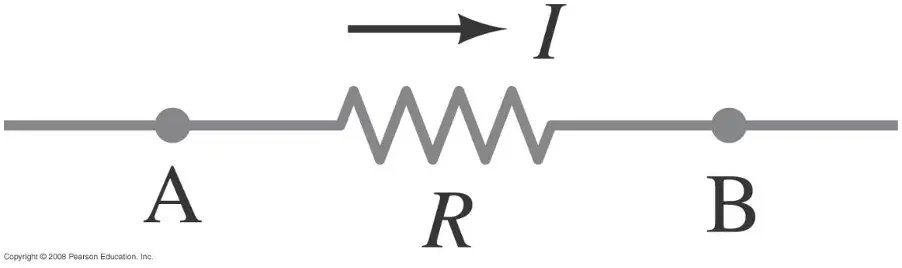
Is the current greater at point A or B?
The current is greater at point A.
The current is greater at point B.
The current is equal at points A and B.
Is the electric potential (voltage) greater at point A or B?
Its higher at point A
It is higher at point B
It is the same
A wire of resistance R is stretched uniformly (keeping its volume constant) until it is twice its original length. What happens to the resistance?
It decreases by a factor of 4.
It decreases by a factor of 2.
It stays the same.
It increases by a factor of 2.
It increases by a factor of 4
Two wires, A and B, are made of the same metal and have equal length, but the resistance of wire A is four times the resistance of wire B. How do their diameters compare? Assume both wires have circular X-sections.
dA = 4 dB
dA = 2 dB
dA = dB
dA = 0.5 dB
dA = 0.25 dB
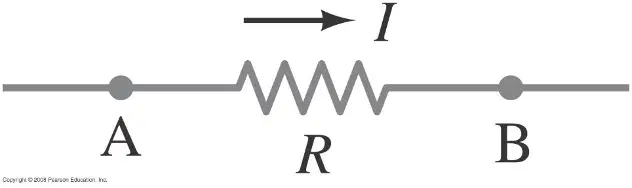
Current flows through a resistor
with no direction since it is not a vector.
from any potential to any different potential
from high potential to low potential
from low potential to high potential
You are given a copper bar of dimensions 3 cm × 5 cm × 8 cm and asked to attach leads to it in order to make a resistor. If you want to achieve the smallest possible resistance, you should attach the leads to the opposite faces that measure
3 cm x 5cm
3 cm x 8 cm
5 cm x 8 cm
Any pair of faces produces the same resistance
A 100-W driveway light bulb is on 10 hours per day. Assuming the power company charges 10 cents for each kilowatt-hour of electricity used, estimate the annual cost to operate the bulb.
$3.65
$7.30
$21.40
$36.50
$73.00
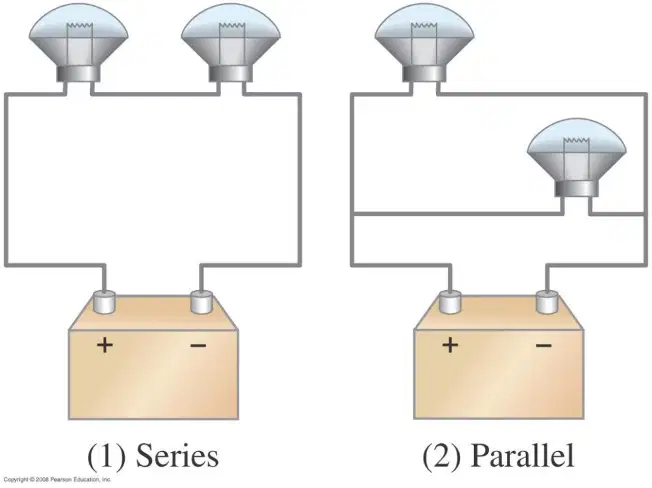
The light bulbs in the figure are identical. Which configuration produces more light? Hint: Brightness is determined by POWER.
They’re equally bright.
The parallel configuration is four times as bright.
The parallel configuration is twice as bright.
The parallel configuration is half as bright.
The parallel configuration is 25% as bright.
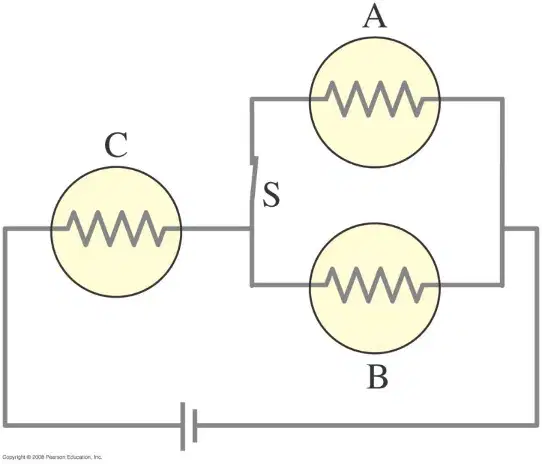
When switch S is closed, how will the brightness of bulb B compare with that of bulbC? The three bulbs are identical.
Bulb C is 4x as bright.
Bulb C is 2x as bright.
Bulb C is equally bright.
Bulb C is half as bright.
Bulb C is 25% as bright.
Switch is initially closed. What happens when switch S is opened? (the three bulbs are identical)
Bulb C is dimmer than before.
Bulb B is brighter than before.
Both A and B are true.
Neither A and B are true.
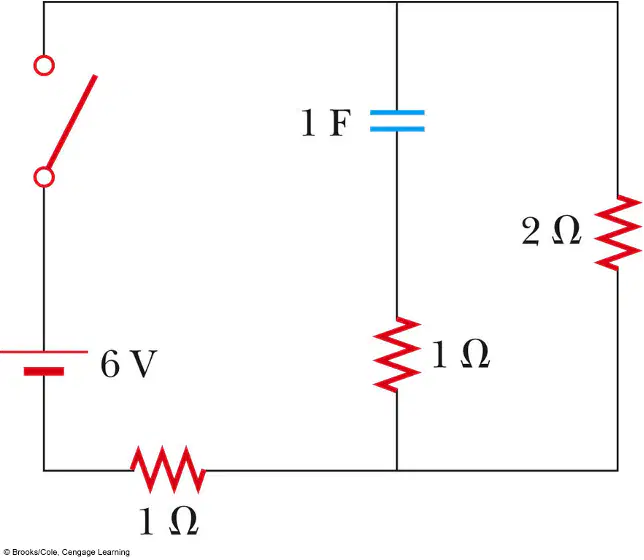
We close the switch. We wait a really long time (compared to t). What will the current be in the 2 ohm resistor?
4 A
3 A
2 A
1 A
need more info
We close the switch. We wait a really long time (compared to t). What will be the voltage drop across the 1F capacitor?
4 V
3 V
2 V
1 V
need more info
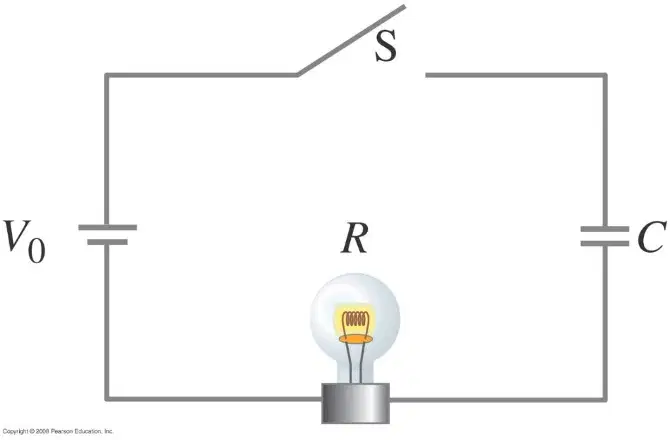
What happens to the light bulb when the switch is closed?
The bulb turns on and stays on.
The bulb is off, but gets brighter as the capacitor gets charged, eventually reaching maximum brightness.
The bulb turns on, but gets dimmer as the capacitor gets charged, eventually going out
A straight wire carries a current directly towards you. In what direction are the magnetic field lines surrounding the wire?
Clockwise circles
Counter-clockwise circles
Pointing directly towards you
Pointing directly away from you
A wire carrying current I is perpendicular to a magnetic field of strength B. Assuming a fixed length of wire, which of the following changes will result in decreasing the force (FB) on the wire by a factor of 2?
Decrease the angle from 90º to 30º.
Decrease the current in the wire to ½ I.
Decrease the magnetic field strength to ½ B.
All of the above.
I’ve got a negative charge (-Q) at rest near a magnet. Will it move?
Yes
No
I’ve got a negative charge (+Q) at rest near a magnet. Will it move?
Yes
No
Can magnetic fields stop charged particles?
Yes, if the force is in the direction opposite the particle’s velocity.
No, the particles are always moving too fast and the magnetic fields are too weak.
No, because the force is always perpendicular to the velocity of a particle and thus can only change the direction of the particle, not it’s magnitude.
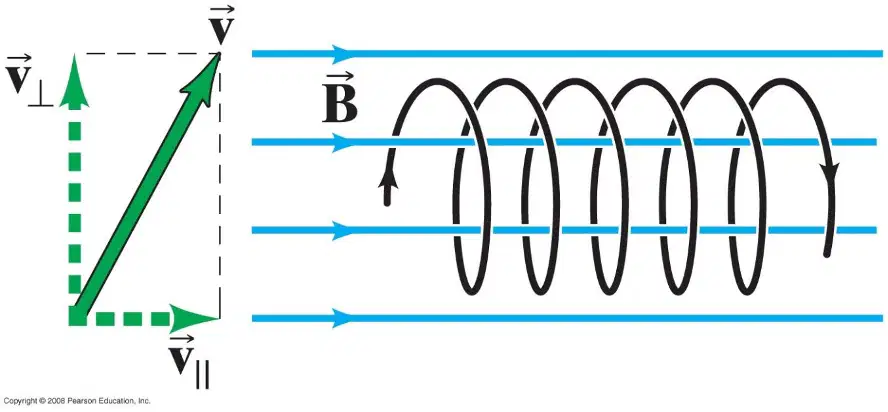
What is the polarity of the charge in the previous slide?
Positive
Negative
Can be either
Need more info
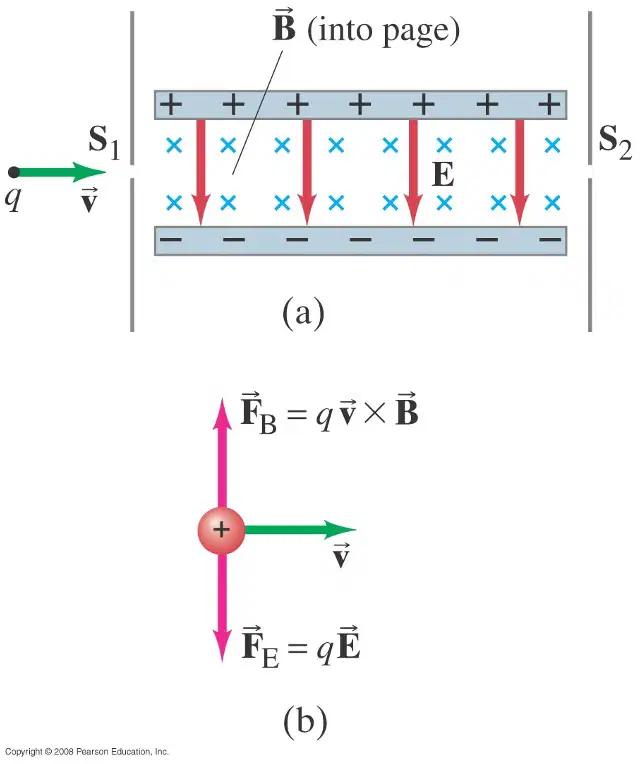
A particle in this velocity selector hits below the exit hole, S2. That means the particle is
A. Going faster than the selected speed
B. going slower than the selected speed
Answer (A) is true if q > 0, and (B) is true if q < 0.
Answer (A) is true if q < 0, and (B) is true if q > 0.
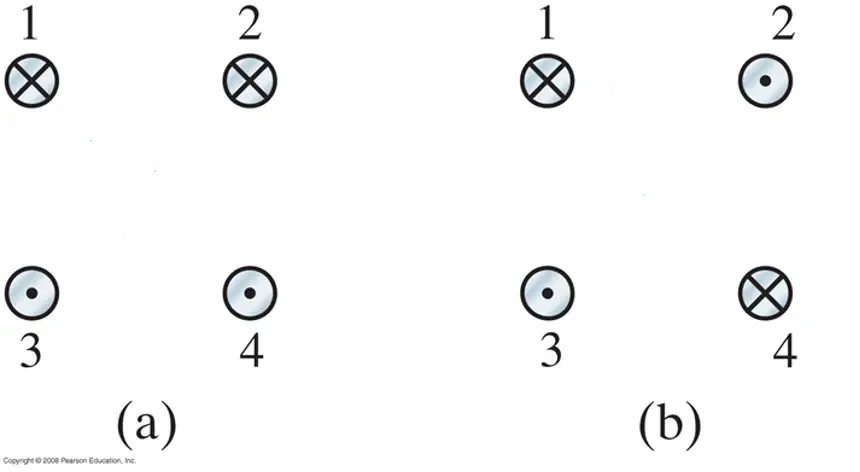
Situations (a) and (b) both represent four wires carrying equal currents. In which configuration is the magnetic field greater at the center?
A
B
same
need more info
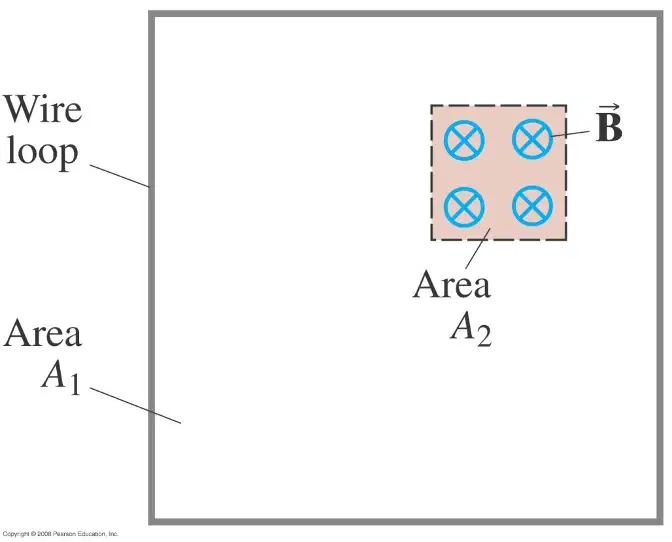
A square loop of wire encloses area A1. A uniform magnetic field B perpendicular to the loop extends over the area A2. What is the magnetic flux through the loop A2?
Zero
BA1
BA2
B(A1-A2)
not enough info
A square loop of wire encloses area A1. A uniform magnetic field B perpendicular to the loop extends over the area A2. What is the magnetic flux through the loop A1?
Zero
BA1
BA2
B(A1-A2)
not enough info
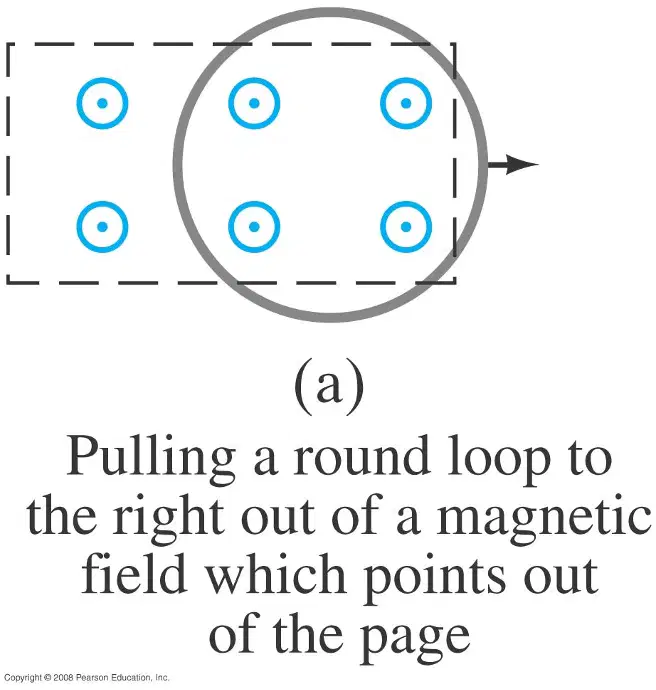
Which way will the induced current go? You’re REMOVING the loop from the B-field
Clockwise
Counterclockwise
not induced current
not enough info
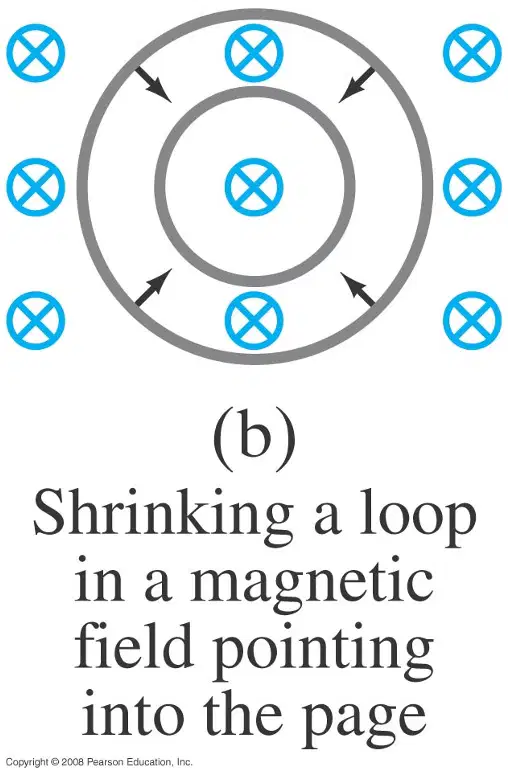
Which way will the induced current go?
Clockwise
Counterclockwise
not induced current
not enough info
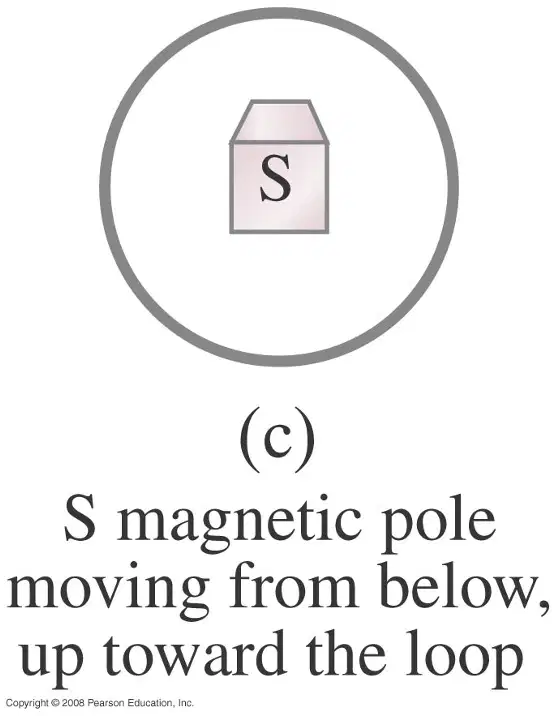
Which way will the induced current go?
Clockwise
Counterclockwise
not induced current
not enough info
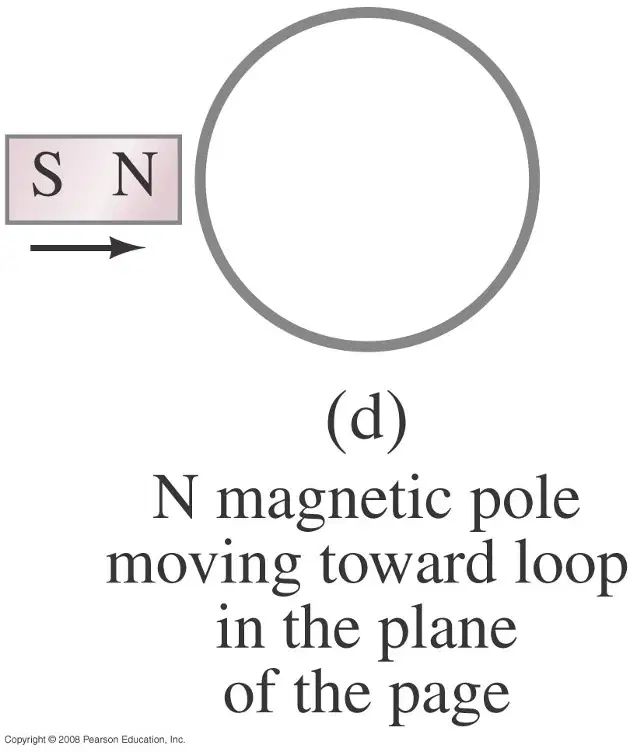
Which way will the induced current go?
Clockwise
Counterclockwise
not induced current
not enough info
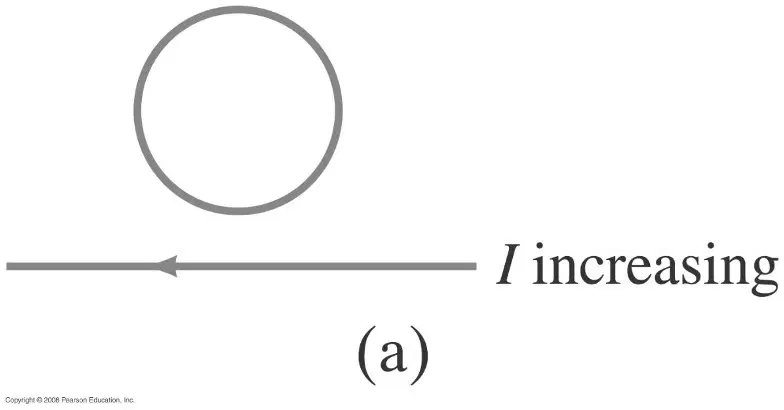
The induced current in the circular loop due to the current shown is…
Clockwise
Counterclockwise
no induced current
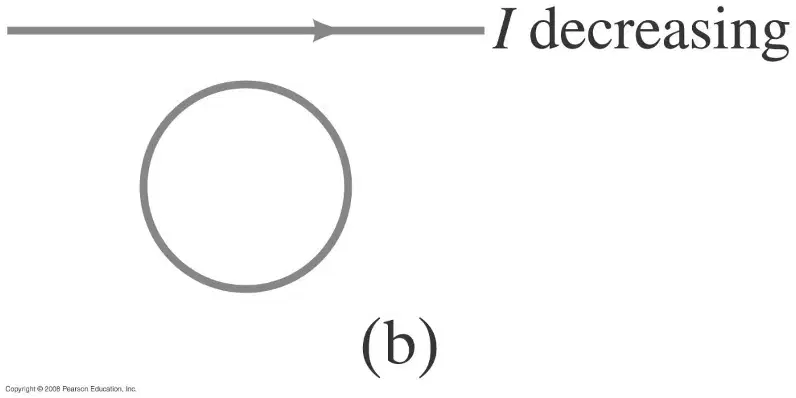
The induced current in the circular loop due to the current shown is…
Clockwise
Counterclockwise
no induced current
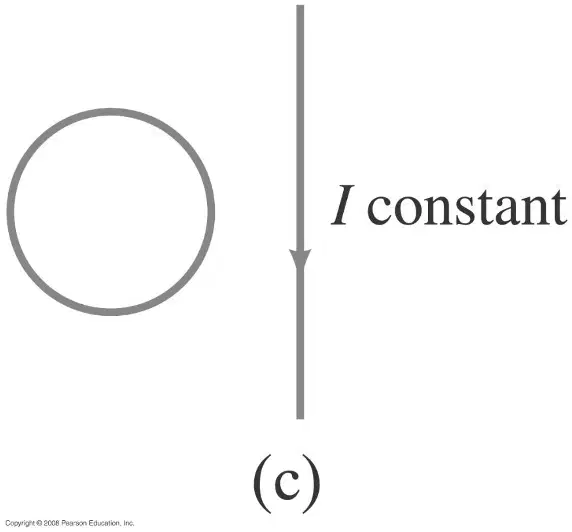
The induced current in the circular loop due to the current shown is…
Clockwise
Counterclockwise
no induced current
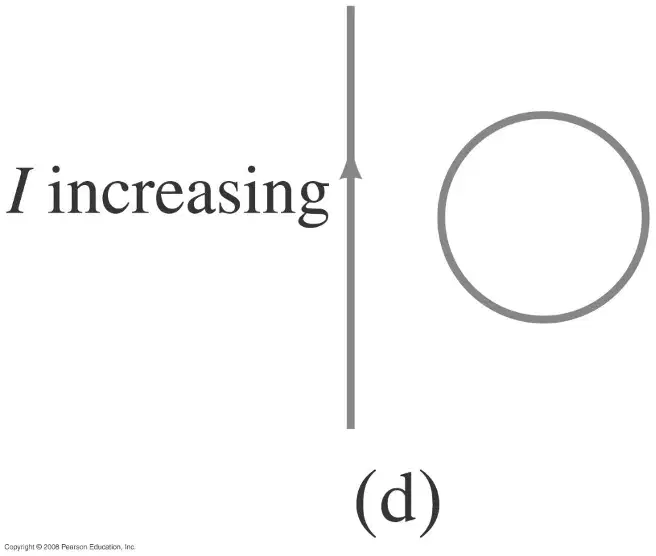
The induced current in the circular loop due to the current shown is…
Clockwise
Counterclockwise
no induced current
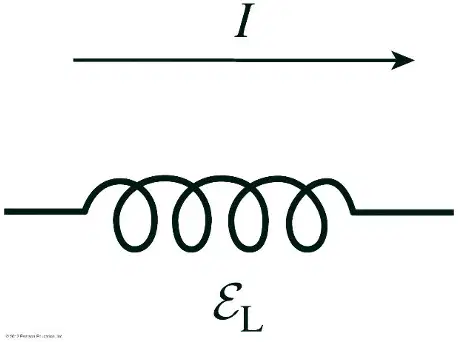
Current flows from left to right through an inductor as shown. This current is either increasing, decreasing, or remaining constant. A voltmeter connected across the inductor gives a constant reading, and shows that the left end is positive. What can you say about the current?
The current is increasing
The current is decreasing
The current is constant
At the same temperature, two wires made of pure copper have different resistances. The same voltage is applied at the ends of each wire. The wires may differ in
length
cross sectional area
resistivity
amount of electric current passing through them
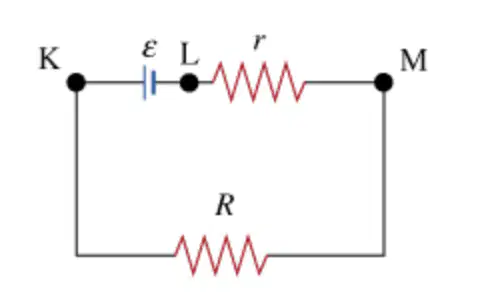
For the circuit shown on the left in (Figure 1), which potential difference corresponds to the terminal voltage of the battery?
between point K and L
between points L and M
between points K and M
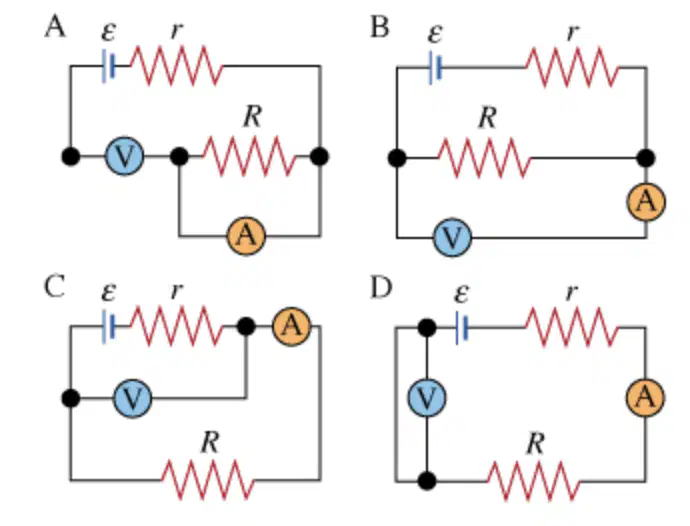
In which diagram(s) (labeled A - D) is the ammeter connected correctly to measure the current through the battery?
A
B
C
D
In which diagram is the current through the battery nearly zero?
A
B
C
D
In which diagram or diagrams does the ammeter correctly measure the current through the resistor with resistance R?
A
B
C
D
In which diagram does the voltmeter correctly measure the terminal voltage of the battery? Choose the best answer.
A
B
C
D
In which diagram does the voltmeter read almost zero?
A
B
C
D
In which diagram or diagrams does the ammeter read almost zero?
A
B
C
D
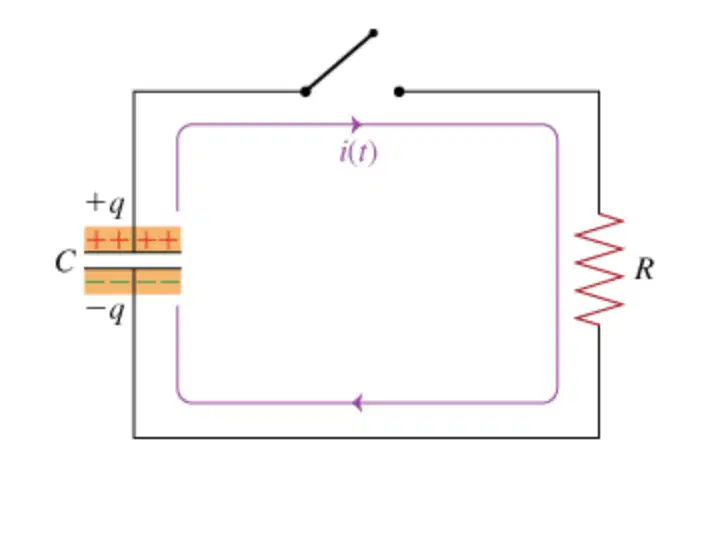
What happens to the charge on the capacitor immediately after the switch is thrown?
The electrons on the negative plate of the capacitor are held inside the capacitor by the positive charge on the other plate.
Only the surface charge is held in the capacitor; the charge inside the metal plates flows through the resistor.
The electrons on the negative plate immediately pass through the resistor and neutralize the charge on the positive plate.
The electrons on the negative plate eventually pass through the resistor and neutralize the charge on the positive plate.
the junction rule describes the conservation of which quantity?
charge
voltage
resistance
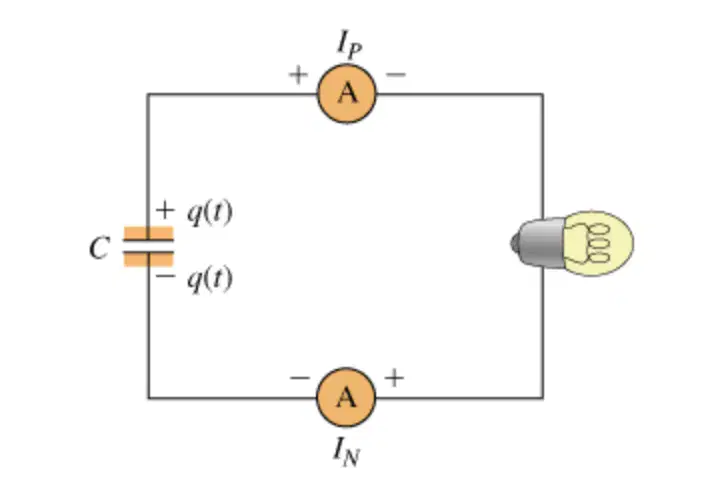
Immediately after time t=0, what happens to the charge on the capacitor plates?
Individual charges flow through the circuit from the positive to the negative plate of the capacitor
Individual charges flow through the circuit from the negative to the positive plate of the capacitor.
The positive and negative charges attract each other, so they stay in the capacitor
Current flows clockwise through the circuit.
Current flows counterclockwise through the circuit
What is the relationship between the current and charge? As the charge q(t)on the positive plate of the capacitor decreases, what happens to the value of the current? The current...
increases
decreases
does not change
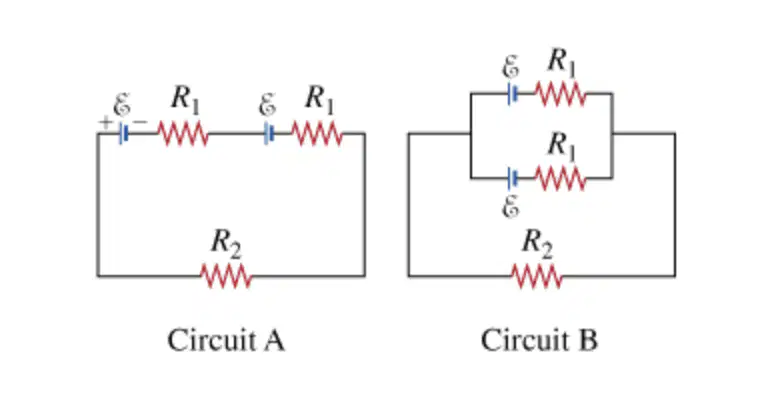
In which direction does the current in circuit A flow?
clockwise
counterclockwise
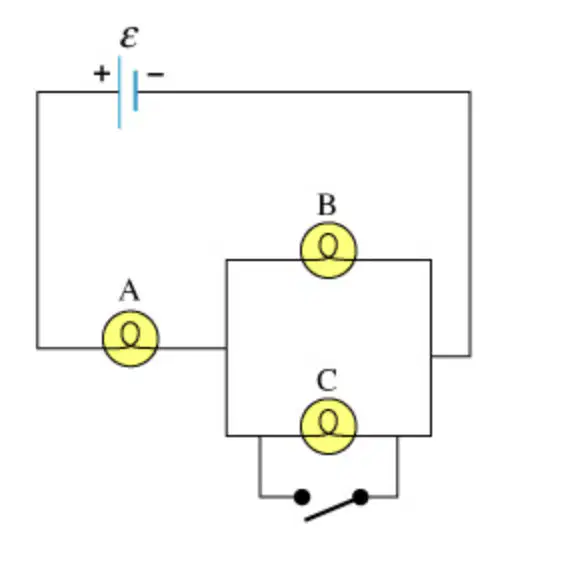
Bulbs A, B, and C in the figure(Figure 1) are identical and the switch is an ideal conductor. How does closing the switch in the figure affect the potential difference?
The potential difference across A is unchanged.
The potential difference across B drops to zero.
The potential difference across A increases by 50%.
The potential difference across B drops by 50%.
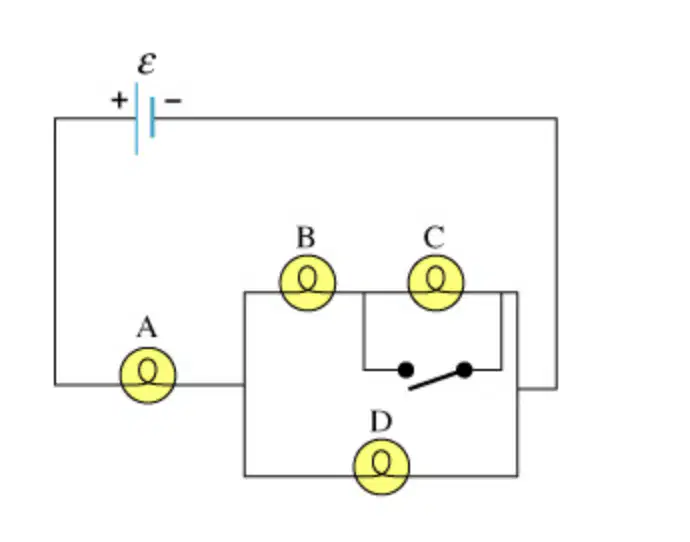
One more bulb is added to the circuit and the location of the switch is changed. The new circuit is shown in the figure.(Figure 2) Bulbs A, B, C, and D are identical and the switch is an ideal conductor. How does closing the switch in the figure affect the potential difference?
The potential difference across A increases.
The potential difference across B doubles.
The potential difference across B drops to zero
The potential difference across D is unchanged
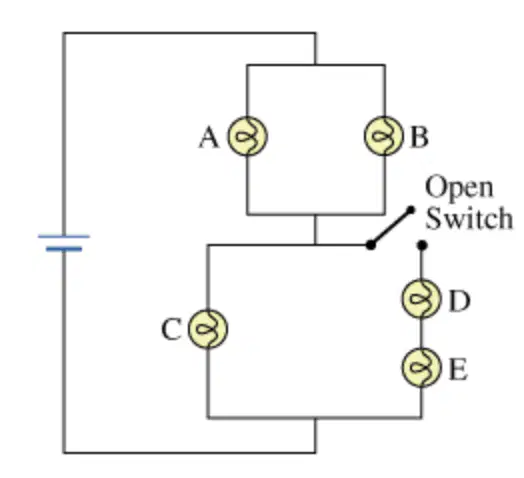
What happens the the brightness of bulb A when the switch is open?
it gets dimmer
it get brighter
there is no change
What happens to bulb C when the switch Is open?
it gets dimmer
it get brighter
there is no change
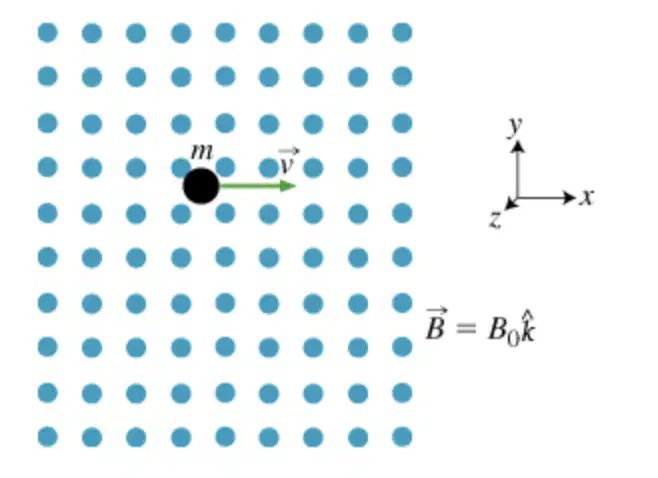
At a given moment the particle is moving in the +x direction (and the magnetic field is always in the +z direction). If q is positive, what is the direction of the force on the particle due to the magnetic field?
+y direction
-y direction
-z direction
-x direction
This force will cause the path of the particle to curve. Therefore, at a later time, the direction of the force will ____________.
have a component along the direction of motion
remain perpendicular to the direction of motion
have a component against the direction of motion
first have a component along the direction of motion; then against it; then along it; etc.
The fact that the magnetic field generates a force perpendicular to the instantaneous velocity of the particle has implications for the work that the field does on the particle. As a consequence, if only the magnetic field acts on the particle, its kinetic energy will ____________.
increase over time
decrease over time
remain constant
oscillate
Are there components of the velocity that cannot be determined by measuring the force?
yes
no

Assume that the length of the magnet is much smaller than the separation between it and the charge. As a result of magnetic interaction (i.e., ignore pure Coulomb forces) between the charge and the bar magnet, the magnet will experience which of the following?
A torque due to the charge attracting the north pole of the manget
A torque due to the charge attracting the south pole of the magnet
A torque only if one magnetic pole is slightly closer to the charge than the other
No torque at all
Due to its motion in the magnetic field of the bar magnet, the charge will experience a force in which direction?
-i
+j
-j
+k
-k
As a result of the magnetic interaction between the soft iron and the bar magnet, which of the following will occur?
The magnet will experience a torque due to the iron attracting its north pole.
The magnet will experience a torque due to the iron attracting its south pole.
Whichever pole of the magnet is closest to the iron will be attracted to the iron.
Whichever pole of the magnet is closest to the iron will be repelled from the iron
Which of the following changes would increase the potential energy stored in an inductor by a factor of 5?
increasing the inductance by a factor of 5; leaving the current unchanged
leaving the inductance unchanged; increasing the current by a factor of 5
leaving the inductance unchanged; increasing the current by a factor of √5
reducing the inductance by a factor of 5; increasing the current by a factor of 5
increasing the inductance by a factor of 5; reducing the current by a factor of 5

which of the following statements is true in the limit of large w
Vout/Vin is proportional to 1/w
Vout/Vin is proportional to 1/w^2
Vout/Vin is proportional to w
Vout/Vin is close to 1
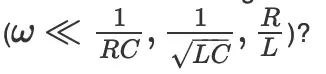
which of the following statements is true in the limit of small w
Vout/Vin is proportional to 1/w
Vout/Vin is proportional to 1/w^2
Vout/Vin is proportional to w
Vout/Vin is close to 1

