
 Worksheets
Semester 1 Final Exam Review Part 1
Total questions: 48
Worksheet time: 28mins
A chimpanzee eats fruits, nuts, leaves, and small mammals. What kind of organism is a chimpanzee?
carnivore
decomposer
producer
omnivore

90% of the energy that gets lost as you move up a food pyramid or chain gets lost as
pollution to the environment
heat to the environment
energy for decomposers
gets recycled
What percentage of energy is passed on to the next trophic level?
5%
10%
50%
90%
A tree is an example of a ....
composer
decomposer
producer
omnivore
Tertiary Consumer
Secondary Consumer
A wolf eats a rabbit, that just ate some berries. What would you call the wolf?
Tertiary Consumer
Secondary Consumer
In a food web the arrow always points to
the consumer
the prey
producer
autotroph
Eats both plants and animals
carnivore
herbivore
omnivore
terrestrial
Which group of organisms are not consumers?
baceria, fungi
cactus, fern, tree
deer, rabbit, squirrel

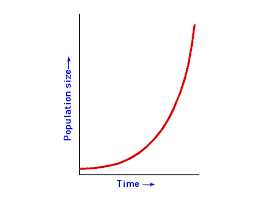
What type of growth is shown in the diagram?
exponential growth
logistic growth
predator-prey cycle
boom-bust curve
Largest number of individuals of a population that the environment can support...
carrying capacity
population
biome
mutualism

If a disease destroying wheat plants in a field swept through an ecosystem, what would happen to the bird population that feed off of the wheat in the the field ?
The bird population would stay the same
The bird population would increase
The bird population would decrease
Limiting factors are sometimes helpful because they can keep the population from getting too large.
True
False
Factors that affect population size:
INCREASE: Number of ___________ & ____________
(Choose 2 answers)
Birth
Death
Immigration
Emigration
Factors that affect population size:
DECREASE: Number of ___________ & ____________
Choose all that applies.
Birth
Death
Immigration
Emigration
The term ecologists use to describe the number of individuals moving into a population is
Emigration
Immigration
If a population is growing exponentially, it has met its carrying capacity.
True
False
What is the term that refers to an interaction where one species kills another species?
Predation
Displacemet
Symbiosis
Population
A relationship in which two different organisms live in close association with each other
interspecific competition
Mutualism
Symbiosis
Commensalism


Why is Carbon Dioxide considered to be a Greenhouse Gas?
It is a combination of natural and human forces
It has a biogeochemical cycle
It is a type of weather that occurs during a particular season
It absorbs and reradiates infrared radiation to warm the Earth
True or False: Greenhouse gases occur naturally in the atmosphere
True
False
An organism that gets energy from eating other organisms is a ______________.
producer
consumer
decomposer
prey

A heterotroph is also a
producer
consumer

Will competition increase or decrease the population of a species of animals?
Decrease
Increase
Average weather over a long period of time.
Seasons
Climate
Weather
Over the last decade we have had an increase in the amount of rain in our area.
weather
climate
What can invasive species do to ecosystems?
Outcompete native species for resources
Disrupt the balance of the ecosystem
Cause the decline or extinction of native species
Alter habitats and reduce biodiversity
All of the following are characteristics of living things EXCEPT:
All living things are made up of cells
All living things are based on a universal genetic code (DNA)
All living things need oxygen, water & sun
All things grow and develop
The tree is 6 meters tall
quantitative data
qualitative data
The tree is tall
quantitative data
qualitative data
The chicken laid 15 eggs
quantitative data
qualitative data
The chicken is brown
quantitative data
qualitative data
Which is an example of Qualitative Data:
Fluffy Unicorn
17 feet
8 fingers
1 toe
Which is an example of Quantitative Data:
Brown hair
6 feet tall
White shoes
Khaki pants

