Wayground logo

Free Printable Worksheets

Font size

S
M
L
XL
Worksheets

Regular Chemistry Midterm

Total questions: 55

Worksheet time: 2hrs 36mins

Name
Class
Date
1.
Iron rusts.
a)
Chemical change
b)
Physical Change
2.
Milk Sours
a)
Chemical Change
b)
Physical Change
3.
A tire is inflated with air.
a)
Chemical Change
b)
Physical Change
4.
Which of the following is a Physical Property 
a)
Toxicity
b)
Flammability
c)
Malleability
d)
Reactivity
5.

Which of the following is a chemical property?

a)

Flammability

b)

Density

c)

Mass

d)

Color

6.
There are __?__ significant digits in the number 0.00076
a)
2
b)
4
c)
5
d)
6
7.
There are __?__ significant digits in the number 90,000.00
a)
1
b)
2
c)
5
d)
7
8.

Which of the following is the answer for the problem with the correct number of significant digits?

24.32 + 1.2

a)

25.6

b)

25.52

c)

25.5

d)

25

9.
Which of the following is the answer for the problem with the correct number of significant digits?
23.91 x 12.861 = 307.50651
a)
308
b)
307.51
c)
307.5
d)
307
10.

Convert 5.0m to km.

(a)  

11.

Convert 7.0 L to hL.

(a)  

12.

Convert 5.6 kg to g.

(a)  

13.
What two types of measurements make up DENSITY? 
a)
Mass and Volume
b)
Temperature and Mass
c)
Grams and Centimeters
d)
Volume and Weight
14.
Jack has a rock. The rock has a mass of 14g and a volume of 2cm3. What is the density of the rock?
a)
7 mL
b)
7 g/cm3
c)
28 g/cm3
d)
1/7 g/cm3
15.

Mercury has a density of 13.55 g/ml. What would be the mass of a 15 mL sample of mercury?

a)

203.25 g

b)

20.325 g

c)

2.0325 g

d)

1.1 g/ml

16.

How many kilograms of calcium are there in 173 pounds of calcium? (1 pound = 454 grams; 1 kg = 1000 g)

a)

1.10 kg

b)

78.5 kg

c)

110 kg

d)

78500 kg

17.

How many minutes are in a school year, 187 days?

a)

279,280 min.

b)

16, 200 min.

c)

16, 156 min.

d)

269,280 min.

18.
A positively charged particle found in the nucleus of the atom
a)
Proton
b)
Electron
c)
Neutron
19.
The area of the atom where protons and neutrons are found
a)
Electron Cloud
b)
Nucleus
c)
Energy Level
20.
The negative charge particles that float around the outside of the atom
a)
Proton
b)
Neutron
c)
Electron
21.
This number is represented by the number of protons in the atom
a)
Atomic Mass
b)
Atomic Number
c)
Mass Number
22.
The electrons that are on the outer most region of the atom
a)
Shell Electrons
b)
Violent Electrons
c)
Valence Electrons
23.
The horizontal rows of the periodic table
a)
Groups
b)
Periods
c)
Families
24.
The vertical rows of the periodic table, also called families
a)
Groups
b)
Periods
c)
Rows
25.
What is similar between the elements in the same group?
a)
They have the same atomic mass.
b)
They have the same energy levels.
c)

They have the same number of valence electrons.

26.

What is the correct number of subatomic particles of a phosphorous atom with a mass of 31?

a)

p# - 15, n# = 15, e# = 15

b)

p# - 15, n# = 16, e# = 15

c)

p# - 15, n# = 15, e# = 16

d)

p# - 16, n# = 15, e# = 15

27.
24.1% of all the isotopes of a an element have a mass of 75.23 amu, 48.7% have a mass of 74.61 amu, and 27.2% have a mass of 75.20 amu.
What is the average mass of this element?
a)
74.92 amu
b)
24.97 amu
c)
75.01 amu
d)
74.51 amu
28.
4.35% of all X atoms have a mass of 39.946 amu. 83.79% have a mass of 41.941 amu, 9.50% have a mass of 42.941 amu, and 2.36% have a mass of 43.939 amu. What is the average atomic mass of atom X?
a)
41.97 amu
b)
42.19 amu
c)
10.43 amu
d)
40.04 amu
29.
Ions are: 
a)
atoms with a positive or negative charge
b)
atoms with no charge
c)
atoms with ONLY a positive charge
d)
atoms with ONLY a negative charge
30.
How many electrons are in an atom that has an atomic number of 34, an atomic mass of 74 and a charge of -2?
a)
34
b)
36
c)
2
d)
40
31.
The half-life of strontium-90 is 25 years. How much strontium-90 will remain after 100 years if the initial amount is 4.0 g?
a)
3.0g
b)
0.25mg
c)
0.3g
d)
0.25g
32.
If 10 mg of iodine 131 is given to a patient, how much is left after 24 days? The half-life of iodine-131 is 8 days.
a)
1.25mg
b)
1.25g
c)
10g
d)
10mg
33.

Which element has a larger radius?

a)

Oxygen (O)

b)

Sulfur (S)

c)

Tellurium (Te)

d)

Polonium (Po)

34.

Which has a higher ionization energy?

a)

Hydrogen (H)

b)

Lithium (Li)

c)

Potassium (K)

d)

Cesium (Cs)

35.

Which element has the highest electronegativity?

a)

Fluorine (F)

b)

Iodine (I)

c)

Bromine (Br)

d)

Chlorine (Cl)

36.
Which atom has the largest atomic radius?
a)
potassium
b)
rubidium 
c)
francium
d)
cesium
37.
As you move down the periodic table atoms get bigger.  This is because ____________.
a)
The atoms have more mass.
b)
The atoms have more protons.
c)
The atoms have more energy levels
d)
The atoms have more nuetrons
38.
As you move across the periodic table atoms tend to get smaller because, ______________.
a)
the atoms have more mass.
b)
the atoms have less mass
c)
the atoms have more protons.
d)
the atoms have less electrons.
39.
Atoms that have a high electronegativity, _______________.
a)
give up their electrons more easily.
b)
hold on to their electrons more tightly.
c)
have more electron shells.
40.
Ionization energy is...
a)
the energy required to add an electron to a specific atom
b)
how much energy it takes to remove an electron from an atom
c)
the energy required to shield the outer electrons from the nucleus
d)
a measure of the ability of an atom to attract electrons
41.

The frequency of violet light is 7.5x10¹⁴ Hz. What is its wavelength?

a)

4.0x10⁻⁷ m

b)

4.0x10⁷ m

c)

2.25x10²³m

d)

2.25x10²³ Hz

42.

What is the speed of light?

a)

3.0x10⁸ ms

b)

3.0x10⁸ m/s

c)

6.626x10⁻³⁴ Js

d)

6.626x10⁻³⁴ J/s

43.
What atom matches this electron configuration?
1s22s22p63s23p64s23d10
a)
Zinc
b)
Copper
c)
Nickel
d)
Germanium
44.
What atom matches this electron configuration?
1s22s22p63s2
a)
Neon
b)
Magnesium
c)
Aluminum
d)
Potassium
45.

Choose the correct shortcut configuration for iodine.

a)

[Ar]4s24d104p5

b)

[Kr]5s24d105p5

c)

[Xe]5s25d105p5

d)

none of the above

46.

Each row on the periodic table represents:

a)

an energy level

b)

a sublevel

c)

an electron

d)

an orbital

47.

Which area on the periodic table represents the electrons in the "d" sublevel?

a)

representative elements

b)

columns 3-8

c)

rare earth elements

d)

transition elements

48.
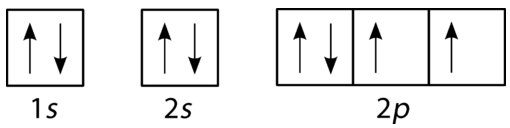
This orbital diagram represents:  
a)
C
b)
B
c)
N
d)
O
49.
What is incorrect about this orbital diagram?
a)
Both arrows in the 2p box should be pointing up
b)
There is nothing incorrect with this diagram
c)
In the there should only be 1 orbital in the first 2p box and one in the 2nd 2p box
d)
All the arrows should be pointing up.
50.

What element's orbital notation is pictured here?

a)

Ar

b)

Br

c)

Cu

d)

Cl

51.
How many electrons should Boron have around its Lewis dot model?
a)
1
b)
3
c)
5
d)
7
52.
How many electrons should Oxygen have around its Lewis dot model?
a)
5
b)
6
c)
7
d)
8
53.
What is the correct structure for BF3?
a)
Option A.
b)
Option B. 
c)
Option C.
d)
Option D.
54.
Which of the following is the correct Lewis dot structure for the molecule fluorine (F2)?
a)
A
b)
B
c)
C
d)
D
55.
Which of the following is the correct Lewis structure for the compound PBr3?
a)
structure A
b)
structure B
c)
structure C
d)
structure D