
 Worksheets
Finals Review
Total questions: 49
Worksheet time: 39mins
What is the name of the change of state where a gas becomes solid without first becoming liquid
What particle number is equal to the atomic number (Z)
Protons
Electrons
Neutrons
What is the charge of a neutron?
Negative
Positive
Neutral

Which statement is correct for the ion shown?
The ion contains 15 subatomic particles in the nucleus.
The ion contains more protons than neutrons in the nucleus.
The ion has an electron arrangement of 1s2 2s2
Most of the total volume of the ion is empty space.

A sample of zinc has the following composition:
What is the relative atomic mass of the zinc in this sample?
64.5
65.0
65.9
66.4
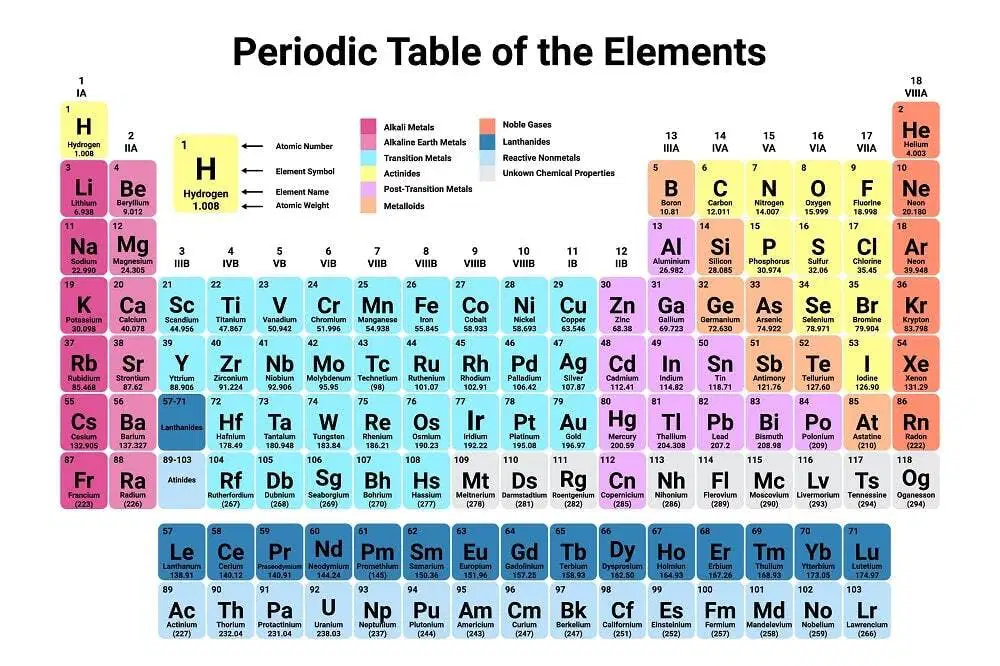
Which of the following elements is a metalloid?
Hydrogen
Helium
Chromium
Astatine
Which trends are correct across period 3 (from Na to Cl)?
I. Atomic radius decreases II. Melting point increases III. First ionization energy increases
I and II only
I and III only
II and III only
I, II and III
‘Bronze is harder than copper’. Which of the following is the best to explain the statement?
Atoms in bronze are arranged closely packed and less empty spaces.
Layers of atoms in bronze are not easily slide over each other.
Atomic size of copper and tin is different.
Bronze is a mixture of copper and tin
Electronegativity increases and metallic properties (character) decrease.
Electronegativity decreases and metallic properties (character)increase.
Both electronegativity and metallic properties increase.(character)
Both electronegativity and metallic properties decrease.(character)
What properties does an ionic compound have?
A low boiling point and it conducts electricity when dissolved in water
A high melting and it conducts electricity when liquid
A high boiling point and it conducts electricity when solid
The number of electrons in the valence shell of elements A and B, are 6 and 7 respectively. What is the formula and type of bonding in a compound formed by these elements?
A2B Covalent
AB2 Covalent
A2B Ionic
AB2 Ionic
Which equation represents the sublimation of carbon dioxide?
CO2 (g) → CO2 (s)
CO2 (s) → CO2 (g)
CO2 (g) → CO2 (l)
CO2 (l) → CO2 (g)
Which experimental results support the theory that electrons exist in discrete energy levels?
NMR
X-Ray diffraction
Emission Spectra
IR Spectra

The composition of this substance is uniform throughout
Homogenous mixtures
Heterogeneous misxtures
Elements
Compounds
Ionization energy increases
from L to R and from bottom to top in the periodic table
from L to R and from top to bottom in the periodic table
from R to L and from bottom to top in the periodic table
from R to L and from top to bottom in the periodic table
Which combination would create the strongest ionic bond?
Large ionic radius
High charge on ions
Small ionic radius
High charge on ions
Large ionic radius
Low charge on ions
Small ionic radius
Low charge on ions

Describe the state of the substance at letter A. (a)

Which letter indicates where water is in both the solid and liquid phase at the same time?
A
B
C
D
E

Which species has the same electron configuration as Neon?
Cl-
O
Na+
P3-
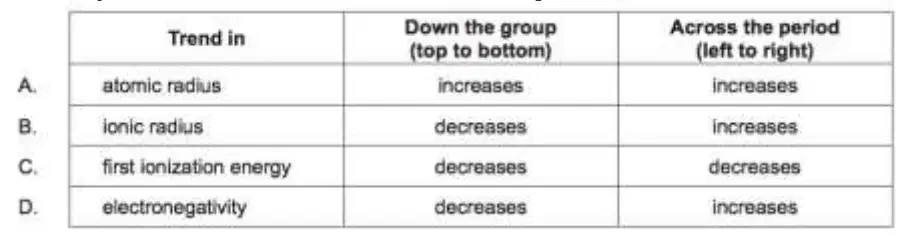
Which periodic trend is described correctly?
A
B
C
D


In order to go from ground state to an excited state, an electron must
emit energy
absorb energy
wiggle
When an electron returns to ground state from an excited state, the atom will (a)
Which block of elements are known as transition elements?
p-block
s-block
d-block
f-block
0.00345


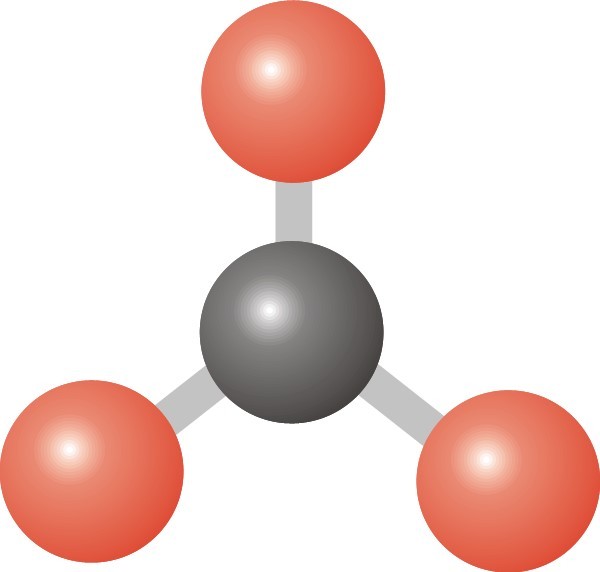
What is the correct Lewis Dot Structure for ammonia NH3


Which type of bonding involves positive ions surrounded by a sea of mobile electrons?
metallic bonds
polar covalent bonds
nonpolar covalent bonds
ionic bonds
Which compound contains ionic bonds?
NaH
CH4
H2O
C6H12O6

What kind of mixture is shown in the picture?
Homogeneous
Heterogeneous

How many protons does indium have?
49
66
114
115
How many valence electrons does Lithium (Li) have?
8
1
5
2
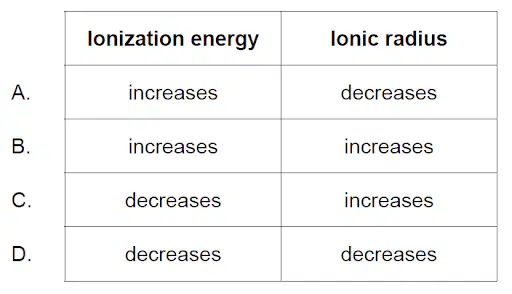
How do the following properties change down Group 17 of the periodic table?
A
B
C
D

Describe the electron arrangement arround the central atom.
achieved octet
incomplete octet
expended octet
odd number electrons
What is the shape of carbon dioxide (CO2)?
Tetrahedral
Trigonal Planar
Linear
Bent
What is the shape of boron trihydride (BH3)?
Trigonal Planar
Bent
Linear
Tetrahedral
What is the shape of methane (CH4)?
Linear
Trigonal Planar
Bent
Tetrahedral
How many electrons would a Nitrogen ion gain/lose? If it has 5 valence electrons.
lose 5
gain 5
lose 3
gain 3

