
 Worksheets
Forestry Science - Fall Final Exam Review
Total questions: 136
Worksheet time: 1hrs 8mins
Match the following terms with their correct definition
Fauna
Animals
Flora
Plants
Old-Growth Primary Forests
Old, untouched by human activity
Second Growth Forests
What grows back after a forest is destroyed by humans or natural disasters
Tree Plantations
human-managed forests that are used to harvest wood products
Reorder the forests by which have the most biodiversity (1) and the least biodiversity (3)
Old-Growth Forests
Secondary Growth Forests
Tree Farms
Which of the following are examples of ecosystem services? Select all that apply.
Stores carbon dioxide
Produces oxygen
Purifys water
Produces wood Products
Provides habitat
What is a forest?
A large wooded area
A small wooded area
An area home to beavers and deer
An area home to foxes and horses
What is the art and science of managing forests to maintain or improve the quality and quantity of trees?
Forestry
Wildlife
Forest Care
Forester
Which of the following is not a benefit of trees?
Oxygen
Shade
Prevention of soil erosion
Carbon Dioxide
What is a complex forest ecosystem?
An ecosystem comprised of lots of plants
An ecosystem comprised of only a few, complex plants
An ecosystem comprised of only one species of tree
An ecosystem comprised of many species of trees
What does binomial mean?
Two wheels
Three names
Scientific names
Two names
The two parts of a scientific name are classified by what areas?
Species and family
Genus and variety
Genus and species
Family and variety
Which of the following are the main body parts of an insect?
Abdomen
Cephalothorax
Head
Thorax

What main body part is the arrow pointing at?
Abdomen
Cephalothorax
Head
Thorax

What main body part is the arrow pointing at?
Abdomen
Cephalothorax
Head
Thorax
How many main stages are there in Complete metamorphosis?
(a)
How many main stages are there in Incomplete metamorphosis?
(a)
Which of the following are main life stages in Complete metamorphosis?
Adult
Egg
Larva
Nymph
Pupa
Which of the following are main life stages in Incomplete metamorphosis?
Adult
Egg
Larva
Nymph
Pupa

Which metamorphosis is this?
Complete
Incomplete

Which metamorphosis is this?
Complete
Incomplete

What type of mouthparts does this insect have?
Chewing
Piercing-Sucking
Sponging
Siphoning

Which metamorphosis is this?
Complete
Incomplete
What do insects use for feeling and smelling?
antennae
eyes
wings
proboscis
True or false: a spider is an insect?
True
False
Which is not an insect?
caterpillar
ladybug
worm
wasp


Click on the picture of the insect.


Click on the picture of the insect.


Click on the picture of the insect.


What order does the Tent Caterpillar Moth belong to?
Lepidoptera
Odonata
Mantodea
Blattodea

What order does the tachnid fly belong to?
Diptera
Dermoptera
Coleoptera
Isoptera

What order does the long-horned grasshopper belong to?
Odonata
Orthoptera
dermoptera
hemioptera

What order does the tiger beetle belong to?
Mecoptera
Neroptera
Coleoptera
Anoplura

What order does the velvet ant belong to?
Hymenoptera
Isoptera
Hemioptera
Blattodea

What order does the water strider belong to?
Hemioptera
Diptera
Dermoptera
Plecoptera

What type of insects belong to diptera?
Bees & Wasps
True Flies
True Bugs
Grasshoppers

What type of insects belong to the order hymenoptera?
Wasps & Bees & Ants
Cicadas & Leafhoppers
Crickets & Grasshoppers
Beetles

What type of insects belong to the order hemiptera?
True Flies
True Bugs
Crickets & Grasshoppers
Cockroaches

What type of insects belong to orthoptera?
Beetles
Butterflies & Moths
Cockroaches & Termites
Grasshoppers, Katydids & Crickets

What type of insects belong to the order coleoptera?
Beetles
True Bugs
Butterfly & Moths
Grasshoppser, Katydids, Crickets

What type of insects belong to the order lepidoptera?
Grasshoppers, Katydids, Crickets
Beetles
Cockroaches & Termites
Butterflies & Moths
How many rings do most trees grow each year?
one
two
three
four
The pale colored ring that grows at the beginning of the year.
alpha growth
beta growth
early wood
late wood
The dark colored ring that grows at the end of the year.
alpha growth
beta growth
early wood
late wood
Cells of the outer part of the cambium known as phloem die and become
the wood of the tree
the bark of the tree
the leaves of the tree
the roots of the tree
Cells of the inner part of the cambium known as xylem die and become
the wood of the tree
the bark of the tree
the leaves of the tree
the roots of the tree
Phloem in the tree carries material
across the leaves
to other trees
down from the leaves
up from the roots
Xylem in the tree carries material
across the leaves
to other trees
down from the leaves
up from the roots
Scars present in tree rings indicate
fire
disease
insect damage
all of the above


Toothed / Serrated


What process makes glucose in plant cells?
Photosynthesis
Cellular respiration
Osmosis
Transpiration
What organelle is responsible for photosynthesis?
mitochondria
chloroplast
ribosomes
cytoplasm
Fill in the chemical equation for photosynthesis:
(a) (b) (c)
What are the round membrane disks inside the chloroplast where the light reactions take place?
Thylakoids
Cristae
Ribosomes
Cytoplasm
Photosynthesis is broken down into two parts - first the (a) create ATP and NADPH. Second the (b) uses carbon dioxide to make (c) .
Select all that apply: How do plants use the glucose that they make in photosynthesis?
They break it down for energy
They use it to make their cell walls
They use it for locomotion
They convert it into polypeptides
Match the following parts of the cell to their functions:
Green pigment that absorbs light energy
Chlorophyll
Space in the chloroplast where the Calvin Cycle occurs
Stroma
Membrane in the chloroplast where light reactions occur
Thylakoids
Organelle responsible for photosynthesis in plants
Chloroplast
Select all that apply: What kinds of organisms can do photosynthesis?
Plants (with chloroplasts)
Animals
Bacteria (with chlorophyll)
Fungi
Fill in the equation for photosynthesis:
(a) + Water -- (b) --> (c) + Glucose
Which part of photosynthesis is most similar to the electron transport chain in cellular respiration?
the Calvin Cycle
the Light Reactions
the Citric Acid Cycle
the Hardy-Weinberg equilibrium

What are the reactants of cellular respiration?
CO2 + H2O
H2O + O2
C6H12O6 + O2
C6H12O6 + H2O
A measure of both species richness and relative number of species.
Species diversity
Species richness
Biodiversity
Keystone species
Biotic factors are
Living
nonliving
Abiotic factors
living
nonliving
Categorize the following:
Zebra
Rock
Spider
Temperature
Rain
Tree
Bacteria
Sunshine
Describe the flow of water through the plant.
Water enters through the root hairs
Water travels up the xylem of the stem through cohesion and adhesion
Water travels through the xylem into the central vein of the leaf
Water exits through the stoma on the bottom of the leaf
Describe the flow of water through the plant.
Water enters through the root hairs
Water travels up the xylem of the stem through cohesion and adhesion
Water travels through the xylem into the central vein of the leaf
Water exits through the stoma on the bottom of the leaf
Which of the following indicates the pathway of water through a plant?
root hair cell --> xylem --> Mesophyll --> substomatal space --> stomata
substomatal space -- > stomata --> root hair cell --> xylem --> Mesophyll
xylem --> stomata --> root hair cell --> Mesophyll --> Substomatal space
What is a cuticle? Choose 2
A waxy layer of a fatty substance called cutin covering the epidermis
A waxy layer of a fatty substance called cutin covering the dermis
Part of Xylem
A plant cuticle is a protecting film covering the epidermis of leaves

Plant tissues come in several forms: vascular, epidermal, ground, and meristematic. Each type of tissue consists of different types of cells, has different functions, and is located in different places. In the human body, the blood stream transports water and nutrients throughout the body.
Which type of tissue serves a similar function in plants?
Dermal tissue
Ground tissue
Vascular tissue
Meristematic tissue
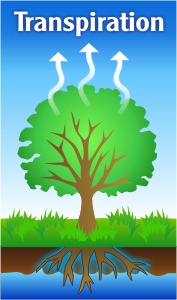
In plants, water can escape through the leaves by the process of transpiration. Which of the following structures are involved in transpiration?
xylem, phloem, stomata
phloem, root hairs, xylem
root hairs, xylem, stomata
stomata, phloem, root hairs

According to this simplified water cycle, what is the function of the process of transpiration?
releases water vapor from plants
decreases the rate of the water cycle
causes
photosynthesis in plants
speeds the evaporation of water
If the xylem in a young tree is damaged, which process is FIRST affected?
performing photosynthesis
transporting sugar to the roots
transporting water to the leaves
water entering from the soil
What provides the embryo with nutrition
endosperm
photosynthesis
light
sugar
what is the first thing the send sends out
radicle
plumule
chlorophyll
leafs
What is it called when the seed sprouts the radical and begins to send out cotyledons?
germination
gravity
plumule
Photosynthesis
what are the early leaves called after germination
cotyledons
chlorophyll
flume
plumule
Insects that pass through the egg, larva, pupa, and adult stages in their life cycle have _________________.
incomplete metamorphosis
no metamorphosis
complete metamorphosis
gradual metamorphosis
What type of mouthparts does this insect have?
Chewing
Piercing-Sucking
Sponging
Siphoning
Which statement best describes the difference between azimuth and quadrant compasses?
Azimuth uses compass points, while quadrant bearings only use numbers.
Azimuth bearings range 0–360°, while quadrant bearings use NE/SE/SW/NW with angles 0–90°.
Quadrant bearings measure full circles, while azimuth bearings only measure half circles.
They are identical systems used interchangeably.
Convert an azimuth reading of 135' into a quadrant bearing.
N 45' E
S 45' E
S 35' W
N 35' W
A direction of S 25' E is equal to what azimuth reading?
25'
90'
155'
205'
An azimuth of 310' falls into which general quadrant?
Northeast
Southeast
Southwest
Northwest
Which of the following is a common source of compass error?
Holding the compass perfectly level.
Standing near metal objects while taking a bearing.
Taking a reading away from your body.
Taking multiple readings and averaging them.
What is the purpose of knowing your personal pace factor?
To determine tree height without instruments.
To convert bearings into azimuth.
To measure distance by counting steps.
To identify soil type in a timber stand.
If your pace factor is about 2.6 paces per 10 meters, approximately how many paces are needed to measure 65 meters?
10 Paces
17 Paces
26 Paces
42 Paces
Which situation makes pacing a better option than using a tape or GPS?
Measuring extremely steep slopes.
Measuring short distances through dense vegetation.
Mapping a highway boundary.
Calculating timber volume.
Walking 180' for 120 meters, then 270' for 80 meters, results in what directional movement form the original point?
North, then further North.
South, then West.
East, then South.
West, then North.
What is one consequence of incorrect compass mapping during a timber harvest?
Trees may photosynthesize incorrectly.
Property boundaries or skid trails may be placed in the wrong location.
Tree seedlings may grow too quickly.
Wildlife populations may immediately disappear.
If you walk 45' for 50 meters and then 200' for 40 meters, what is the best way to confirm whether you remain inside a timber stand boundary?
Measure DBH of trees at each point.
Compare your path boundary to lines on a stand map.
Convert bearings into tree height measurements.
Estimate distance using only visual judgement.

