

wayground logo

Free Printable Worksheets

Font size

S
M
L
XL
Worksheets

Midterm Review Questions

Total questions: 89

Worksheet time: 45mins

Name
Class
Date
1.

Which lab equipment is used to hold and heat liquids?

a)

Beaker

b)

Erlenmeyer flask

c)

Test tube

d)

Graduated cylinder

2.

Which piece of lab equipment is used to hold small amounts of liquid and is commonly used in experiments?

a)

Beaker

b)

Erlenmeyer Flask

c)

Test Tube

d)

Pipette

3.

Which lab equipment is used to hold and organize multiple test tubes?

a)

Test tube rack

b)

Beaker

c)

Test tube holder

d)

Graduated cylinder

4.

Which lab equipment is used to support apparatus during experiments?

a)

Iron ring

b)

Funnel

c)

Test tube rack

d)

Bunsen burner

5.
Which lab equipment is used for heating substances?
a)
Hot plate
b)
Watch glass
c)
Dropper
d)
Erlenmeyer flask
6.

Which lab equipment is used to transfer small amounts of liquid?

a)

Pipette

b)

Beaker

c)

Funnel

d)

Test tube

7.

Which piece of lab equipment, used for holding small amounts of liquid and having a narrow opening, is being referred to?

a)

Test tube

b)

Erlenmeyer flask

c)

Beaker

d)

Watch glass

8.
Which metric unit is used to measure length?
a)
Centimeter
b)
Pound
c)
Gallon
d)
Fahrenheit
9.
Convert 5 meters to centimeters.
a)
50 cm
b)
500 cm
c)
5 cm
d)
0.5 cm
10.

According to the model of the sun's lifespan, which stage comes after the main sequence?

a)

Red Giant stage

b)

White Dwarf stage

c)

Protostar stage

d)

Neutron Star stage

11.
What is the Big Bang theory?
a)
The explosion of a giant star
b)
The formation of Earth's oceans
c)
The creation of the universe from a hot, dense state
d)
The process of continental drift
12.
Which process occurs in stars to produce elements over their life cycle?
a)
Photosynthesis
b)
Nuclear fission
c)
Nuclear fusion
d)
Cellular respiration
13.
Which of the following best describes the motion of a planet in the solar system?
a)
Straight line
b)
Zigzag pattern
c)

Elliptical path

d)
Random motion
14.

What factor determines the shape of a planet's orbit?

a)

Planetary size

b)

Planetary mass

c)

Planetary temperature

d)

Distance from the sun

15.
Which law of motion explains why planets move in elliptical orbits?
a)
Newton's First Law
b)
Newton's Second Law
c)
Kepler's First Law
d)
Kepler's Second Law
16.
What happens to the speed of a planet as it gets closer to the sun in its orbit?
a)
It increases
b)
It decreases
c)
It remains constant
d)
It becomes unpredictable
17.
How does the gravitational force between two objects change as the distance between them increases?
a)
It increases
b)
It decreases
c)
It remains constant
d)
It becomes unpredictable
18.

Which of the following accurately describes the relationship between the period and distance of a planet's orbit?

a)

Longer period, greater distance

b)

Longer period, smaller distance

c)

Shorter period, greater distance

d)

Shorter period, smaller distance

19.

Which object in the solar system has the fastest orbital speed?

a)

Mercury

b)

Venus

c)

Mars

d)

Jupiter

20.
What is the term used to describe the point in a planet's orbit where it is closest to the sun?
a)
Perihelion
b)
Aphelion
c)
Equinox
d)
Solstice
21.
Which of the following is NOT a terrestrial planet in our solar system?
a)
Earth
b)
Venus
c)
Mars
d)
Jupiter
22.
What initiates the collapse of a massive star before a supernova explosion?
a)
The depletion of the star's fuel
b)
The expansion of the star's outer layers
c)
The fusion of iron in the star's core
d)
The formation of a black hole
23.
Which type of star is most likely to produce heavy elements during its life cycle?
a)
Red dwarf
b)
White dwarf
c)
Supermassive black hole
d)
Massive star
24.
What is the final stage in the life cycle of a massive star before it explodes as a supernova?
a)
Red giant phase
b)
White dwarf phase
c)
Neutron star formation
d)
Black hole formation
25.
How do supernova explosions contribute to the dispersion of elements in the universe?
a)
By releasing shockwaves that scatter elements
b)
By converting all matter into energy
c)
By creating new elements through fusion
d)
By causing the formation of black holes
26.
Which type of evidence supports the Big Bang theory?
a)
Fossil records
b)
Ice core samples
c)
Light spectra and motion of distant galaxies
d)
Rock layers
27.
How do astronomers use light spectra as evidence for the Big Bang theory?
a)
By analyzing the colors of stars
b)
By studying the behavior of planets
c)
By observing the expansion of the universe
d)
By measuring the composition of distant galaxies
28.
What does the motion of distant galaxies suggest about the universe?
a)
The universe is expanding
b)
The universe is shrinking
c)
The universe is static
d)
The motion of galaxies is unrelated to the Big Bang theory
29.
Which of the following best describes the composition of matter in the universe according to the Big Bang theory?
a)
Mostly composed of dark matter
b)
Mostly composed of visible light
c)
Mostly composed of solid rock
d)
Mostly composed of hydrogen and helium
30.

How does the Big Bang theory explain the abundance of light elements (H & He)?

a)
They were created during the explosion of stars
b)
They were formed through volcanic activity on Earth
c)
They were produced during the early stages of the universe
d)
They were brought to Earth by meteorites
31.

What is the role of gravitational forces in the Big Bang theory?

a)

Gravitational forces caused the initial explosion.

b)

Gravitational forces prevent galaxies from colliding.

c)

Gravitational forces shape the formation of galaxies.

d)

Gravitational forces have no effect on the Big Bang theory.

32.

How does the Big Bang theory explain the background radiation in the universe?

a)

It is caused by the collision of galaxies.

b)

It is the result of radioactive decay.

c)

It is leftover radiation from the early stages of the universe.

d)

It is a result of solar flares from the Sun.

33.

What is the significance of cosmic microwave background radiation?

a)

It provides evidence for the existence of black holes

b)

It supports the theory of plate tectonics

c)

It confirms the presence of dark matter in the universe

d)

It supports the Big Bang theory and provides insight into the early universe

34.
According to the Big Bang theory, what happened immediately after the initial explosion?
a)
The formation of Earth
b)
The formation of galaxies
c)
The formation of stars
d)
The universe rapidly expanded and cooled
35.

What is the primary source of the Sun's energy?

a)

Nuclear fission

b)

Nuclear fusion

c)

Chemical reactions

d)

Gravitational collapse

36.
Which of the following correctly describes nuclear fusion in the sun's core?
a)
Combining hydrogen atoms to form helium
b)
Splitting helium atoms to form hydrogen
c)
Converting hydrogen into carbon
d)
Absorbing energy from the surroundings
37.
What role does nuclear fusion play in the sun's core?
a)
It releases energy in the form of light and heat
b)
It causes the sun's gravitational pull
c)
It creates magnetic fields around the sun
d)
It converts matter into pure energy
38.
How does the energy released by nuclear fusion in the sun's core reach the Earth?
a)
By conduction
b)
By convection
c)
By radiation
d)
By convection and radiation
39.

Which of the following correctly describes the lifespan of the sun?

a)

It lasts for billions of years

b)

It lasts for thousands of years

c)

It lasts for millions of years

d)

It lasts for trillions of years

40.
What happens to the sun after it enters the Red Giant stage?
a)
It expands and becomes cooler
b)
It contracts and becomes hotter
c)
It explodes in a supernova
d)
It transforms into a black hole
41.
Which stage of the sun's life cycle is characterized by the fusion of helium in its core?
a)
Main sequence
b)
Red Giant
c)
White Dwarf
d)
Protostar
42.

What is the impact of the sun's energy on Earth?

a)

It provides heat and light

b)

It causes earthquakes and volcanic eruptions

c)

It produces oxygen

d)

It influences the rotation of the Earth

43.
What is the ultimate fate of the sun?
a)
It will become a black hole
b)
It will implode and shrink into a white dwarf
c)
It will continue to exist as a main sequence star
d)
It will explode in a supernova
44.

Convert 3 kilometers to meters.

a)

0.003 m

b)

0.03 m

c)

300 m

d)

3000 m

45.
Convert 120 centimeters to meters.
a)
0.12 m
b)
12 m
c)
1.2 m
d)
1200 m
46.
Convert 8 liters to milliliters.
a)
800 mL
b)
80 mL
c)
0.8 mL
d)
8,000 mL
47.
Convert 500 grams to kilograms.
a)
50 kg
b)
0.05 kg
c)
0.5 kg
d)
5 kg
48.
Which metric unit is used to measure mass?
a)
Liter
b)
Meter
c)
Kilogram
d)
Celsius
49.
Which metric unit is used to measure volume?
a)
Pound
b)
Inch
c)
Gallon
d)
Liter
50.
Which metric unit is used to measure temperature?
a)
Newton
b)
Fahrenheit
c)
Kilogram
d)
Celsius
51.
Which metric unit is equivalent to 1000 millimeters?
a)
Centimeter
b)
Decimeter
c)
Meter
d)
Kilometer
52.
Which lab equipment is used for measuring the volume of liquids?
a)
Graduated cylinder
b)
Iron ring
c)
Test tube holder
d)
Ring stand
53.

Which lab equipment is used to reduce condensation and observe reactions during heating?
a)
Test tube holder
b)
Dropper
c)
Watch glass
d)
Hot plate
54.
Which lab equipment is used for supporting a beaker during heating?
a)
Iron ring
b)
Bunsen burner
c)
Dropper
d)
Pipette
55.
Which lab equipment is used for heating substances with a flame?
a)
Bunsen burner
b)
Pipette
c)
Hot plate
d)
Test tube rack
56.
Which lab equipment is used for transferring small amounts of liquid by a suction method?
a)
Dropper
b)
Funnel
c)
Beaker
d)
Graduated cylinder
57.
Which lab equipment is used for holding a small amount of solid during heating and evaporation?
a)
Watch glass
b)
Erlenmeyer flask
c)
Test tube
d)
Iron ring
58.
Which lab equipment is used for supporting apparatus during experiments and is commonly used with an iron ring?
a)
Ring stand
b)
Test tube rack
c)
Funnel
d)
Beaker
59.
A scientist studies the light from a distant galaxy. The light from the galaxy shows a shift to longer wavelengths. What can the scientist conclude about the galaxy?
a)
The galaxy is orbiting faster than the Milky Way.
b)
The galaxy is moving closer to Earth.
c)
The galaxy is stationary in the universe.
d)
The galaxy is moving farther away from Earth.
60.
According to the big bang theory, which element most likely formed first?
a)
Carbon dioxide
b)
Hydrogen
c)
Oxygen
d)
Nitrogen
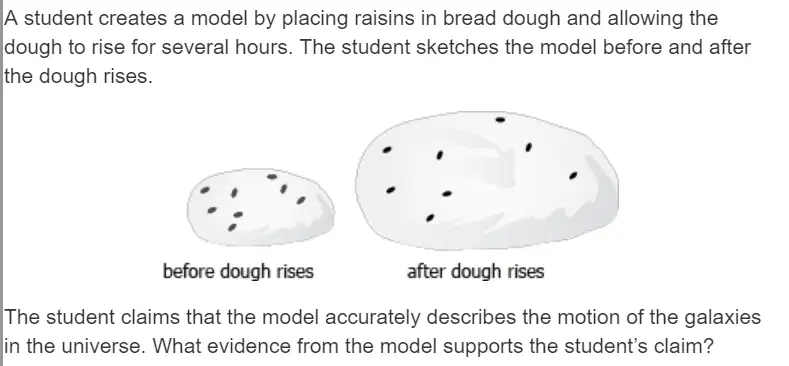
61.
a)
As the dough rises, the size of the raisins increases, resembling the expansion of the galaxies.
b)
As the dough rises, the distance between the raisins decreases, indicating that the galaxies will collide.
c)
As the dough rises, the size of the raisins decreases, resembling the emission of light from stars.
d)
As the dough rises, the distance between the raisins increases, indicating that the galaxies are moving apart.
62.
How would the gravitational force between the Earth and the Moon change if the Moon was twice as far away?
a)
The force would increase.
b)
The force would be the same.
c)
The force would decrease.
d)
The force would disappear.
63.
Halley’s Comet is a well-known space object named after Edmond Halley, who studied comets. Halley’s Comet is visible from Earth and last appeared in the inner solar system in 1986; it is scheduled to return in 2061.
a)
energy absorbed by the Sun on the surface of the comet
b)
comet’s long tail moving aside objects in its path
c)
gravitational attraction between the comet and the Sun
d)
solar wind pushing the comet through the solar system
64.
a)
position 1 only
b)
position 2 only
c)
positions 1 and 3
d)
positions 2 and 4
65.
record data and analyze the outcome of the experiment
a)
results
b)
conclusion
c)
control
d)
data
e)
dependent variable
66.
an If-Then statement that makes a prediction about the outcome
a)
hypothesis
b)
conclusion
c)
control
d)
data
e)
dependent variable
67.
the information gathered from observations
a)
data
b)
conclusion
c)
control
d)
dependent variable
e)
experiment
68.
supplies and equipment used in the experiment
a)
materials
b)
conclusion
c)
control
d)
data
e)
dependent variable
69.
step-by-step description of how the hypothesis was tested
a)
procedure
b)
conclusion
c)
control
d)
data
e)
dependent variable
70.
what is measured as a result of a change
a)
dependent variable
b)
conclusion
c)
control
d)
data
e)
experiment
71.
the question that needs to be answered
a)
purpose
b)
conclusion
c)
control
d)
data
e)
dependent variable
72.
the group that is not changed or modified
a)
control
b)
conclusion
c)
data
d)
dependent variable
e)
experiment
73.
determining what is already known
a)
research
b)
conclusion
c)
control
d)
data
e)
dependent variable
74.
the factor that is deliberately changed in the experiment
a)
independent variable
b)
conclusion
c)
control
d)
data
e)
dependent variable
75.
reporting what happened and why it supports or rejects the hypothesis
a)
conclusion
b)
control
c)
data
d)
dependent variable
e)
experiment
76.
a controlled process to test the hypothesis
a)
experiment
b)
conclusion
c)
control
d)
data
e)
dependent variable
77.
a)
The refracting telescope uses lenses to focus light, while the reflecting telescope uses mirrors
b)
The refracting telescope uses incoming radio waves to focus light, while the reflecting telescope uses mirrors.
c)
The refracting telescope uses lenses to focus light, while the reflecting telescope uses radio waves.
d)
The refracting telescope uses mirrors to focus light, while the reflecting telescope uses lenses.
78.
An astronomer wants to gather information on the gravitational field of a planet in the solar system. Which technology would the astronomer send to the planet to get the required data?
a)
Spectroscope
b)
Space probe
c)
Reflector telescope
d)
Radio telescope
79.
Which tool should an astronomer use to identify different elements in a star?
a)
Reflecting telescope
b)
Satellite
c)
Radio telescope
d)
Spectroscope
80.
Which of the following should you always wear during a lab experiment?
a)
A) Safety goggles
b)
B) Headphones
c)
C) Flip flops
d)
D) Wristwatch
81.
What should you do if you accidentally spill a chemical on your skin?
a)
A) Wait for it to evaporate
b)
B) Rinse with water for at least 15 minutes
c)
C) Ignore it and continue the experiment
d)
D) Wipe it off with a towel
82.
Why is it important to tie back long hair and remove loose clothing during a lab experiment?
a)
A) It makes you look more professional
b)
B) It helps prevent accidents and injuries
c)
C) It allows you to move faster
d)
D) It keeps your hair and clothes clean
83.
What should you do if you break a glass beaker during a lab experiment?
a)
A) Clean it up yourself
b)
B) Leave it for someone else to clean up
c)
C) Tell the teacher
d)
D) Ignore it and continue the experiment
84.
Which of the following is a safe behavior in the lab?
a)
A) Running
b)
B) Eating or drinking
c)
C) Pouring chemicals down the sink
d)
D) Following the instructions
85.
What should you do if you don't understand the instructions for a lab experiment?
a)
A) Make your best guess
b)
B) Ask your lab partner for help
c)
C) Read the instructions again carefully or ask teacher for help
d)
D) Skip that part of the experiment
86.
Why is it important to keep the lab clean and organized?
a)
A) It impresses your teacher
b)
B) It reduces the risk of accidents and promotes efficiency
c)
C) It makes it easier to find things
d)
D) It keeps you busy during the lab
87.
Which of the following should NOT be used to smell a chemical in the lab?
a)
A) Your hand
b)
B) A wafting motion
c)
C) Your nose directly over the container
d)
D) A fume hood
88.
What should you do if you accidentally spill a liquid on the floor?
a)
A) Ignore it and continue the experiment
b)
B) Clean it up yourself
c)
C) Inform your teacher or lab supervisor
d)
D) Ask someone else to clean it up
89.
Why is it important to read and understand the safety precautions before starting a lab experiment?
a)
A) It helps prevent accidents and injuries
b)
B) It makes the experiment more fun
c)
C) It impresses your lab partners
d)
D) It saves time
