
 Worksheets
Test 7: Quadratics (part 3) REVIEW
Total questions: 70
Worksheet time: 17hrs 16mins
y=5(x-3)2+5
In which form is this equation? y = (x - 3)2 + 4
Standard
Intercept
Vertex
Parabolic
Which form is this in? y = 3x2 - 7x + 2
Intercept
Standard
vertex
Cubic
What is the axis of symmetry? y = (x + 9)2 + 1
x = 9
x = -9
x = 1
x = -1
What's the y-intercept? y = 2x2 + 6x + 7
(0, -7)
(7, 0)
(0, 7)
(-7, 0)
What's another name for the x-intercepts?
Roots
Vertices
axis of symmetry
Minimums
Which is parabola opens downward?
y = x2 - 5x - 4
y = (x - 3)2 - 8
y = -3x + 2
y = -x2 + 2x - 7
What is the "b" term of this equation? y = 2x2 - 5x + 10
10
-5
2
0
In which form is this equation? y = (x - 3)(x + 8)
Standard
Intercept
Vertex
Parabolic
How do you convert y = 2x2 - 5x + 10 to vertex form?
Factor
(p+q)/2
Complete the square
Quadratic Formula
How do you convert y = 2x2 - 5x + 10 to Intercept form?
Factor
Complete the Square
(p+q)/2
-b/2a
What are the zeros? y = (x - 3)(x + 8)
-3 and 8
3 and -8
-3 and -8
3 and 8
Which of the following is Standard Form?
y=ax2+bx+c
y=a(x−p)(x−q)
y=a(x−h)2+k
Which of the following is Vertex Form?
y=ax2+bx+c
y=a(x−p)(x−q)
y=a(x−h)2+k
What is an equation of a parabola with the vertex of (3,−4) ?
y=−21(x+3)2−4
y=2(x−3)2+4
y=23(x−3)2−4
y=(x+3)2+4
Which of the following is Intercept (Factored) Form?
y=ax2+bx+c
y=a(x−p)(x−q)
y=a(x−h)2+k
What is an equation of a quadratic with x-intercepts at (−1,0) and (−10,0)
y=−2(x+1)(x−10)
y=31(x+1)(x+10)
y=−101(x−1)(x+10)
y=3(x−1)(x−10)
Convert the following function into intercept form:
f(x)=x2+4x−12
f(x)=(x+2)(x−6)
f(x)=(x+2)2−16
f(x)=(x−2)(x+6)
f(x)=(x−2)2−16
Convert the following function into vertex form: f(x)=2(x−3)(x+1)
f(x)=2x2−4x−6
f(x)=2(x−1)2−8
f(x)=(x−1)2−8
f(x)=2(x+1)2−8
Convert the following function into standard form: f(x)=−(x+2)2–5
f(x)=−x2−4x−1
f(x)=−(x−2)(x−9)
f(x)=x2+4x−1
f(x)=−x2−4x−9

Convert the following graph into intercept form:
f(x)=2x2+4x−6
f(x)=(x−1)(x+3)
f(x)=(x−8)(x−1)
f(x)=2(x−1)(x+3)
Convert the following function into standard form: f(x)= 3(x−2)2+1
f(x)= 3x2−12x+13
f(x)=3(x+2)(x+1)
f(x)=3(x+2)(x−1)
f(x)=3x2−12x−11
Convert the following function into intercept form: f(x)= −2(x−1)2+8
f(x)=2(x−3)(x+1)
f(x)=−2x2+4x+6
f(x)=−2(x−3)(x+1)
f(x)=−2(x+1)(x+6)
Convert the following function into standard form: f(x)=3(x−5)(x−1)
f(x)=−3(x+3)2+12
f(x)=3(x−3)2−12
f(x)=3x2−18x+15
f(x)=x2−6x+5

Convert the following graph into standard form:
f(x)=(x+1)2−4
f(x)=x2+2x−3
f(x)=(x+3)(x−1)
f(x)=x2+x−4
What is the vertex form of a quadratic function?
f(x) = 2a(x-h)2 + k
f(x) = a(x-h)2 + k
f(x) = (x+h)2 + k
f(x) = a(x-h) - k
What steps transform the graph y = x2 to y = -1/2(x-4)2 + 1?
Compressed by 1/2, shifted 4 units right and 1 unit up
Reflected across x-axis, compressed by 1/2, shifted 4 units right and 1 unit up
Reflected across x-axis, stretched by 1/2, shifted 4 units left and 1 unit up
Stretched by 1/2, shifted 4 units right and 1 unit down
What steps transform the graph y = x2 to y = 2(x+2)2 - 5?
Compress by 2, shifted 2 units left and 5 down
Stretch by 5, shifted 5 units left and 2 down
Stretch by 2, shifted 2 units left and 5 down
Compress by 5, shifted 2 units left and 2 down
What steps transform the graph y = x2 to y = x2 + 8
shifted up 8 units
shifted down 8 units
shifted left 8 units
shifted right 8 units
What steps transform the graph y = x2 to y = (x - 4)2
Shifted down 4 units
Shifted left 4 units
Shifted right 4 units
Shifted up 4 units
f(x) = x2 to the graph of g(x) = (x + 4)2?

Match the equation to its description.
Vertically stretched by 2 and shifted up 4
Vertically compressed by 2 and shifted up 4
Vertically stretched by 2 and shifted left 4
Vertically compressed by 2 and shifted left 4

Match the equation to its description.
Reflected over x-axis and shifted up 4
Reflected over x-axis and shifted down 4
Reflected over x-axis and shifted right 4
Reflected over x-axis and shifted left 4

Match the equation to its description.
Vertically stretched by 4 and shifted up 4
Vertically compressed by 4 and shifted up 4
Vertically stretched by 4 and shifted right 4
Vertically compressed by 4 and shifted right 4
y = 4x2
y = 2x2 - 2
y = 0.5 x2
y = x2
y = 2x2 - 2
y = 4x2
y = 2x2 - 2
y = x2
y = 0.5 x2
y = 4x2
y = 0.5x2
y = x2

If the blue is f(x)=x2, then the red must be
g(x)=x2 - 5
g(x)=x2 + 5
g(x)=(x - 5)2
g(x)=(x + 5)2
y = x2 + 2
How did we transform from y=x2?
y = -3x2
vertical reflection and vertical shift down
vertical reflection and vertical stretch
horizontal stretch
vertical reflection and vertical compression

Identify the y-intercept
(0, -3)
(0, 1)
(0, 3)
(2, 1)


Range : 0 ≤ y ≤ 4
Range : -2 ≤ y ≤ 2
Range : y ≤ 4
Range : y ≤ 4


What is the significance of the ordered pair (2, -4) to the graph?
It is the vertex
It is an x-intercept
It is the y-intercept
It is the axis of symmetry


What are the coordinates of the vertex, and is it a maximum or minimum?
(-1, 4); Maximum
(-1, 4); Minimum
(4, -1); Maximum
(4, -1); Minimum


Which graph best represents a quadratic function that has only one zero?


The graph of quadratic function k is shown on the grid.
Which statements are best supported by the graph of k ?
I. The x-Intercept is located at (−3,0) .
II. The coordinates of the y-intercept are (0,9) .
III. The axis of symmetry Is x=−3 .
I and II only
I and III only
II and III only
I, II, and III

Quadratic function h can be used to model the height in feet of a rocket from the ground t seconds after it was launched. The graph of the function is shown.
Which of the following statements is true?
The minimum value of the graph is 0
The graph has exactly one zero
The axis of symmetry is x=144
The maximum value of the graph is 225
Two characteristics of quadratic function w are given.
○ The axis of symmetry of the graph of w is x=3 .
○ Function w has exactly one zero.
Based on this information, which graph could represent w ?


What is the average rate of change of f(x) from f(-3) and f (-2)?
What is the average rate of change of f(x) from f(2) to f(3)
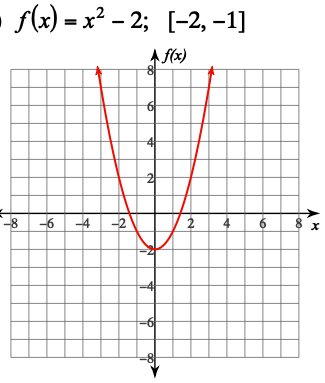
Use the given function or the graph to find the average rate of change
3
-3
3/2
-1/3


Which of the following graphs or equations have an average rate of change of 2 from the x-values 0 to 3? (check all that apply)
f(x)=x2+2x-3


f(x)=x3-7x-1

Which of the following graphs has the largest average rate of change from -1 to 2?


Calculate the average rate of change from 20 to 40 minutes.
-2 minutes per gallon
-20 minutes per gallon
-2 gallons per minute
-20 gallons per minute
m=x2−x1y2−y1
In order to calculate rate of change using the slope formula you must first get...
TWO ordered pairs
ONE ordered pair
help from your math teacher
Who lives in a pineapple under the sea?
Sandy Cheeks
Patrick Star
Spongebob Squarepants
Larry the Lobster

