
 Worksheets
8th Grade Mid-Year Review
Total questions: 76
Worksheet time: 55mins
What is the renewable source that produces energy from the sun?
Hydroelectric
Solar
Biomass
Geothermal
The unit for work is
Newton (N)
Pounds (lb)
kilogram (kg)
Joules (J)
Energy can be transformed but cannot be created or destroyed
Law of Conservation of Mass
Law of Conservation of Energy
Law of Conservation of Momentum
Law of Conservation of Force
When one form of energy changes into a new type of energy
Energy Transfer
Energy Alignment
Energy Conversation
Energy Transformation
When energy moves from one object to another without changing form
Energy Transfer
Energy Conversation
Energy Alignment
Energy Transformation
Coal, gas, & oil are examples of this
renewable resources
fossil fuels
nuclear energy
solar energy
an energy resource that replaces itself as fast as/ faster than it is being used
renewable resource
nonrenewable resource
fossil fuels
nuclear energy
an energy resource that is available in limited amounts/ being used faster than it is being replaced
renewable resource
nonrenewable resource
fossil fuels
nuclear energy
Solar, wind, & hydroelectric energy are examples of
nonrenewable resources
renewable resources
fossil fuels
nuclear energy
Fossil fuels & nuclear energy are examples of
nonrenewable resources
renewable resources
life
law of conservation of energy
In all energy transformations, some energy is "lost" as
chemical energy
thermal (heat) energy
nuclear energy
mechanical energy
Which resource uses the earth's heat to provide electric energy
solar
wind
biomass
geothermal
Which resource uses falling/running to provide electric energy
solar
hydroelectric
biomass
geothermal
Which resource uses the sun's radiant energy to provide electric energy
solar
hydroelectric
biomass
geothermal
which energy resource uses uranium atoms to produce electricty?
fossil fuels
solar
geothermal
nuclear
Which type of energy transformation occurs when we eat food?
nuclear --> chemical
chemical --> mechanical
mechanical --> nuclear
thermal --> mechanical
Which type of energy transformation occurs when you play an instrument?
mechanical --> radiant
kinetic --> radiant
mechanical --> sound
nuclear --> chemical

Particles of a liquid
are tightly packed together and stay in a fixed position.
are free to move around one another but still touch.
The slower the particles in a substance move,
the colder it is.
the warmer it is.
the more energy it has.
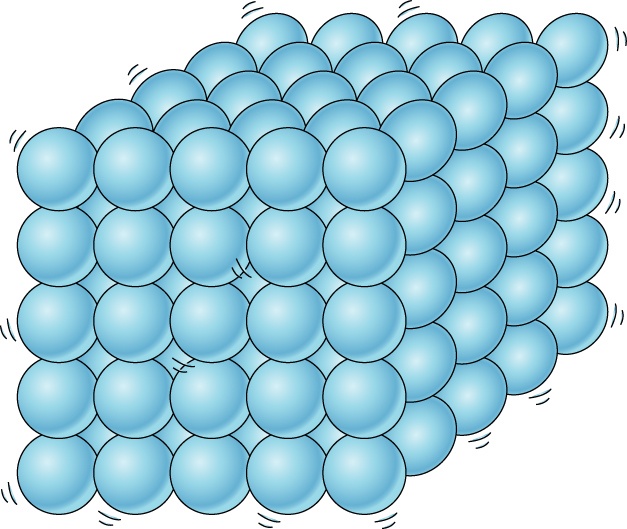
What state of matter?
Solid
Liquid
Gas
Plasma!!!
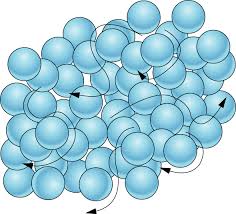
What state of matter?
Solid
Liquid
Gas
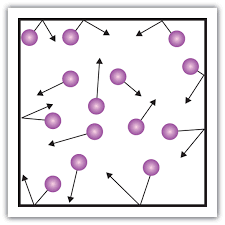
What state of matter?
Solid
Liquid
Gas
What is the phase change of a solid to a liquid?
freezing
melting
boiling
condensation
Change from Liquid to Solid is called ...
fusion
Freezing
sublimation
evaporation
Change from liquid to gas is called....
expansion
evaporation
condensation
sublimation
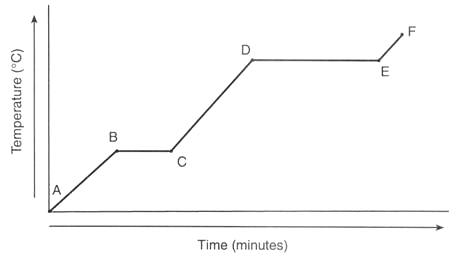
What state/phase is the object likely from points A to B?
Solid
Liquid
Gas
Plasma
What is happening to the particles in the substance between points D and E?
Melting
Freezing
Vaporizing
Sublimating

Where on the graph are phase changes taking place?
1
2
3
4
5

TRUE or FALSE: The particles in solids move around a lot and spread out.
TRUE
FALSE

When changing a substance from liquid to solid, the energy has to...
INCREASE
DECREASE
When changing a substance from liquid to gas, the energy has to...
INCREASE
DECREASE

Which of the following statements is true about phase changes?
Solid turning into liquid is called freezing
When ice melts, the kinetic energy is decreased
Liquid turning into gas is called condensing
When water boils, the kinetic energy is increased

Which of the following statements is true about solids?
Particles do not move around much, but vibrate
Particles have a lot of free space and spread out
Solids have fixed shape but not volume.
Particles are less closely packed than gas.
Which statement BEST describes the relationship between the weight and mass of an object?
If mass increases, weight will decrease.
Doubling mass reduces weight by half.
An increase in mass will not affect weight.
If mass increases, weight will increase.
What happens to the mass and weight of an object that is launched into space, where the pull of gravity is less?
The mass decreases while the weight stays constant.
The mass stays constant while the weight decreases.
The mass stays constant while the weight increases.
The mass increases while the weight decreases.
Jen is explaining the difference between weight and mass to her sister. In comparing the two, which of the following could Jen use to CORRECTLY describe the weight of an object?
Weight is the same everywhere in space.
Weight is how much matter is in an object.
Weight is the amount of gravitational pull on an object.
Weight is not impacted by the force of gravity.

303.4 g
370.4 g
373.0 g
373.4 g
Particles in motion have ___________ energy.
thermal
kinetic
potential
sound

What type of thermal energy transfer is warming the man from the fire?
Convection
Conduction
Radiation
Heat

What type of thermal energy transfer is occurring at point A?
Radiation
Convection
Conduction
None of the above

What type of thermal energy transfer is occurring at point B?
Convection
Conduction
Radiation
Kinetic

What type of thermal energy transfer is occurring at point C?
Convection
Conduction
Radiation
Heat

What type of thermal energy transfer is occurring when you are warmed by the sun?
Convection
Conduction
Radiation
Solar

Uneven heating and cooling of the Earth's surface forces the air to circulate in an attempt to find equilibrium or balance. This type of heat transfer is an example of ______.
Convection
Conduction
Radiation
Solar energy

In this example, explain the movement of thermal energy in the glass.
Heat is moving from the lemonade to the glass
Heat is moving from the lemonade to the ice
Cold is moving from the ice to the lemonade
Cold is moving from the ice to the glass
Thermal energy always moves from areas of ______ heat to areas of ______ heat.
low -- high
high -- low
high -- high
low -- low
When matter moved from a solid to a liquid the molecules ____________.
Expand and slow down
Expand and become more dense
Expand and speed up
Contract and become more dense
When matter goes from a gas to a liquid, the molecules ____________.
Expand and slow down
Contract and slow down
Contract and speed up
Expand and speed up
What is the measurement of kinetic energy of molecules?
Heat
Thermal Energy
Temperature
Density

Copper wire is a good example of a _____________.
Conductor
Insulator
Metal
Thermometer

This Styrofoam cup is a good example of a _________.
Conductor
Insulator
Drinking device
Solid

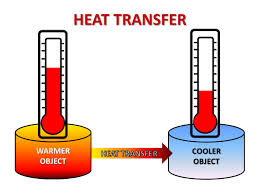
Heat transfers from an area of ____temperature to an area of ___ temperature. (Look at the diagram!)
A characteristic of matter that can only be observed when matter is changed into a new kind of matter.
Chemical property
Physical property
The words "blue", "large", and "soft" all describe _________.
Chemical property
Physical property
The ability of matter to change when heated (like a new odor is smelled)
Chemical property
Physical property
Rusting or tarnishing describes matter undergoing a __________ change with gases in the air.
Chemical
Physical
Mass, volume, or density of an object is a _______________ of that object.
Chemical property
Physical property
The ability to cook, burn, rust, tarnish, or explode is an example of a ___________ .
Chemical property
Physical property
Solubility (when a substance dissolves)
Chemical Property
Physical Property
Atoms of the reactants were rearranged to form different molecules to form the products
Chemical Property
Physical Property
This property can be observed and measured without changing the matter being studied
Physical Property
Chemical Property

This change is a
chemical reaction
physical change
musical change
Ice Ice baby
How is a chemical change different from a physical change?
there is no difference
a physical change creates a new substance
a chemical change creates a new substance

A precipitate is a ___________ that forms when 2 liquids react together.
solid
liquid
gas
plasma

