
Font size
 Worksheets
PMA Review Unit 2.3: How do Plants function in the environment?
Total questions: 35
Worksheet time: 42mins
Which of the following tissues is most clearly associated with rapid cellular division?
Meristematic
Vascular
Dermal
Epidermal
Which statement describes the role of flowers in plant survival?
Flowers can absorb carbon dioxide for sugar production.
Flowers produce oxygen through cellular respiration.
Flowers contain cells that carry out photosynthesis.
Flowers contain cells that produce gametes.
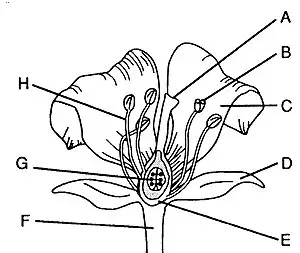
The diagram below represents a flower, the reproductive structure of some plants. Most flowers have both male and female structures for fertilization and reproduction. Which structure is represented by the letter A in the diagram above?
the stamen, a male structure which produces pollen
the pistil, a female structure which collects pollen and passes it to the ovary
the sepal, a modified leaf used for protection of the flower
the petals, decorative structures which attract pollinators
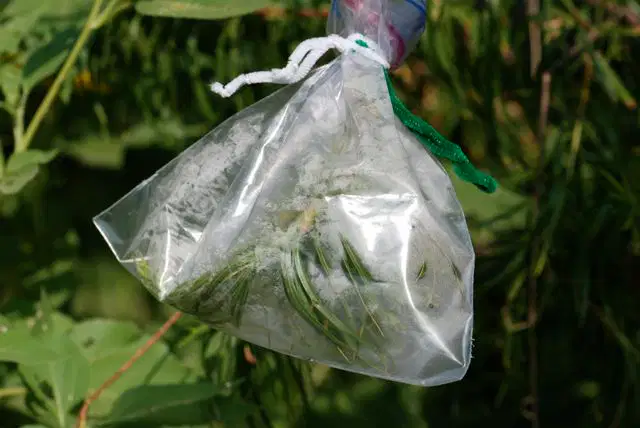
The image below shows a plant that has one stem wrapped in plastic. You can see the condensation of water on the inside of the plastic bag. Which of the following best explain the process required for the bag to accrue condensation?
Transpiration from the root to the leaves via the xylem.
Photosynthesis from the leaves via the stomata.
Cellular respiration through the stems.
Cellular division within the dermal tissue.
Terrestrial plants have stomata on the surface of their leaves. A single stoma is surrounded by two guard cells that change shape in response to environmental factors and open or close the stoma. Which of the following best explains how the structure of the leaf is used in processes that occur in the plant?
Water enters the plant through the surface of the leaf for transpiration.
Gases for photosynthesis are exchanged through the surface of the leaf.
Micronutrients are taken in through the microscopic stoma
Energy for cellular reproduction is absorbed through the surface of the leaf.
Which statement is true when discussing aerobic and anaerobic respiration?
Aerobic uses oxygen and produces less ATP than anaerobic.
Aerobic does not use oxygen and produces less ATP than anaerobic.
Aerobic uses oxygen and produces more ATP than anaerobic.
Aerobic does not use oxygen and produces more ATP than anaerobic.
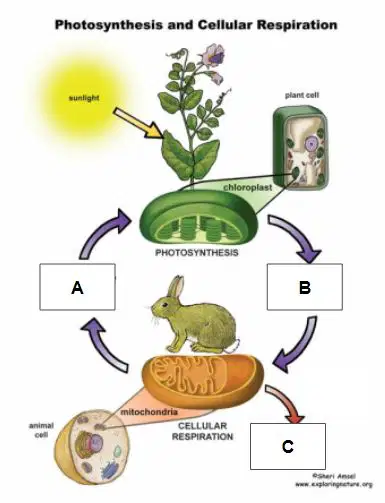
Which choice below correctly identifies the molecules at points A, B, and C?
A - Glucose and ATP; B - Oxygen and water; C - Heat
A - Carbon Dioxide and Oxygen; B - Water and ATP ; C - Heat
A - Carbon dioxide and water; B - Glucose and Oxygen; C - ATP
A - Glucose and Oxygen; B - Carbon dioxide and water; C - Water Vapor
Which of the following is a reactant of photosynthesis?
energy
oxygen
glucose
carbon dioxide
A potted plant is placed inside a clear, sealed vacuum container that has water pumped into it on a regular basis. The container is placed in direct sun and the plant's growth is monitored. Which statement best describes what will most likely happen to the plant over time?
The plant will die because it does not have oxygen for photosynthesis.
The plant will grow faster because it is able to perform aerobic respiration.
The plant will die because it does not have carbon dioxide for photosynthesis.
The plant will grow at a slower rate because it requires more water for aerobic respiration.
You have been growing some animal cells in culture. The cells grow well for several weeks, and then their growth slows down. You conduct some tests and determine that there is a lot of lactic acid in the culture fluid. Which of the following is the most likely explanation for the poor growth of the cells?
There is too much glucose in the culture fluid.
There is not enough glucose in the culture fluid
There is too much oxygen in the culture fluid.
There is not enough oxygen in the culture fluid.
How are cellular respiration and photosynthesis related in terms of energy?
The energy transformed in photosynthesis is used to power cellular respiration.
The energy transformed in cellular respiration is used to power photosynthesis.
Photosynthesis and respiration perform the same task in terms of energy transformation.
Energy is not involved in either photosynthesis or cellular respiration.


Which of the following is NOT a function of the roots?
Store sugars
Absorb water and minerals
Anchor plant to the ground
Photosynthesis
Which of the following tissues whose role is to protect and cover the plant?
Dermal tissue
Epidurial tissue
Ground tissue
Vascular tissue

Phloem in the plants performs the function of
conduction of food
conduction of water
providing support
photosynthesis

Guard cells are present in
cork
cortex
stomata
vascular bundle
Which statement about photosynthesis is correct?
Plants get the energy they need for photosynthesis from water.
Plants get the energy they need for photosynthesis from soil.
Plants get the energy they need for photosynthesis from sunlight.
Plants do not require energy to perform photosynthesis.
Which of the following is the correct equation for PHOTOSYNTHESIS?
6CO2 + 6H2O → 6O2 + C6H12O6
6CO2 + C6H12O6 + 6H2O → O2
6O2 +6H2O → 6CO2 +C6H12O6
C6H12O6 + 6O2 → 6H2O + 6CO2
What gas is released (Product) by plants during photosynthesis?
nitrogen
carbon dioxide
oxygen
hydrogen
Select all that are inputs for (reactants) Photosynthesis.
Water
Carbon Dioxide
Oxygen
Sunlight (Light Energy)
Glucose (Sugar/food)
Select all that are outputs (Products) of Photosynthesis.
Water
Carbon Dioxide
Oxygen
Sunlight (Light Energy)
Glucose (Sugar/food)
Select all that are outputs (products) of Cellular Respiration.
Water
Carbon Dioxide
Oxygen
ATP (Cellular Energy)
Glucose (Sugar/food)
Select all that are inputs (reactants) for Cellular Respiration.
Water
Carbon Dioxide
Oxygen
Sunlight (Light Energy)
Glucose (Sugar/food)

BTB was used to indicate the amount of carbon dioxide present in the test tubes. A plant was placed in each test tube. The test tube on the left was placed in the dark and the one on the right was in the light. Which of the following best explains the results?
The solution in the right test tube became more blue because the algae was doing more photosynthesis and using carbon dioxide.
The solution in the right test tube became more blue because the algae was doing more photosynthesis and producing carbon dioxide.
The solution in the right test tube became more blue because the algae was only doing cellular respiration and producing carbon dioxide.
The solution in the right test tube became more yellow because the algae was only doing cellular respiration and using carbon dioxide.
If the amount carbon dioxide is increased what happens to the rate of photosynthesis?
it increases
it decreases
it doesn't change
it is not affected
If the amount of glucose is increased for an animal cell, what will happen?
the cell will produce less ATP
the cell will produce no ATP
the cell will produce more ATP
the cell will produce the same amount of ATP

