

wayground logo

Free Printable Worksheets

Font size

S
M
L
XL
Worksheets

PMA Review unit 2.2: How do the piecies of a cell support life?

Total questions: 36

Worksheet time: 23mins

Name
Class
Date
1.
What organelle of the cell produces energy?
a)
Mitochondria 
b)
Golgi Body 
c)
Vesicle 
d)
Vacuole 
2.
What kind of transport does not require energy?
a)
Active 
b)
Vacuole 
c)
Passive 
d)
Na/K Pump 
3.
What is something that prokaryotic and eukaryotic cells have in common?
a)
They have a nucleus. 
b)
They are multi-cellular. 
c)
They have DNA. 
d)
They have organelles that are membrane-bound.
4.
What is facilitated diffusion?
a)
Transport that uses proteins to help move molecules across the membrane. 
b)
Movements of substances through a membrane. 
c)
When molecules spread from High to Low concentration on their own. 
d)
When pressure pushes something through a membrane. 
5.
All of the following statements are true about prokaryotic cells EXCEPT 
a)
No nucleus 
b)
They are simple and small 
c)
Have a cell wall 
d)
Have organelles 
6.

Which of the following is the BEST example of osmosis? 

a)
NA/K Pump 
b)
Water moving though the cell membrane 
c)
Kidneys 
d)
Photosynthesis 
7.
What are the 2 parts of a phospholipid? 
a)
Hydrophobic head, hydrophilic tails 
b)
Hydrophobic heads, hydrophobic tails 
c)
Hydrophilic heads, hydrophobic tails 
d)
Hydrophilic heads, hydrophilic tails 
8.
What is an isotonic solution?
a)
When solutions are in equilibrium 
b)
When the solution has more solute 
c)
When the solution has less solute 
d)
Has a greater pressure 
9.
Which of the following is correct about the Golgi? 
a)
Digests waste materials 
b)
Protection and Support 
c)
Modifies and packages molecules 
d)
cellular movement 
10.

What macromolecule is A?

a)

phospholipid

b)

carbohydrate

c)

protein

d)

nucleic acid

11.
Which means of particle transport is shown in this diagram?
a)
endocytosis
b)
exocytosis
c)
facilitated diffusion
d)
protein pump
12.

In this situation, where the solute is illustrated by red dots, predict if WATER will move into or out of the cell, and how that will affect the cell.

a)
Water will move into the cell and the cell will expand.
b)
Water will move into the cell and the cell will shrink.
c)
Water will move out of the cell and the cell will expand.
d)
Water will move out of the cell and the cell will shrink.
13.
Which illustration of transport across the membrane requires energy?
a)
A
b)
B
c)
C
d)
D
14.
A person with swollen gums rinses his mouth with warm salt water, and the swelling decreases. Which of the following has occurred?
a)
The swollen gums have absorbed the saltwater solution.
b)
The saltwater solution lowers the temperature of the water in the gums.
c)
The salt in the solution has moved against the concentration gradient.
d)
The water in the gums has moved out due to the high concentration of salt in the solution. 
15.

Storage where food nutrients and waste are kep

a)

cytoplasm

b)

mitochondria

c)

vacuole

d)

Golgi Body

16.

The cell power house where nutrients are digested and energy is created for the cell. It is also responsible for cellular respiration.

a)

lysosome

b)

mitochondria

c)

cytoplasm

d)

ER

17.

The fluid of dissolved molecules that fills the cell and suspends organelles.

a)

nucleus

b)

vacuole

c)

lysosome

d)

cytoplasm

18.

These connect amino acids to build proteins in the cell. They are needed for cell function

a)

cell membrane

b)

ribosomes

c)

vacuole

d)

golgi Body

19.

The center of the cell contains DNA

a)

nucleus

b)

ER

c)

golgi Body

d)

ribosomes

20.

Functions as protein manufacturing and packaging system. Ribosomes attach to the surface

a)

Smooth ER

b)

Rough ER

c)

Cell Wall

d)

Golgi body

21.

Produce food by converting light energy into sugar that cells can use. (Plant cells )

a)

cell wall

b)

cytoplasm

c)

chloroplast

d)

mitochondria

22.

Eukaryotic cells are

a)

plants

b)

animals

c)

both

d)

neither

23.

a)

Golgi body

b)

smooth ER

c)

centrioles

d)

I have no ides

24.

a)

nucleus

b)

cytoplasm

c)

vacuole

d)

ER

25.

a)

Mitochondria

b)

Cell wall

c)

cytoplasm

d)

flagella

26.

Which do BOTH prokaryotes and eukaryotes contain?

a)

nucleus

b)

mitochondria

c)

ribosomes

d)

cell wall

27.
What type of cell has a nucleus? 
a)
eukaryotic
b)
prokaryotic 
28.

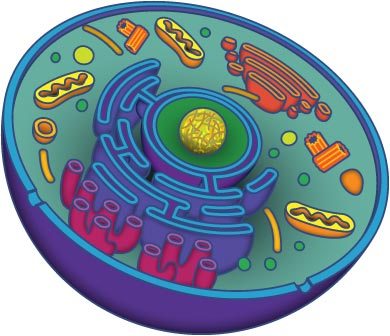
Which type of cell is this?

a)

Prokaryote

b)

Eukaryote

29.
Which is true of prokaryotic and eukaryotic cells?
a)
Prokaryotic cells are larger than eukaryotic cells.
b)
Eukaryotic cells do not have nuclei, and prokaryotic cells do have nuclei.
c)
Prokaryotic cells lack membrane-bound organelles, and eukaryotic cells contain membrane-bound organelles.
d)
Eukaryotic cells are simpler than prokaryotic cells.
30.
Which organelle belongs in plant cells only?
a)
Cell Membrane
b)
Mitochondrion
c)
Chloroplast
d)
Nucleus
31.

Which of the following is a correct list of structures found in both plant AND animal cells?

a)

mitochondria, vacuole, nucleus, cell membrane, cytoplasm

b)

mitochondria, vacuole, nucleus, cell membrane, cytoplasm, cell wall, chloroplasts
32.
All living things are made up of...
a)
cells
b)
cell tissues
c)
organ
d)
organ systems
33.
All cells come from___________ cells.
a)
pregnant
b)
pre-existing
c)
paternal
d)
pin size
34.

Unicellular organism that lacks a nucleus

a)

Prokaryotic Cell

b)

Eukaryotic Cell

35.
The ___ is the basic unit of sturucture and function of organisms
a)
atom
b)
cell
c)
matter
d)
all other answers are correct
36.
Which statement is a part of the cell theory?
a)
all cells come from preexisting cells
b)
bacteria are prokaryotic cells
c)
eukaryotic cells are complex
d)
humans are multicellular
