
 Worksheets
Unit 3 exam revision
Total questions: 49
Worksheet time: 29mins

What scale of production is used in the manufacture of paper?
One off
Batch
Mass
Continuous
Batches might be as small as a handful and as large as several thousand
True
False
This involves manufacturing a number of identical products, usually by workers who take on more specialised roles.
One off
Batch
Mass
Continuous
Sometimes called custom production it is dependent upon highly skilled workers who are able to take on a number of tasks and build a product to a customer’s exact needs.
One off
Batch
Mass
JIT
Workers are often less skilled as there is usually more reliance upon machinery set up to do a single task at each stage.
Batch
Mass
JIT
Continuous
With this scale of production it is usual for the products to move along a production line as it is a very efficient way of making products in a short period of time.
Mass
Batch
One off
Continuous

What scale of production is used in the manufacture of cars?
Mass
Batch
One off
Continuous
This is where the number of products required is so huge that the production line needs to run day and night.
Mass
JIT
Continuous
Batch
Automation is vital to this type of production
Mass
Batch
Continuous
JIT
To ensure that this can happen the whole manufacturing plant is often designed around a single product.
Mass
Batch
Continuous
JIT
No two products will be exactly the same which is often the reason the customers are prepared to pay more.
JIT
One off
Mass
Batch
Simple products made by a single worker, such as a wedding cake, to very complex products, such as oil rigs manufactured by hundreds of workers are examples of one-off production.
True
False

Bread and cakes are often made using batch production.
True
False
Most clothing will be produced using which scale of production?
Mass
Batch
Continuous
JIT
Materials, such as steel, timber and paper stock are all made using this scale of production.
Mass
Batch
Continuous
JIT

Ferrous metals contain iron and never rust
True
False

Ductile metals
Will stretch without being damaged
Can be drawn or stretched out into long wires
Will never break
include examples such as Copper
Tensile strength is
the amount of weight a material can support.
the amount of stretching a material can withstand before breaking or failing.
the amount of liquid a material can absorb before breaking.
a test for the amount of iron in a metal.
Which of the following are Non-Ferrous Metals?
Stainless Steel
Tin
Copper
Low Carbon Steel
Which of the following are Ferrous Metals?
Cast Iron
Aluminium
High Carbon Steel
Zinc

Which metal is the best conductor of electricity?
Steel
Zinc
Copper
Brass

Which metal is the best thermal insulator?
Steel
Copper
Zinc
Iron

Alloys are created to improve the working properties and appearance of metals, they are made by cobining two or more elements.
True
False
Ectracting metal to manufacture products creates more carbon emissions than recycling existing metals.
Which stage of production contributes most to the carbon footprint of metal based products?
Extraction
Transport
Processing
Recycling
An alloy is harder than its pure metal because the foreign atoms in the alloy
increase the bond strength between the atoms.
increase the empty spaces between the atoms.
react with the pure metal atoms to form a compound.
reduce the ability of the atoms to slide across each other.
Brass is an alloy consisting of a mixture of
copper and zinc
copper and lead
copper and tin
tin and lead
The main element present in brass and bronze is
copper
lead
zinc
tin
Which of the following is not the aim of alloying?
To increase the strength and hardness of metal.
To prevent corrosion of metal.
To improve the appearance of metal
To increase the melting point.
Which of the following characteristics belong to pure metals?
I. Ductile
II. Malleable
III. Brittle
IV. Good conductor of electricity
I and II
I and IV
I, II and IV
I, II, III and IV
Which of the following properties does not belong to an alloy as compared to its pure metal?
Stronger
More corrosion resistant
Harder
More malleable
Alloy is a ...
A chemical compound with combination between metal and non-metal
A salt contain of two or more elements where the main element is non-metal
Mixture of two or more elements where the main element is metal
Which is the follow processes increases the hardness of a metal?
Purification
Plating
Alloying
Electrolysis

The image shown is a...
Sketch
2d drawing
3d drawing
Concept drawing

The drawing shown is ..
30degreemetric
Isometric
Triangularmetric
3dmetric
Production drawings require which properties to the drawing?
Check all that apply.
Dimensions
Materials
Drawings
Tolerance
UK units are typically shown in...
Milli or centimetres
Inches

What extra details has been added to these sketches.
Click all that apply.
Shading
Shadows
Surface finish
Texture

Acrylic paint is made up of water, pigment, and:
color
oil
binder
water
Acrylic paint is permanent once dry.
true
false
A group of people that a policy or campaign is hoping to influence in some way is called a _______________________
an advantage or profit gained from something is a ______________
Marketing research provides information on the desired characteristics of a product or service is called ----------------------------------


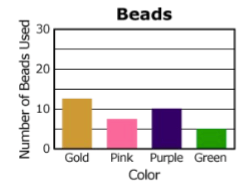
The graph shows the number of colored beads used to make a necklace. How many purple and green beads were used in all?
23
20
18
15

