wayground logo

Free Printable Worksheets

Font size

S
M
L
XL
Worksheets

Winter Chemistry Final Review

Total questions: 94

Worksheet time: 1hrs 23mins

Name
Class
Date
1.

What is the purpose of the scientific method?

a)

To solve problems and create experiments

b)

To research new information

c)

To practice safety

d)

To become a scientist

2.

Which is a good example of a hypothesis for the following scientific question, "Does playing violent video games lead to higher blood pressure?"

a)

Playing violent video games gives people higher blood pressure.

b)

If you have higher blood pressure, then you play violent video games.

c)

If you play violent video games you will have higher blood pressure.

d)

If you play violent video games, then you will have higher blood pressure.

3.

A qualitative observation is ________.

a)

Describing qualities and characteristics

b)

A guess you make using an observation

c)

Numbers and labels

d)

What is kept the same in an experiment

4.
These contain only one kind of atom. 
a)
element 
b)
compound 
c)
mixture 
d)
water 
5.

Pure water is a ___________.

a)

element

b)

mixture

c)

compound

6.
These are mixtures that are the same throughout. 
a)
homogeneous mixtures 
b)
heterogeneous mixtures 
c)
mixed mixtures 
7.
These are mixtures that are not the same throughout. 
a)
homogeneous mixtures 
b)
heterogeneous mixtures 
c)
solutions 
d)
water 
8.

A student mixes yellow powder with water. Which observation would prove a CHEMICAL change occurred?

a)

The powder DISSOLVED in the water

b)

The water turned the COLOR yellow

c)

The bag's TEMPERATURE changed

d)

The STATE OF MATTER changed

9.

Which of the following examples provides evidence of a PHYSICAL change?

a)

Wood is burned and releases ash and smoke

b)

Iron rusts over time

c)

When mixed, baking soda and vinegar form gas bubbles

d)

A piece of paper changes shape when you rip it up

10.

Which observations prove a chemical change has occurred?

a)

Dissolving and expected color change

b)

Mixing and dissolving

c)

State of matter change and boiling water bubbles

d)

Unexpected color change and temperature change
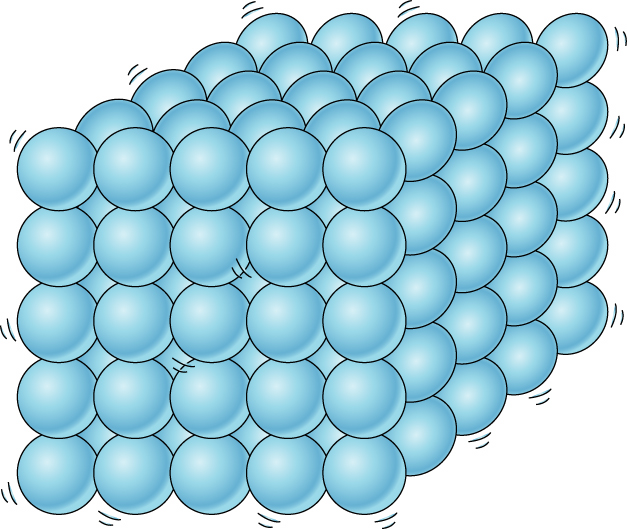
11.
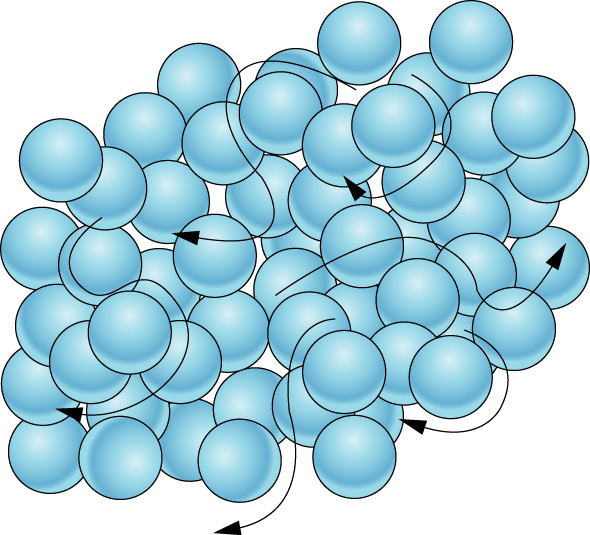
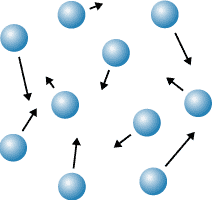
The particles in a liquid are:
a)
moving faster than a solid
b)
mover slower than a solid
c)
moving faster than a gas
d)
moving faster than a plasma
12.
a)
solid
b)
liquid
c)
gas
d)
plasma
13.
a)
solid
b)
liquid
c)
gas
d)
plasma
14.
a)
solid
b)
liquid
c)
gas
d)
plasma
15.

Which of the following is a chemical property?

a)

State of matter (solid, liquid, gas)

b)

Odor

c)

Color

d)

Flammability

e)

Density

16.

Which part of the atomic theory did Niels Bohr prove?

a)

there are electrons

b)

there is a nucleus

c)

electrons are in energy levels

d)

gold foil experiment

17.

Which part of the atomic theory did JJ Thomson prove?

a)

there are electrons

b)

electrons are in energy levels

c)

there is a nucleus

d)

cathode ray tube

18.

What experiment did JJ Thomson use?

a)

gold foil experiment

b)

cathode ray tube experiment

19.

JJ Thomson came up with which model for the atom?

a)

planetary model

b)

electron cloud model

c)

plum pudding model

d)

nuclear model

20.

What determines the identity of the atom?

a)

protons

b)

neutrons

c)

electrons

d)

isotopes

21.

Which subatomic particle has a neutral charge?

a)

protons

b)

neutrons

c)

electrons

d)

isotope

22.

What are atoms with the same number of protons but different numbers of neutrons?

a)

electrons

b)

protons

c)

neutrons

d)

isotopes

23.

When an atom loses or gains electrons to become more stable it becomes an:

a)

ion

b)

isotope

c)

atom

d)

average

24.

After Rutherford discovered the nucleus, which model is believed to be true?

a)

protons, neutrons, and electrons are evenly distributed

b)

the nucleus is made of protons, neutrons, and electrons

c)

the nucleus is made of protons and electrons

d)

the model is mostly empty space with a central nucleus

25.
He developed the planetary model of the atom.
a)
Rutherford
b)
Bohr
c)
Chadwick
d)
Dalton
26.
James Chadwick discovered the ________.
a)
proton
b)
neutron
c)
electron
d)
nucleus
27.

Subatomic particles with a negative charge

a)

Electrons

b)

Neutrons

c)

Protons

d)

Quarks

28.
Subatomic particles with a positive charge
a)
neutrons
b)
atomic mass
c)
protons
d)
isotopes
29.
A tiny but very dense, positively charged portion of the atom that holds most of the atomic mass
a)
Electron Shells
b)
Orbitals
c)
Electron Cloud
d)
Nucleus
30.

He claimed that matter was made of small, hard particles that he called “atomos.”

a)

Democritis

b)

Dalton

c)

Moseley

d)

Einstein

31.
The scientist responsible for "discovering" the nucleus is:
a)
Bohr
b)
Rutherford
c)
Schroedinger
d)
Einstein
32.

All of the COLUMNS on the Periodic Table are called?

a)

Periods

b)

Rows

c)

Groups

d)

Lines

33.

All of the ROWS on the Periodic Table are called what?

a)

Periods

b)

Groups

c)

Columns

d)

Lines

34.

Column / Group 2 on the Periodic Table has what family name?

a)

Alkali Metals

b)

Alkali Earth Metals

c)

Halogens

d)

Noble Gases

35.

The atomic number is the same as......

a)

the number of protons

b)

the number of electrons

c)

the number of neutrons

d)

the number of protons plus neutrons

36.

The mass number is the same as......

a)

the number of protons

b)

the number of electrons

c)

the number of neutrons

d)

the number of protons plus neutrons

37.

If we are talking about the isotope carbon-14, the mass number of this isotope is.....

a)

12

b)

13

c)

14

d)

6

38.

Isotopes of an element have different numbers of ......

a)

protons

b)

neutrons

c)

electrons

39.

What is the atomic number of boron?

a)

10

b)

11

c)

5

d)

10.81

40.

If boron only has two isotopes (B-10 and B-11), which isotope is the most abundant?

a)

boron-10

b)

boron-11

c)

We can't tell without more information

41.

Challenge: what is the mass of an atom with 2 protons, 2 neutrons, and 2 electrons?

a)

mass = 2

b)

mass = 4

c)

mass = 6

d)

mass = 8

42.

Challenge: What is the charge of an atom with 3 protons and 2 electrons?

a)

0 (neutral)

b)

+1

c)

-1

43.

How many neutrons does lithium have?

a)

3

b)

4

c)

6

d)

7

44.

How many neutrons does beryllium have?

a)

4

b)

5

c)

9

d)

13

45.
a)
12
b)
7
c)
8
d)
14
46.
How many valence electrons are found in atoms of group 14?
a)
4
b)
3
c)
14
d)
16
47.
How many electrons does a Copper atom have?
a)
63
b)
29
c)
92
d)
34
48.
How many neutrons are in Phosphorus (P) ?
a)
15
b)
31
c)
16
d)
14
49.
How many protons are in Zirconium (Zr) ?
a)
40
b)
91
c)
30
d)
65
50.
How many electrons are in Bromine (Br) ?
a)
35
b)
80
c)
5
d)
11
51.

How many neutrons are in an atom of this element?

a)

19

b)

39

c)

58

d)

20

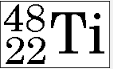
52.
How many protons does this isotope of titanium have?
a)
48
b)
22
c)
26
d)
70
53.
How many neutrons does the isotope below have?     89 36Kr
a)
53
b)
36
c)
89
d)
125
54.

There are _____ types of atomic orbitals.

a)

1

b)

2

c)

3

d)

4

55.

How many electrons can fit in one orbital?

a)

1

b)

2

c)

3

d)

4

56.
How many atomic orbitals are there in the d sublevel?
a)
3
b)
4
c)
5
d)
6
57.

Electrons fill energy levels and sublevels _____ in energy first.

a)

lower

b)

higher

58.

Which of the following units is represented simply by a letter?

a)

orbital

b)

energy level

c)

sublevel

d)

quantum number

59.
Which is the electron configuration for an oxygen atom?
a)
1s22s22p63s23p64s2
b)
1s22s22p4
c)
1s22s22p6
d)
1s22s22p63s23p6
60.
What atom matches this electron configuration?
1s2s2p3s2
a)
Neon
b)
Magnesium
c)
Aluminum
d)
Potassium
61.
What does Pauli exclusion principle state ?
a)
states that each electron occupies the lowest energy orbital available
b)
states that a maximum of two electrons can occupy a single atomic orbital, but if only if the electros have opposite spins
c)
states that single electrons electrons with the same spin must occupy each-energy orbital before additional electrons with opposite spins can occupy the same orbitals
62.
What does Hund's rule states ?
a)
states that single electrons electrons with the same spin must occupy each-energy orbital before additional electrons with opposite spins can occupy the same orbitals
b)
states that each electron occupies the lowest energy orbital available
c)
states that a maximum of two electrons can occupy a single atomic orbital, but if only if the electros have opposite spins
63.
Which electron configuration belongs to Chlorine (Cl)?
a)
1s2s2p3s3p5
b)
1s2s2p3s3p6
c)
1s2s2p3s3p7
64.
What is the shorthand electron configuration for Sulfur atom?
a)
[Ar] 3p4
b)
[He] 3s23p4
c)
[Ne] 3s23p4
d)
[Na] 3s23p3
65.

1,221 km = ________ m

a)

1,221 m

b)

1,221,000 m

c)

1.221 m

d)

12,210 m

66.

29 mm = ______ m

a)

0.029 m

b)

290 m

c)

0.29 m

d)

0.0029 m

67.

0.563 L = _____ mL

a)

5,630 mL

b)

5.63 mL

c)

56.3 mL

d)

563 mL

68.

2319 kL = _______ mL

a)

2,319,000 mL

b)

2,319,000,000 mL

c)

2.319 mL

d)

0.0002319 mL

69.
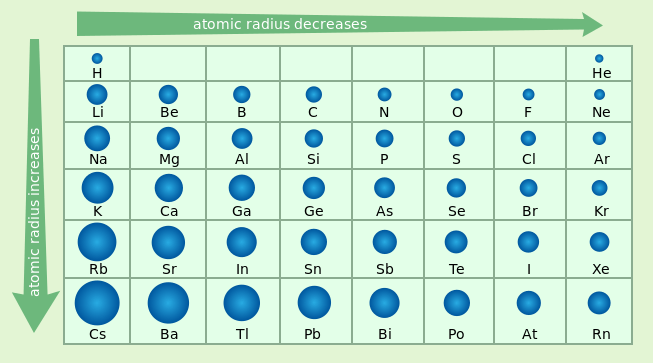
As you move down the periodic table atoms get bigger.  This is because ____________.
a)
The atoms have more mass.
b)
The atoms have more protons.
c)
The atoms have more energy levels
d)
The atoms have more nuetrons
70.
As you move across the periodic table atoms tend to get smaller because, ______________.
a)
the atoms have more mass.
b)
the atoms have less mass
c)
the atoms have more protons.
d)
the atoms have less electrons.
71.
Which atom has the largest atomic radius?
a)
potassium
b)
rubidium 
c)
francium
d)
cesium
72.
The atom with the largest atomic radius in Group 18 is - 
a)
Ar
b)
He
c)
Kr
d)
Rn
73.
Ionization energy is...
a)
the energy required to add an electron to a specific atom
b)
how much energy it takes to remove an electron from an atom
c)
the energy required to shield the outer electrons from the nucleus
d)
a measure of the ability of an atom to attract electrons
74.
Which of the following will have a lower ionization energy than Scandium (Sc)?
a)
Helium (He)
b)
Titanium (Ti)
c)
Calcium (Ca)
d)
Magnesium (Mg)
75.
Which of the following will have a higher ionization energy than arsenic (As)?
a)
Gallium (Ga)
b)
Neon (Ne)
c)
Antimony (Sb)
d)
Germanium (Ge)
76.
Which of the following will have a higher electronegativity than arsenic (As)?
a)
Carbon (C)
b)
Neon (Ne)
c)
Antimony (Sb)
d)
Germanium (Ge)
77.
As atoms of elements in group 16 are considered in order from top to bottom, the electronegativity of each successive element....
a)
decreases
b)
increases
c)
remains the same
d)
none of the above
78.
What term is used to describe "The energy required to remove an electron from gaseous atoms"
a)
excitation energy
b)
ionization energy
c)
polarization energy
d)
electrolytic energy 
79.
The atom with the largest atomic radius in Group 18 is - 
a)
Ar
b)
He
c)
Kr
d)
Rn
80.
As you move across the periodic table from left to right, the atomic radius decreases.  This is because - 
a)
the number of protons increases, so attraction to electrons increases
b)
the number of energy levels increases
c)
the number of electrons increases
d)
the atomic mass increases
81.
Francium (Fr) has the lowest ionization energy in Group 1 because - 
a)
it has the smallest number of valence electrons
b)
it has the greatest atomic mass
c)
it has the greatest number of protons, so it attracts its electrons the strongest
d)
its 1 valence electron is very far from the nucleus, so little energy is needed to remove it
82.
Which atom has the largest atomic radius?
a)
potassium
b)
rubidium 
c)
francium
d)
cesium
83.
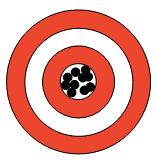
This bullseye demonstrates...
a)
High Accuracy & High Precision
b)
High Accuracy & Low Precision
c)
Low Accuracy & High Precision
d)
Low Accuracy & Low Precision
84.
?
a)
High Accuracy & High Precision
b)
High Accuracy & Low Precision
c)
Low Accuracy & High Precision
d)
Low Accuracy & Low Precision
85.
This image is an example of...
a)
precision ONLY
b)
accuracy ONLY
c)
BOTH precision and accuracy
d)
NEITHER precision and accuracy 
86.
Describe the accuracy and precision of the image
a)
Accurate and Precise
b)
Accurate and not precise
c)
Not Accurate and Precise
d)
not accurate and not precise
87.
a)

Element

b)

Compound

c)

Mixtures of Elements

d)

Mixture of Compounds

e)

Mixture of Elements and Compounds

88.
a)

Element

b)

Compound

c)

Mixtures of Elements

d)

Mixture of Compounds

e)

Mixture of Elements and Compounds

89.
a)

Element

b)

Compound

c)

Mixtures of Elements

d)

Mixture of Compounds

e)

Mixture of Elements and Compounds

90.
a)

Element

b)

Compound

c)

Mixtures of Elements

d)

Mixture of Compounds

e)

Mixture of Elements and Compounds

91.
a)

Element

b)

Compound

c)

Mixtures of Elements

d)

Mixture of Compounds

e)

Mixture of Elements and Compounds

92.
a)

Element

b)

Compound

c)

Mixtures of Elements

d)

Mixture of Compounds

e)

Mixture of Elements and Compounds

93.
anions are _____ ions.
a)
positive
b)
negative
c)
neutral
94.
Cations are...
a)
Positive
b)
Negative
c)
Neutral
d)
Purring