Wayground logo

Free Printable Worksheets

Font size

S
M
L
XL
Worksheets

Exam 3 - Practice Exam

Total questions: 70

Worksheet time: 3hrs 25mins

Name
Class
Date
1.

A neutron has what charge?

a)

Positive

b)

Negative

c)

It has no charge (it is neutral)

2.

A proton has what charge?

a)

Positive

b)

Negative

c)

It has no charge (it is neutral)

3.

An electron has what charge?

a)

Positive

b)

Negative

c)

It has no charge (it is neutral)

4.

What is the atomic # of iron?

a)

55

b)

56

c)

26

d)

2

5.

How many protons does krypton have?

a)

84

b)

36

c)

48

d)

8

6.

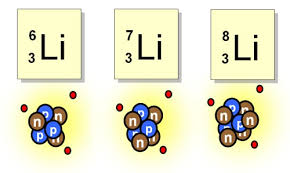
How many neutrons does lithium have?

a)

3

b)

4

c)

6

d)

7

7.

What is the atomic number of silicon?

a)

14

b)

28

c)

42

d)

7

8.

Which particles are found in the nucleus of an atom?

a)

protons only

b)

neutrons only

c)

protons & electrons

d)

protons & neutrons

9.

The atomic number is the same as......

a)

the number of protons

b)

the number of electrons

c)

the number of neutrons

d)

the number of protons plus neutrons

10.

The mass number is the same as......

a)

the number of protons

b)

the number of electrons

c)

the number of neutrons

d)

the number of protons plus neutrons

11.

If we are talking about the isotope carbon-14, the mass number of this isotope is.....

a)

12

b)

13

c)

14

d)

6

12.

If we are talking about the isotope carbon-13, the mass number of this isotope is...

a)

12

b)

13

c)

14

d)

6

13.

Isotopes of an element have different numbers of ......

a)

protons

b)

neutrons

c)

electrons

14.

This picture shows different isotopes of hydrogen written in isotope notation. What is the mass number of deuterium?

a)

1

b)

2

c)

3

15.

This picture shows different isotopes of hydrogen written in isotope notation. What is the atomic number of deuterium?

a)

1

b)

2

c)

3

16.

This picture shows different isotopes of hydrogen written in isotope notation. What is the mass number of tritium?

a)

1

b)

2

c)

3

17.

This picture shows different isotopes of hydrogen written in isotope notation. How many protons does tritium have?

a)

1

b)

2

c)

3

18.

On the periodic table, the number under the symbol for carbon is "12.01" This number is the....

a)

atomic number

b)

mass number

c)

average atomic mass

d)

number of neutrons

19.

What is the average atomic mass of boron?

a)

10 amu

b)

11 amu

c)

5 amu

d)

10.81 amu

20.

What is the atomic number of boron?

a)

10

b)

11

c)

5

d)

10.81

21.

If boron only has two isotopes (B-10 and B-11), which isotope is the most abundant?

a)

boron-10

b)

boron-11

c)

We can't tell without more information

22.

How many electrons would a neutral atom of boron have?

a)

10.81

b)

5

c)

10

d)

15

23.

What is at the center of every atom?

a)

An electron

b)

A compound

c)

A molecule

d)

A nucleus

24.
What is the role of an electron in an atom?
a)
Electrons live inside the nucleus and carry a neutral charge.
b)
Electrons circle the nucleus and have a positive charge.
c)
Electrons circle the nucleus and have a negative charge.
d)
Electrons live inside the nucleus and have a negative charge.
25.
Sodium has an atomic number of 11, how many protons does this atom have?
a)
22
b)
11
c)
12
d)
2
26.
What number on the element key tells you how many protons an element has?
a)
Atomic Mass
b)
Element name
c)
Atomic number
d)
Element Symbol
27.
The following element key shows how many protons?
a)
16
b)
15.999
c)
Oxygen
d)
8
28.
Which subatomic particle causes the nucleus to have a positive charge?
a)
Neutron
b)
Electrons
c)
Protons
d)
Valence electrons
29.
Which subatomic particle along with the protons make up the total mass of an atom.
a)
Neutron
b)
Electrons
c)
Valence electrons
d)
protons make up all the mass
30.

What is the structure of a neutral Phosphorus-32

a)

15 Protons

15 Neutrons

17 Electrons

b)

17 Protons

15 Neutrons

15 Electrons

c)

15 Protons

17 Neutrons

17 Electrons

d)

15 Protons

17 Neutrons

15 Electrons

31.

Select the correct number of electrons.

a)

8

b)

6

c)

10

d)

16

32.

Which atom will have a +1 charge?

a)

3 protons

4 neutrons

3 electrons

b)

3 protons

4 neutrons

4 electrons

c)

3 protons

4 neutrons

2 electrons

d)

3 protons

3 neutrons

3 electrons

33.

What is the mass number of this element?

a)

17

b)

18

c)

35

d)

7

34.

What element is this?

a)

Argon

b)

Chlorine

c)

Iron

d)

Nitrogen

35.

What is the element?

Mass Number = 197

Number of Electrons = 79

Number of Neutrons = 118

a)
Gold
b)

Copper

c)

Boron

d)

Silver

e)

Tin

36.
In a correctly written symbol what would be located in the "A" position?
a)
number of neutrons
b)
atomic number
c)
number of electrons 
d)
mass number
37.

What is the most common isotope of Arsenic

a)

33

b)

79

c)

75

d)

47

38.

What is the most common isotope of Oxygen

a)

8

b)

16

c)

15

d)

6

39.
Blue Color: Chemical or Physical Property
a)
Chemical Property
b)
Physical Property
40.

What element is represented?

a)

Potassium (K)

b)

Calcium (Ca)

c)

Indium (In)

d)

Sulfur (S)

41.

How many electrons are in an S-2 ion?

a)

18

b)

16

c)

20

d)

22

42.

How many electrons are in in an Rb+1 ion?

a)

36

b)

37

c)

39

d)

40

43.
How many protons are in this element?
a)
79
b)
196
c)
117
d)
Cannot be determined
44.
What charge does an atom have if it LOSES an electron? 
a)
Positive (+)
b)
Negative (-)
45.
What is the number of protons?
a)
34
b)
16
c)
18
d)
S
46.
What is the number of neutrons?
a)
34
b)
79
c)
45
d)
35
47.
What is the charge on a lithium atom that looses 1 electron?
a)
+1
b)
0
c)
-1
d)
-2
48.
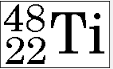
How many protons does this isotope of titanium have? Hint titanium has an atomic number of 22.
a)
48
b)
22
c)
26
d)
70
49.
Which atom has  4 neutrons?
a)
Li-6
b)
Li-7
c)
Li-8
d)
they have the same # of neutrons
50.

How many neutrons are in an atom of carbon-14?

a)

6

b)

8

c)

10

d)

14

51.

How many electrons are in an atom that has an atomic number of 34, an atomic mass of 74 and a charge of -2?

a)

2

b)

34

c)

36

d)

40

52.
Four isotopes of lead include lead-204, lead-206, lead-207, and lead-208.  The average atomic mass of lead is 207.2.  Which isotope of lead is likely to be the most abundant.
a)
204
b)
206
c)
207
d)
208
53.
How many neutrons does the isotope of lithium have?
a)
8
b)
3
c)
4
d)
5
54.
How many neutrons does the isotope below have?     89 36Kr
a)
53
b)
36
c)
89
d)
125
55.
How many neutrons does an atom of the isotope Neon-22 have?
a)
12
b)
10
c)
22
d)
20
56.
Ions are: 
a)
atoms with a positive or negative charge
b)
atoms with no charge
c)
atoms with ONLY a positive charge
d)
atoms with ONLY a negative charge
57.
How many electrons are in an atom that has an atomic number of 34, an atomic mass of 74 and a charge of -2?
a)
34
b)
36
c)
2
d)
40
58.
How many neutrons does a Sodium 24 isotope have?
a)
12
b)
13
c)
14
d)
15
59.
How many neutrons does a Calcium 48 isotope have?
a)
16
b)
20
c)
28
d)
12
60.
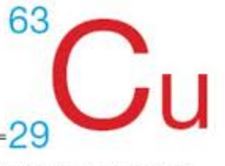
How many electrons does a Copper atom have?
a)
63
b)
29
c)
92
d)
34
61.
What is the name of the pictured isotope?
a)
Copper-29
b)
Copper-63
c)
Copper-34
d)
CopperWopperHopperBopper
62.
On the semester final, Joe scored 85, Jill scored 89, and Bill scored a 99.What was the average score for these students? _________
a)
91
b)
273
63.
Find the class grade for a student with grades: Test 89%, Quiz 92, Homework 86%, and Classwork 95%.
Tests are 60% of the grade, Quiz 15%, Homework is 10% of the grade, and Classwork is 15% of the grade.
a)
89.25
b)
91.55
c)
90.05
d)
i don't know
64.
A student's grade in a Psychology course is comprised of tests (40%), quizzes (20%), papers (20%), and a final project (20%). His scores for each of the categories are 85 (tests), 100 (quizzes), 92 (papers) and 84 (final project). Calculate his overall grade.
a)
90.25
b)
88.2
c)
89.2
d)
86.7
65.

An element has three isotopes. Given the abundances and relative masses, calculate the average atomic mass and determine (from the periodic table) which element it is.


Abundances | Relative masses

0.005% | 234.04 amu

0.720% | 235.04 amu

99.275% | 238.05 amu

a)

Uranium (#92, Atomic Mass: 238.03 amu)

b)

Fluorine (#9, Atomic Mass: 19.00 amu)

c)

Mercury (#89, Atomic Mass: 200.59 amu)

d)

Polonium (#84 209 amu)

66.
Four isotopes of lead include lead-204, lead-206, lead-207, and lead-208.  The average atomic mass of lead is 207.2.  Which isotope of lead is likely to be the most abundant.
a)
204
b)
206
c)
207
d)
208
67.

Rubidium has two naturally occurring isotopes, 85Rb (relative mass 84.9118 amu) and 87Rb (relative mass 86.9092 amu). The abundance of 87Rb is 27.8%, If rubidium has an average atomic mass of 85.47 amu, what is the % abundance of 85Rb (in percent)?

a)

27.9%

b)

72.1%

c)

74.63%

d)

34.29%

68.
4.35% of all X atoms have a mass of 39.946 amu. 83.79% have a mass of 41.941 amu, 9.50% have a mass of 42.941 amu, and 2.36% have a mass of 43.939 amu. What is the average atomic mass of atom X?
a)
41.97 amu
b)
42.19 amu
c)
10.43 amu
d)
40.04 amu
69.
24.1% of all the isotopes of a an element have a mass of 75.23 amu, 48.7% have a mass of 74.61 amu, and 27.2% have a mass of 75.20 amu.
How many protons does this element have?

a)
32
b)
33
c)
34
d)
no way to know
70.
An element has two naturally occurring isotopes. One is 10.013 amu and is 19.9% abundant. The other is 11.01 amu and is 80.1% abundant. What is the average atomic mass? What element is it?
a)
9.012, Beryllium
b)
12.011, Carbon
c)
6.941, Lithium
d)
10.812, Boron