wayground logo

Free Printable Worksheets

Font size

S
M
L
XL
Worksheets

Science Grade 8 Midterm Review

Total questions: 197

Worksheet time: 4hrs 12mins

Name
Class
Date
1.

Which of the following is the thinnest layer of Earth?

a)

Mantle

b)

Crust

c)

Lithosphere

d)

Inner Core

2.

Which of the following metals are present in Earth's Core? (Select all that apply)

a)

Nickel

b)

Steel

c)

Aluminum

d)

Iron

e)

Titanium

3.

Which of the following layers are not completely solid?

a)

Crust

b)

Outer Core

c)

Upper Mantle

d)

Lower Mantle

e)

Inner Core

4.

Who is credited with proposing the hypothesis of Continental Drift?

a)

Harry Hess

b)

Galileo Galilei

c)

Alfred Wegener

d)

Isaac Newton

e)

Albert Einstein

5.

Which is more dense?

a)

Continental Crust

b)

Oceanic Crust

6.

What happens to temperature and pressure as you get to deeper layers within Earth?

a)

Temperature and Pressure increase

b)

Temperature increases, Pressure decreases

c)

Temperature decreases, Pressure increases

d)

Temperature and Pressure decreases

7.

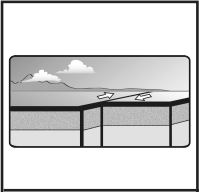
This image here shows what type of boundary?

a)

Divergent

b)

Convergent: Subduction

c)

Convergent: Collision

d)

Transform

8.

What do geologists notice about the rocks along the sea floor?

a)

They get older as they get farther away from mid ocean ridges

b)

They get thicker closer to continents

c)

Density is impossible to measure

d)

Youngest parts of the crust are along the continents

9.

How do you calculate density?

a)

Mass x Volume

b)

Mass / Volume

c)

Volume / Mass

d)

Volume + Mass

10.

If something floats in water, what can we say about its density?

a)

It is more dense than the water

b)

It is less dense than the water

c)

It has the same density as water

11.

The idea that the continents were once together, and separated over a long period of time is

a)

Seafloor Spreading

b)

Transform Boundaries

c)

Continental Drift

d)

Mid Ocean Ridges

12.

Was was Wegener's hypothesis rejected?

a)

He had no evidence for it

b)

More detailed maps show that continents don't match up

c)

No continents had similar fossils to support him.

d)

He couldn't explain how the continents could be moved

13.

Why is the upper mantle liquid, but the lower mantle is solid?

a)

Upper mantle is hotter

b)

Lower mantle is under higher pressure

c)

Upper mantle is under higher pressure

d)

Lower mantle is hotter

14.

What kind of boundary is shown in this image?

a)

Divergent

b)

Convergent: Subduction

c)

Convergent: Collision

d)

Transform

15.

Which of the following is not a feature we could expect near a convergent subduction boundary?

a)

Volcanoes

b)

Mid Ocean Ridges

c)

Earthquakes

d)

Ocean Trenches

16.

Which of the following is a feature common with transform boundaries?

a)

Volcanoes

b)

Mountain chains

c)

Ocean Trenches

d)

Earthquakes

17.

Where would you find most volcanoes that are on a continent?

a)

Randomly scattered

b)

In the middle

c)

Along the coastlines (edges)

d)

Most volcanoes are not on continents

18.

What did Harry Hess propose about the mid ocean ridges?

a)

Ancient aquatic creatures may still be alive there

b)

The waters there should be very warm

c)

The crust there should be old

d)

The valley of the ridge are actual cracks within the crust

19.

What was an important detail about the animal fossils Wegener saw had been discovered on different continents?

a)

They were great swimmers when they were alive

b)

They were from different periods of time

c)

They wouldn't be able to swim across the ocean to get to other places

d)

There were no similar fossils found on different continents

20.

Which of the following is an example of a divergent boundary?

a)

Great Rift Valley

b)

Mt. Everest

c)

Mt. Saint Helen

d)

San Andreas Fault

21.
If differences in air pressure produce winds, what can you conclude about temperature and air pressure based on the figure?
a)
As warm air rises, it creates an area of lower pressure, and cooler air flows in as wind
b)
Warm air is denser than cold air is, creating an area of high pressure the produces wind.
c)
Winds flow from areas of low pressure to areas high pressure when temperature is warmer
d)
Air pressure decreases at night because temperature is lower, producing land and sea breezes
22.

What does heat do when convection currents are moving?

a)

Sinks

b)

Rises

c)

Stays in place

23.

Which picture shows material that is more dense?

a)

The picture of the left

b)

The picture on the right

24.

What causes convection current in the Earth?

a)

The uneven heating on each layer inside the Earth.

b)

The crusts outer layer.

c)

The temperatures we feel outside.

25.

A seismic wave is simply a means of transferring energy from one spot to another within the earth through vibrations or shock waves. What are the two types of seismic waves?

a)

P-Waves

b)

Light Waves

c)

S-Waves

d)

T-Waves

e)

Radio Waves

26.

What is a seismograph?

a)

A record of the Earth's temperature

b)

A recording of earthquake waves

c)

A log of the times and locations of Earthquakes

d)

A list of the different states of matter found in the Earth

27.

How are the two types of waves different from each other?

a)

Within the earth, P waves can travel through solids and liquids, whereas S waves can only travel through solids.

b)

Within the earth, S waves can travel through solids and liquids, whereas P waves can only travel through solids.

28.

What wave is recorded first? The p-wave or the s-wave?

a)

S-Wave

b)

P-wave

c)

Ocean Wave

29.

What are the areas called that don't receive seismic data (p-waves, s-waves, or both) at the seismograph during an earthquake called?

a)

No Mans Land

b)

Dead Zone

c)

Epicenter

d)

Shadow Zone

30.

When _________ produce ground motion, we call this an Earthquake.

a)

light waves

b)

seismic waves

c)

sound waves

d)

radio waves

31.

What do seismic waves help scientists prove?

a)

The Outer Core is liquid

b)

The Outer Core is solid

c)

Both the Outer Core and Inner Core are liquid

d)

Both the Outer Core and Inner Core are solid

32.
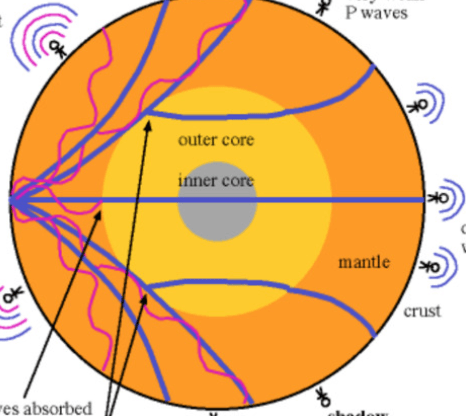
The green seismic body waves are...
a)
S Waves because they don't travel through the outer core
b)
P Waves because they don't travel through the outer core
c)
S Waves because they refract as they hit the outer core
d)
P Waves because they refract as they hit the outer core
33.

If an earthquake happened at F/E, which point(s) would NOT receive P-waves?

a)

G

b)

Y

c)

W

d)

U

34.

S waves do not travel through the liquid outer core and reach the side opposite the epicenter of an earthquake due to the fact that they are:

a)

absorbed

b)

refracted

c)

diffracted

35.

The blue lines are _______

a)

p waves

b)

s waves

c)

rayleigh waves

d)

love waves

36.

The green/blue region highlight in this model represents a

a)

P wave shadow zone

b)

S wave shadow zone

c)

Surface wave shadow zone

d)

Convection currents

37.

Which station is located within the S-Wave shadow zone?

a)

A

b)

B

c)

C

d)

D

38.

Why did the S-Wave stop moving at a depth of 2900 km?

a)

Because the medium changed from solid to liquid

b)

Because P-waves cannot travel through liquids

c)

The seismograph station cant read S waves

d)

S waves move faster than a seismograph can detect

39.
Made of dark, dense rock such as basalt.
a)
Oceanic Crust
b)
Continental Crust
c)
Lithosphere
d)
Asthenosphere
40.
Earth's only liquid layer:
a)
Upper Mantle
b)
Lower Mantle
c)
Outer Core
d)
Inner Core
41.
Made of the uppermost mantle and crust:
a)
Oceanic Crust
b)
Continental Crust
c)
Lithosphere
d)
Asthenosphere
42.
Name this boundary
a)
Convergent
b)
Divergent
c)
Transform
d)
Sergent
43.
Name the boundary
a)
divergent
b)
convergent
c)
transform
d)
sergent
44.
Name the boundary
a)
convergent
b)
transform
c)
divergent
d)
sergent
45.
Which of the following is where one plate slides under another plate?
a)
submarine zone
b)
divergence zone
c)
subduction zone
d)
lower zone
46.
Which of the following is associated with transform boundary?
a)
volcanoes
b)
mountains
c)
trenches
d)
earthquakes and fault line
47.
Which of the following land formation occurs at a divergent continental/continental boundary?
a)
mid-ocean ridge
b)
deep ocean trench
c)
Pacific hot spot
d)
rift valley
48.
Mountains form from....
a)
Plates sliding past one another
b)
collision of plates
c)
plates moving away from each other
d)
none of these
49.
Oceanic crust is.....
a)
Younger and less dense than continental crust
b)
Thinner, younger, and more dense than continental crust
c)
older, thicker, and less dense than continental crust
d)
Bigger and younger than continental crust
50.
Earth's plates are....
a)
Constantly moving and changing the face of the Earth
b)
Never moved
c)
Move seldom and very fast
d)
move when they feel like it
51.
What was the name given to all the continents when they were joined as one super continent?
a)
Supreme Continent
b)
Eurasia
c)
Plate tectonics
d)
Pangea
52.
Whenever a subduction zone is formed a ____ is formed.
a)
mountains
b)
Island arc
c)
rift valley
d)
volcanoes
53.
Plate movement is caused by _____
a)
The rotation of the Earth
b)
Ocean tides
c)
Convection current in the mantle
d)
The moon's gravity
54.
What are mid-ocean ridges?
a)
A chain of underwater falls
b)
A chain of underwater volcanoes
c)
A chain of underwater mountains
d)
A chain of underwater rocks
55.
Created by a divergent boundary
a)
rocky mountain
b)
Mariana's Trench
c)
mid-Atlantic ridge
d)
volano
56.
Plates moving apart would be...
a)
convergent
b)
divergent
c)
transform
57.
Which is subducted in an ocean-continental convergent boundary?
a)
continental plate
b)
oceanic plate
58.
What type of boundary creates a new seafloor?
a)
convergent continental to continental
b)
convergent ocean to continental
c)
convergent ocean to ocean
d)
divergent 
59.
A subduction zone is formed....
a)
when one tectonic plate sinks below another
b)
at all plate boundaries
c)
when plates diverge
d)
at transform boundaries
60.
Which of the following is the softer moving area of the mantle that contains convection current?
a)
asthenosphere
b)
lithosphere
c)
outer core
d)
oceanic crust
61.
This area contains over 70 percent of volcanoes and 90 percent of earthquakes in the world.
a)
North American plate
b)
Ring of Fire
c)
Fiery rings
d)
African plate
62.
Which of the following did not support the Continental Drift Theory?
a)
Magnetic striping in the ocean floor
b)
identical fossils found in different continents
c)
Mountains that extend over continents
d)
Coastlines of continents such as South America and Africa fit like a puzzle
63.

Three Types of Plate Boundaries

a)

Transform (slide past)

b)

Convergent (collision)

c)

Divergent (pull apart)

d)

All the above

64.

Boundary between two colliding plates, often associated with mountain building, and volcanic eruptions

a)

plate boundary

b)

magma

c)

divergent boundary

d)

convergent boundary

65.

Example of divergent boundary between two continental plates.

a)

Mid-Atlantic Ridge (valley in the Atlantic Ocean)

b)

Andes Mountains (S. America)

c)

Himalayan Mountains

d)

None of the above

66.

formed by two continental plates colliding and forcing each other upwards during convergent boundary

a)

grassland

b)

mountain ranges

c)

snow

d)

trench

67.

What type of boundary is this?

a)

convergent

b)

divergent

c)

transform

68.

What type of boundary is this?

a)

convergent

b)

divergent

c)

transform

69.

What type of boundary is this?

a)

convergent

b)

divergent

c)

transform

70.

New crust forms along a(n)

a)

subduction zone

b)

divergent boundary

c)

convergent boundary

d)

transform boundary

71.

___________, meaning "all land," is the name of the great landmass that existed millions of years ago.

a)

lithosphere

b)

Pangaea

c)

subduction zone

d)

tectonic

e)

Wegener

72.

____________ is the scientist credited with the theory of continental drift (which led to the theory of plate tectonics).

a)

lithosphere

b)

Pangaea

c)

subduction zone

d)

tectonic

e)

Wegener

73.

The outermost, rigid layer of the earth, consisting of the earth's crust and upper part of the mantle is known as the ________________.

a)

lithosphere

b)

Pangaea

c)

subduction zone

d)

tectonic

e)

Wegener

74.

BONUS! FUTURE TOPIC! Which layer of Earth is characterized by rock that is plastic, or soft enough to flow?

a)

asthenosphere

b)

crust

c)

lithosphere

d)

inner core

75.

BONUS! FUTURE TOPIC! This is the outermost, rigid layer of the Earth, made up of two parts, is divided into pieces call tectonic plates.

a)

Inner Core

b)

Asthensophere

c)

Lithosphere

d)

Outer Core

76.

BONUS! FUTURE TOPIC! What is the correct order (starting from the surface) of Earth’s layers?

a)

crust, outer core, inner core, mantle

b)

mantle, outer core, inner core, crust

c)

crust, mantle, outer core, inner core

d)

outer core, inner core, crust, mantle

77.

The San Andreas Fault in California is known as an active earthquake area. What type of

boundary is it?

a)

Converging

b)

Diverging

c)

Transform

d)

Sea Floor Spreading

78.

A CONSTRUCTIVE force...

a)

Builds up the Earth's surface

b)

Breaks down the Earth's surface

c)

Gives Earth more daylight

d)

Causes the stock market to crash

79.

Which of the following is a CONSTRUCTIVE force

a)

Weathering

b)

Erosion

c)

Deposition

d)

Earthquake

80.

Is a volcano a constructive or destructive force?

a)

constructive

b)

destructive

c)

neither

d)

both

81.

A DESTRUCTIVE force...

a)

Builds up the Earth's surface

b)

Breaks down the Earth's surface

c)

Ruins everything

d)

Causes a Lunar Eclipse

82.

Which is a DESTRUCTIVE force?

a)

Deposition

b)

Lying

c)

Stealing

d)

Weathering

83.

How would you define the word "weathering"?

a)

When bits of weathered material move from one place to another

b)

When big rocks are broken down into smaller rocks by wind, water, or ice

c)

When weathered material settles in a new place after being eroded

84.

How would you define the word "erosion"?

a)

When bits of weathered material move from one place to another

b)

When weathered material settles in a new place after being eroded

c)

When big rocks are broken down into smaller rocks by wind, water, or ice

85.

How would you define the word "deposition"?

a)

When big rocks are broken down into smaller rocks by wind, water, or ice

b)

When weathered material settles in a new place after being eroded

c)

When bits of weathered material move from one place to another

86.

What is one of the most famous examples of the effects of Erosion and Weathering over time?

a)

The Pacific Ocean

b)

The Grand Canyon

c)

The Sandlot

d)

My favorite pair of jeans

87.

What is sediment?

a)

small bits of rock, sand, and silt

b)

a bunch of cement

c)

water

d)

wind

88.

"A river slows down when it meets the ocean and makes a river delta" is an example of...

a)

Weathering

b)

Erosion

c)

Deposition

89.

Where are delta's found?

a)

In the middle of the ocean

b)

at the mouth of a river

c)

at the top of a mountain

d)

Desert

90.

What are the three types of Weathering?

a)

Mechanical, Chemical, Organic

b)

Mechanical, Robotic, Chemical

c)

Chemical, Organic, Technological

d)

Sunny, Cloudy, Ideal

91.

When a Volcano erupts, it releases...

a)

Magma

b)

Mud

c)

Candy

d)

Lava

92.

Which is the greatest band/musician of all time?

a)

Spice Girls

b)

Jonas Brothers

c)

Phish

d)

Eminem

93.

Check all of the agents of weathering.

a)

wind

b)

water

c)

gravity

d)

ice

94.

When camping in west Texas, we wake one morning to discover that our car and tent are covered with a thin layer of sand. This is an example of:

a)

weathering

b)

erosion

c)

deposition

95.

A beautiful display of bluebonnets bloomed along the bank of the river, but after the storm last night, the flowers and a large section of the soil in which they grew is gone. What is this an example of?

a)

weathering

b)

erosion

c)

deposition

96.

When we walk along the seashore, we look for shark teeth in the sand. Sometimes we also find unbroken sand dollars, too. This is an example of

a)

weathering

b)

erosion

c)

deposition

97.

This landform is created by deposition.

a)

mountain

b)

volcano

c)

delta

d)

mid-ocean ridge

98.

As a river approaches the ocean, the water speed __________ and sediments are ______________.

a)

increases; deposited

b)

decreases; weathered

c)

decreases; weathered

d)

decreases; deposited

99.

How does freezing water cause the weathering of rocks?

a)

It keeps the rocks in place.

b)

It expands cracks and breaks rocks.

c)

It makes the rocks last longer

d)

It causes rocks to fall in landslides

100.

Which process breaks rock into sediments?

(a)  

101.

Which process moves sediment from its original location to another location?

(a)  

102.

Which process drops sediment off in a new location?

(a)  

103.

How are you feeling about the content we learned this week?

a)

Great! I could explain it to someone else easily.

b)

Getting there! I feel ok about this information but need some more practice.

c)

Not great yet, but I know that once I complete my assignments this week I'll be comfortable with the material.

d)

Not good at all. Help me!!

104.
Used to determine whether an object is older or younger than other objects
a)
Superposition
b)
Relative Dating
c)
Fossil
d)
Unconformity
105.
States that younger rocks lie above older rocks if the layers have not been disturbed
a)
Law of crosscutting
b)
Law of superposition
c)
Relative Dating
d)
Unconformity
106.
Traces or remains of organisms that lived long ago
a)
Fossil
b)
Unconformity
c)
Superposition
d)
Column
107.
Analyze the seashell found in the white layer.  Which statement is true of the rock layer that contains this fossil?
a)
It could also contain a fossil from the bottom layer.
b)
It is older than the layers below it.
c)
It is younger than the layers above it.
d)
It is older than the layers above it.
108.
How do geologists use relative dating?
a)
Placing rocks in order from youngest to oldest
b)
Placing rocks in order by minerals they contain
c)
Classifying rocks by different textures
d)
Classifying rocks by different isotopes
109.
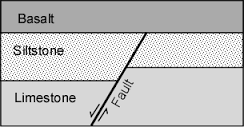
What are the relative ages of the features in order from oldest to youngest?
a)
Limestone, Basalt, Fault, Siltstone
b)
Siltstone, Fault, Basalt, Limestone
c)
Limestone, Fault, Basalt, Siltstone
d)
Limestone, Siltstone, Fault, Basalt
110.
Relative dating of rock layers tells us that the deeper we dig, _______.
a)
the younger the rocks get
b)
the smellier the rocks get
c)
the harder the rocks get
d)
the older the rocks get
111.
The Law of Superposition helps scientists to determine what?
a)
The absolute age of rock layers
b)
The age of fossils
c)
The relative age of rock layers
d)
the super powers of rocks
112.
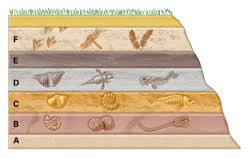
Which rock layer in the diagram seems to be the oldest?
a)
F
b)
E
c)
B
d)
A
113.
According to the law of superposition, which layer is the youngest?
a)
A
b)
B
c)
C
114.
According to the law of superposition, which layer is the youngest?
a)
A
b)
B
c)
C
115.
An organism that no longer exists on Earth is called
a)
Decayed
b)
Evolved
c)
Extinct
d)
Preserved
116.
Which rock layer contains the newest fossils?
a)
F
b)
E
c)
B
d)
C
117.
According to the law of superposition, the oldest fossils are found 
a)
At the top of the rock layers
b)
Near the bottom of the rock layers
c)
In the middle of the rock layers
d)
Somewhat near the surface
118.
The best index fossils have which two traits?
a)
widespread geographically, long lifespan
b)
widespread geographically, short lifespan
c)
specific place, long lifespan
d)
specific place, short lifespan
119.
Index fossils help determine relative age through correlating rock layers.
a)
True
b)
False
120.
One of the oldest organisms discovered is called a(n) _________.
a)
dinosaur
b)
micro-organism
c)
trilobite
d)
cast and mold fossil
121.
The Law of Superposition helps scientists to determine what?
a)
The absolute age of rock layers
b)
The age of fossils
c)
The relative age of rock layers
d)
the super powers of rocks
122.
According to the law of superposition, which layer is the youngest?
a)
A
b)
B
c)
C
123.
Which rock layer in the diagram seems to be the oldest?
a)
F
b)
E
c)
B
d)
A
124.
Which rock layer most likely contains fossils of the most recently evolved organisms?
a)
1
b)
2
c)
3
d)
4
125.
How old do Paleontologists believe the Earth is?
a)
2015 years old
b)
3.6 billion years old
c)
4.6 billion years old
d)
4.6 million years old
126.
Which of the following organisms formed last on Earth?
a)
Jellyfish
b)
Shark
c)
Lizards
d)
Horses
127.
To be considered an index fossil, it had to have lived for a relatively short period of time.
a)
True
b)
False
128.

___________ are drilled from sheets of ice, mostly from Greenland or Antarctica.

a)

extrusions

b)

ice cores

c)

intrusions

129.

Ice cores can trap gases, like carbon dioxide. And increased concentration of carbon dioxide found in a layer of ice is one piece of evidence for ____________.

a)

climate change

b)

cell theory

130.

Since 1958, increased levels of CO2 have been detected in ice cores. Which is most likely responsible for this increase?

a)

Using wind turbines

b)

Using moving water to generate electricity

c)

Burning fossil fuels

131.

Ice cores also follow the Law of Superposition, which shows that the oldest deposits can be found at the __________, and the youngest are found at the top.

a)

bottom

b)

middle

c)

top

132.

How can ice cores provide evidence for the evolution of Earth's atmosphere?

a)

Ice cores can show how the composition of the atmosphere has changed over time.

b)

Ice cores can show how reptiles have changed over time.

133.
Drawn observed several different types of finches.  Why are there so many different types?
a)
Finches live in different places, but eat the same food.
b)
Finches live in the same place, but eat different types of food.
c)
Finches live in different habitats and eat different types of food.
d)
Finches are found all over the world.
134.
The differences among a species, like different bird beaks, are called
a)
genes.
b)
variations.
c)
traits.
d)
theories.
135.
Organisms with the most beneficial traits will survive.  This is commonly known as
a)
theory of evolution.
b)
variations.
c)
survival of the fittest.
d)
ecosystems.
136.
This scientist developed the theory of evolution as he studied the finches.
a)
Charles Darwin
b)
Isaac Newton
c)
Albert Einstein
d)
Marie Curie
137.
Behavioral changes of individuals of a species that allow for better survival. (Acquired traits)
a)
Variation
b)
Adaptation
c)
Behavior
d)
Environment
138.
Where the better adapted organisms survive to pass traits along to offspring.
a)
Evolution
b)
Natural Selection
c)
Extinction
d)
Artifical Selection
139.
What are the most studied animals in the galapagos?
a)
Finches
b)
Tortoises
c)
Turtles
d)
Lizards
140.
What is the advantage of having different shaped beaks?
a)
To look different from other species.
b)
To be able to eat the food readily available in the environment.
c)
To protect itself against predators.
d)
To protect itself against prey.
141.
Why are advantageous traits more likely to be passed onto offspring?
a)
Because they are more likely to survive and reproduce.
b)
Because they come from dominant alleles.
c)
Because they come from recessive alleles.
d)
Because the trait is an acquired phenotype.
142.
Do organisms "decide" to evolve and change?
a)
Yes, they know they need to change to survive 
b)
No, they change because of natural selection
143.

Organisms with a ___________ gene pool have a __________ chance of surviving

a)

smaller, lesser

b)

larger,greater

c)

smaller, greater

d)

larger, smaller

144.

What is a monoculture?

a)

a section of land where one species grows

b)

a section of land where two species grow

c)

a section of land where 6 species grow

d)

a section of land where 15 species grow

145.

What is a Polyculture

a)

a section of land where one species grows

b)

a section of land where more than one species grows

146.
Which of the following genotypes is homozygous dominant?
a)
BB
b)
bb
c)
Bb
d)
green eyes
147.
What is the definition of a phenotype?
a)
letter combination
b)
physical characteristic
148.
Which of the following genotypes is hybrid?
a)
AA
b)
Aa
c)
aa
149.
Which of the following genotypes is heterozygous?
a)
AA
b)
Aa
c)
aa
150.
Which of the following answers correctly represents this Punnett Square if freckles are dominant?
a)
25% chance freckles
b)
50% chance freckles
c)
75% chance freckles
d)
100% chance freckles
151.
True or False: Traits can skip a generation.
a)
True
b)
False
152.
Which of the following genotypes is purebred recessive?
a)
a
b)
aa
c)
Aa
d)
AA
153.
Which of the following genotypes is purebred dominant?
a)
AA
b)
Aa
c)
aa
154.
the passing of genetic traits from parent to offspring.
a)
heredity
b)
trait
c)
gene
d)
allele
155.
In this diagram, the phenotypes are....
a)
green and yellow
b)
only green
c)
Gg, GG, gg
d)
not enough information
156.
Dominant or recessive?
Dd
a)
Dominant
b)
recessive
c)
neither
d)
homozygous
157.
He is known as the father of modern day genetics.
a)
Gregory Maxim
b)
Grant Mendel
c)
Gregor Mendel
d)
Grace Mendel
158.
Which of the following alleles is homozygous recessive?
a)
Tt
b)
tt
c)
TT
d)
T
159.
Dominant alleles are represented by a:
a)
Male gene
b)
lowercase letter
c)
recessive trait
d)
capital letter
160.
Which of the following is a phenotype?
a)
Aa
b)
red hair
c)
heterozygous
d)
DNA
161.
AA and Aa always show up as
a)
dominant
b)
recessive
162.
___________________________ is the study of how traits are passed on, or inherited.
a)
dominant traits
b)
ratio
c)
phenotype
d)
genetics
163.
A ________________________ is used to predict the possible genotype from certain parents
a)
Mendel Grid
b)
Genetic Tic Tac Toe
c)
Punnett Square
d)
Pedigree Plot
164.
______________________ is the mathematical chance that something will happen
a)
division
b)
selective breeding
c)
ratio
d)
probability
165.
What are the possible phenotypes in this cross?
a)
Bb, bb, BB
b)
purple, white
c)
Bb, bb
d)
light purple
166.
What are the possible genotypes for this cross?
a)
TT = 25% Tt= 50% tt=25%
b)
all tall
c)
TT= 75% tt = 25%
d)
Tt = 100%
167.
To be a yellow seed genotype must be
a)
aa
b)
Aa
c)
AA
d)
AA or Aa
168.
Two brown eyed parents (Bb) have a baby. What is the chance the baby is blue eyed?
a)
0 %
b)
25%
c)
50%
d)
75%
169.

The blending of two traits is known as ---

a)

incomplete dominance

b)

codominance

170.

A condition in which both alleles for a gene are expressed so that both traits are visible is known as ---

a)

Codominance

b)

Incomplete dominance

171.

What type of inheritance pattern is shown here?

a)

Codominance

b)

Incomplete dominance

172.
Is this trait (the shaded individuals) dominant or recessive?
a)
dominant
b)
recessive
173.
What do half colored symbols represent?
a)
The individual is a carrier.
b)
The individual expresses the trait.
c)
The individual has both recessive alleles.
d)
The individual has both dominant alleles.
174.
Examine the pedigree. The allele for the presence of a widow’s peak is dominant. Therefore, we can tell from the chart that in the couple labeled 2:
a)
the male is heterozygous and the female is homozygous.
b)
the male is homozygous and the female is heterozygous.
c)
the male is homozygous and the female is homozygous.
d)
the male is heterozygous and the female is heterozygous.
175.
How many generations are shown in this pedigree?
a)
1
b)
2
c)
3
d)
4
176.

Give the genotype for person II-1, for this autosomal trait.

a)

GG

b)

Gg

c)

gg

d)

we cannot be 100% sure of the genotype
177.

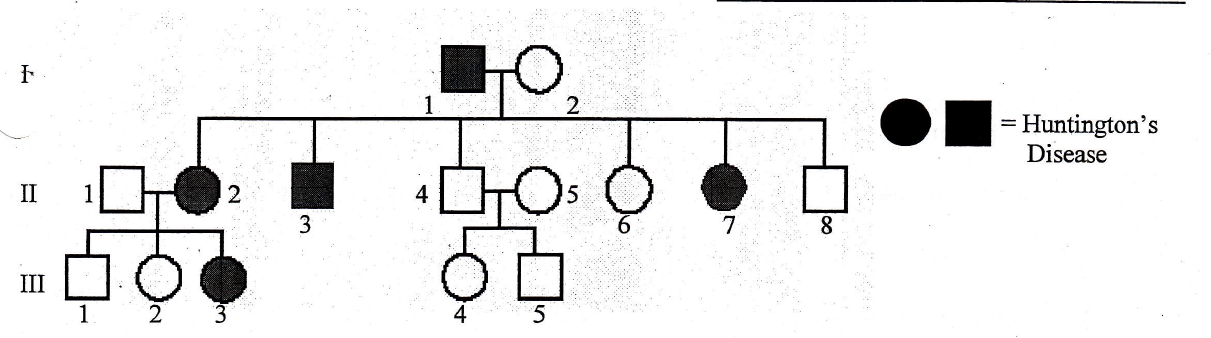
There are no carriers for Huntington's Disease - you either have it or you don't. Is Huntington's disease caused by a dominant or recessive trait? (hint - Every generation has a shaded person)

a)

Dominant

b)

Recessive

178.
Determine the contour interval
a)
10 m
b)
20 m
c)
50 m
d)
100 m
179.
What do close contour lines represent on a map?
a)
waterfall
b)
steep area
c)
gradual area
d)
river
180.
What do contour lines that are farther apart represent?
a)
waterfall
b)
steep area
c)
gentle slope
d)
river
181.
How many mountain tops does this map have?
a)
one
b)
two
c)
three
d)
four
182.
What is the profile view to Topographic Map #1? 
a)
A
b)
B
c)
C
d)
D
183.
What is the profile view to Topographic Map #2?
a)
B
b)
C
c)
D
d)
E
184.
What is the most likely elevation of the mountain below?
a)
1550  meters
b)
 1652 meters
c)
1500 meters
d)
1700 meters
185.
How many mountain peaks are represented?
a)
one
b)
two
c)
three
d)
four
186.
What is the difference in elevation between Point X and Point Y?
a)
120 m
b)
240 m
c)
360 m
d)
340 m
187.
What is the change in elevation from point X to the top of the hill in the topographic map shown?
a)
303 m
b)
203 m
c)
250 m
d)
253 m
188.
Which topographic map matches formation C?
a)
1
b)
2
c)
3
d)
4
189.
What is the elevation of A?
a)
10 meters
b)
20 meters
c)
40 meters
d)
120 meters
190.
What is the contour interval of the topographic map below?
a)
400 m
b)
200 m
c)
100 m
d)
80 m
191.
What is the most likely elevation of the mountain below?
a)
 774 meters
b)
871 meters
c)
922 meters
d)
985 meters
192.
Determine the contour interval:
a)
5 m
b)
10 m
c)
15 m
d)
20 m
193.
Which side of Lookout Hill has the steepest slope (closest together)?
a)
North (top)
b)
South (bottom)
c)
East (right)
d)
West (left)
194.
What is the difference in elevation between Point X and Point Y?
a)
120 m
b)
240 m
c)
360 m
d)
340 m
195.
What is the elevation of point B?
a)
800 ft
b)
850 ft
c)
900 ft
d)
1000 ft
196.
Determine the contour interval:
a)
5 m
b)
10 m
c)
15 m
d)
20 m
197.
Determine the contour interval:
a)
20 ft
b)
25 ft
c)
40 ft
d)
50 ft