
 Worksheets
CA4 Review TEKS 8.5 - 8.8
Total questions: 200
Worksheet time: 17hrs 40mins

In what section would you most likely find an element that is a brittle solid at room temperature and is not a good conductor?
Section 1
Section 2
Section 3
There are no elements that are brittle solids

Most of an atom's mass can be found at location X in the diagram. What is the charge of the sub atomic particles outside of location X?
Neutral
Negative
Positive
Cannot be determined

Assuming the atom depicted has an overall neutral charge. Which sub atomic particle(s) make up the Atomic Mass?
Protons Only
Protons and Electrons
Electrons and Neutrons
Protons and Neutrons

The following element has a total of 3 electrons and has highly reactive chemical properties. In which Group/Family can this element be found?
Group 1
Group 3
Group 11
Cannot be determined

What element has 6 Valence Electrons but only two (2) Energy shells/Orbitals?
Gold
Oxygen
Barium
Sulfur
Valence Electrons determine an element's___________________________, While Protons determine an element's____________________________.
IDENTITY; REACTIVITY
Both determine reactivity
REACTIVITY; IDENTITY
Both determine identity

A researcher began the following reaction with 52.6 grams of sugar and Sulfiric Acid in part A. The final mass of the products in part B would MOST LIKELY be:
More than 52.6 grams
Less than 52.6 grams
Exactly 52.6 grams
Cannot be determined

The following reaction includes 4 Elements.
TRUE
FALSE

This reaction has the same number of Oxygen atoms in the reactants as it does in the products.
TRUE
FALSE
To create a Precipitate, means to form a_____________.
Liquid
Semi-solid
Solid
Metal
How many valence electrons makes most atoms stable (nonreactive)?
2
8
1
4
Poor conductor of heat and electricity is a property of ___________.
metals
nonmetals
metalloids

Which two elements are similar?
Beryllium and Magnesium
Carbon and Lithium
Lithium and Beryllium
Magnesium and Carbon

An atom of a certain element has 11 electrons, and a mass number of 23. This element is very reactive in room temperature. How many neutrons are in this atom?
11
12
33
23

How many electrons are in this element?
39
19
20
21

How many neutrons are in this element?
39
19
20
40
A chemical formula is provided below. How many atoms are contained in the substance?
H2SO4
3
6
7
10

A model of one molecule of a chemical compound is shown. What is the correct way to write the formula for three molecules of this compound?
A. 2H2O
B 3(2H2O)
C. H2O2
D. 3H2O2
During an investigation, two flasks of unknown, clear liquids are combined in a beaker and the following observations are recorded. Which of the listed observations indicate a new substance was formed during this investigation?
I. Solution color remains clear
II. The amount of solution in the beaker increased
III. Solution temperature changed from 10 degrees C to
20 degrees C
IV. Some of the liquid remained in the flasks
A. I and II
B. I, II, and IV
C. III, only
D. I and III
Which of the following examples would support that a chemical reaction has occurred?
A. After putting liquid batter into a hot pan, the batter solidifies and begins to turn brown.
B. After turning on a blender filled with fruits, the fruit is chopped up and mixed together.
C. After taking a tray filled with ice cubes out of the freezer, the cubes begin to melt.
D. After adding a spoonful of sugar to a mug of hot coffee, the sugar dissolves completely.
When vinegar and baking soda are combined, bubbles begin to form. Bubbles are evidence of a chemical reaction because they -
A. are less dense than air.
B. form at a fast rate.
C. released a gas
D. have no mass.
What element is in:
Group 2
Period 2
(a)
What element is in:
Group 14
Period 2
(a)
What element is in:
Group 18
Period 6
(a)
What element is in:
Group 15
Period 3
(a)
What element is in:
Group 18
Period 1
(a)
What element is in:
Group 1
Period 5
(a)
How many Valence Electrons does the element in Group 14 Period 7 have?
(a)
What's the atomic weight of the element at group 17 period 4?
(a)
What element is in:
Group 9
Period 4
(a)
Whats the atomic number of the element at Group 13 Period 2
(a)

This element is on period (a) .

This element has (a) valence electrons

This element is in Group (a)

What is the atomic number of this element?
(a)

Which atom has the highest atomic mass?
(a)
. How many elements are in the compound C2H8O ?
(a)
How many total atoms are in the compound H2SO4?
(a)

The graph shows the distance traveled by a ball over a certain amount of time. According to the graph, between 2 and 4 seconds the ball was -
traveling at a constant speed.
increasing its speed.
changing its direction.
remaining at rest.
Which of the following examples accurately describes an object that is accelerating?
A ball sitting motionless on the floor.
An airplane moving at 500 kilometers per hour.
A car slows down to turn a sharp corner.
A bike moving backward at 3 meters per second.
Which of the following graphs displays the data of an object that is accelerating?


Which measurements are necessary for determining both the speed and velocity of a moving object?
Distance, time and direction
Direction, displacement, and distance
Distance, direction and acceleration
Direction, time and acceleration
A quarterback throws a football 40 yards in 4 seconds. What is the average speed of the football?
10 yd/s
100 yd/s
160 yards
0.1 seconds

What is the average speed of the boat between 4 and 6 seconds?
150 m/min
166 m/min
250 m/min
125 m/min
A plane flies from Houston to NYC in 4 hours. The distance it travelled was 1627 miles. What was the average speed of the plane?
6508 mph
410 mph
6500 mph
407 mph

What is the average speed of the runner at 4 seconds?
40 m/s
30 m/s
20 m/s
10 m/s

Are the forces acting on the object balanced or unbalanced? The man does a flip on the fly board.
(a)

How will this object move?
It will not move
It will move in both directions
It will move to the right
It will move to the left

How will this object move?
It will not move
It will move in both directions
It will move to the right
It will move to the left
Shadell pushes a box 35 N to the right. Nazai pushes the box 25 N in the same direction. What is the net force?
(a)

What is net force?
(a)

Balanced or Unbalanced
(a)

What is the net force?
(a)
Which of the answer choices is not a characteristic of a balanced force?
no change in motion
moving at a constant speed
causes a change in motion
net force of zero

If an object is not moving the forces acting upon it are (a)

A (a) is a push or a pull on an object.
Balanced forces causes
speed of an object
change in motion
no change in motion
no friction on object
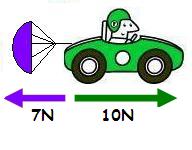


Calculate the net force shown in the diagram?
(a)
The following is an example of:
8 m/s
speed
velocity
acceleration
The following is an example of:
15 m/s north
speed
velocity
acceleration
25 s2m is an example of
(a)
5 m/s southeast is an example of
speed
velocity
acceleration
6 m/s is an example of:
(a)
Which of the examples below is an accurate description of Velocity? Select two answers.
15 h2km
20 m/s south
10 km/s
25 mph
Which of the following is the correct definition of speed?
Speed in a given direction
When an object's speed remains unchanged.
the total distance traveled by an object over a total amount of time.
change in an object's motion (position, direction, speed); caused by unbalanced forces.
Which of the following is the correct definition of Velocity?
Speed in a given direction
the path that a moving object follows
the total distance traveled by an object over a total amount of time.
change in an object's motion (position, direction, speed); caused by unbalanced forces.

The graph represents Kyle's movement over 20 hours. What does the graph tell us about his movement from points E to F?
Kyle is not moving
Kyle is moving at a constant speed back to the starting point.
Kyle is stopping for coffee
Kyle is slowing down.
How are speed and velocity different?

The graph represents the movement of Mrs. Salas's son over the period of 50 seconds. What is William's average speed from 0-30 seconds?
1 m/s
0 m/s
2 m/s2
1.5 m/s
Louie was traveling north with his herd from San Antonio to Dallas. Louie has an excellent sense of direction and time and figured in his horse brain that it would take them 36 hours to travel the 283 miles. What would be the velocity of Louie's herd in order to cover that distance in that amount of time?
7.9 mi/hr southeast
7.9 hr2mi
79 mi/hr
7.9 mi/hr north
___ refers to how fast an object is moving.
Speed
Velocity
Acceleration
Motion
What do you need to calculate speed?
distance and direction
distance and time
direction and time
distance, time, and direction
An elevator traveled 15 floors (150 ft) at a speed of 4.5 m/s. What additional information is needed to determine the velocity of the elevator?
the direction the elevator traveled
how many times the elevator stopped
how long the elevator was stationary
the total distance the elevator traveled

According to Newton's Second Law, How do you calculate force?
Multiply mass and acceleration
Divide mass by acceleration
Divide acceleration by mass
Divide force by mass
According to Newton's Second Law, How do you calculate mass?
Multiply mass and acceleration
Divide force by acceleration
Divide acceleration by mass
Divide force by mass
According to Newton's Second Law, How do you calculate acceleration?
Multiply mass and acceleration
Divide force by acceleration
Divide acceleration by mass
Divide force by mass


What causes day & night?
Earth's rotation on the equator
Earth's revolution around the Sun
The Moon's rotation around the Sun
Earth's rotation on its axis

What is the line running down the center of Earth called?
Equator
Axis
North Pole
South Pole

No longer tilted on its axis
Stopped rotating on its axis
Took an additional month to orbit the Sun
Revolved around the Sun in the opposite direction
If there is a 3rd Quarter moon on July 2nd, what is the approximate date of the next full moon?
July 9th
July 16th
July 23rd
July 30th
A student keeps a record of the phases of the moon for one month. On the first night of the student's observations, the full moon is visible in the sky. After the full moon, which of these phases will the student observe next?
Waxing crescent moon
Waxing gibbous moon
Waning crescent moon
Waning gibbous moon

F
H
G
J

1
2
3
4
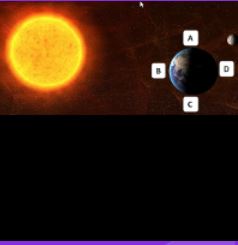


Waning Gibbous


How much of the Moon, as seen from Earth, is illuminated during a gibbous moon?
more than 50%
less than 50%

If today is a first quarter, in how many days will we have a 3rd quarter?
21 days
14 days
7 days
3.5 days


A student notices that the moon is full one evening. Which sequence of moon phases will the student observe over the next eight days?
Full, waning gibbous, third quarter
Full, waning gibbous, first quarter, waning crescent
Full, new, waning gibbous
Full waxing gibbous, new, waning crescent

A student shows a model of Earth and the moon to a class. Which picture shows how the moon appears from Earth when it is in the position shown in this model?


The diagram shows four consecutive moon phases. Which of the following diagrams shows the next four moon phases in the correct order?


Which best explains the changes in the seasons?
Seasons change as a result of high temperatures caused by Earth's tilt and revolution around the Sun.
Seasons change as light from the Sun hits Earth's atmosphere and as Earth rotates around the Sun.
Seasons change as a result of the temperature decreasing because of Earth's revolution around the Sun.
Seasons change due to the amount of sunlight hitting Earth and Earth's tilt as it revolves around the Sun

Two friends want to go for a night hike when there is a full moon in July. If there is a third-quarter moon on July 2, what is the approximate date of the next full moon?
July 9
July 16
July 23
July 30

A student must complete the column of the table that lists the dates of the full moons. What are the most likely dates of the full moons?
February 5, March 7, April 5, May 4
February 15, March 17, April 15, May 14
February 25, March 27, April 25, May 24
February 29, March 31, April 29, May 28

A student uses paper and fasteners to create a model of Earth, the sun, and the moon. The sun and Earth are attached to the paper background, while the moon is free to revolve around Earth. Which diagram shows the objects arranged so that a new moon would be visible from Earth?


Early scientists believed the Sun revolved around Earth. What do modern scientists believe about the revolution of the Sun and Earth?
Earth revolves around the Sun, causing day and night.
Earth revolves around the Sun, causing seasons, as well as day and night.
Earth revolves around the Sun on a tilted axis, causing a change in seasons, and Earth rotates on its axis, causing day and night.
Earth revolves around the Sun, causing day and night, and Earth rotates on its axis, causing a change in seasons.

On July 4, 1776, the American colonies declared their independence. The table shows the lunar phases for June 1776. What lunar phases occurred on July 4, 1776?
Waning gibbous
Waxing gibbous
Waning crescent
Waxing crescent

Some students used records from the U.S. Naval Observatory to make the table of the percent of the moon that was visible on each night in January 2011. Based on these data, what part of the lunar cycle occurred between January 5 and January 7?
Waxing crescent moon
Waning crescent moon
Full moon
New moon

The diagram shows four phases of the moon as it revolves around Earth. A Student builds a model based on this diagram. The student uses foam balls to represent the moon and Earth and a flashlight to represent the sun. The student should shine the flashlight on the model of Earth from position---
1
2
3
4

Which of the following identifies the seasons in model Y?
A- Summer, B- Rainy or dry season, C- Winter
A- Fall, B- Rainy or dry season, C- Spring
A- Spring, B- Rainy or dry season, C- Fall
A- Winter, B- Rainy or dry season, C- Summer
There are four groups of stars on the HR Diagram. About 90% of all stars are in the ________.
Supergiants
Giants
White dwarfs
Main sequence

Based on the data, which star would you presume would have the greatest mass? Hint: The larger the apparent brightness, the brighter the star appears.
Star X
Star Y
Star Z

How can you rearrange the words to match the diagram correctly in terms of sizes in space?
Solar systems in the largest circle, then galaxies, followed by the universe in the smallest circle.
Universe in the largest circle, then galaxies, followed by the solar systems in the smallest circle.
Galaxies in the largest circle, then universe, followed by the solar systems in the smallest circle.
The diagram is already correct.

Analyze this HR Diagram. Which group of stars is considered to have a lower than average luminosity as well as a higher than average temperature?
Giants
Main Sequence
White Dwarfs
Supergiants
Analyze this HR Diagram. Which group of stars is considered to have a higher than average luminosity as well as a lower than average temperature?
Giants
Main Sequence
White Dwarfs
Supergiants
A collection of dust and gas where stars can form is called a...
universe
nebula
black hole
supernova
Our sun is located near the edge of a ______ galaxy, named the _______.
Spiral shaped; Milky Way
Spiral shaped; Solar System
Elliptical shaped; Milky Way
Elliptical shaped; Solar System
Stars are classified on the HR Diagram by...
luminosity and brightness.
temperature and absolute magnitude (or luminosity).
temperature and apparent magnitude.
temperature and distance.
Stars radiate thermal energy through space by a process called _____ where the element _____ is converted into helium.
nuclear fusion; hydrogen
nuclear fusion; lithium
nuclear transfer; hydrogen
nuclear transfer; boron
Which of the following best describes the sun's position in the Milky Way galaxy?
The sun is a giant yellow star located close to the galactic core.
The sun is a medium yellow star located approximately 2/3 of the way down one of the galaxy's spiral arms.
The sun is a dwarf star located at the end of one of the spiral arms.
The sun is a medium yellow star located one light year from the galactic core.
All of space and time
Galaxy
Solar system
Universe
Quantum physics
Model of the observable universe from the earliest known periods through its subsequent large-scale evolution
Doppler effect
Big Bang Theory
Creation
Red shift
System of stars, stellar remnants, interstellar gas, & dust
Galaxy
Nebulae
Universe
Solar system
Brightness of a celestial object
Magnitude
Light year
Star
Luminosity
Massive self-luminous celestial body due to burning gases.
Nebulae
Star
Planet
Comet
Displacement of the EM spectrum to shorter wavelengths in the light coming from distant celestial objects moving toward the observer
Big bang
Meteor
Blue shift
Red shift
Enormous cloud of dust and gas acting as a birth place for new stars
Nebulae
Galaxy
Comet
Cloud
wavelength of the light is stretched, so the light is seen as 'shifted' towards the red (longer) part of the spectrum because the object is moving away.
Blue shift
Big Bang
Red shift
Gravity
Star that appears on the main sequence of an HR diagram
White dwarf
Main sequence star
Blue giant
Red giant
Large explosion that takes place at the end of a star's life cycle
Big Bang
Supernova
Black hole
Luminosity
Graph in which the absolute magnitude of stars is plotted vertically against their surface temperatures. How we classify stars.
Doppler effect
Magnitude
HR diagram
Meteor
Change in wave frequency during the relative motion between a wave source and its observer.
Doppler effect
Motion
Asteroid
Apparent magnitude
Cosmic snowballs of frozen gases, rock and dust that orbit the Sun. Have a "tail."
Asteroid
Moon
Meteor
Comet
Measure of the brightness of a star or other astronomical object observed from Earth
Luminosity
Apparent magnitude
Absolute magnitude
Light year
Small, rocky objects that orbit the Sun
Meteor
Asteroid
Comet
Moon
Brightness of a celestial object as it would be seen at a standard distance
Absolute magnitude
Luminosity
Apparent magnitude
Red shift
Asteroid or other object that burns and vaporizes upon entry into the Earth's atmosphere (falling stars)
Comet
Satellite
Asteroid
Meteor
Distance that light can travel in one year
Meter
Light year
Relativity
Gravity
Which of the following star types is the BRIGHTEST?
Supergiant
Giant
Main Sequence
White Dwarf
Which of the following star types is LEAST BRIGHT?
Supergiant
Giant
Main Sequence
White Dwarf
Which star stage could belong to Spectral Class K and have the lowest luminosity?
Supergiant
Giant
Main Sequence
White Dwarf
Which star stage could belong to Spectral Class K and have the highest luminosity?
Supergiant
Giant
Main Sequence
White Dwarf
Select ALL star stages that have greater luminosity than our Sun.
Supergiant
Giant
Main Sequence
White Dwarf
Which star stage does our Sun belong to?
Supergiant
Giant
Main Sequence
White Dwarf
Which star stage is generally the HOTTEST?
Supergiant
Giant
Main Sequence
White Dwarf
Which star stage is generally the COOLEST?
Supergiant
Giant
Main Sequence
White Dwarf
Which comparison is correct?
Supergiants are hotter and brighter than White Dwarfs
Supergiants are hotter and less bright than White Dwarfs
Supergiants are cooler and brighter than White Dwarfs
Supergiants are cooler and less bright than White Dwarfs
Which comparison is correct?
Giants are brighter than Superigants
Giants are just as bright as Supergiants
Giants are less bright than Supergiants
Giants do not have a brightness
Parallel forces acting in opposite directions
compression
shear
tension
Squeezing force that acts from opposite sides
compression
shear
tension
A pulling apart force
compression
shear
tension
What is strain?
any force acting on rocks
a change in a rock's shape due to stress
a balance between the crust and the matle
What can bring deeply buried rocks to Earth's surface?
uplift
subduction
compaction
What is subsidence?
a horizontal movement of the crust
a vertical upward movement of the crust
a vertical downward movement of the crust
Earth's mountains float in balance on top of the mantle as a result of _______________.
strain
isostasy
subduction
If glaciers on Greenland grew larger, the crust underneath would
uplift
subside
subduct
Which term is a rock cycle process caused by plate motion
erosion
weathering
subduction
____________________ is a tectonic process that continues the rock cycle by taking surface rocks deep into the Earth.
Subduction
Equillibrium
Weathering
A mid-ocean ridge forms when tension acts on seafloor rocks.
TRUE
FALSE
Transform faults form when compression acts on rocks.
TRUE
FALSE
High mountain ranges can form on land where two plates diverge, or move away.
TRUE
FALSE
A volcanic island arc forms when an oceanic plate is subducted.
TRUE
FALSE
A continental rift forms when shear acts on continental crust.
TRUE
FALSE
A transform fault is an underwater trough that forms where plates meet.
TRUE
FALSE
Which formation occurs when plates move horizontally past each other?
ocean trench
transform fault
mid-ocean ridge
The San Andreas system is an example of a __________________.
fault zone
volcanic arc complex
folded mountain range
Ocean trenches form as the result of _______________ acting on two tectonic plates.
compression
tension
shearing
Transform faults form when ________________ stresses acts on rocks.
compression
tension
shearing

