
 Worksheets
8th Grade Science Category 3
Total questions: 204
Worksheet time: 3hrs 13mins
A student notices that the moon is full one evening. Which sequence of moon phases will the student observe over the next eight days?
Full, waning gibbous, third quarter
Full, waning gibbous, first quarter, waning crescent
Full, new, waning gibbous
Full waxing gibbous, new, waning crescent

A student shows a model of Earth and the moon to a class. Which picture shows how the moon appears from Earth when it is in the position shown in this model?


The diagram shows four consecutive moon phases. Which of the following diagrams shows the next four moon phases in the correct order?


Which best explains the changes in the seasons?
Seasons change as a result of high temperatures caused by Earth's tilt and revolution around the Sun.
Seasons change as light from the Sun hits Earth's atmosphere and as Earth rotates around the Sun.
Seasons change as a result of the temperature decreasing because of Earth's revolution around the Sun.
Seasons change due to the amount of sunlight hitting Earth and Earth's tilt as it revolves around the Sun

Two friends want to go for a night hike when there is a full moon in July. If there is a third-quarter moon on July 2, what is the approximate date of the next full moon?
July 9
July 16
July 23
July 30

A student must complete the column of the table that lists the dates of the full moons. What are the most likely dates of the full moons?
February 5, March 7, April 5, May 4
February 15, March 17, April 15, May 14
February 25, March 27, April 25, May 24
February 29, March 31, April 29, May 28

A student uses paper and fasteners to create a model of Earth, the sun, and the moon. The sun and Earth are attached to the paper background, while the moon is free to revolve around Earth. Which diagram shows the objects arranged so that a new moon would be visible from Earth?


Early scientists believed the Sun revolved around Earth. What do modern scientists believe about the revolution of the Sun and Earth?
Earth revolves around the Sun, causing day and night.
Earth revolves around the Sun, causing seasons, as well as day and night.
Earth revolves around the Sun on a tilted axis, causing a change in seasons, and Earth rotates on its axis, causing day and night.
Earth revolves around the Sun, causing day and night, and Earth rotates on its axis, causing a change in seasons.

On July 4, 1776, the American colonies declared their independence. The table shows the lunar phases for June 1776. What lunar phases occurred on July 4, 1776?
Waning gibbous
Waxing gibbous
Waning crescent
Waxing crescent

Some students used records from the U.S. Naval Observatory to make the table of the percent of the moon that was visible on each night in January 2011. Based on these data, what part of the lunar cycle occurred between January 5 and January 7?
Waxing crescent moon
Waning crescent moon
Full moon
New moon

The diagram shows four phases of the moon as it revolves around Earth. A Student builds a model based on this diagram. The student uses foam balls to represent the moon and Earth and a flashlight to represent the sun. The student should shine the flashlight on the model of Earth from position---
1
2
3
4

Which of the following identifies the seasons in model Y?
A- Summer, B- Rainy or dry season, C- Winter
A- Fall, B- Rainy or dry season, C- Spring
A- Spring, B- Rainy or dry season, C- Fall
A- Winter, B- Rainy or dry season, C- Summer

But first look at the picture and answer below
F
G
H
J

Is the Sun or the Moon more responsible for the Earth's tides?
Sun
Moon

When the moon's pull is strongest on the part of the Earth directly facing the moon what kinds of tides occur?
High Tide
Low Tide
How many high and low tides occur each day?
1
2
3
4
What are tidal ranges based off of?
The Sun
The moon
The earth
all of the above
When do spring tides occur
New moon
Full moon
Both
Are neap tides weak or strong
Strong
Weak

Look at the picture and answer below.
f
g
h
j

What is the line running down the center of Earth called?
Equator
Axis
North Pole
South Pole


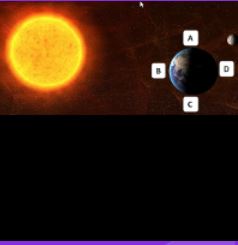


Y = day
Y = night

A student wants to use a spinning basketball to model the day-and-night cycle on Earth.
What should the student do in order to best model the cause of the day-and-night cycle?
Spin the ball in different directions
Tilt the ball while it is spinning
Paint one half of the ball black and the other half white
Shine a bright light on one side of the ball

Which of these locations on Earth experiences the least change in the number of daylight hours throughout the year?
Equator
North Pole
Tropic of Cancer
Tropic of Capricorn

A student notices that the moon is full one evening. Which sequence of moon phases will the student observe over the next eight days?
Full, waning gibbous, third quarter
Full, waning gibbous, first quarter, waning crescent
Full, new, waning gibbous
Full waxing gibbous, new, waning crescent
A student shows a model of Earth and the moon to a class. Which picture shows how the moon appears from Earth when it is in the position shown in this model?
The diagram shows four consecutive moon phases. Which of the following diagrams shows the next four moon phases in the correct order?
Which best explains the changes in the seasons?
Seasons change as a result of high temperatures caused by Earth's tilt and revolution around the Sun.
Seasons change as light from the Sun hits Earth's atmosphere and as Earth rotates around the Sun.
Seasons change as a result of the temperature decreasing because of Earth's revolution around the Sun.
Seasons change due to the amount of sunlight hitting Earth and Earth's tilt as it revolves around the Sun
Two friends want to go for a night hike when there is a full moon in July. If there is a third-quarter moon on July 2, what is the approximate date of the next full moon?
July 9
July 16
July 23
July 30
A student must complete the column of the table that lists the dates of the full moons. What are the most likely dates of the full moons?
February 5, March 7, April 5, May 4
February 15, March 17, April 15, May 14
February 25, March 27, April 25, May 24
February 29, March 31, April 29, May 28
A student uses paper and fasteners to create a model of Earth, the sun, and the moon. The sun and Earth are attached to the paper background, while the moon is free to revolve around Earth. Which diagram shows the objects arranged so that a new moon would be visible from Earth?
Early scientists believed the Sun revolved around Earth. What do modern scientists believe about the revolution of the Sun and Earth?
Earth revolves around the Sun, causing day and night.
Earth revolves around the Sun, causing seasons, as well as day and night.
Earth revolves around the Sun on a tilted axis, causing a change in seasons, and Earth rotates on its axis, causing day and night.
Earth revolves around the Sun, causing day and night, and Earth rotates on its axis, causing a change in seasons.
On July 4, 1776, the American colonies declared their independence. The table shows the lunar phases for June 1776. What lunar phases occurred on July 4, 1776?
Waning gibbous
Waxing gibbous
Waning crescent
Waxing crescent
Some students used records from the U.S. Naval Observatory to make the table of the percent of the moon that was visible on each night in January 2011. Based on these data, what part of the lunar cycle occurred between January 5 and January 7?
Waxing crescent moon
Waning crescent moon
Full moon
New moon
The diagram shows four phases of the moon as it revolves around Earth. A Student builds a model based on this diagram. The student uses foam balls to represent the moon and Earth and a flashlight to represent the sun. The student should shine the flashlight on the model of Earth from position---
1
2
3
4
Which of the following identifies the seasons in model Y?
A- Summer, B- Rainy or dry season, C- Winter
A- Fall, B- Rainy or dry season, C- Spring
A- Spring, B- Rainy or dry season, C- Fall
A- Winter, B- Rainy or dry season, C- Summer
But first look at the picture and answer below
F
G
H
J
Is the Sun or the Moon more responsible for the Earth's tides?
Sun
Moon
When the moon's pull is strongest on the part of the Earth directly facing the moon what kinds of tides occur?
High Tide
Low Tide
How many high and low tides occur each day?
1
2
3
4
What are tidal ranges based off of?
The Sun
The moon
The earth
all of the above
When do spring tides occur
New moon
Full moon
Both
Are neap tides weak or strong
Strong
Weak
Look at the picture and answer below.
f
g
h
j
A system of stars, gas, dust, and dark matter bound together by gravity is called -
an asteroid.
a nebula.
a galaxy.
a moon.
Stars are made mostly of which two elements?
Selenium and sodium
Astatine and arsenic
Chlorine and cesium
Hydrogen and helium
A large celestial body made of gases that emits light due to nuclear reactions is called -
a galaxy.
a nebula.
a comet.
a star.
An interstellar cloud of dust and gases that serves as a location for the formation of new stars is -
a meteor.
a planet.
a galaxy.
a nebula.
Galaxies are classified into all of the following types by their shapes EXCEPT -
spiral.
elliptical.
lenticular.
crescent.

The Hertzsprung-Russell diagram is provided, which is used for classifying stars based on the relationship between their brightness and their temperature and color. Regulus belongs in which of the following classifications?
Super Giants
Giants
Main Sequence Stars
White Dwarfs
Which of the following is an accurate description of the relationship between components of the universe?
Stars always contain galaxies.
Galaxies contain many stars.
Stars contain several nebulae.
Nebulae contain many galaxies.
A characteristic of a nebula is that it -
is at the center of the solar system.
is a region where stars are born.
forms halfway through a star’s life cycle.
has the coolest temperature in space.

What is the Universe?
All space and the matter space contains
A bright ball of gas held together by its' own gravity
The intensity of light from a celestial body
Large cloud of gas and dust

What is a star?
A large grouping of stars in space.
All space and the matter space contains.
A self-luminous celestial body consisting of a mass of gas.
The death of a large star by explosion.

What is the hottest type of star?
Orange Supergiants
Red Giants
Yellow Supergiants
White Dwarfs

What is the brightest type of star?
Main Sequence
White Supergiants
White Dwarfs
Red Giants

What is luminosity?
Color
Temperature
Brightness
Distance

90% of all stars are ___.
Black Holes
White Dwarfs
Red Giants
Main Sequence

This is where stars are born.
Nebulae
Black Holes
Main Sequence
Hollywood

The death of a large mass star by explosion.
Quasar
Nova
Supernova
Black Hole

An object that is so massive that even light cannot escape its gravity.
Black Hole
Neutron Star
Quasar
Moon

A large group of stars in space.
Solar System
Local Group
Constellation
Galaxy

What type of galaxy is this?
Elliptical Galaxy
Spiral Galaxy
Lenticular Galaxy
Irregular Galaxy

What type of galaxy is this?
Elliptical Galaxy
Irregular Galaxy
Spiral Galaxy
Lenticular Galaxy

What type of galaxy is this?
Elliptical Galaxy
Irregular Galaxy
Spiral Galaxy
Lenticular Galaxy

Islands are often formed at the boundaries of tectonic plates. These plates are large portions of lithosphere that move slowly over the more fluid, underlying material in the region below the crust.
What is the term for the region indicated by an X in the diagram?
asthenosphere
hydrosphere
inner core
outer core

A student records observations about two different layers of the Earth as shown in the table.
What do Layers 1 and 2 represent?
Layer 1: asthenosphere; Layer 2: continental crust
Layer 1: continental crust; Layer 2: lithosphere
Layer 1: asthenosphere; Layer 2: lithosphere
Layer 1: lithosphere; Layer 2: asthenosphere
How are the lithosphere and the asthenosphere similar?
They are both part of the crust.
They are both part of the mantle.
They both have the same thicknesses.
They both have the same physical properties.

Assume that the diagram below shows a cross section of part of the lithosphere.
Which diagram correctly shows what will happen to the lithosphere when pushed by tectonic forces?


Use the information to answer the question.
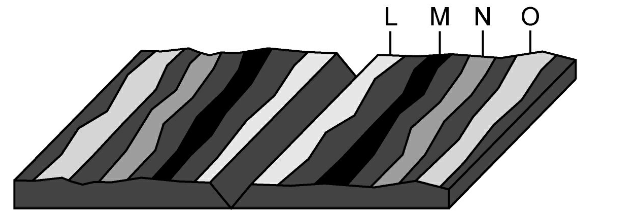
Which statements are true?


How do rock samples collected from the sea floor provide evidence of tectonic plate movement?
Older rocks are found near the deep-ocean trenches.
Older rocks are near the center of mid-ocean ridges.
Younger rocks are near the deep-ocean trenches.
Younger rocks are mixed with older rocks at mid-ocean ridges.
Which statement describes the differences between continental and oceanic crust?
Continental crust is thin with low density, while oceanic crust is thick with high density.
Continental crust is thick with low density, while oceanic crust is thin with high density.
Continental crust is thick with high density, while oceanic crust is thin with low density.
Continental crust is thin with high density, while oceanic crust is thick with low density.
In 1912, Alfred Wegener proposed the theory of continental drift, stating that all the continents were once joined together and slowly moved apart. However, his theory was not widely accepted in his time. In 1962, the discovery of sea floor spreading (sea floor being forced apart by the formation of new crust) eventually led to a more modern and widely accepted theory of plate tectonics.
Why did the theory of plate tectonics improve upon Wegener’s theory of continental drift?
The theory of plate tectonics was a less complete theory because it provided a reason and mechanism for why the plates and continents moved.
The theory of plate tectonics was a more complete theory because it failed to provide reasons and mechanisms for why the plates and continents moved.
The theory of plate tectonics was a less complete theory because it failed to provide complete reasons and mechanisms for why the plates and continents moved.
The theory of plate tectonics was a more complete theory because it provided a reason and mechanism for why the plates and continents moved.

Ancient fossils have been placed on the map indicating where they were found.
The strongest evidence exists for which two continents to have been connected when Pangaea was present?
South America and Africa
North America and Africa
Africa and Australia
South America and Australia
Greenland is very close to the North Pole and is covered with continental glaciers. What conclusion can be made about evidence of glaciers found in the northeastern United States?
It was much colder in the northeastern United States in the past.
It was much warmer near the North Pole in the past.
The glaciers near the North Pole formed later than the ones farther south.
The northeastern United States was once located closer to the Equator.

Use the information to answer the question.
Which explanation best accounts for the fossil evidence?
The continents were once connected by a large land bridge.
The reptile species evolved on the two different continents at the same time.
The continents were once joined together within a larger landmass.
The reptile species floated across the Atlantic Ocean on logs.

The image shows fossils in different layers of rocks.
Which layer most likely contains fossils of organisms that resemble the presently living dragonfly?
layer B
layer C
layer D
layer F

A student makes a model to show two continental plates at a convergent boundary by first breaking a clay block into two pieces. He then pushes the two pieces against one another with constant force, as shown in stages 1 and 2.
The student concludes that mountains are formed when two continental plates collide at a convergent boundary. Which statement best supports the student’s conclusion?
Both halves of the block are equal in dimensions.
The texture of the block resembles continental crust.
The fault line in stage 1 is vertical, and this is descriptive of all continental boundaries.
Both stages 1 and 2 have the same densities, and one plate cannot sink under the other.

A student prepared a list of changes that can occur to landforms through volcanic eruptions.
Which changes in the student’s list are correct?
1 and 2
1 and 3
2 and 3
3 and 4
Earthquakes occur along the San Andreas Fault in California. Which statement best describes plate motion in the area during the time between earthquakes?
Plate motion stops, and plate tension decreases.
Plate motion continues, and plate tension increases.
Plate motion continues, and plate tension increases. Plate motion stops, and only the mantle moves.
Plate motion reverses, and plates return to their original positions.
What type of landform is most likely formed by a divergent tectonic plate boundary?
island arc
oceanic trench
rift zone
folded mountains

The map below shows the present day locations of South America and Africa. Remains of Mesosaurus, an extinct fresh water reptile have been found in similarly aged rock layers formed from lake sediments.
Which statement represents the most logical conclusion from this evidence?
Mesosaurus migrated across frozen oceans from Africa to South America during an ice age.
The continents of South America and Africa were once joined when the Mesosaurus lived.
The continents of South America and Africa once had underground waterways where the Mesosaurus travelled from continent to continent.
The continents of South America and Africa had very different climates from each other which caused the Mesosaurus to migrate from season to season.

A student writes down some possible properties of different layers of Earth.
Which layer(s) is (are) matched with the correct properties?
asthenosphere only
continental crust only
asthenosphere and lithosphere
continental crust and oceanic crust

The diagram below shows the continents present day continents once joined together as one super continent.
What is the name of this one large landmass?
Eurasia
Gondwanaland
Laurasia
Pangaea

The Mesosaurus was a fresh water reptile that existed on Earth about 250 million years ago. Fossils of the reptile can be found today in some rock layers in both Africa and South America as shown on the map below in locations X and Y.
Which reason bestexplains why fossils of this animal are found on both continents today?
The ocean between the two continents was once frozen, and the Mesosaurus traveled across the ice.
The continents were once joined together as a single land mass.
The Mesosaurus swam across the ocean due to its migration.
During a sea level rise and floods fossil remains of the Mesosaurus were carried across the oceans between the two continents.


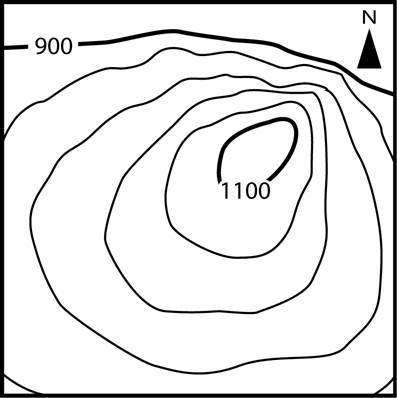
The steepest slope on this hill can be found on the side that is facing which direction?

Which side is steeper?
The left side of the hill
The right side of the hill

If sea level always equals (0), and the contour interval is 10 feet how tall is this mountain?
30 ft
40 ft
50 ft
60 ft

Match topographic map #4 with the appropriate profile.
C
D
E
F
A line that connects points of equal elecation on a map
Contour interval
Contour legend
Contour line
Index Contour
The difference in elevation between two adjacent contour lines of a map.
Relief
Space in between
contour line
contour interval
Distance above or below sea level
Relief
Contour line
Altitude
Elevation


A topographic map of a region is provided. Which position indicated by the letters is at an elevation of 475 meters?
W
X
Y
Z

Match topographic map #3 with the appropriate profile.
A
B
C
D


The universe has many different components. Which list places four components of the universe in the most likely order from smallest to largest?
Planets, stars, galaxies, nebulae
Nebulae, stars, planets, galaxies
Galaxies, stars, planets, nebulae
Planets, stars, nebulae, galaxies
There are four groups of stars on the HR Diagram. About 90% of all stars are in the ________.
Supergiants
Giants
White dwarfs
Main sequence

Analyze this HR Diagram. Which group of stars is considered to have a lower than average luminosity as well as a higher than average temperature?
Giants
Main Sequence
White Dwarfs
Supergiants
Analyze this HR Diagram. Which group of stars is considered to have a higher than average luminosity as well as a lower than average temperature?
Giants
Main Sequence
White Dwarfs
Supergiants
A collection of dust and gas where stars can form is called a...
universe
nebula
black hole
supernova
Our sun is located near the edge of a ______ galaxy, named the _______.
Spiral shaped; Milky Way
Spiral shaped; Solar System
Elliptical shaped; Milky Way
Elliptical shaped; Solar System
Which of the following best describes the sun's position in the Milky Way galaxy?
The sun is a giant yellow star located close to the galactic core.
The sun is a medium yellow star located approximately 2/3 of the way down one of the galaxy's spiral arms.
The sun is a dwarf star located at the end of one of the spiral arms.
The sun is a medium yellow star located one light year from the galactic core.

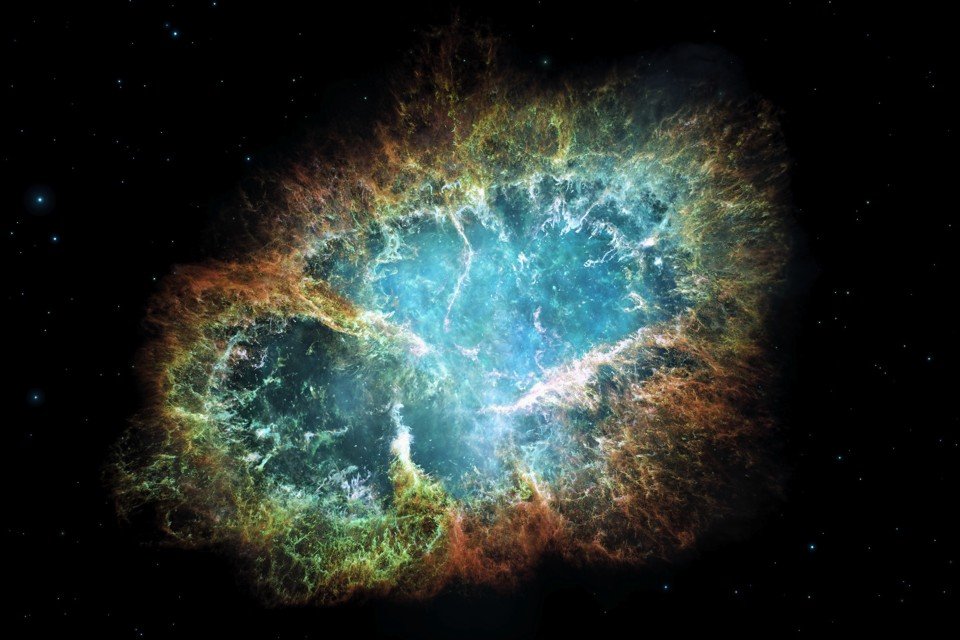

Our sun is in what stage?
planetary nebula
protostar
main sequence
red giant

This is a model of a galaxy a student made out of sand, each grain of sand would represent-
comet
black hole
asteroid
star
Why does the sun appear brighter than the supergiant star Betelgeuse?
the sun is a different color
the sun is older
the sun is closer
the sun is made of different elements


What type of galaxy is the Milky Way?
Spiral
Elliptical
Irregular
Irrational
Brightness of a celestial object
Magnitude
Light year
Star
Luminosity
Why do all objects in the solar system orbit the sun?
Because
The Sun`s gravity
Gravity
Earth
What color of star's temperature is hottest?
Blue
Red
Green
White
What color of star's temperature is coldest?
Blue
White
Green
Red
What kind of size star is the Sun?
Medium
Average
Small
Big

After a small star has used up all of it's hydrogen, it will become a......
white dwarf
red giant
interstellar cloud
supernova
True or False: All stars will eventually become a black hole
True
False
Where are stars "born"?
from the sun
in a nebula
in a supernova
in a white dwarf


Which star is hotter than Deneb
Procyon
Sun
Regel
Banard's Star

Which star is brighter than the sun?
Sirius B
Procyon B
Van Maanan's Star
Aldebaran

Which star is considered a giant star?
Mira
Zeta Arindani
Barnard's Star
Betelgeuse


How many Stars are in our Solar System?
(a)
Nitrogen - 78.0%
Oxygen - 20.0%
Argon - 0.9%
Carbon Dioxide - 0.04%


Fossil records indicate that the continents were once connected. How do fossil records support this claim?
We have been able to transport the same types of fossils from one continent to another.
Fossils of the same organism have been found on continents that are now separated by oceans.
Some continents contain fossils of many different types of organisms.

One piece of evidence for Plate Tectonics is that--
some continents appear to fit together like a puzzle.
we have video footage of the plates actually moving.
all continents have formed from volcanic eruptions.
the continents are no longer moving.

Younger crust being found near mid-ocean ridges supports the idea of Plate Tectonics because---
this indicates that new crust is being formed over time, pushing old crust outward.
this indicates that volcanoes are able to take place in different places on the Earth.
this indicates that new crust is never formed.
this indicates that the continents are stationary.
Which of the following is NOT evidence to support the theory of plate tectonics?
Fossils
Continental fit
Glaciers
Sand Erosion

Which of the following occurs because of convection currents?
Pressure in the crust decreases.
The mantle increases in size.
Pressure in the crust increases.
Pieces of the crust, known as tectonic plates, move.

At first, a lack of evidence for continental drift prevented many scientists from believing a single supercontinent called _________ existed.
Glossopteris
Pangaea
Gondwanaland
Mesosaurus

The theory of _______ states that Earth’s crust and upper mantle are broken into sections that are in constant, slow motion.
Plate Tectonics
continental drift
seafloor spreading
divergent boundaries

How do glaciers play a role in Plate Tectonics?
Glaciers cover parts of the Earth that have remained stationary.
There is evidence that glaciers have not always existed.
There is evidence that shows that the same glaciers covered different regions of several continents.
Glaciers exist in different in different places on the Earth.
The Great Rift Valley in Africa and the Mid-Ocean Ridge were all created by this boundary
Divergent
Convergent
Reform
Transform

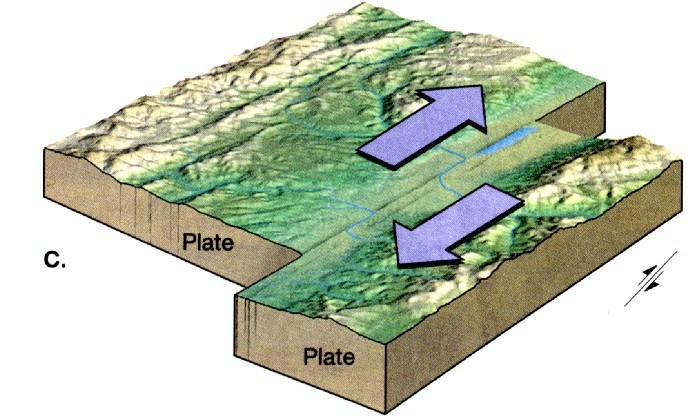
What is this image...
Revolving boundary
San Andreas (Transform)
Convergent
This landform can occur at a divergent plate boundary.
ocean trench
mid-ocean ridge
tall mountains
transform fault



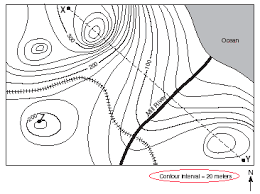
In which direction is Mill River flowing?
Southeast
Southwest
Northeast
Northwest


The river shown in the satellite image is carrying sediments in which direction?

