
 Worksheets
Quarter 2 Comprehensive Review
Total questions: 207
Worksheet time: 2hrs 44mins
Why are experimentation and evidence important in science?
They provide a systematic way to test hypotheses.
They eliminate the need for observation.
They ensure that all scientific theories are correct.
They allow scientists to avoid making mistakes.
Which of the following best describes the role of hypotheses in scientific investigations?
They are final conclusions based on data.
They are untested assumptions.
They are testable explanations for observations.
They are irrelevant to the scientific method.
What does the term “electromagnetic spectrum” refer to?
The range of different sound frequencies.
The range of all types of light radiation.
The range of different types of gases.
The range of temperatures in space.
How has studying old solar system models helped us understand how planets move and are arranged today?
By providing historical context and comparison
By offering precise mathematical models
By predicting future planetary positions
By showing the influence of other galaxies
Which of the following statements is true about the scientific method?
It is a rigid set of steps.
It is based solely on intuition.
It does not require experimentation.
It involves making observations, forming hypotheses, and testing them.
The ozone layer plays a crucial role in protecting life on Earth by:
Blocking harmful ultraviolet radiation from the sun
Increasing the Earth's temperature
Absorbing carbon dioxide
Producing oxygen
Which historical model of the solar system placed Earth at the center?
Heliocentric model
Big Bang model
Geocentric model
Nebular model
Gravity affects the formation of objects in our solar system by influencing the structure and movement of celestial bodies. Which of the following is NOT an example of an object formed by gravity?
Planets
Stars
Moons
Asteroids
The process of testing a scientific hypothesis through experiments and observations is known as ______.
hypothesis
experimentation
control
variable
analysis
Which of the following is a property of stars?
They have no gravitational pull.
They emit light and heat.
They are always cold.
They do not produce energy.
Electromagnetic waves that are also low in energy and used for cell phones and heating food.
Microwaves
Gamma rays
X-rays
Ultraviolet rays
Energy that travels in waves, including light, radio waves, and microwaves.
Electromagnetic energy
Thermal energy
Chemical energy
Nuclear energy
The distance between one wave and the next. Long wavelengths mean the waves are more spread out, and short wavelengths mean they are closer together.
Wavelength
Frequency
Amplitude
Velocity
Waves that are between microwaves and visible light. Felt as heat, like warmth from the sun or a fire.
Infrared waves
Ultraviolet waves
Radio waves
X-rays
Electromagnetic waves with low energy and long wavelengths, used for sending signals like music to radios or helping with GPS navigation.
Radio waves
Gamma rays
X-rays
Ultraviolet rays
The strongest type of electromagnetic waves, which come from changes in atoms. They can be harmful because they have so much energy.
Gamma rays
X-rays
Microwaves
Radio waves
How often a wave moves up and down in a certain amount of time.
Frequency
Amplitude
Wavelength
Velocity
The properties of stars, such as color and temperature, can be used to determine their:
Age and composition
Distance from Earth
Size and mass
Orbital speed
Compare and contrast the properties and behaviors of light when interacting with each different material: 1. Transparent objects 2. Translucent objects 3. Opaque objects
Light passes through transparent objects without scattering.
Light is scattered as it passes through translucent objects.
Light does not pass through opaque objects.
All of the above
Which model, Heliocentric or Geocentric, places the Sun at the center of the solar system?
Heliocentric
Geocentric
The distance between the Earth and the Sun is approximately:
1 million kilometers
200 thousand kilometers
50 million miles
93 million miles
What type of light interaction occurs when light passes through a transparent material and bends?
Reflection
Absorption
Refraction
Diffraction
How has new technology made it easier to watch and study space objects and events?
By providing high-resolution telescopes
By reducing the cost of space missions
By enabling real-time data transmission
By increasing the number of space observatories
How do astronomers determine the distance between celestial objects?
By measuring the angle of parallax
By using the Doppler effect
By calculating the object's brightness
By observing the object's color
Which of the following phrases is most appropriate when discussing scientific findings?
The results prove the hypothesis
The hypothesis is correct
The results support the hypothesis
The data confirms the theory
Which of the following is a characteristic of scientific knowledge?
It is fixed and unchangeable.
It is based on empirical evidence and subject to revision.
It is based on personal beliefs and opinions.
It remains the same across all cultures.
How does light from the Sun reach the Earth?
Through a vacuum in space
By conduction through air
Via sound waves
Through water currents
Sort the electromagnetic waves on the electromagnetic spectrum from lowest frequency (left) to highest frequency (right):
Radio Waves, Microwaves, Infrared Waves, Visible Light, Ultraviolet Waves, X-Rays, Gamma Waves
Gamma Waves, X-Rays, Ultraviolet Waves, Visible Light, Infrared Waves, Microwaves, Radio Waves
Visible Light, Infrared Waves, Microwaves, Radio Waves, Ultraviolet Waves, X-Rays, Gamma Waves
X-Rays, Gamma Waves, Ultraviolet Waves, Visible Light, Infrared Waves, Microwaves, Radio Waves
Which type of electromagnetic radiation is primarily used in medical imaging to view the inside of the body?
Radio Waves
Microwaves
Infrared
X-rays
Which layer of the Earth’s atmosphere contains the ozone layer?
Troposphere
Mesosphere
Thermosphere
Stratosphere
Scientists use models to understand complex systems in space, like the solar system, because they help simplify and explain these systems. Which of the following is an example of a historical model that impacted scientific knowledge?
The Ptolemaic model
The Copernican model
The Tychonic model
The Aristotelian model
Which of the following is an example of refraction in everyday life?
A mirror reflecting light
A straw appearing bent in a glass of water
A black shirt absorbing sunlight
A white wall reflecting sunlight
What type of light interaction causes the colors of a rainbow to appear?
Refraction
Reflection
Absorption
Transmission
How is space organized from galaxies to single stars? Explain how this helps us understand the universe.
Space is organized into galaxies, which contain stars, planets, and other celestial bodies.
Space is a random collection of stars and planets without any organization.
Galaxies are smaller than stars and are part of a larger cosmic structure.
Stars are organized into galaxies, which are isolated and do not interact with each other.
How do light waves travel through different materials?
Light travels through air and water but not solids.
Light travels through solids and water but not air.
Light travels at the same speed through all mediums.
Light travels through all mediums but travels slowest through solids.
How do light waves travel through different materials?
Light travels through air and water but not solids.
Light travels through solids and water but not air.
Light travels at the same speed through all mediums.
Light travels through all mediums but travels slowest through solids.
Why do astronomers use X-ray or radio telescopes to capture images of objects in space?
Telescopes are the only form of technology that can detect images in space
Telescopes can capture images in all forms of the electromagnetic spectrum
Telescopes can capture images at wavelengths of light that are visible to the human eye
Telescopes can capture images at wavelengths of light that are invisible to the human eye
The Sun is classified as this type of star:
Red Giant
Yellow Dwarf
White Dwarf
Main Sequence
The layer of the Sun where Nuclear Fusion occurs:
The Chromosphere
The Core
The Photosphere
The Corona
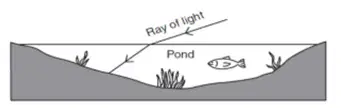
What happens to the light as it enters the pond?
Reflection
Refraction
Absorption
Scattering
An astronomer observes a sunspot. Which of the following describes this feature of the Sun?
Where heat rises to the Sun’s surface
Location that produces most of the Sun’s heat energy
Location that is cooler than other parts of the Sun’s surface
Where energy and matter leave the Sun’s atmosphere
The visible surface of the Sun that we can see from Earth
Photosphere
Chromosphere
Radiative Zone
Atmosphere
Energy from the Sun's core moves through the radiative zone via
Nuclear Fusion
Radiation
Convection
Emanation

How does Star X compare to the Sun?
Star X is brighter and hotter than the Sun.
Star X is dimmer and cooler than the Sun.
Star X is dimmer and hotter than the Sun.
Star X is brighter and cooler than the Sun.
The outermost layer of the Sun's atmosphere
Stratosphere
Photosphere
Chromosphere
Corona
Why an apple is green?
It refracts green light
It absorbs all colors of visible light but reflects green light
It absorbs green and reflects all other colors of visible light.
Green is the only color of visible light that shines on the apple
The Sun rotates every _ days at the Equator
27
25
24
30
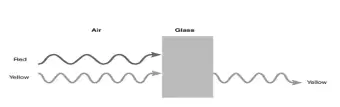
What happened to the red light?
The glass absorbs the red light.
The glass absorbs the yellow light.
The glass refracts the yellow light.
The glass reflects the red light.
What is the most common element found in stars?
Oxygen
Helium
Hydrogen
Carbon
Which property of a star is directly related to its color?
Age
Temperature
Distance
Size
How is visible light from the Sun different from other forms of electromagnetic radiation?
It has different amplitudes.
It travels a different distance through space.
It is a different form of energy.
It has different wavelengths.
How bright a star appears from Earth:
Distance
Luminosity
Absolute Brightness
Apparent Magnitude
How bright a star looks from a standardized distance of 10 parsecs
Absolute Brightness
Apparent Brightness
Luminosity
Radiance
The total energy output of a star
Absolute Brightness
Radiance
Luminosity
Apparent Brightness
Why do we see objects as the color that they are?
The color of the object is the color of light being absorbed, all other colors are reflected.
The color of the object is the color of light being reflected, all other colors are absorbed.
The color of the object is due to all of the colors being absorbed.
The color of the object depends on the transparency of the object.
The hottest stars radiate _ visible light.
Red
Orange
Yellow
Blue
The coolest stars radiate _ visible light.
Blue
White
Orange
Red
Energy that moves through space in waves, like sunlight or heat from a fire
Visible Light
Frequency
Microwaves
Radiation
When a star's size and temperature increases, its absolute brightness _
Increases
Decreases
Why does thunder sound like a loud boom when lightning strikes nearby, but it makes a rumbling sound from far away?
The further away the source of sound, the more the sound gets distorted
Thunder travels slower over longer distances
The sound is absorbed by the Earth's magnetic field
The temperature of the clouds changes the sound of thunder
An effect that occurs when light bends as it passes from one substance into another
Reflection
Absorption
Refraction
Diffraction
An effect where light is taken in by a substance or surface
Absorption
Reflection
Refraction
Diffusion
An effect that occurs when light hits smooth, shiny surfaces and bounces back.
Refraction
Reflection
Absorption
Diffusion
Anything that has mass and takes up space
Matter
Energy
Light
Force
Part of the electromagnetic (EM) spectrum that has the highest frequency
Radio Waves
Gamma Rays
X-Rays
Infrared Waves
The distance between one crest of a wave to the next
Velocity
Amplitude
Frequency
Wavelength
Which of the following types of radiation has the longest wavelength?
Infrared
Ultraviolet (UV)
X-rays
Gamma Rays
All light passes through
Opaque
Translucent
Transparent
Baroque
No light passes through
Opaque
Baroque
Equivoque
Transparent
Some light passes through
Opaque
Translucent
Transparent
Transfixed
An object that _ a certain color of light appears to be that color.
Absorbs
Reflects
Converts
Transfers
Electromagnetic waves that are low in energy and used for cell phones and heating food.
Infrared Waves
Radio Waves
Microwaves
Cellular Data
Invisible waves with more energy than light. These waves might cause skin damage or cancer.
Ultraviolet (UV)
Waves
X-Rays
Gamma Rays
Infrared Waves
What is the first step in the scientific method?
Formulating a hypothesis
Communicating results
Conducting an experiment
Making an observation
What is a hypothesis?
A final conclusion
A scientific tool
A testable possible answer to a question
A detailed experiment
What is the purpose of a control group in an experiment?
To test multiple variables
To provide a baseline for comparison
To change the outcome of the experiment
To ensure the experiment is complex
What is an independent variable?
A variable that is not used
A variable that is kept constant
A variable that is measured
A variable expected to have an effect
What is a null hypothesis?
A hypothesis that states there is no effect
A hypothesis that is proven
A hypothesis that cannot be tested
A hypothesis that is always true
Why do scientists avoid claiming to 'prove' a specific idea?
Because science is mutable and continuously changes
Because experiments are always wrong
Because hypotheses are never testable
Because observations are not important
What should be done if the results of an experiment do not support the hypothesis?
Stop the experiment
Prove the hypothesis
Modify the hypothesis based on new observations
Ignore the results
What is the dependent variable in an experiment?
The variable that is manipulated
The variable that is measured
The variable that is kept constant
The variable that is not used
What is the role of communication in the scientific method?
To keep results secret
To stop further experiments
To change the hypothesis
To share results with other scientists and the public
What is the crux of scientific inquiry?
A stepwise recipe
A continuous refinement and testing of ideas
A final conclusion
A single experiment

Which of the following statements describes one limitation of geocentric and heliocentric models of our solar system?
Both models include the Sun.
Both models include the Earth with one revolving moon.
Both models represent multiple stars within our solar system.
Both models include a central astronomical body with other astronomical bodies revolving around it.

Which planet has the highest average temperature?
Mercury
Venus
Earth
Mars

What is the main component of Venus's atmosphere?
Nitrogen
Oxygen
Carbon dioxide
Hydrogen

Which planet is 1 AU from the Sun?
Mercury
Venus
Earth
Mars

What is the average temperature on Mars?
15 °C
-65 °C
-110 °C
-140 °C

What is the distance from the Sun to Saturn in AU?
0.4 AU
1.5 AU
5.2 AU
9.6 AU

Which of the following points on the diagram represents summer in the Southern Hemisphere?
1
2
3
4

What is the revolution period of Mars in Earth years?
1.88 Earth years
11.9 Earth years
164.8 Earth years
365 days

Which planet has a thick atmosphere mostly composed of nitrogen and oxygen?
Mercury
Venus
Earth
Mars
During a solar eclipse, what occurs?
The moon casts its shadow on Earth and a new moon occurs.
The sun casts its shadow on the moon and a full moon occurs.
The Earth casts its shadow on the moon and a new moon occurs.
The moon casts its shadow on Earth and a full moon occurs.
Why does Venus have a higher average temperature than Mercury?
The rotational period of Venus is longer.
The atmosphere on Venus is thicker.
The atmosphere on Venus is thinner.
The revolution period of Venus is longer.
Michael created a model of the Sun-Earth-Moon system. He rotated the model until the north end of Earth’s rotation axis was tilted toward the Sun. Which season would the Southern Hemisphere be experiencing in Michael’s model?
Fall
Spring
Summer
Winter
Which statement below best describes how scientists explain gravity's role in the formation of our solar system?
The combined gravitational attraction between our planets was so large that it pulled the Sun away from a nearby star cluster in the center of our solar system.
The eight planets in our solar system were originally orbiting a nearby star, and the Sun's gravity was large enough to pull those planets into orbit around the Sun.
Due to the expansion of neighboring solar systems, the gravitational attraction of our planets to those solar systems forced the formation of the planets around our Sun.
As the Sun was forming, the force of gravity caused surrounding dust grains to collide and stick together, forming dust granules into increasingly larger bodies that became planets.
What revolves around Earth as Earth revolves around the Sun?
The Moon
Mars
Venus
Jupiter

How does the heliocentric model compare to the geocentric model?
The Earth is in the center of the solar system in the heliocentric model.
The Sun is in the center of the solar system in the geocentric model.
The Earth is in the center of the solar system in the geocentric model.
The Sun is in the center of the solar system in both models.
Which of the following points on the diagram represents summer in the Northern Hemisphere?
1
2
3
4
The planet Saturn takes 10,747 Earth days to complete one orbit around the Sun. Why does Saturn take longer to complete one orbit around the Sun than Earth does?
Saturn has stronger gravity.
Saturn is farther from the Sun.
Saturn has a thicker atmosphere.
Saturn is the only planet with rings.
The tides at the beach changes during the day. Which of the following most impacts the changes in tides?
Earth's magnetic field.
Earth's revolution around the Sun.
The Moon's gravitational pull on Earth.
The Sun's gravitational pull on the moon.

The correct order of objects in a solar eclipse:
Sun – Moon – Earth
Sun – Earth – Moon
Earth - Sun - Moon
Moon - Sun - Earth

The correct order of objects in a lunar eclipse:
Sun – Moon – Earth
Sun – Earth – Moon
Earth - Sun - Moon
Moon - Sun - Earth
How does Earth’s gravitational attraction to the Sun affect Earth’s orbit?
It pulls Earth into a circular orbit, keeping Earth’s distance from the Sun constant.
It pulls Earth into a slightly elliptical orbit, keeping Earth in motion around the Sun.
It makes Earth move in a straight line around the Sun.
It causes Earth to rotate more slowly when it is farther from the Sun.
Which of the following best describes why the Moon has phases?
Earth’s shadow falls on the Moon at different angles.
The Moon moves through Earth’s shadow at different times.
We see varying amounts of the sunlit side of the Moon as it orbits Earth.
The Moon rotates, changing the side that faces Earth.
Which planet has the largest diameter in our solar system?
Earth
Saturn
Venus
Jupiter

Which planet is known for having the most prominent ring system?
Uranus
Neptune
Saturn
Jupiter
Which object in the solar system has the strongest gravitational force?
Mars
The Sun
Jupiter
Mercury
Which of the following best describes the asteroid belt?
A region with multiple small planets between Earth and Mars.
A group of comets near the Sun.
A band of rocky objects orbiting between Mars and Jupiter.
The icy region beyond Neptune.

What is the primary composition of comets?
Solid metal and rock
Ice, dust, and gases
Pure gas
Water and soil
Which of the following best describes the surface of Mars?
Lush and green with vegetation
Mainly composed of water
Covered with thick ice layers
Rocky with iron oxide dust, giving it a reddish color
Which planet rotates on its side with an axis almost parallel to its orbit?
Earth
Venus
Uranus
Neptune
What characteristic is unique to Earth compared to other planets in our solar system?
Liquid water on its surface
Presence of an atmosphere
Active volcanoes
Orbit around the Sun
What do all inner planets (Mercury, Venus, Earth, Mars) have in common?
Lack of moons
Gas compositions
Rocky surfaces
Ring systems
What role does gravity play in the formation of stars and planets?
It pushes objects apart.
It attracts gas and dust to form larger masses.
It has no effect on formation.
It only affects planets, not stars.

Why do planets closer to the Sun orbit faster than those farther away?
They have weaker gravitational pulls.
The Sun’s gravity is stronger closer to it.
They are larger in size.
They are made of heavier materials.
Which of the following describes how planets form into spherical shapes?
The rotation speed shapes the planet.
Gravity pulls matter evenly towards the center.
The magnetic field shapes the planet.
Their atmospheres shape them.
What prevents objects in space from colliding with each other all the time?
Gravity maintains stable orbits.
Lack of gravitational attraction
Magnetic repulsion
They move in the same direction.
Why are gas giants like Jupiter and Saturn less dense than terrestrial planets?
They are farther from the Sun.
Their gravity is weaker.
They rotate faster.
They are primarily composed of gases.
Who proposed the geocentric model, where Earth is at the center of the solar system?
Copernicus
Galileo
Ptolemy
Kepler
Which model of the solar system correctly places the Sun at the center?
Geocentric model
Lunar-centric model
Heliocentric model
Stellar-centric model
What was one major flaw in the geocentric model?
It stated that the Sun revolves around Earth.
It placed Earth at the outer edge of the solar system.
It stated that planets move in straight lines.
It included multiple stars in the solar system.
How do the positions of the Sun, Earth, and Moon cause spring tides?
The Sun, Earth, and Moon form a right angle.
The Sun and Moon line up, making tides higher and lower than usual.
The Sun is far from Earth, causing weaker tides.
The Earth is between the Sun and Moon, pulling water away.
How does the gravitational pull of the Moon influence Earth’s oceans?
It pulls water away from Earth, creating high tides.
It causes the water to evaporate, reducing the ocean’s volume.
It causes a bulge of water to form, resulting in high tides.
It has no effect on the oceans.
Why does the Earth experience two high tides each day?
Earth rotates on its axis every 12 hours.
The Moon’s gravitational force pulls the water on Earth’s surface, creating two high tides.
The Sun’s position causes two tidal waves.
Earth’s shape causes the water to rise and fall.

During which phase of the Moon does a solar eclipse occur?
Full Moon
First Quarter
New Moon
Third Quarter

A lunar eclipse occurs when:
The Moon moves into the Sun's shadow.
The Earth moves into the Moon's shadow.
The Sun moves into Earth's shadow.
The Moon moves into Earth's shadow

Compared to Earth’s moon, the moons of Mars are:
Equal in size
Larger in size
Smaller in size
Made of different substances
Which of the following provides the best reasoning for how the planets form their spherical shapes?
The gravitational attraction of the planets towards each other
The gravitational pull towards the center of the planets
The gravitational repulsion of the planets away from each other
The gravitational push away from the center of the planets

Based on the information given, which is the most likely reason we have not sent humans to investigate the nearest Earth-like planet?
Humans would have to travel through the vacuum of space to get there.
The nearest Earth-like body does not have conditions friendly to humans.
There is no reason to travel to any celestial bodies outside our solar system.
Due to the enormous distances in space, it would take humans too long to travel there.

Which point on the chart best represents the approximate size of Earth?
X
W
Y
Z
One of the ways that scientists determine the distance between Earth and other objects in space is to send light waves toward an object and measure how long it takes for the waves to bounce back. If a scientist sent light waves to four different objects in space, which of the following would take the longest to reflect the light wave back to Earth due to their distance from Earth?
A star in the Milky Way Galaxy
A star in the Andromeda Galaxy
A planet in Earth's Solar System
A planet in another star system within the Milky Way Galaxy
Proxima Centauri is the closest star to Earth, after the Sun. It is located 4.3 light years away from Earth. How long does it take light from Proxima Centauri to reach Earth?
1 year
43 years
4.3 years
63,200 years
The Andromeda Galaxy was previously called the Great Andromeda Nebula because astronomers thought this patch of light was composed of glowing gases. In the 1900s, scientists determined the nebula was actually a spiral galaxy. Which of the following describes the relationship between this galaxy and other astronomical bodies?
This galaxy is the largest star and is found in the universe.
This galaxy is surrounded by thousands of stars in the universe.
This galaxy includes a universe that is composed of millions of stars.
This galaxy is one of billions of galaxies in the universe and contains billions of stars.
Which object is closest to Earth?
Barnard's Star
Planet Neptune
Triangulum Galaxy
Andromeda Galaxy
In 2004 the Hubble Space Telescope captured images of distant star clusters, each containing about a million stars. These star clusters were most likely part of which structure?
galaxy
nebula
Solar system
Asteroid belt

If "Z" represents a planet, what would "Y" most likely represent?
A universe because it contains billions of planets.
A solar system because it contains planets and a star.
A nebula because that is what the planets formed from.
A galaxy because it contains one solar system that has several planets.
Which of the astronomical bodies below are composed of a single star, moons, planets, comets, asteroids, and meteors?
Galaxy
Nebula
Universe
Solar System
Susan is making a model to represent a universe, galaxy, and a star. She places a bowl inside a shoebox. She places a ball inside the bowl. What do the shoebox, bowl, and ball represent?
The shoebox represents a universe, the bowl represents a star, and the ball represents a galaxy.
The shoebox represents a universe, the bowl represents a galaxy, and the ball represents a star.
The shoebox represents a galaxy, the bowl represents a universe, and the ball represents a star.
The shoebox represents a star, the bowl represents a galaxy, and the ball represents a universe.
Ava is trying to help her brother Samuel with his science homework about the Universe. Which description below best explains what the Universe is?
The Universe is a black hole made of dark matter.
The Universe is a giant cloud of dust and gas in space.
The Universe contains the Milky Way galaxy which contains most of the stars in space.
The Universe contains many billions of galaxies and each galaxy contains many billions of stars.
The distance that light travels in one year.
Light Year
Parsec
Astronomical Unit
Speed of Light
The distance from the Earth to the Sun
0.1 AU
0.4 AU
1.0 AU
1.2 AU
What is a galaxy?
A small rock that orbits the Earth.
A huge group of stars, gas, and dust bound together by gravity.
A single star with no planets or other objects around it.
A type of cloud made of water vapor in space.
The Sun and everything that orbits around it, including planets, moons, asteroids, and comets.
Solar System
Galaxy
Universe
Sun-Earth-Moon System
The space between stars.
Parsec
Intergalactic
Interstellar
Asteroid Belt
A natural satellite that orbits a planet, reflecting light from the sun.
Moon
Satellite
Asteroid
Comet
All of space and time, containing everything that exists, including galaxies, stars, and planets.
Black Hole
Universe
Solar System
Galaxy
A large celestial body that orbits a star, is spherical in shape
Comet
Nebula
Moon
Planet
A small rocky body that orbits the Sun
Comet
Asteroid
Moon
Dwarf Planet
What is the name of our galaxy?
Andromeda
Triangulum
Milky Way
Whirlpool
About how many stars are in a galaxy?
Hundreds
Thousands
Millions
Billions
Sirius is one of the brightest stars visible from Earth and is located approximately 8.6 light years away. How long does it take light from Sirius to reach Earth?
4.3 years
8.6 years
86 years
860 years
What is the universe mostly made of?
Planets, moons, and comets
Stars, galaxies, and space dust
Asteroids, comets, and planets
Only stars and planets
Which of the astronomical bodies below are composed of a single star, moons, planets, comets, asteroids, and meteors?
Galaxy
Nebula
Universe
Solar System
If a scientist were to send a radio signal to four different celestial bodies, which of the following would take the longest to receive the signal back on Earth due to its distance from Earth?
A moon orbiting Jupiter
A star in the Milky Way Galaxy
A planet in the Andromeda Galaxy
A distant galaxy outside of our local group
Temperature and density vary in Earth’s layers. Which of the following accurately describes the temperature and density of Earth's layers?
The lithosphere is the densest of Earth's layers and has the lowest average temperature.
The convecting mantle is the hottest and most dense layer of Earth.
The liquid outer core has the lowest average temperature and is the least dense layer of Earth.
The solid inner core is the hottest and most dense layer of Earth.
The Andes Mountains formed along the western coast of South America at the boundary between the Nazca Plate and the South American Plate. Which type of boundary most likely exists between the Nazca Plate and the South American Plate?
Transform boundary, where the plates are sliding past each other
Transform boundary, where the plates are moving closer to each other
Convergent boundary, where the plates are moving toward each other
Convergent boundary, where the plates are moving parallel to each other
Which of the following processes of the rock cycle takes place deep below Earth's surface and occurs as a result of Earth's tectonic plates?
Deposition
Solidification
Weathering and erosion
Heat and pressure
The Earth is made up of several large, slow-moving tectonic plates that sometimes cause earthquakes. Which layer of the Earth contains these large plates?
Mantle
Solid core
Lithosphere
Molten core

The diagram shows four layers of the solid Earth. Which part of this diagram represents the only liquid layer of Earth?
1
2
3
4
Which process did scientists finally determine to be the drive behind continental motion?
Superposition
Convection currents
Magnetic reversals
Mountain building
The direction and motion of Earth’s tectonic plates create a variety of features at the boundaries between the plates. Which of the events below is a slow change on Earth that occurs at a divergent boundary?
Earthquake
Volcanic eruption
Sea floor spreading
Mountain range formation

The diagram shows two hypotheses for the same process that occurs beneath Earth’s surface. Which of the following processes is represented by these hypotheses?
Convection current movement in Earth’s mantle
Layer separation in Earth’s inner core
Plate movements in Earth’s outer core
Rock formation in Earth’s lithosphere

At a mid-ocean ridge, plates are pulled apart. Fracturing in the sea floor allows magma to move up from the mantle. The diagram below shows two plates that are moving apart. Which process in the rock cycle does this diagram best represent?
Chemical weathering of rocks
Formation of igneous rock
Erosion of sedimentary rocks
Compaction of melted rock

Two students are studying plate tectonics, focusing on how mountains and volcanoes form. They learned the Andes and Himalayas are among the largest mountain ranges, with the Andes in South America and the Himalayas between India and China. They also discovered the "Ring of Fire," home to 75% of Earth's active and dormant volcanoes, and marked the Himalayas on a map with a star.
Which statement best describes how the Ring of Fire was formed?
Oceanic plate subducted under a continental plate at a divergent boundary.
Oceanic plate subducted under a continental plate at a convergent boundary.
Continental plate subducted under an oceanic plate at a divergent boundary.
Continental plate subducted under an oceanic plate at a convergent boundary.
What makes the rock cycle a cycle?
Rocks always stay in the same form over time.
Rocks move through different processes and can change into different types of rocks.
Rocks are formed only once and remain unchanged.
Rocks are destroyed completely and never reused in nature.
How is rock classification related to the rock cycle?
Rock classification determines which rocks are destroyed during the rock cycle.
Rock classification has no connection to the rock cycle.
The rock cycle prevents rocks from being classified because they constantly change.
The rock cycle creates the processes that form different types of rocks, which are then classified into groups.

Examine the diagram. What types of rocks do the numbers 2, 3, and 5 represent, in that order?
igneous, sedimentary, metamorphic
metamorphic, igneous, sedimentary
sedimentary, igneous, metamorphic
sedimentary, metamorphic, igneous
What part does subduction play in the rock cycle?
It breaks rocks into sediment.
It pulls rocks deep into Earth.
It decreases pressure on buried rocks.
It pushes rocks up to Earth’s surface.
Which processes cause rocks to be exposed at Earth’s surface?
erosion and subduction
extreme heat and pressure
erosion and uplift
melting and cooling

Examine the diagram and the graphs. In which layer of Earth are temperature and pressure greatest?
A
B
C
D
Which statement best differentiates the layers of the mantle?
The mantle is divided into the lithosphere, asthenosphere, and lower mantle based on their physical properties and behavior.
The mantle consists of a single solid layer with no subdivisions.
The mantle is the outermost layer of Earth, directly above the crust.
The mantle's layers are defined by their chemical composition only.
Which of Earth’s upper layers flows very slowly?
Asthenosphere
Continental crust
Lithosphere
Ocean crust
How do scientists learn about Earth’s core?
Wells
Mines
Earthquake waves
Temperature measurements
Sediment is formed through what process?
Cooling and crystallization
Extreme pressure and heat
Melting
Weathering
What processes are necessary in order to turn sand into rock?
Cooling and crystallization
Compaction and cementation
Uplift and deposition
Weathering and erosion
What type of rock is likely to form where continental plates collide?
Extrusive
Igneous
Metamorphic
Sedimentary
What happens when two oceanic plates collide?
The older plate subducts, forming an oceanic trench.
The younger plate subducts, forming an oceanic trench.
Neither plate subducts and folded mountains form.
Neither plate subducts and a mid-ocean ridge forms.
Which of the following describes the evidence scientists used to support the idea that continents have moved over time?
Earthquakes in the ocean
Matching fossils found across different continents
Volcanic islands
Flooding around the world

Where on the map are mountains most likely to form?
A
B
C
D
Which statement correctly describes how two tectonic plates sliding past each other at a transform plate boundary change Earth's surface?
They cause earthquakes and move rocks down.
They cause volcanism and move rocks up.
They cause mountain building and move rocks up.
They cause earthquakes and move rocks laterally.
Temperature and density vary in Earth’s layers. Which of the following accurately describes the temperature and density of Earth's layers?
The solid inner core is the hottest and most dense layer of Earth.
The convecting mantle is the hottest and most dense layer of Earth.
The lithosphere is the densest of Earth's layers and has the lowest average temperature.
The liquid outer core has the lowest average temperature and is the least dense layer of Earth.

The diagram illustrates processes in the rock cycle.
Which of the following processes of the rock cycle takes place deep below Earth's surface and occurs as a result of Earth's tectonic plates?
Deposition
Solidification
Heat and pressure
Weathering and erosion
The processes of weathering and erosion remove rock material from the surface of rocks. If the eroded surface gets buried during deposition of sediment, a specific geologic feature is formed. This feature marks a gap in time. What is it called?
half-life
correlation
index fossil
unconformity
Index fossils are used to help correct rock layers. They are also used to help determine the relative age of rock layers. What makes index fossils useful to geologists?
the species lived over a short period of geologic time
few in number
not easily recognized
distributed over a small geographic area

Suppose that this figure represents the Miccosukee Formation.
Where is the oldest layer of the Miccosukee Formation?
1
2
3
4
Geologists have determined that while the Miccosukee Formation was being deposited, some of the layers were eroded away by wave action. The eroded surface was later covered by more sediment. The layers of the Miccosukee Formation are all horizontal. Suppose that this figure represents the Miccosukee Formation.
In what type of environment did the Miccosukee Formation form?
in a desert
on a glacier
along a coastline
at the bottom of a lake
What characteristic of radioactive decay makes it useful for determining the absolute age of samples?
occurs at a constant rate
changes based on temperature
slows down in very dense samples
speeds up based on the amount of the sample
Radiocarbon dating is used to determine the age of materials that contain the isotope carbon-14. Which choice below can be dated using radiocarbon dating?
lava flows
igneous rock
organic matter
living organisms
When using radiometric dating, what are we determining?
the relative date that a fossil lifeform died
the time of crystallization of an igneous rock
the degree of foliation in a metamorphic rock
the rate of sedimentation of a sedimentary rock
Angel and Ramona are studying relative time in their Earth science class. They have taken a day trip to Gadsden County, in Florida’s panhandle. They want to study the layers of sand and gravel that make up a rock unit called the Miccosukee Formation.
Geologists have determined that while the Miccosukee Formation was being deposited, some of the layers were eroded away by wave action. The eroded surface was later covered by more sediment. The layers of the Miccosukee Formation are all horizontal.
When Angel and Ramona returned home from the field trip, they wanted to determine the numerical ages of their sandstone samples they collected. Their professor told them that it would not be possible to do. Why not?
The samples are poorly sorted and only grain sizes that are the same can be used in radioactive dating.
The pieces of rock in the sandstone are too old for radioactive dating to work correctly.
The grains that make up the sandstone are from older rocks that were broken apart and deposited as sandstone.
The cement that glues the sandstone together is made of a different material which will interfere with the testing.

The figure shows a newly discovered index fossil. What happened that helped this fish become a fossil?
It was buried quickly.
It was eaten by scavengers.
It got exposed at the surface.
It got subjected to high temperatures.
In a recent science magazine, a scientist reported the discovery of a new variety of fossil. It is very different from other fossils in the area. It is only present in rock layers at the bottom of a small lake area. The organism seems to have been very rare, and the fossil records indicate that this species existed for a short period of time. Would this make a good index fossil?
Yes because a rare fossil is very distinct and index fossils are distinct.
Yes because the lifeform lived for a short period of time and the fossil is rare.
No because index fossil species must be both abundant and have lived for a short period of time.
No because index fossils must be abundant, have lived for a short period of time and be distinct in appearance.

Which choice lists the rocks and features in the correct order from oldest to youngest?
dike, fault, sedimentary layers
fault, dike, sedimentary layers
sedimentary layers, fault, dike
sedimentary layers, dike, fault
A scientist wants to find the actual age of a rock in years. What would be the best way of doing this?
Count the number of fossils the rock contains.
Measure the relative amounts of radioactive elements in it.
Judge its position in the rock layers relative to the other rock layers.
Estimate how much of the rock has been worn away since it originally formed.
The pollen from each type of plant has its own shape. Large quantities of pollen from a tropical tree were found fossilized in many of the rocks in a desert. What would be the best scientific explanation for this discovery?
Great quantities of pollen blew in from a tropical area.
People and animals carried the pollen as they crossed the desert.
The area once had a tropical climate which supported the tropical tree.
The rocks must have been brought in from a place where the tree grows.
A student finds a fossil and observes its preserved body structures to learn about the location where the fossil was found. What information can best be determined about the location by studying the fossil?
Types of organisms found in the location today
The environmental conditions of the location today
The age of the oldest rocks present in that location
Environmental conditions during the geologic time when the fossil formed
A scientist studies the side of a mountain with many layers of Earth exposed. Which observation would best help to determine what the environmental conditions were like during the geological time period in which this layer was formed?
the width of the layer of sediment
the type of fossils in the sediment
the amount of moisture in the sediment
the color of the minerals in the sediment
A scientist is studying large sedimentary rock layers in the Grand Canyon. She is certified to remove fossils for her research. She digs one fossil out of the layer of rock near the top of the outcrop. She digs another fossil out of the rock layer almost at the bottom of the outcrop.
What do their positions most likely tell her about the two fossils?
The lower fossil is older than the upper fossil.
The upper fossil is older than the lower fossil.
The upper fossil must be of a climbing animal.
The lower fossil must be the same age as the upper fossil.

This is a diagram of rock layers.
Which of the following statements is true about this rock formation?
B is older than I.
M is older than F.
I is younger than M.
H is younger than M.

This is a diagram of rock layers.
Based on the law of superposition, which of the following is true about the rock layers?
Layer B is older than layer C.
Intrusion A is older than layer D.
Layer D is younger than layer C.
Intrusion A is younger than layer E.

Fold mountains form at continental convergent plate boundaries. Continental plates are pushed towards one another by tectonic forces. The plate is deformed and folded at the boundary, creating high mountains and low valleys.
Which of the following statements best explains how this rock formation changed over time?
The layers were formed from top to bottom.
The rock layers formed over time before folding occurred.
The folding of the rock layers occurred before the rock layers were formed.
Folding and formation of the layers of rock took place at the same geological time period.
Fossils of both ocean animals and land animals were found inland on the continent of North America. Which of the following changes on Earth is supported by this evidence?
Not all former life was preserved as fossils.
Ocean animals migrated several miles inland.
Ocean waters covered the land millions of years ago.
Volcanoes erupted, and the animals were preserved in the lava.

The figure below illustrates a type of rock formation that can be found on Earth.
Which of the following statements best explains how these rock layers and features may have formed over geologic time?
A volcano erupted before the rock layers were deposited.
An earthquake caused a fault after the rock layers were deposited.
Weathering and erosion occurred after the rock layers were deposited.
Rocks folded to form mountains before the rock layers were deposited.
The processes of weathering and erosion remove rock material from the surface of rocks. If the eroded surface gets buried during deposition of sediment, a specific geologic feature is formed. This feature marks a gap in time. What is it called?
half-life
correlation
index fossil
unconformity
Earth's axis is tilted. When the Northern Hemisphere is tilted toward the Sun, how does this affect the length of days and nights in the Northern Hemisphere?
Days are longer and our nights are longer.
Days are shorter and our nights are longer.
Days are longer and our nights are shorter.
The length of our days and nights are constant throughout the year.
Terry designed an investigation to test the effect of car shape on wind resistance. He did this by comparing the speeds of four differently-shaped cars rolling on a smooth level surface immediately after having rolled down the same ramp. All four cars had the same mass and wheel structure. What was the test variable (independent variable) in this investigation?
the speed of the car
the shape of the car
the height of the ramp
the length of the ramp

