
 Worksheets
8th Grade Physical Science GMAS Review
Total questions: 208
Worksheet time: 3hrs 36mins

What is the atomic number of Palladium
atomic number is 107
atmoic number is 106
atomic number is 46
5 protons. 6 neutrons

What is the atomic mass of Copper
atomic mass is 20
atomic mass is 63
atomic mass is 64
atomic mass is 15
Elements in the same _______ on the periodic table have the same number of valence electrons
rows
periods
groups
What is the purppse of the zigzag line on the periodic table?
To separate metals from nonmetals
To break up the different families or groups on the periodic table
To make the periodic table more attractive of protons
The tendency of a substance to catch fire and burn
Reactivity
Flammable
Combustibility
Sparking
Subatomic particle that has a negative charge
Proton
Electron
Neutron
Nucleus
Change of state where a liquid becomes a solid, heat is removed
Melting
Freezing
Condensation
Sublimation
Subatomic particle that has no charge and that is located in the nucleus of an atom
Neutron
Proton
Electron
Nucleus
An atom's central region, which is made up pf proton and neutron
Neutron
Neptune
Nucleus
Negative


Salt - NaCl
Element
Compound
Homogeneous Mixture
Heterogeneous Mixture
Air
Element
Compound
Homogeneous Mixture
Heterogeneous Mixture
A pure substance can either be a(n) _____ or a(n) _____.
element
homogeneous mixture
heterogeneous mixture
compound
What must be added to water in order to change state from liquid to a gas?
more liquid
energy or heat
more oxygen atoms
more hydrogen atoms
The features that describe a substance without changing its identity
physical property
chemical property
characteristic property
The amount of matter found in a object
volume
mass
weight
What causes an object to float or sink. D=mass divided by volume
weight
density
matter
The ability to form a new substance
reactivity
ductility
malleability
The ability to be pulled into a wire
ductility
solubility
malleability
What is matter?
Only the things we can see with our eyes.
Anything that has mass and takes up space.
Only liquids and solids.
The things that are important to us like happiness.
Match the arrangement to the state of matter

Solid

Gas

Liquid

Plasma

Melting
B
E
D
F
Condensation
B
E
D
F
Substances that are made up of ONLY one type of atom (element) or compound.
Heterogeneous mixture
Pure substance
Suspension
Homogeneous mixture
Which of the following is NOT a mixture?
milk
lemonade
vegetable salad
carbon

What type of substance is pictured?
element
compound
mixture
solution

What type of substance is pictured?
element
compound
mixture
solution

What type of substance is pictured?
element
compound
mixture

What type of mixture does this diagram represent?
Homogeneous
Heterogeneous

When baking soda mixes with vinegar, a chemical reaction occurs. This reactivity is an example of a _______________.
Chemical Property
Physical Property
Which of the following is an example of a chemical change?
Cutting paper
Sugar burning
Freezing water
Solubility is an example of a....
Physical Property
Chemical Property
The formation of a solid when two liquids combine is called?
Solidification
Freezing
Precipitate
Solubility
Rusting metal is an example of a ____ change.
chemical
phase
state
physical
What is physical change?
How two chemicals react with one another when combined
A property that we can measure or observe with our 5 senses or other tools
When two chemicals react with one another to form a new substance
When a change occurs but it does not result in the formation of a new substance


Which best explains why a wooden spoon can be used to stir hot soup on the stove?
Wood is a good conductor of heat and transfers energy to the spoon.
Wood is a poor conductor of heat and transfers energy to the spoon.
Wood is a good conductor of heat and does not allow the transfer of energy to the spoon.
Wood is a poor conductor of heat and does not allow the transfer of energy to the spoon.
Which is an example of radiation?
boiling a pot of noodles for dinner
getting hot from lying in the sun
feeling warm while taking a shower
burning yourself after touching a hot plate


1. S8P3a ~ Which of the following are accelerating?
a comic book that is sliding across a coffee table with decreasing speed
a heavy textbook that a student is lifting straight up at a constant speed
a partially finished coloring book that a girl is waving in a circle
2. S8P3a ~ Which of the following are accelerating?
an SUV that is cruising north at a steady speed
a mini van that is parked in a driveway during a storm
a mail truck that is slowing down as it approaches a mailbox
3. S8P3a ~ Which of the following are accelerating?
a cantaloupe that is curving to the right as it rolls down the aisle of a grocery store
a heavy coconut that is speeding up as it falls from a tree toward the ground
a pomegranate that is flying upward with decreasing speed after being tossed in the air
4. S8P3a ~ A motorcycle traveling at a constant speed is swerving to the right to avoid a pothole. Select the two correct answers that describe the motorcycle's motion.
The motorcycle has constant velocity.
The motorcycle has a changing velocity.
The motorcycle is accelerating.
The motorcycle has zero acceleration.
5. S8P3a ~ A piece of driftwood is floating straight down a stream at a constant speed. Select the two correct answers that describe the driftwood's motion.
The driftwood has constant velocity.
The driftwood has increasing velocity.
The driftwood has decreasing velocity.
The driftwood is accelerating.
The driftwood has zero acceleration.
6. S8P3a ~ A sled is slowing down at the bottom of a snowy hill. Select the two correct answers that describe the sled's motion.
The sled has constant velocity.
The sled has increasing velocity.
The sled has decreasing velocity.
The sled is accelerating.
The sled has zero acceleration.
7. S8P3a ~ An antelope is running faster and faster away from a hungry lion. Select the two correct answers that describe the antelope's motion.
The antelope has constant velocity.
The antelope has increasing velocity.
The antelope has decreasing velocity.
The antelope is accelerating.
The antelope has zero acceleration.
8. S8P3a ~ A golf ball is sitting still on the grass three feet from the hole. Select the two correct answers that describe the golf ball's motion.
The golf ball has constant velocity.
The golf ball has increasing velocity.
The golf ball has decreasing velocity.
The golf ball is accelerating.
The golf ball has zero acceleration.
9. S8P3b ~ Ross and Kenneth are playing tug-of-war. Ross is pulling on one end of a rope with a force of 230 N. Kenneth is pulling on the other end of the rope with a force of 300 N. Based on only the forces described, which statement describes the forces on the rope?
The forces are balanced, so there is no net force on the rope.
The forces are balanced, so there is a net force on the rope.
The forces are unbalanced, so there is no net force on the rope.
The forces are unbalanced, so there is a net force on the rope.
10. S8P3b ~ A calico cat is asleep in a box. Earth's gravity is pulling down on the cat with a force of 40 N. The bottom of the box is pushing up on the cat with a force of 40 N. Based on only the forces described, which statement describes the forces on the cat?
The forces are balanced, so there is no net force on the cat.
The forces are balanced, so there is a net force on the cat.
The forces are unbalanced, so there is no net force on the cat.
The forces are unbalanced, so there is a net force on the cat.
11. S8P3b ~ Malia is sliding a heavy dresser across the carpeted floor of her apartment. She is pushing the dresser forward with a force of 350 N. The carpet is pushing the dresser backward with a force of 380 N. Based on only the forces described, which statement describes the forces on the dresser?
The forces are balanced, so there is no net force on the dresser.
The forces are balanced, so there is a net force on the dresser.
The forces are unbalanced, so there is no net force on the dresser.
The forces are unbalanced, so there is a net force on the dresser.
12. S8P3b ~ An ice cube is floating in a glass of water. Earth's gravity is pulling down on the ice cube with a force of 0.1 N. The water is pushing up on the ice cube with a force of 0.1 N. Based on only the forces described, which statement describes the forces on the ice cubes?
The forces are balanced, so there is no net force on the ice cubes.
The forces are balanced, so there is a net force on the ice cubes.
The forces are unbalanced, so there is no net force on the ice cubes.
The forces are unbalanced, so there is a net force on the ice cubes.
13. S8P3b ~ Julie is walking her dog. A squirrel just ran by, and Scout is pulling forward on the leash with a force of 250 N. Julie is pulling backward on the leash with a force of 180 N. Based on only the forces described, which statement describes the forces on the leash?
The forces are balanced, so there is no net force on the leash.
The forces are balanced, so there is a net force on the leash.
The forces are unbalanced, so there is no net force on the leash.
The forces are unbalanced, so there is a net force on the leash.
14. S8P3b ~ Toby, Denise, and Brennan are spreading out a tarp for their campsite. Toby and Denise are pulling the tarp to the left. Toby is pulling the a force of 140 N, and Denise is pulling with a force of 120 N. Brennan is pulling the tarp to the right with a force of 260 N. Based on only the forces described, which statement describes the forces on the tarp?
The forces are balanced, so there is no net force on the tarp.
The forces are balanced, so there is a net force on the tarp.
The forces are unbalanced, so there is no net force on the tarp.
The forces are unbalanced, so there is a net force on the tarp.
15. S8P3b ~ Irene and Joel are trying to open their garage door because the remote is broken. Irene is pulling up on the garage door with a force of 320 N. Joel is pulling up on the garage door with a force of 300 N. Earth's gravity is pulling down on the garage door with a force of 600 N. Based on only the forces described, which statement describes the forces on the garage door?
The forces are balanced, so there is no net force on the garage door.
The forces are balanced, so there is a net force on the garage door.
The forces are unbalanced, so there is no net force on the garage door.
The forces are unbalanced, so there is a net force on the garage door.
16. S8P3b ~ Dakota is sitting on a porch swing while her young son sits in her lap. Earth's gravity is pulling down on Dakota with a force of 800 N. Dakota's son is pushing down on her with a force of 300 N. The swing is pushing up on Dakota with a force of 1100 N. Based on only the forces described, which statement describes the forces on Dakota?
The forces are balanced, so there is no net force on Dakota.
The forces are balanced, so there is a net force on Dakota.
The forces are unbalanced, so there is no net force on Dakota.
The forces are unbalanced, so there is a net force on Dakota.
17. S8P3b ~ Carson and Robert are pushing their kayak across the grass toward a lake. Carson is pushing the kayak forward with a force of 400 N. Robert is pushing the kayak forward with a force of 300 N. The grass is pushing the kayak backward with a force of 600 N. Based on only the forces described, which statement describes the forces on the kayak?
The forces are balanced, so there is no net force on the kayak.
The forces are balanced, so there is a net force on the kayak.
The forces are unbalanced, so there is no net force on the kayak.
The forces are unbalanced, so there is a net force on the kayak.

18. S8P3c ~ Some pilots of hot-air balloons are getting ready to launch their balloons. Each pilot lights the flame to heat the air in her balloon. Then, the surrounding air applies a force to each balloon to lift it up. Each hot-air balloon has the same acceleration as it starts to rise. Based on the chart, order the colors from greatest to least to show the size of the force applied to each balloon.
magenta, coral, turquoise, violet, cyan
cyan, violet, turquoise, coral, magenta
coral, cyan, magenta, turquoise, violet
violet, turquoise, magenta, cyan, coral

19. S8P3c ~ People are riding buses to work in the morning. The buses are all the same, but they are carrying different numbers of people. The buses are going the same speed, and each bus is one block away from its next stop. Based on the chart, order the buses from least to greatest to show the size of the force applied to each bus.
B43, M2, CT5, X9, SL1
SL1, X9, CT5, M2, B43
B43, CT5, M2, SL1, X9
X9, SL1, M2, CT5, B43

20. S8P3c ~ Volunteers are moving boxes at the food bank. The boxes are all the same size, but they contain different objects. The boxes have the same acceleration when the volunteers start to lift them. Based on the chart, order the boxes from greatest to least to show the size of the force applied to each box.
apple, box of crackers, box of pasta, can of soup
can of soup, box of pasta, box of crackers, apple
box of pasta, can of soup, box of crackers, apple
apple, box of crackers, can of soup, box of pasta

21. S8P3c ~ Identical train engines pull trains on different lines. The number of cars each engine pulls depends on the line. Each train has the same acceleration as it begins to move. Based on the chart, order the trains from least to greatest to show the size of the force applied to each train.
commuter, holiday, midday, late night, weekend
weekend, late night, midday, holiday, commuter
holiday, commuter, weekend, midday, late night
late night, midday, weekend, commuter, holiday

22. S8P3c ~ Acrobats are being thrown by a catapult during a performance. The catapult applies the same force to each acrobat's feet. Based on the chart, order the acrobats from least to greatest to show the size of the acceleration the acrobats will have as they are being thrown.
Vince, Mika, Troy, Olivia, David
Troy, Mika, David, Vince, Olivia
Olivia, Vince, David, Mika, Troy
David, Olivia, Troy, Mika, Vince

23. S8P3c ~ Horses are walking side by side while each pulls a cart from the field to the barn. The carts are identical, but each has a different load of objects. It starts to rain, and the horses speed up. Each horse pulls with the same force to get back to the barn quickly. Based on the chart, order the loads from greatest to least to show the size of the acceleration each cart will have.
bundle of wheat, large stone, bag of soil, sack of compost
sack of compost, bag of soil, large stone, bundle of wheat
bag of soil, bundle of wheat, large stone, sack of compost
sack of compost, large stone, bundle of wheat, bag of soil

24. S8P3c ~ A darts player is throwing new darts at a target to test them out. The player applies the same force to each dart as she is throwing it. Based on the chart, order the darts from least to greatest to show the size of the acceleration each dart will have as it is being thrown.
blue, green, gold, red, silver
silver, red, gold, green, blue
silver, green, red, blue, gold
gold, blue, red, green, silver

25. S8P3c ~ A tugboat tows ships out of a harbor. The tugboat starts pulling the ships when they are stopped at a dock. The tugboat tows with the same force not matter the size of the ship. Based on the chart, order the ships from greatest to least to show the size of the acceleration each ship will have as it starts to move.
Standard, Thunderer, Eden, Viceroy, Skipjack
Skipjack, Viceroy, Eden, Thunderer, Standard
Viceroy, Thunderer, Standard, Skipjack, Eden
Eden, Skipjack, Standard, Thunderer, Viceroy
Carol tries to push a bookshelf across the room. As much as she tries, she can not get the bookshelf to move. Which statement best describes why the bookshelf is not moving?
Carol did not apply enough force to the bookshelf and so the forces are unbalanced.
Carol did not apply enough force to accelerate the bookshelf and so the forces are still balanced.
Carol applied too much force to the bookshelf and now the forces on the bookshelf are balanced.
Carol applied too much force to the bookshelf and now the forces on the bookshelf are unbalanced.

How is a space shuttle able to leave Earth's surface?
The space shuttle's engines create an upward force greater than the downward force of gravity.
The space shuttle's engines create a downward force greater than the upward force of gravity.
The space shuttle's engines create an upward force less than the downward force of gravity.
The space shuttle's engines create a downward force less than the upward force of gravity.
Katrina pushes off a flat sidewalk on her new skateboard. What causes her to move?
The force of her push overcomes the forces of gravity and friction.
The force of gravity overcomes the forces of her push and friction.
The force of friction overcomes the normal force of the skateboard and the force of gravity.
The normal force of the skateboard overcomes the force of her push and the force of gravity.
The picture shows two teams playing tug-of-war. If the force of each team is balanced by the other, then
both teams will fall to the ground.
both teams will move to the right.
both teams will move to the left.
both teams will remain in place.

The car is moving to the right. Which of the following explanation best describes the motion of the car?
The speed of the car is increasing to the right because the rightward force is 1000 Newtons.
The speed of the car is decreasing because the leftward force is greater than the rightward force.
The car is moving to the left because the leftward force is greater than the rightward force.
The car is at rest because the upward and downward forces are equal and opposite.
A ball is falling to the Earth. Which explanations best describes the behavior of the ball as it falls?
The ball is floating because the forces acting on the ball are balanced.
The ball is at rest because the forces acting on the ball are balanced.
The ball is moving at a constant velocity (zero acceleration) because the forces acting on the ball are balanced.
The ball is accelerating towards the Earth due the force of gravity.
Which of the following are accelerating?
an SUV that is cruising north at a steady speed
a mini van that is parked in a driveway during a storm
a mail truck that is slowing down as it approaches a mailbox
A motorcycle traveling at a constant speed is swerving to the right to avoid a pothole. Select the two correct answers that describe the motorcycle's motion.
The motorcycle has constant velocity.
The motorcycle has a changing velocity.
The motorcycle is accelerating.
The motorcycle has zero acceleration.
A piece of driftwood is floating straight down a stream at a constant speed. Select the two correct answers that describe the driftwood's motion.
The driftwood has constant velocity.
The driftwood has increasing velocity.
The driftwood has decreasing velocity.
The driftwood is accelerating.
The driftwood has zero acceleration.
A sled is slowing down at the bottom of a snowy hill. Select the two correct answers that describe the sled's motion.
The sled has constant velocity.
The sled has increasing velocity.
The sled has decreasing velocity.
The sled is accelerating.
The sled has zero acceleration.
Some pilots of hot-air balloons are getting ready to launch their balloons. Each pilot lights the flame to heat the air in her balloon. Then, the surrounding air applies a force to each balloon to lift it up. Each hot-air balloon has the same acceleration as it starts to rise. Based on the chart, order the colors from greatest to least to show the size of the force applied to each balloon.
magenta, coral, turquoise, violet, cyan
cyan, violet, turquoise, coral, magenta
coral, cyan, magenta, turquoise, violet
violet, turquoise, magenta, cyan, coral
A darts player is throwing new darts at a target to test them out. The player applies the same force to each dart as she is throwing it. Based on the chart, order the darts from least to greatest to show the size of the acceleration each dart will have as it is being thrown.
blue, green, gold, red, silver
silver, red, gold, green, blue
silver, green, red, blue, gold
gold, blue, red, green, silver


Which side has more force?
Left
Right
Which side will win?
Left
Right
Tamara exerts a force downward on a chair by sitting on it. Using Newton's 3rd Law, select the statement that best explains why the chair does not move downward.
The chair exerts an upward force that is greater than the force exerted by Tamara.
The floor exerts an upward force that is greater than the force exerted by Tamara.
The chair exerts an upward force that is greater than the downward force exerted by Tamara.
The floor exerts an upward force on the chair that balances the downward force exerted by Tamara.
Label the oranges with the correct label that says how much Potential Energy they have.

Which ball has the greater potential energy and why?
The blue ball has more PE because it is closer to the ground.
The blue ball has more PE because it has more mass.
The green ball has more PE because it's height is greater.
The green ball has more PE because it has less mass.

Which object has the greatest potential energy?
Object A because it has a large mass
Object B because it has a high height and low mass
Object C because it has a high height and a large mass
Object B & C because they have the highest height


What can you claim from the graph?
KE increases as mass decreases
KE increases as mass increases
Nothing

The diagram show Oxygen and Nitrogen.
What does this diagram represent?
one molecule of oxygen and one molecule of nitrogen
one atom of oxygen and one molecule of nitrogen
one atom of oxygen and one atom of nitrogen
one molecule of oxygen and one atom of nitrogen


Why does this picture demonstrate the Law of Conservation of Mass?
the number of atoms of each element are the same on both sides
they start out separate and end up combined
the same elements are used
it doesn't demonstrate the Law of Conservation of Mass

What number belongs in the blanks?
40, 30
30, 40
100, 10
0,0

This lens is an example of what type of lens?
concave
convex
hourglass
refracting

This lens is an example of what type of lens?
concave
convex
refracting
oval

3. Which of the following correctly shows what happens to light when it passes through a convex lens?
1
2
3
4
Jhadin claims that waves cannot travel through the vacuum of space. Caleb argues that Jhadin is incorrect. Which statement should Caleb use as evidence?
Matter travels from the sun to Earth.
Sound waves travel from the sun to Earth.
Longitudinal waves travel from the sun to Earth.
Electromagnetic radiation travels from the sun to Earth.
Which of the following correctly lists electromagnetic waves in order from highest to lowest frequency?
gamma, X-rays, UV, visible light, infrared, microwaves, radio waves
microwaves, infrared light, UV, gamma, visible light, radio, gamma
gamma, visible light, UV, X-rays, infrared, microwaves, radio waves
radio waves, micro, red, visible light, UV, X-rays, gamma.
Which of the following statements is false?
A convex lens refracts light.
A concave lens refracts light.
We see objects because they absorb visible light waves.
We see objects because they reflect visible light waves.
What type of electromagnetic waves are created by the sun?
sound
ultraviolet and visible only
ultraviolet, visible, and infrared only
all seven types of electromagnetic waves
What happens to a light wave that is absorbed by matter?
It is reflected from the surface of the matter.
It is refracted.
It bends around the matter.
Its energy is turned into heat.

The four diagrams represent electromagnetic waves. Which wave transmits the MOST energy?
A
B
C
D
In which medium do sound waves travel slowest?
air
ice
solid steel
liquid water
An engineer is designing a mobile phone. The mobile phone must meet the following criteria. It must allow people to communicate over large distances. It must be safe for use around humans. It should not use too much energy. Which type of waves would be BEST for use in the engineer's design?
X-Rays
Microwaves
Gamma rays
Ultraviolet rays
An echo heard in a canyon and an image seen in a mirror are BOTH produced by which process?
diffraction of waves
refraction of waves
reflection of waves
absorption of waves
Which statement explains why painting a rooftop white can help keep a building cool?
Light waves do not strike white surfaces.
Ultraviolet waves do not strike white surfaces.
A white rooftop refracts the light that falls on it.
A white rooftop reflects the light that falls on it.

The table shows the wavelengths of different colors of visible light. Which of the color choices transmits the MOST energy?
blue
green
violet
red
Which type of waves contains compressions and rarefactions?
microwaves
sound waves
transverse waves
electromagnetic waves
16. Waves transmit. . .
matter but not energy
both matter and energy
energy but not matter
neither energy nor matter
____________ is the number of wavelengths that pass a point in a given time.
Amplitude
Wavelength
Frequency
Rarefaction
The distance between the middle line or resting point and the crest is called the ______________.
crest
amplitude
frequency
wavelength
Janet wants to make the pitch of a sound wave lower. What should Janet do?
increase its speed
decrease its frequency
increase its amplitude
decrease its speed
If you strike a drum gently and then strike it harder, the sound gets louder because
you are increasing its frequency.
you are increasing its wavelength.
you are increasing its amplitude.
you are increasing its resting position.

F (a)
G (b)
H (c)
dotted line (d)
J (e)
Which is not an example of an electromagnetic wave?
Radio Wave
Microwave
Light
Sound
Which color has the longest wavelength?
Red
Orange
Yellow
Blue

Of the visible spectrum, what color has the highest frequency?
Blue
Green
Yellow
Red
Violet
Match the following
opaque
does not allow light to pass
transparent
light passes through; clear image
translucent
light passes through; blurry image
transmit light
light travels through an object
absorb light
energy transfers to the medium light travels in

How do you think the incident and reflected angles compare?
The incident angle is greater than the reflected angle.
The incident angle is less than the reflected angle.
The incident and reflected angles have the same value.


How many wavelengths are pictured here?
0.5
1.0
1.5
2.0


What type of wave is this? (a)
the attraction or repulsion between electric charges
Electric Force
Law of Universal Gravitation
Conduction
All above
The direct transfer of electrical energy from one object to another that it is touching
Conduction
Mass
Induction

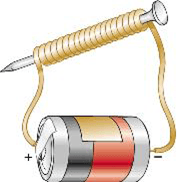
A student is planning an investigation to determine the relationship between magnetism and the movement of electrical charge in a circuit. A diagram of the circuit is shown.
The student is planning to make changes to the circuit to see how the changes will affect the number of paper clips that are picked up by the electromagnet. What is the likely effect of the magnetic field if the student adds more coils?
increase
decrease
no change

Students want to test several objects to see if they are insulators or conductors of electricity. They make this testing device.
Step 1: Assemble the testing device as show in the picture.
Step 2: Place an iron bar between the two clips
Step 3: Connect one clip to each end of the object
Step 4: Make the observation
Step 5: Make a conclusion based on the observation
Select one possible observation and its matching conclusion to explain the results of this experiment.
the light bulb glows
the object is a conductor
the object is an insulator
the light bulb does not glow

Students want to test several objects to see if they are insulators or conductors of electricity. They make this testing device.
Select two steps from below the instructions into the correct boxes to complete the instruction list below:
Step 1: Assemble the testing device as show in the picture.
Step 2:
Step 3:
Step 4: Make the observation
Step 5: Make a conclusion based on the observation
Connect the two clips together
Place the object between the two clips
Connect one clip to one side of the object.
Connect one clip to each end of the object.
Touch the object to one side of the battery
Which change would result in a stronger generator (aka electromagnet)?
reducing the number of batteries
increasing the voltage of the battery
substituting another metal for the iron core
decreasing the number of coils around the iron core
When the current in an electromagnet increases, what does its magnetic field do?
changes direction
gets stronger
gets weaker
does not change
The strength of gravity is affected by these factors. They are
mass only
mass and distance
distance only
mass and weight

Magnets and electromagnets can both be used to pick up metal items like iron nails.
Although they are alike, there is a difference between magnets and electromagnets. An example of this is that increasing the current running through the electromagnet's wire will make it stronger.
What is another difference?
Increasing the amount of wire loops will increase the strength of an electromagnet
There is no other difference between electromagnets and magnets.
Electromagnets are always stronger than regular magnets.
Decreasing the voltage will increase the strength
A magnet has two poles, a North and South. What happens when two magnet's South poles are placed near each other?
They attract
They do nothing
They move sideways
They repel each other


Friction, conduction and induction are three ways of creating a static charge on an object. Which method or methods will produce the same charge on two objects?
Friction Only
Conduction Only
the neutrally charged wall.
another negatively charged balloon.
Sandy rubs a rubber rod with a piece of animal fur. The total charge of the system before rubbing is zero. The system is made up of the rubber rod and the fur. Initially, the charge on the rod is zero and it is electrically neutral. The same is true for the fur. When Sandy rubs the rubber rod with the fur, the rubber rod acquires negative (-) charges. How does the system change, overall, based on the law of conservation of charge?
The total charge of the system is now negative rather than neutral.
Although the rod becomes negatively charged, the piece of fur remains neutral.
If the rod becomes negatively charged, then the fur becomes positively charged.
Both the rod and the piece of fur have become negatively charged during the rubbing.


A student is shown a simple model of particles that make up a liquid, as shown .
How should the model be changed to show the particles of a solid?
(S8P1)
Increase the velocities of the particles, and increase the space between the particles .
Increase the velocities of the particles, and decrease the space between the particles .
Decrease the velocities of the particles, and increase the space between the particles .
Decrease the velocities of the particles, and decrease the space between the particles .

How should the model be changed to show the particles of a liquid at a higher temperature?
(S8P1)
Separate the particles into positive and negative charges, and increase the space between the particles .
Separate the particles into positive and negative charges, but maintain the same space between the particles .
Decrease the velocities of the particles, and decrease the space between the particles .
Increase the velocities of the particles, but maintain the same space between the particles .

Which of the following correctly describes the models? (S8P1)
Model 1 is a pure substance and Model 2 is a mixture
Model 1 and Model 2 are both mixtures because they contain different types of atoms
Model 1 is a homogeneous mixture and Model 2 is a heterogeneous mixture
Model 1 is a mixture and Model 2 is a pure substance

A student is planning an investigation in which different modes of heat transfer will be used to heat a thermometer . The diagram shows the setup used to conduct the first part of the investigation .
In this setup, the thermometer is being heated by conduction and convection . How should the student change the setup to heat the thermometer by using only radiation?
(S8P2)


A student is planning an investigation to explore different properties of matter.
Which investigation will help the student explore a physical property of matter? (S8P1)
investigation: Place a solid in a beaker and add a small amount of liquid . observation: The beaker becomes warm to the touch .
investigation: Add a small amount of solid to a liquid in a beaker . observation: The solid dissolves in the liquid .
investigation: Add a small amount of solid to a liquid in a beaker . observation: The solution starts to fizz and overflows the container .
investigation: Place a solid in a beaker and add a small amount of liquid . observation: Bubbles form on the top of the solid .
A student is asked to conduct an investigation that will determine a physical property of a cube- shaped solid block of salt sample .
Which procedure BEST measures a physical property of the sample?
(S8P1)
1 . Measure 10 mL of vinegar (acetic acid) in a graduated cylinder . 2 . Pour the acetic acid into a beaker . 3 . Drop the sample into the beaker of acetic acid to determine what happens to the sample . 4 . Record your observations .
1 . Gently break the solid sample into smaller pieces using a hammer . 2 . Use long-handled forceps to pick up one of the small sample pieces . 3 . Hold the small sample piece in the flame of a Bunsen burner for a few seconds to determine what happens to the sample . 4 . Record your observations .
1 . Use a ruler to measure the length of one side of the sample . 2 . Record this value to the nearest millimeter . 3 . Cube the value in step 2 . 4 . Place the cubed sample on the digital balance .
5 . Record this value to the nearest tenth of a gram . 6 . Divide the value in step 5 by the value in step 3 .
1 . Cut away two different-sized pieces of the sample and place into a container on a hot plate . 2 . Place two thermometers in the containers, one touching each sample . 3 . Record the time it takes the temperature of the smaller sample to increase 1°C . 4 . Continue to heat the sample .
5 . Record the time it takes the temperature of the larger sample to increase 1°C . 6 . Subtract the value in step 3 from the value in step 5 .

Which model shows the structure and movement of particles in a solid? (S8P1)
Model 1
Model 2
Model 3
Model 4

Students are exploring the relationship between velocity and acceleration . This graph shows the acceleration of a remote-controlled toy car .
Which statement is TRUE based on the graph?
(S8P3)
Segment BC and segment EF show constant speed .
Segment OA and segment BC show constant speed .
Segment AB and segment CD show positive acceleration .
Segment OA and segment DE show positive acceleration .

Which pair of statements is a valid description and explanation of the motion of the ball based on evidence from the diagram? (S8P3)
description: The ball slows down as it moves to the right because the horizontal forces are unbalanced, with the larger force acting to the left . explanation: The ball speeds up as it moves downward because the vertical forces are unbalanced, with the larger force acting downward .
description: The ball speeds up as it moves to the right because the horizontal forces are unbalanced, with the larger force acting to the right . explanation: The ball speeds up as it moves downward because the vertical forces are unbalanced, with the larger force acting downward .
description: The ball moves at a constant speed to the right because the horizontal forces are unbalanced, with the larger force acting to the left . explanation: The ball slows down as it moves downward because the vertical forces are unbalanced, with the larger force acting upward .
description: The ball slows down as it moves to the right because the horizontal forces are unbalanced, with the larger force acting to the right . explanation: The ball moves at a constant speed downward because the vertical forces are unbalanced, with the larger force acting upward .

A coach at a track meet measured the time of a runner every 10 meters (m) during a 100 m dash . The data for the runner are shown .
Which statement is the BEST analysis of the data for the runner?
(S8P3)
The runner covers the first 80 m running at a constant speed and then slows down, reaching a
minimum speed during the final 20 m .
The runner starts slower and speeds up, reaching a constant speed between 20 and 80 m, and then
speeds up again during the final 20 m .
The runner covers the first 70 m running at a constant speed and then speeds up, reaching a maximum speed during the final 30 m .
The runner starts slower and speeds up, reaching a maximum speed between 50 and 70 m, and then slows down during the final 30 m .

What is the net force acting on this skier? (S8P3)
0 Newtons up
890 N Down
110 N Right
110 N Left

A physics student used radar to measure the velocity of a vehicle over a 10-second period . The student presented the data in the graph shown .
Which graph of the kinetic energy of the vehicle versus time corresponds to the velocity versus time graph?
(S8P3)


Two toy cars move in the same direction with velocities that are shown in the graph .
Based on the information in the graph, which statement describes the motion of the two toy cars?
(S8P3)
Car 1 is traveling faster than car 2 .
Car 2 is traveling farther than car 1 .
Car 1 has constant velocity between 0 and 10 seconds .
Car 2 is changing direction between 10 and 15 seconds .

A student is investigating how a negatively charged rubber rod affects how charges are distributed on two stainless steel spheres that are touching each other. A diagram that shows two steps of the investigation is shown .
Which diagram for step 2 correctly predicts the distribution of charges on the stainless steel spheres?
(S8P5)


(S8P2)


A student reads that a number of electrical devices utilize electromagnets . Some of these devices require strong magnetic fields . The student decides to investigate how to increase the strength of a basic electromagnet .
How can the student test whether the magnetic field produced by an electromagnet is increasing in strength?
(S8P5)
A stronger magnet will require less wire for the coils .
A stronger magnet will have more widely spaced coils .
A stronger magnet will have a reduced measurable current .
A stronger magnet will attract a greater number of metallic items .

The model shows how light waves are transmitted through a transparent substance .
How would the model be different for a sound wave that is being transmitted through the same substance?
(S8P4)
The wavy arrows representing sound waves would have a smaller wavelength .
The wavy arrows representing sound waves would go in the opposite direction .
The atoms in the model would move parallel to the direction of the incoming wave.
The atoms in the model would move perpendicular to the direction of the incoming wave.

The diagram shows three types of electromagnetic radiation and their range of frequencies .
Which explanation correctly uses the data in the diagram to show how infrared radiation and ultraviolet radiation are related in terms of energy?
(S8P4)
Ultraviolet radiation has less energy than infrared radiation because energy is inversely proportional to
frequency and the frequency of ultraviolet radiation is higher .
Ultraviolet radiation has more energy than infrared radiation because energy is inversely proportional to frequency and the frequency of ultraviolet radiation is lower .
Ultraviolet radiation has less energy than infrared radiation because energy is proportional to frequency and the frequency of ultraviolet radiation is lower .
Ultraviolet radiation has more energy than infrared radiation because energy is proportional to frequency and the frequency of ultraviolet radiation is higher .

The densities of four different materials at the same temperature are shown in the table .
Based on the densities shown in the table, in which material will a sound wave MOST LIKELY travel at the GREATEST speed?
(S8P4)
Material W
Material X
Material Y
Material Z

Which TWO predictions can be made based on the data shown in the table?
(S8P4)
The speed of sound generally increases as it moves from gases to liquids to solids .
The speed of sound generally increases as it moves from solids to gases to liquids .
As the density of liquids and solids increases, the speed of sound generally increases .
As the density of gases and liquids increases, the speed of sound generally decreases .

A lab group is investigating how Earth’s gravitational acceleration affects the force exerted on toy blocks of different masses . The diagram shows the results of their investigation .
The group claims that the amount of force needed to accelerate a toy block is directly proportional to its inertia .
(S8P3)
The claim is false because every time the mass of the metal cube is increased, the pointer on the spring scale moves downward .
The claim is true because every time the mass of the metal cube is doubled, the gravitational force doubles .
The claim is false because every time the volume of the metal cube is increased, the pointer on the spring scale moves downward .
The claim is true because every time the volume of the metal cube is doubled, the gravitational force doubles .

A space agency tracked the path of an asteroid named 2011 MD, which passed within 12,300 kilometers of Earth’s surface . The path of the asteroid is projected onto the plane of the moon’s orbit around Earth in the diagram .
Space scientists claimed that Earth’s strong gravitational field was responsible for the path of
asteroid 2011 MD . Which argument BEST supports this claim?
(S8P5)
The velocity of the asteroid changed as evidenced by the changing direction of the asteroid .
The velocity of the asteroid changed as evidenced by the straight line path after it passes Earth .
The position of the asteroid bends slightly away from Earth as evidenced by the different locations relative to Earth .
The position of the asteroid bends slightly toward the sun as evidenced by the different locations relative to the sun .

What step should the students take next in the investigation to increase the strength of the motor? (S8P5)
Reduce the size of the axle running through the center of the motor .
Increase the number of coils of wire within the two sections of the motor .
Decrease the voltage of the power source being used to operate the motor .
Place the permanent magnets and coils of wire farther apart inside the motor .
A substances potential to change based on its composition (flammable, caustic, reacts with water): (a)

