
 Worksheets
8th Grade Science Review
Total questions: 205
Worksheet time: 5hrs 30mins
Anything that has mass and takes up space
Element
Compound
Matter
Mixture
A substance made of only one kind of atom
Matter
Element
Mixture
Compound
a representation of a phenomenon, a system, a process, or a solution to an engineering problem that helps people visualize or understand the concept
Matter
Model
Mixture
Element
A molecule that consists of two atoms that are the same
Diatomic Element
Element
Compound
Mixture
A substance containing atoms of two more different elements connected together chemically
Diatomic Atom
Element
Mixture
Compound
A mixture in which two or more pure substances are evenly mixed
Homogenous Mixture
Heterogeneous Mixture
A mixture in which two or more pure substances are NOT evenly mixed
Homogenous Mixture
Heterogenous Mixture
Another name for a homogenous mixture. Substances are dissolved into each other.
Heterogenous mixture
Compound
Solution
Matter
What are two the two types of pure substances?
elements
compounds
heterogenous mixtures
homogenous mixtures
What are two the two types of mixtures?
elements
compounds
heterogenous
homogenous
A pure substances ________ be broken down into simpler matter using physical methods.
sometimes
can
can not
What is the simplest kind of pure substance?
Element
Compound
Homogenous Mixtures
Heterogenous Mixtures
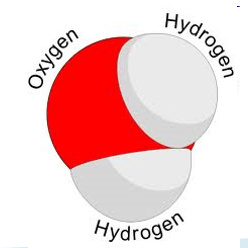
This is a water molecule. It is a ________.
Element
Compound
Heterogenous Mixture
Homogenous Mixture
Homogeneous mixtures are also called _______.
Heterogenous mixtures
Solutions
Problem Solvers
Water

What type of substance is being modeled here?
Element
Compound
Homogeneous Mixture
Heterogeneous Mixture

What type of substance is being modeled here?
Element
Compound
Homogeneous Mixture
Heterogeneous Mixture
Which of these is an element?
Salt (NaCl)
Water (H20)
Oxygen (O)
Carbon Dioxide (CO2)
Which of these is a compound?
Aluminium (Al)
Carbon Dioxide (CO2)
Nitrogen (N)
Sand

What type of substance is pictured?
element
compound
mixture
Surface tension is the property of water in which...
water molecules at the surface tend to stick together.
water spills easily.
water tends to be see-through.
Describe COHESION.
Water molecules attracted to other substances.
Water molecules climbing upwards against the force of gravity.
Water molecules dissolving many substances because of its polarity.
Water molecules attracted to other water molecules.

Water's ability to stick to glass is
adhesion
cohesion
surface tention
capillary action
Used to measure strength of acids and bases in a solution
pH scale
acids
bases
neutral
The pH Scale spans from
____ to _____
(a)
Greater than 7 =
Acid
Base
Turns Litmus paper red
Acid
Base
Sour, sharp taste (lemons)
Acids
Bases
Reactive with metals, corrosive and can burn skin, able to conduct electricity
Acid
Bases
Turns litmus paper blue
Acid
Bases
Has a pH of 7
Neutral
Acid
Base

What test can the students perform to correctly and safely identify acids and bases? They used litmus paper. The blue litmus turned red which indicates.......?
Base
Neutral
alkaline
acid
How many atoms are in the products below?
4Fe +3O2 → 2Fe2O3
7
10
17
20
H2 + O2 --> H2O
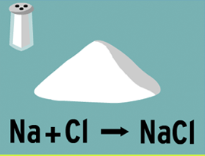
When sodium and chlorine combine to form sodium chloride, sodium chloride is the:
Originator
Reactant
Product
Produce
Fe(NO3)2
Fe(NO3)2
Fe(NO3)2
Used to measure strength of acids and bases in a solution
pH scale
acids
bases
neutral
The pH Scale spans from
____ to _____
(a)
Greater than 7 =
Acid
Base
Turns Litmus paper red
Acid
Base
Sour, sharp taste (lemons)
Acids
Bases
Reactive with metals, corrosive and can burn skin, able to conduct electricity
Acid
Bases
Turns litmus paper blue
Acid
Bases
Has a pH of 7
Neutral
Acid
Base

The pH scale is used to measure how acidic or basic something is. A pH value lower than 7 indicates a substance is _______, while a pH value higher than 7 is considered ________. Pure water is considered _______, with a pH of_______ .
Choose the option that identifies the missing terms, in order of appearance in the sentences.
acidic; acidic; neutral; 12
acidic; basic; neutral; 7
basic; acidic; basic; 1
neutral; basic; basic; 7

A student uses litmus to test an unknown substance. The red litmus turns blue which indicates. the solution is .......?
Base
Neutral
Acid
positive hydrogen
What test can the students perform to correctly and safely identify acids and bases? They used litmus paper. The blue litmus turned red which indicates.......?
Base
Neutral
alkaline
acid


What is Newton's 2nd Law?
Every action has an equal and opposite reaction
An object at rest stays at rest, an object in motion stays in motion.
F = ma
Friction
When you hit a tennis ball with a racket...
The ball exerts more force on the racket
The ball and racket exert the same force on each other
The racket exerts more force on the ball
It depends on how hard you hit it
What is acceleration?
The rate at which velocity changes
What causes an object to slow down
What keeps an object steady
What holds objects down on Earth
What is velocity?
The rate at which an object speeds up
The speed of an object in a given direction
Keeps an object steadily at rest
Releases heat upon colliding
A man is throwing a bowling ball and a basketball. Both, the bowling ball and basketball, have the same mass. Which ball will require more force to move?
Basketball
Bowling Ball
Neither
Both will require the same force
True or False: Things with lower mass have greater acceleration?
True
False
If I had 3 carts that were all pushed with same amount of force, what would be the order of greatest acceleration to least acceleration?
CART 1 = 5 KG
CART 2 = 15 KG
CART 3= 10KG
CART 1, CART 2, CART 3
CART 2, CART 3, CART 1
CART 3, CART 2, CART 1
CART 1, CART 3, CART 2
What is the formula for acceleration?
A = F X M
A = F + M
A = F/M
What is the formula for Force?
F = M X A
F = M + A
F = M/A
What is the formula for Mass?
M = F X A
M = F +A
M = F/A
How do you solve for force?
to solve for force, multiply mass and acceleration
to solve for force, divide mass by acceleratiton
to solve for force, divide acceleration by mass
to solve for net force, add mass and acceleration
When you get an a car accident your seatbelt is the force that stops your body from moving forward. This force stopping the forward motion is known as
friction
gravity
inertia
Newton's 2nd Law
If an object does not move the forces are?
Equal and move in opposite directions
Are not equal and move in opposite directions
Equal and move in the same direction
Amelia pushes an object with a force of 25 newtons and the object does not move. That means that the opposite force is how many newtons?
30 N
20 N
25 N
10 N
If you bounce a bouncing ball on the ground what is the action-reaction pair that causes the ball to bounce?
The floor pushes up on the
ball as the ball pushes down on
the floor with an equal and
opposite amount of force.
The gym floor pushes up on the ball as gravity pulls down on the ball with an equal amount of force.
The floor pushes up on the ball with greater amount of force than gravity pulls down the ball
The floor pushes up on the
ball with a greater amount of
force than the ball pushes down
on the floor.

When a bird is flying, their wings are pushing DOWN against the air. In turn, the air pushes __________ against their wings allowing them to fly.
DOWN
UP
FORWARD
BACKWARD

When a person is skateboarding, their leg is pushing BACKWARD against the ground. In turn, the ground pushes __________ against their foot allowing them to skateboard.
DOWN
UP
FORWARD
BACKWARD
When a rocket engine burns, hot gas flows DOWNWARD out the bottom of the rocket. In turn, a thrusting force is produced ____________. This allows a rocket to launch or takeoff.
DOWNWARD
UPWARD
BACKWARD
FORWARD

When a jellyfish is swimming, their body is pushing DOWN against the water. In turn, the water pushes __________ against their body allowing them to swim.
DOWN
UP
FORWARD
BACKWARD

A rocket pushes burning gases DOWN which causes the rocket to launch UP. Which law is this?
Newton's 1st Law - Law of Inertia
Newton's 2nd Law - Law of Acceleration
Newton's 3rd Law - Law of Force Pairs (Action, Reaction)

It is much more difficult to move a dresser full of clothes than an empty dresser. Which law supports this?
Newton's 1st Law - Law of Inertia
Newton's 2nd Law - Law of Acceleration
Newton's 3rd Law - Law of Force Pairs (Action, Reaction)

When a horse stops suddenly, the rider on its back continues to move forward onto the ground. Which law is this?
Newton's 1st Law - Law of Inertia
Newton's 2nd Law - Law of Acceleration
Newton's 3rd Law - Law of Force Pairs (Action, Reaction)

A sports car speeds up much faster than a tow truck when a traffic light turns from red to green. Which law is this?
Newton's 1st Law - Law of Inertia
Newton's 2nd Law - Law of Acceleration
Newton's 3rd Law - Law of Force Pairs (Action, Reaction)

Which example best explains Newton's Third Law of Motion?
When a glass slid across a table, it spilled water when it stopped suddenly.
An engine used less work to move a lighter car than when it moved a heavier car.
When you sit on a chair, your body exerts a downward force on the surface of the chair, while the chair exerts an equal and upward force on your body.
F = ma
A 50-kg crate is pushed with a horizontal acceleration of 20 m/s2. What net force is acting on the crate?
2.5 N
0.4 N
1000 N
30 N
A 20-N net force acts on an object with a mass of 2.0 kg. What is the object's acceleration?
10 m/s2
0.1 m/s2
40 m/s2
22 m/s2
H2 + O → H2O
Which is the best example of a chemical change?
butter melting
egg cooking
paper tearing
water evaporating

How bright a star appears from Earth
Apparent Magnitude
Absolute magnitude
How bright a star appears from Earth
Apparent Magnitude
Absolute magnitude
How bright stars actually are
apparent magnitude
absolute magnitude


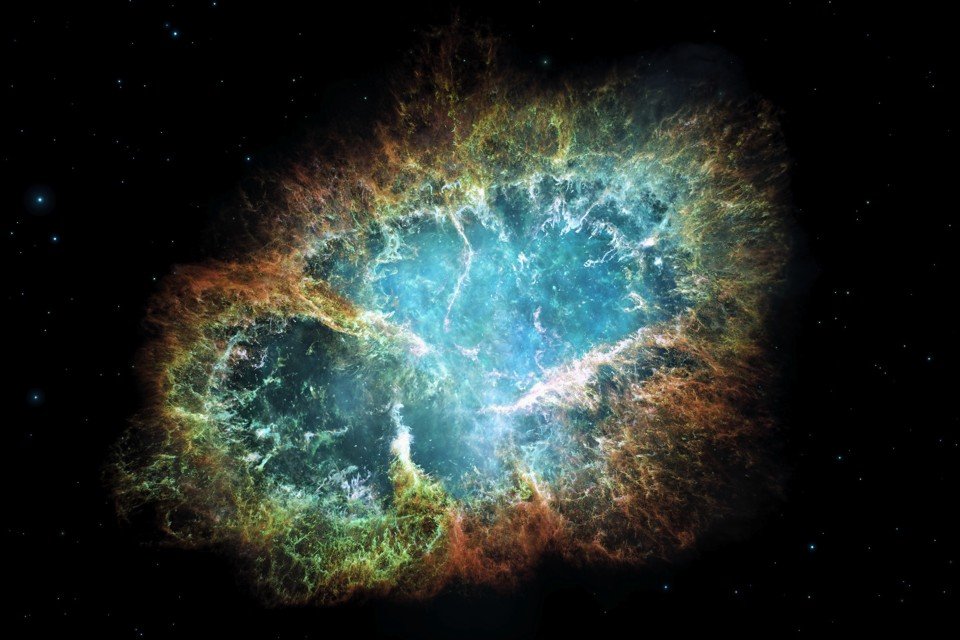
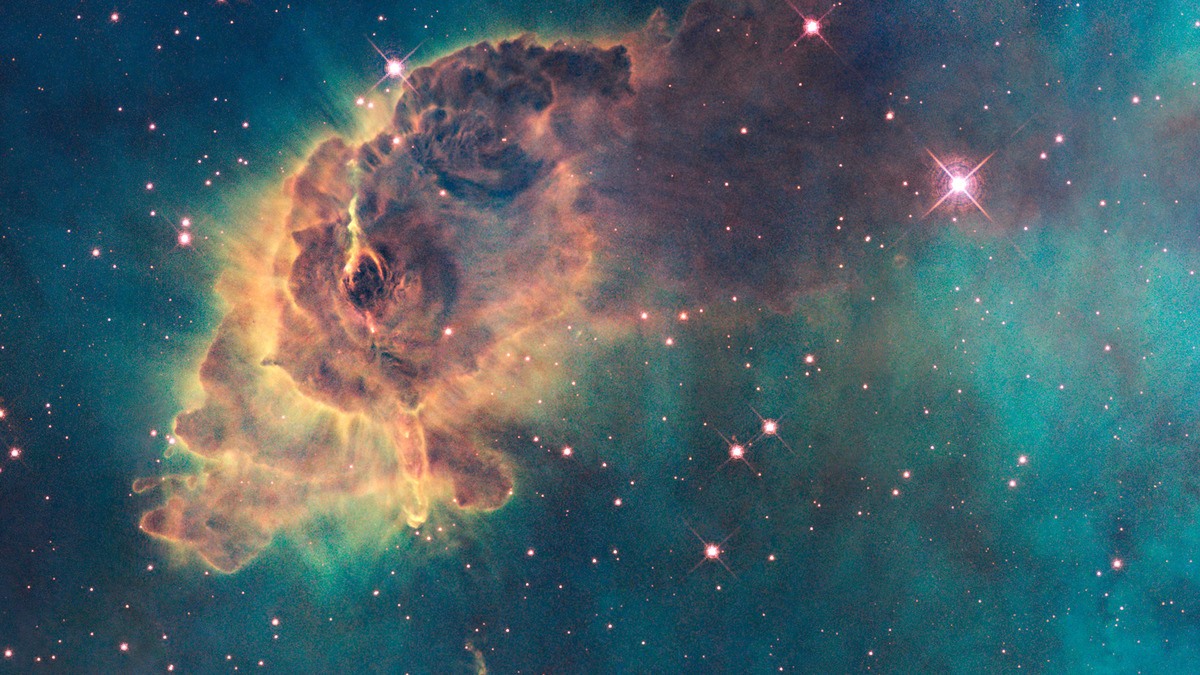


Our sun is currently in what star stage?
Protostar
Nebula
Main Sequence
Red Giant
Felix examined several photos of stars. To compare their temperatures, he looked at the colors of the stars. He organized the photos in order from coolest to hottest. Which of these answers shows the correct order?
red, yellow, white, blue
white, blue, yellow, red
yellow, white, blue, red
blue, yellow, white, red

The Sun is the biggest star in the sky.
What will be the next stage in our star the sun's life cycle?
supernova
white dwarf
blackhole
red giant

Our solar system is located in which galaxy?
Andromeda
Milky Way
Proxima X
Triangulum
What are 90% of stars classified as on the H-R diagram?
Supergiants
White Dwarfs
Main Sequence
Giants
On the H-R diagram, it compares a star's brightness to its
Temperature
Composition
Age

In the diagram given, what happens as we move to the left?
Stars get larger
Stars get colder
Stars get hotter
Stars get sillier

True or False: Red Giants are considered hotter than White Dwarfs.
True
False


Which spectral class does our star, the sun, belong to?
M
K
G
B

What determines the color of a star?
Its size
Its temperature
Its composition
They are all the same color
A cloud of gas and dust
nebula
protostar
supernova
white dwarf
a collection of dust and
gas that forms stars or
results from dying stars
nebula
supernova
the collapse of a massive
star's core resulting in an
explosion
nebula
supernova
A supergiant begins its life cycle in the nebula as a high-mass star before becoming a supergiant. It then
explodes in a supernova due to its increase in mass and loss of pressure.
True
False

The color of a star indicated its
speed
volume
distance
temperature
What feature is used to classify galaxies?
size
shape
color
brightness
Scientist believe that the universe is expanding because of a phenomena known as
black holes
red shift
blue shift
radioactivity
As part of the Big Bang Theory of the formation of the universe, scientists believe that over time, the universe is continually changing in what characteristic?
From more dense to less dense
From rotating to stationary
From cooler to hotter
From very large to very small
All the stars we observe from Earth emit light that is shifted, to varying degrees, to longer wavelengths. This evidence is used to support the Big Bang Theory because it shows that stars we observe -
are all older than our Sun.
are made up of helium gas.
use nuclear fusion to make light.
are moving away from us.
Cosmic Microwave Background Radiation (CMBR) is the term used to describe the residual microwave radiation observed everywhere in the universe that seems to have no single source. The observation of CMBR is used as evidence of the Big Bang Theory because it is believed to be -
the result of collisions between neighboring galaxies.
particles of dust that have absorbed radioactivity.
radiation left over from the rapid expansion of matter.
light energy emitted from the source of the Big Bang.

Absolute Magnitude of -8?
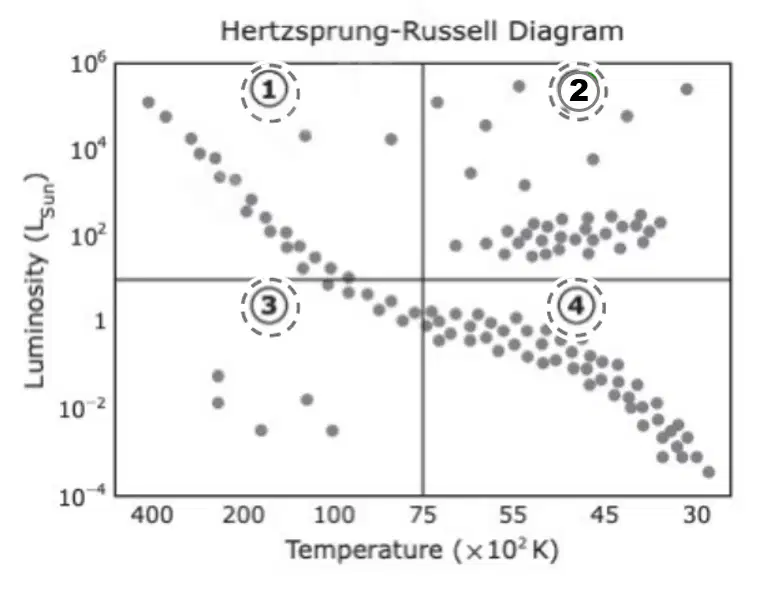
The Hertzsprung-Russell diagram shown is divided into four sections. Which section of the diagram includes the coolest, brightest stars?
1
2
3
4
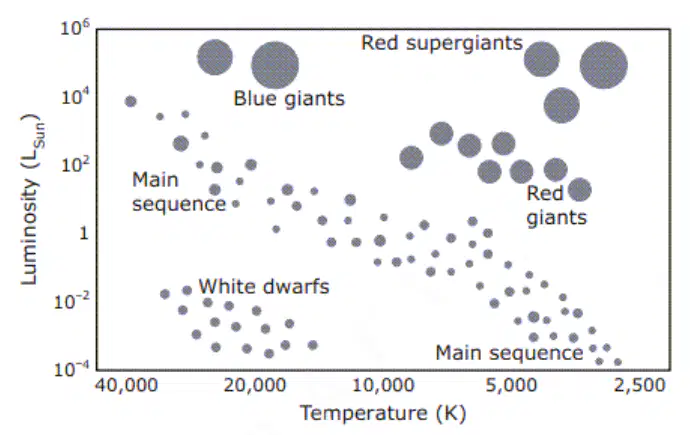
A Hertzsprung-Russell (H-R) diagram is shown. A star that has a luminosity of 10-2 and a temperature of 20,000 K is most likely a –
Main sequence
White dwarf
Blue giant
Red giant
Alpha Centauri appears as a bright object visible in the Milky Way galaxy. Alpha Centauri is actually a system of three objects. Each object produces light and rotates on its own axis. The system is an average of 4 light-years from Earth. Based on this information, the three objects that make up the Alpha Centauri system are all —
asteroids
comets
planets
stars
Which statement best explains why the sun appears brighter to people on Earth than any other star?
Sunlight reaches Earth’s atmosphere at an angle that causes the sun’s light rays to intensify.
Unique chemical reactions in the sun’s core produce a high-energy wavelength of light.
The sun burns at a higher temperature than any other star.
The sun is closer to Earth than any other star.
Atmospheric conditions of a certain place at a certain time (rain, cloud cover, humidity, and wind)
SHORT TERM
weather
climate
hydrosphere
atmosphere
The LONG TERM weather patterns of a particular region (tropical, dry, temperate, continental, polar, wet)
weather
climate
hydrosphere
atmosphere
The 3 main influences on weather are
climate, atmosphere, and sun
atmosphere, sun, and weather
atmosphere, hydrosphere, and sun
hydrosphere, sun, and climate
True or False: Equator receives the most direct sunlight; intense heat
True
False
Uneven heating of the Earth's surface by the Sun causes which of these?
wind patterns
cloud formation
volcanic activity
nutrient cycling
The vertical elevation of an object above a surface, such as sea level or how tall a mountain is
latitude
altitude
longitude
The distance in degrees north or south of the equator
latitude
altitude
longitude


Clear Skies and Happy Weather
Lowest layer of the atmosphere
lifting
troposphere
wind funnel
nitrogen
The highest layer of the atmosphere is
troposhphere
mesosphere
stratosphere
exosphere
Airplanes fly in the
troposhphere
mesosphere
stratosphere
exosphere
As you get farther away from the Earth, the layers of the atmosphere get
colder
warmer

Latitude affects the climate of an area.
True
False

How does latitude affect the climate of an area?
The higher the latitude, the warmer the temperature.
The higher the latitude, the lower the temperature.
The higher the latitude, the more precipitation.
The higher the latitude the less precipitation.

Elevation (Altitude) affects the climate of an area.
True
False

How does elevation affect the climate of an area?
As elevation increases, air temperature increases.
As elevation increases, air temperature decreases.
As elevation increases, precipitation increases.
As elevation increases, precipitation decreases.

Ocean currents affect the climate of an area.
True
False

How do ocean currents affect the climate of an area? Choose all that apply.
Cold ocean currents have a cooling effect on nearby land.
Cold ocean currents have a warming effect on nearby land.
Warm ocean currents make nearby land warmer.
Warm ocean currents make nearby land colder.

Distance from a large body of water does not affect the climate of an area.
True
False

How does distance from a large body of water affect the climate?
Cities near the ocean have less precipitation.
Cities near the ocean have more precipitation.
Cities near the ocean have a smaller temperature range.
Cities near the ocean have a large temperature range.
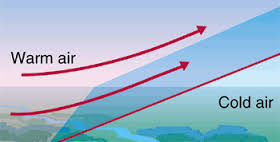


What type of front is shown?
Warm Front
Cold Front
Occluded Front
Stationary Front


A _____________ weather front occurs when a cold air mass moves forward, pushing the warm air mass up.
Cold
Warm
Stationary
Occluded
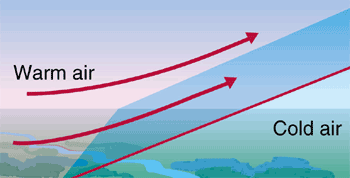
Why does warm air rise above cold air?
Warm air is less dense
Warm air is more dense
Cold air is stronger than warm air

Which type of air mass is cold and dry?
Continental polar
Continental tropical
Maritime polar
Maritime tropical
Which type of air mass is warm and humid?
Continental polar
Continental tropical
Maritime polar
Maritime tropical

This is the symbol for a _____________ weather front.
Cold
Warm
Stationary
Occluded

