
 Worksheets
7th Grade End of Year Review
Total questions: 204
Worksheet time: 2hrs 42mins
What term (word) means having the necessary conditions to support life?
biosphere
landform
habitable
geological process
What term (word) represents all the liquid water and solid water (ice) on a planet?
atmosphere
biosphere
geosphere
hydrosphere
What term (word) represents the solid part of a rocky planet?
atmosphere
biosphere
geosphere
hydrosphere
What term (word) represents the mixture of gases that surrounds a planet?
atmosphere
biosphere
geosphere
hydrosphere
Which of the following can be considered best example of Earth's biosphere?


Which image shows the best example of the geosphere?


Mars is a place to look for potential life because
The temperature is reasonably close to that of Earth due to the sun as a source of energy
Water
Both
Which of the following conditions are necessary for a planet to be considered habitable? (select all correct answers)
needs oxygen
has liquid water
has frozen water
has an available energy source
Mercury, Venus, Earth, and Mars are these types of planets
rocky planets
gas giants
life producers
perfect spheres
One of the main reasons scientists wanted to observe Mars for possible life is because of
the polar ice caps at the top and bottom with evidence that it may have once been liquid
tracks on the surface
phenomenal atmosphere that could support life
abundant liquid water on the surface
A scientist who studies the geospheres of planets other than Earth.
planetary geologist
zoologist
biologist
physicist
Beneath the continents and oceans of the Earth, there is hard and solid rock.
True
False
Beneath the surface, the Earth's outer layer is...
Made of sand and water
Made of hard, solid rock
Beneath the land it is made of hard, solid rock and beneath the water it is made of sand
Made of water
Which image shows what happens at a divergent plate boundary?


What could explain how these fossils came to be so far apart?
As the plates slowly moved, solid and soft rock was added from below to the edges of the plates over millions of years.
The plates floated away from each other across the ocean.
The plates slowly moved as new plates were added from below between them over millions of years.
The plates were sometimes pushed very far by earthquakes, and solid and soft rock was added from below to the edges of the plates.

What does this image show an example of?
Plate Boundary
Plate
Outer Layer
Cross Section
What does vertically mean?
Across
Up and down

Where can geologists find hard and solid rock?
Only under 1
Only under 2
Neither under 1 nor under 2
Under both 1 and 2
What is the mantle made of?
Hard and solid rock
Soft and solid rock
Water
Gelatin
Which image shows what happens at a convergent plate boundary?


True or False: Do plates float across the ocean?
True
False
True or False: Do earthquakes CAUSE the movement of the plates?
True
False
True or False: Are earthquakes a RESULT of plate movement?
True
False
What is a Pattern?
Something we observe that is similar over and over again
The place where two plates meet
An object or diagram that helps us understand something

What could explain why Africa is closer to Europe now than before?
The plates floated towards each other.
The plates were sometimes pushed towards each other by earthquakes, and one plate slid under the other plate into solid and soft rock.
The plates slowly moved towards each other over millions of years. When the plates collided, they broke into smaller pieces.
The plates slowly moved towards each other while one plate slid under the other plate into solid and soft rock over millions of years.
What is a plate boundary?
One of the very large sections of hard, solid rock that make up the Earth's outer layer
The place where two plates meet
The outermost layer of the Earth, made of hard, solid rock
A mid-ocean ridge is formed by what type of plate movement?
Convergent
Transform
Divergent
A sudden shaking of the Earth's surface is called:
An earthquake
A plate boundary
Convergence
The Mantle
Evidence of past life is known as:
A plate
A fossil
A geyser
Under the soil, vegetation, and water you will find:
Dirt
Sand
Outer layer of the Earth
How often or how quickly does something happen?
The rate
A plate boundary
An earthquake

Based on the information, are rocks A and B the same or different? Rock A formed from small pieces of rock, rock B formed from liquid rock in a different place, and rocks A and B formed at the same time.
Same type because both formed from rock material.
Same type because they formed at the same time.
Different types because they formed in different ways.
Different types because they formed in different places.
Bob passes by a building every day on his way to school. He notices that the rock used to build the walls of the building is different from the rock used to build the steps. How might energy have played a role in the formation of the different types of rock?
Energy from different sources leads to different types of rock. Energy within the Earth melts rock into liquid rock, but energy from the sun causes rock to wear down into small pieces of rock.
Energy causes different types of rock to change in different ways. Energy changes igneous rock into liquid rock and changes sedimentary rock into small pieces of rock.
Energy caused one type of rock to form, but not the other. The rock that forms due to energy is a different type of rock than the rock that forms without energy.
Energy changes rock on different continents in different ways. Each continent on Earth has different rocks that can form liquid rock or small pieces of rock when exposed to energy.
Could the material of igneous rock come from sedimentary rock?
Yes, if the sedimentary rock is exposed to the sun's energy on the Earth's surface for a long time, it can melt into liquid rock and form igneous rock.
Yes, if the sedimentary rock moves beneath the Earth's outer layer and is exposed to the Earth's internal energy, it can melt into liquid rock and form igneous rock.
No, igneous rock can only form from another igneous rock. Sedimentary rock cannot become igneous rock.
No, igneous rock forms beneath the Earth's outer layer due to the Earth's internal energy, but sedimentary rock only forms on the Earth's surface.
On the island of Hawaii, Paul notices that the sand on the beach is black, the same color as the rock formations on the island. Paul realizes that the sand used to be part of the rock formations. How did the material from the rock formations turn into sand?
The rays of the sun shone on the rock and it broke into pieces.
If something were left outside for a long time, it would break into small pieces.
The sand was formed by earthquakes, tsunamis, and other natural disasters. These disasters were strong enough to break the rock into small pieces.
The wind and rain interacted with the rock, breaking it into small pieces.
How is a metamorphic rock formed?
Rocks do not form; they stay as they are.
It melted and cooled.
It broke into sediments and then compacted.
It was heated and subjected to pressure.
Mary and her family are going on a trip and driving over a mountain range. Mary wonders how the rock they see while driving over the mountain range might be different when they return home next week. What would you tell Mary about how the rock will change?
The rock will probably change a lot. The rock is always changing and transforming.
The rock will probably not change much. Most rock transformation processes occur very slowly.
The rock will not change at all. The rock simply stays as it is.
The rock could change if it is the right season.
Africa and Europe are very close to each other, but they used to be far apart. Which diagram above shows what happened to the plates that Africa and Europe are part of?


What makes rocks different?
Where they are found
How they are formed
When they are formed
How can energy play a role in the formation of different types of rock?
The energy from different sources leads to different types of rock. The energy within the Earth melts rock into liquid rock, but the energy from the sun causes rock to wear down into small pieces of rock.
Energy causes different types of rock to change in different ways. Energy changes igneous rock into liquid rock and changes sedimentary rock into small pieces of rock.
Energy changes rock on different continents in different ways. Each continent on Earth has different rocks that can form liquid rock or small pieces when exposed to energy.
Energy caused one type of rock to form, but not the other. The rock that forms due to energy is a different type of rock than the rock that forms without energy.
Can sedimentary rock material ever form igneous rock?
No, igneous rock can only form from other igneous rocks. Sedimentary rock cannot become igneous rock.
No, igneous rock forms beneath the Earth's outer layer due to energy from within the Earth, but sedimentary rock is only on the Earth's surface.
Yes, if sedimentary rock is exposed to the sun's energy on the Earth's surface for a long enough time, it can melt into liquid rock and form igneous rock.
Yes, if sedimentary rock moves beneath the Earth's outer layer and is exposed to energy from within the Earth, it can melt into liquid rock and form igneous rock.
During a hike on a mountain, Alex sees small pieces of rock along the trail. The small pieces resemble the rock that the mountain is made of. How did these small pieces of rock break off from the mountain?
The wind and rain interacted with the rock, breaking it into small pieces.
The small pieces of rock were formed by earthquakes, tsunamis, and other natural disasters. These disasters were strong enough to break the rock into small pieces.
The rays of the sun shone on the rock and broke it into pieces.
If something were left outside for a long time, it would break into small pieces.
Is it possible for an igneous rock formation beneath the Earth's outer layer to become a sedimentary rock formation?
Yes, if the igneous rock moves to the Earth's surface and is exposed to the sun's energy, it could wear down into small rock fragments that could form sedimentary rock.
Yes, the energy from within the Earth can cause the igneous rock to break into small rock fragments that form sedimentary rock.
No, sedimentary rock forms on the Earth's surface because the sun's energy causes the rock to wear down, but igneous rock beneath the Earth's outer layer is not exposed to the sun's energy.
No, sedimentary rock can only form from material from another sedimentary rock. There is no way for sedimentary rock to form from material in igneous rock.
A sedimentary rock can transform into an igneous rock.
True
False
Define Subduction:
The process of breaking down rock into smaller pieces due to wind or moving water
The process by which all rock formations in a region are pushed upward due to plate movement
The type of rock that forms when sediment is pressed and sticks together
The process by which rock material moves under the Earth's outer layer and into the mantle due to plate movement
What type of rock forms when magma cools and solidifies?
Sedimentary
Igneous
Metamorphic
What process creates a sedimentary rock?
Cooling below the surface
Compaction and cementation
Cooling on the surface
Melting
What is magma?
Hot liquid rock beneath the Earth's surface
Anything that has mass and occupies space
One of the many different types of matter that make up rocks
The place where two plates meet
What is weathering?
The process by which all rock formations in a region are pushed upward due to plate movement
The process by which rock material moves under the Earth's outer layer and into the mantle due to plate movement
The process of breaking down rock into smaller pieces due to wind or moving water
The movement of sediments from one place to another, often caused by wind or running water
What type of rock is formed when heat or pressure deep underground changes existing rock?
Igneous
Metamorphic
Sedimentary
What type of rock is formed when sediment is pressed and glued together?
Sedimentary
Igneous
Metamorphic

Scientists find two substances. One is a toxic chemical. The other is a safe chemical. Both chemicals are liquids at room temperature. As a test, the scientists transfer the same amount of energy OUT of the two containers and find that only the toxic chemical changes phase. How is the toxic chemical different from the safe chemical?
weaker attraction between its molecules than the safe chemical. Its molecules now move in place.
weaker attraction between its molecules than the safe chemical. Its molecules now move around each other.
stronger attraction between its molecules than the safe chemical. Its molecules now move away from each other.
stronger attraction between its molecules than the safe chemical. Its molecules now move in place.
César and Ming were investigating a transparent container of water. Water can be solid, liquid, or gaseous. At first, César and Ming said that the water molecules were moving in place. Later, the water molecules were moving around each other. What change did they observe in the water?
At first, the water was a gas. Later, it was a liquid.
At first, the water was a liquid. Later, it was a solid.
At first, the water was a solid. Later, it was a liquid.
At first, the water was a liquid. Later, it was a gas.
A company uses a substance that is solid under normal conditions. This substance will be used under extreme conditions, which could cause the molecules of the substance to move faster and lead to a phase change. How would this phase change occur and how would the molecules of the substance be affected under these extreme conditions?
The energy would be transferred . . .
OUT of the substance, and its molecules would move away from each other.
OUT of the substance, and its molecules would move around each other.
INTO the substance, and its molecules would move around each other.
INTO the substance, and its molecules would move in place.

The image above shows information about two different substances in sealed containers. At room temperature, both substances are liquids. A scientist transfers the same amount of energy to both substances. One substance changes phase, but the other does not. Which substance changed phase and why did it change?
Substance A changed phase because its molecules were able to move fast enough to overcome the attraction between them. Its molecules are now moving away from each other.
Substance A changed phase because the weak attraction between its molecules allowed them to move faster. Its molecules are now moving away from each other.
Substance B changed phase because the molecules were able to move fast enough to overcome the attraction between them. Its molecules are now moving away from each other.
Substance B changed phase because the strong attraction between the molecules made their movement slower. Its molecules are now moving in place.
Refrigerators are able to transfer energy out of a substance. At first, the substance is a gas. The refrigerator changes the phase of the substance by transferring energy out of it. How does this change affect the substance’s molecules?
After the phase change, the molecules move . . .
slower, and they move away from each other.
slower, and they move around each other.
faster, and they move around each other.
faster, and they move in place.

Maggie left a sealed jar of water outside her home. Water can be a solid, liquid, or gas. When she put it outside, the water was a solid. Twelve hours later, the water had changed phase and was a liquid. What happened to the water molecules?
Before the student left, the molecules were moving in place. After, the molecules were moving around each other.
Before the student left, the molecules were moving around each other. After, the molecules were moving away from each other.
Before the student left, the molecules were moving around each other. After, the molecules were moving in place.
Before the student left, the molecules were moving away from each other. After, the molecules were moving around each other.

Divers found two substances on the bottom of the ocean. At room temperature, both substances are liquid. Scientists then transferred the same amount of energy out of both substances. When a scientist checked again, Substance 1 had changed phase, but Substance 2 had not. How are Substances 1 and 2 different?
weaker attraction between its molecules than Substance 2. Its molecules now move in place.
weaker attraction between its molecules than Substance 2. Its molecules now move around each other.
stronger attraction between its molecules than Substance 2. Its molecules now move away from each other.
stronger attraction between its molecules than Substance 2. Its molecules now move in place.
Tom measured the temperature of a pond near his house. Before he left for school, the water in the pond was 15°C. When he came home from school, the temperature of the pond was higher than it was in the morning. What happened to the water molecules while he was at school?
The molecules got closer together.
The molecules started moving faster.
The water lost cold molecules.
The molecules became larger.

A scientist had a container of two substances. The image shows these substances. At room temperature, both substances are liquids. The same amount of energy was transferred INTO both substances. After a few hours, one of the substances had changed phase, while the other did not. Which substance would most likely change phases, and explain why?
The substance #1 changed because the molecules were able to move fast enough to overcome the attraction between them. Its molecules now move away from each other.
The substance #1 changed because the strong attraction between molecules made their movement slower. Its molecules now move around each other.
The substance #2 changed because the weak attraction between molecules let them move faster. Its molecules now move away from each other.
The substance #2changed because the molecules were able to move fast enough to overcome the attraction between them. Its molecules now move in place.

A scientist has two substances that she is testing in her lab: a pink substance and a green substance. At room temperature, both substances are liquids. The scientist transferred the same amount of energy into both substances. She finds only the pink substance changed phase. How is the pink substance different from the green substance?
The pink substance has a . .
weaker attraction between its molecules than the green substance. Its molecules now move away from each other.
weaker attraction between its molecules than the green substance. Its molecules now move in place.
stronger attraction between its molecules than the green substance. Its molecules now move away from each other.
stronger attraction between its molecules than the green substance. Its molecules move around each other.

An Earth scientist brought an unknown substance from underground back to her lab. The substance was in the gas phase and was put into a sealed tank as shown above. She slowed down the molecules inside the tank and the substance changed phase. How did she do this, and how did it affect the molecules?
She transferred energy . . .
into the substance, and the molecules moved around each other.
into the substance, and the molecules moved away from each other.
out of the substance, and the molecules moved around each other.
out of the substance, and the molecules moved in place
Detectives find two substances at a crime scene. One is a poison, and the other is a cleaning chemical. At room temperature, both substances are liquids. To test the substances, the detectives transfer the same amount of energy into both substances, but only the cleaning chemical changes phase. How is the cleaning chemical different from the poison?
The cleaning chemical has a . .
weaker attraction between its molecules than the poison. Its molecules now move in place.
weaker attraction between its molecules than the poison. Its molecules now move away from each other.
stronger attraction between its molecules than the poison. Its molecules now move away from each other.
stronger attraction between its molecules than the poison. Its molecules now move around each other.
Cesar and Ming were investigating a see-through container of water. Water can be a solid, liquid, or gas. At first, Cesar and Ming said the water molecules were moving in place. Later , the water molecules were moving around each other. What change did they observe to the water?
At first, the water was a gas. Later, it was a liquid.
At first, the water was a liquid. Later, it was a solid.
At first, the water was a solid. Later, it was a liquid.
At first, the water was a liquid. Later, it was a gas.
A student left a jar of water outside his home. Water can be a solid, liquid, or gas. When he put the jar outside, the water was liquid. Twelve hours later, the water had changed phase and was a gas. What happened to the water molecules?
When the student left the jar outside, the molecules were moving around each other. Later, the molecules were moving in place.
When the student left the jar outside, the molecules were moving away from each other. Later, the molecules were moving around each other.
When the student left the jar outside, the molecules were moving in place. Later, the molecules were moving around each other
When the student left the jar outside, the molecules were moving around each other. Later, the molecules were moving away from each other.
How is the kinetic energy of molecules changing when the molecules move faster?
The kinetic energy . . .
is not changing.
depends on the molecules.
is decreasing.
is increasing.
17. Sammy's superball is made of synthetic rubber. When are the synthetic rubber in her superball moving?
The synthetic rubber molecules are . . .
only moving when the superball is bouncing.
only moving when the superball is in the toy box.
always moving.
never moving.
Does the attraction in a substance change when it changes phases?
Yes, attraction changes with phase change.
No, a substances attraction will stay the same even if the phase changes.
What is condensation of water?
When ice melts to form water vapor
When water vapor cools down to form liquid water
When a solid turns directly to a gas without turning into liquid
What are our 3 states of matter?
Solid, Liquid and Gas
Solid Gas and Plasma
Plasma, Maryland and Virginia
What is the definition and explanation of melting?
When something that is a solid becomes a liquid by adding cold
When something that is solid becomes a liquid by adding heat
When something that is liquid becomes a gas by adding heat
What is the definition of freezing?
When the solid form of matter is cooled enough and changes to a gas
When the liquid form of matter is cooled enough and changes to a solid
When the soild form of matter changes directly to a gas
What is the definition of SUBLIMATION?
When solid rock melts to form lava
When water vapor cools down to form liquid water
The transition of a substance from a solid directly to a gas
What can be seen once in a minute, twice in a moment, and never in a thousand years
A thought
The letter O
The letter M
Which is faster hot or cold?
Cold because it lacks thermal energy
Cold because of the theory of Newton's Laws of Motion
Hot because you can always easily catch a cold
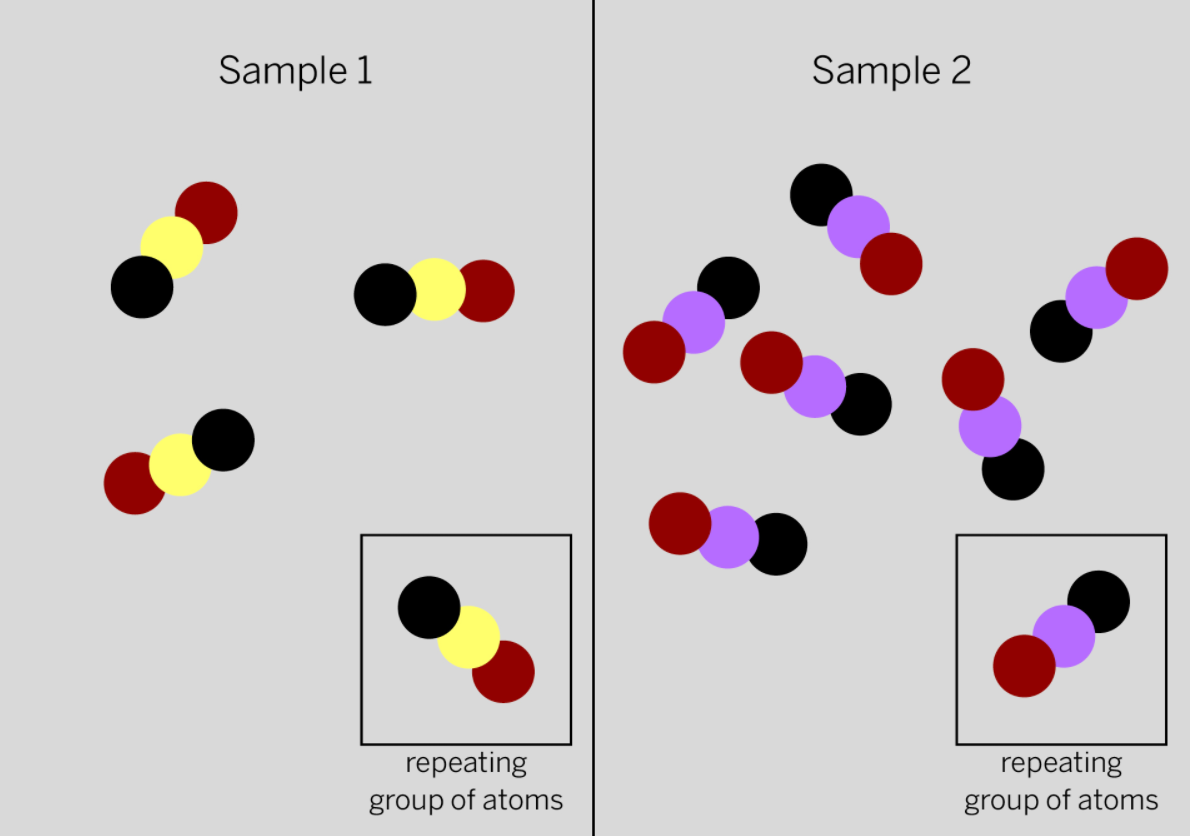
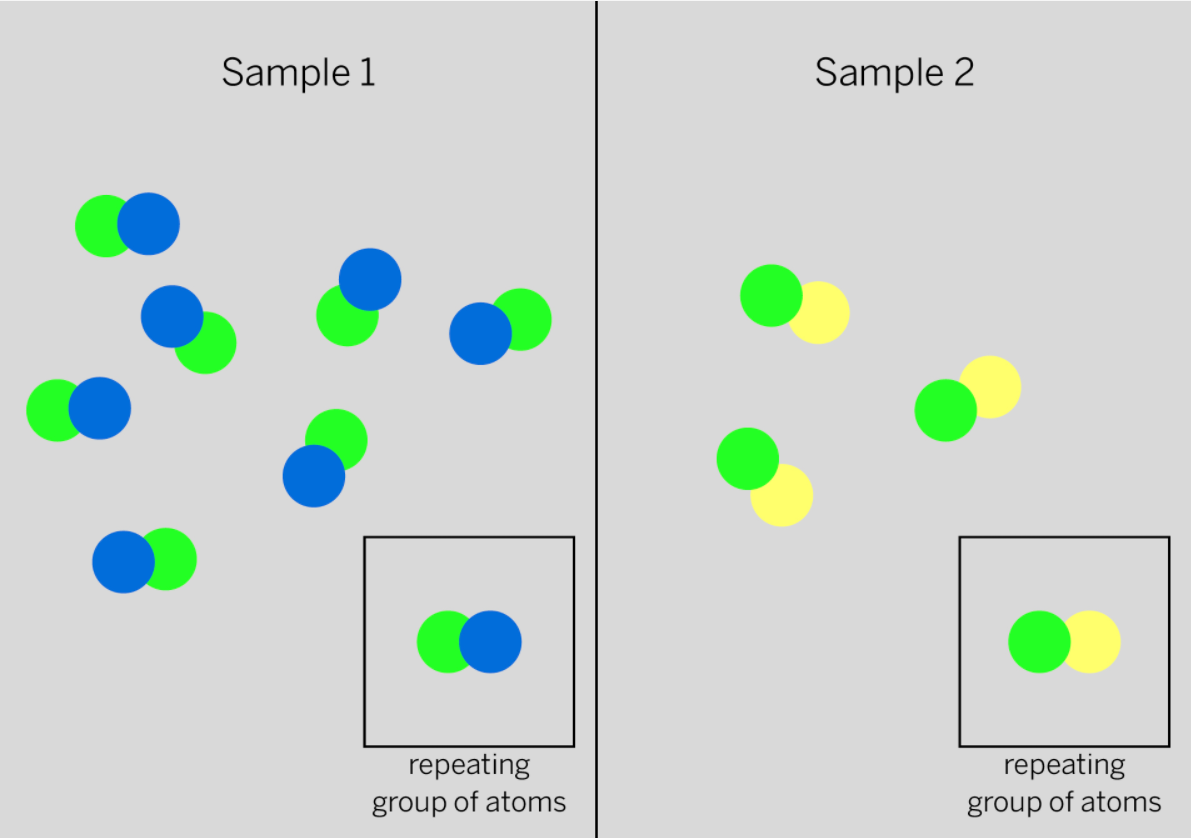
The diagram above shows the repeating groups of atoms that make up two samples. Will the properties of the two samples likely be the same or different? (Examples of properties are smell, color, and the temperature at which a substance melts.)
The properties will likely be different because the repeating groups of atoms that make up each sample are different.
The properties will likely be different because there are more repeating groups of atoms in Sample 2.
The properties will likely be the same because the repeating groups of atoms that make up the two samples have the same number of atoms.
The properties will likely be the same because the repeating groups of atoms that make up the two samples have two of the same types of atoms.
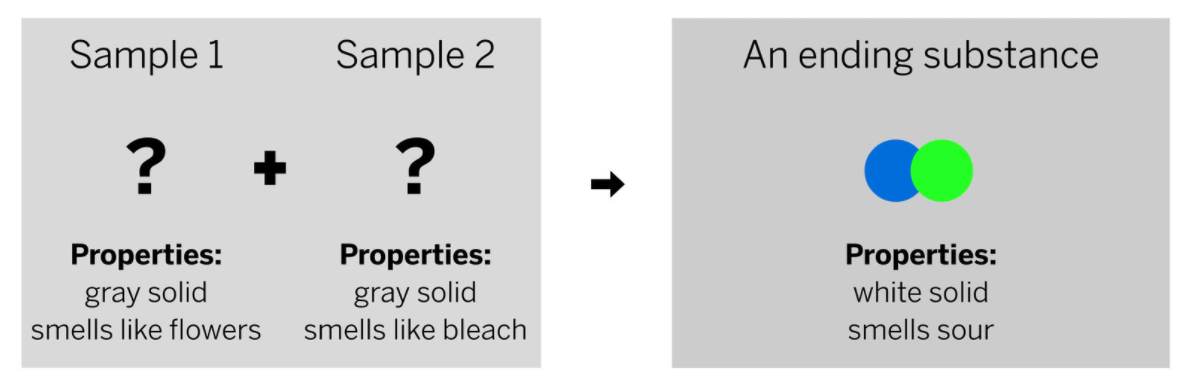
Serena mixed two samples together: a gray solid that smells like flowers and a gray solid that smells like bleach. She analyzed the results and found two ending substances. One of the ending substances was a white solid. This ending substance is made up of the repeating group of atoms shown above. Which of the diagrams to the left shows the repeating groups of atoms that make up the samples Serena mixed together?




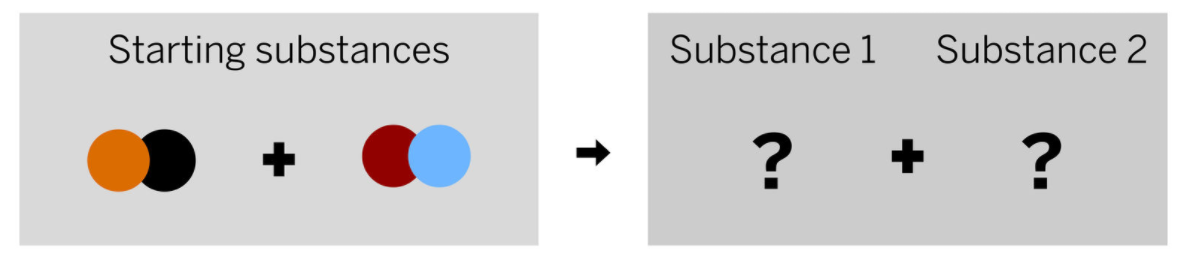
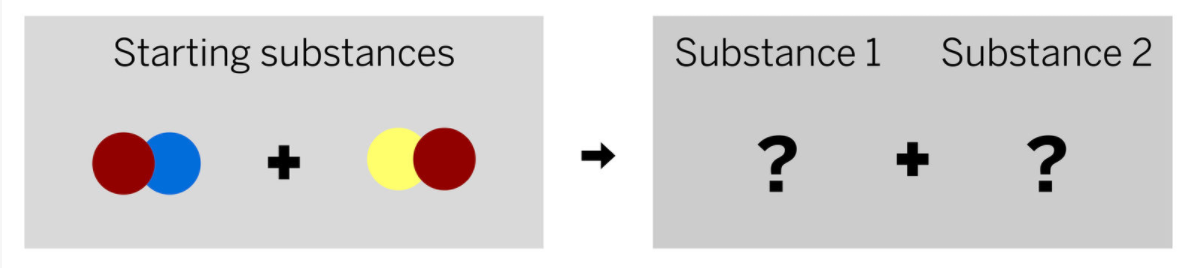
Tiana is a chemist who is making a chemical to add to swimming pools in order to make the water safer. She mixed two solid substances together in a sealed container. The diagram above shows the repeating groups of atoms that make up the two starting substances.
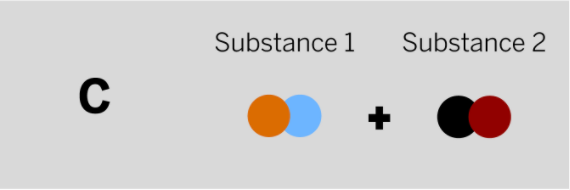
After mixing, Tiana found two liquid substances in the sealed container. (Nothing had escaped.) Which of the diagrams to the left shows the repeating groups of atoms that make up the ending substances?



The diagram above shows the repeating groups of atoms that make up two samples. Will the properties of the two samples likely be the same or different? (Examples of properties are smell, color, and the temperature at which a substance melts.)
The properties will likely be different because the repeating groups of atoms that make up each sample are different.
The properties will likely be different because there are more repeating groups of atoms in Sample 1.
The properties will likely be the same because the repeating groups of atoms that make up the two samples have one of the same types of atoms.
The properties will likely be the same because the repeating groups of atoms that make up the two samples have the same number of atoms.




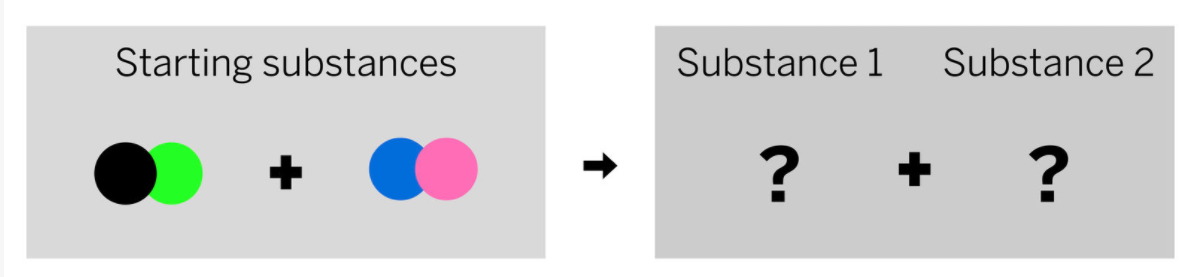
Santiago is a chemist working to make a new kind of antacid, which is a medicine that helps with stomach pain. He mixed two powdery solid substances together in a sealed container. The diagram above shows the repeating groups of atoms that make up the two starting substances.
After mixing, Santiago found two liquid substances in the sealed container. (Nothing had escaped.) Which of the diagrams to the left shows the repeating groups of atoms that make up the ending substances?




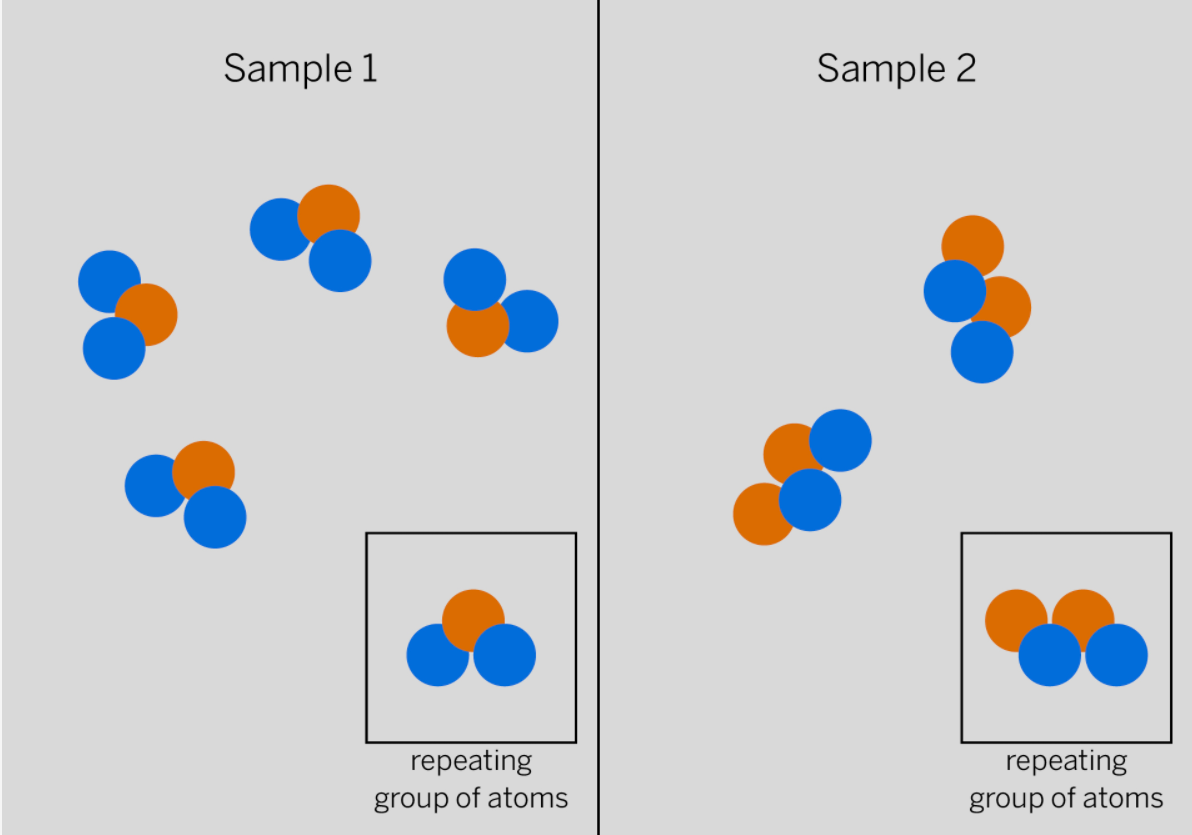
The diagram above shows the repeating groups of atoms that make up two samples. Both samples are liquid at room temperature. Will the properties of the two samples likely be the same or different? (Examples of properties are smell, color, and the temperature at which a substance melts.)
The properties will likely be the same because the repeating groups of atoms that make up the two samples have the same types of atoms.
The properties will likely be the same because both samples are liquids at room temperature.
The properties will likely be different because the repeating groups of atoms that make up the two samples have different numbers of atoms.
The properties will likely be different because there are more repeating groups of atoms in Sample 1.
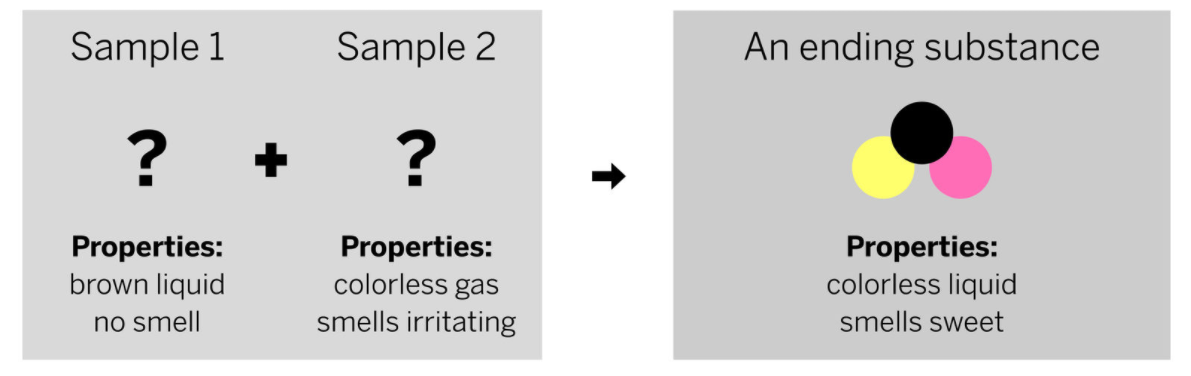
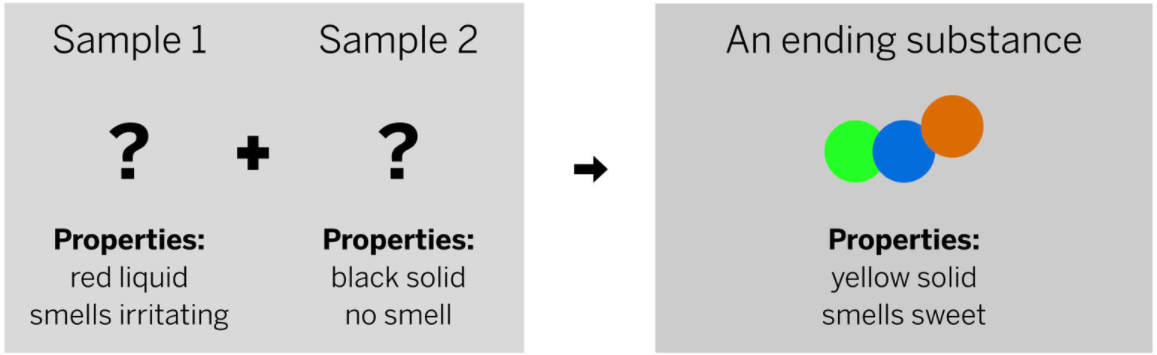
Marisol mixed two samples together: a brown liquid with no smell and a colorless gas that smells irritating. She analyzed the results and found two ending substances. One of the ending substances smelled sweet. This ending substance is made up of the repeating group of atoms shown above. Which of the diagrams to the left shows the repeating groups of atoms that make up the samples Marisol mixed together?




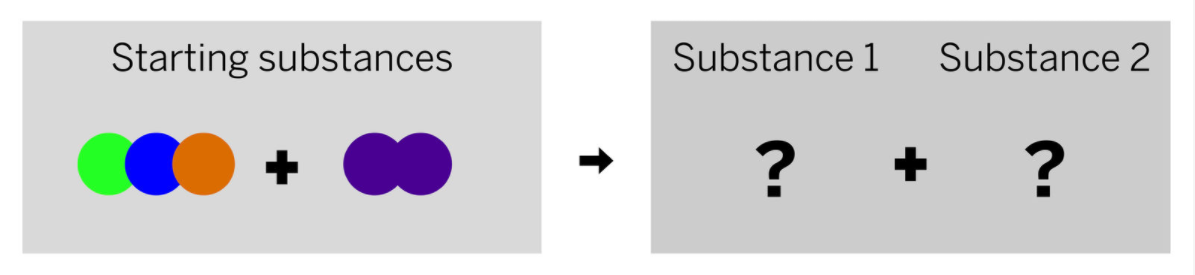
Jamie works at a company that makes cleaning chemicals. She is trying to make a chemical that smells like flowers. She took two samples that were gases at room temperature and mixed them in a sealed container. The diagram above shows the repeating groups of atoms that make up the two starting substances.
After mixing, Jamie found two substances that smelled like flowers in the sealed container. (Nothing had escaped.) Which of the diagrams to the left shows the repeating groups of atoms that make up the ending substances?




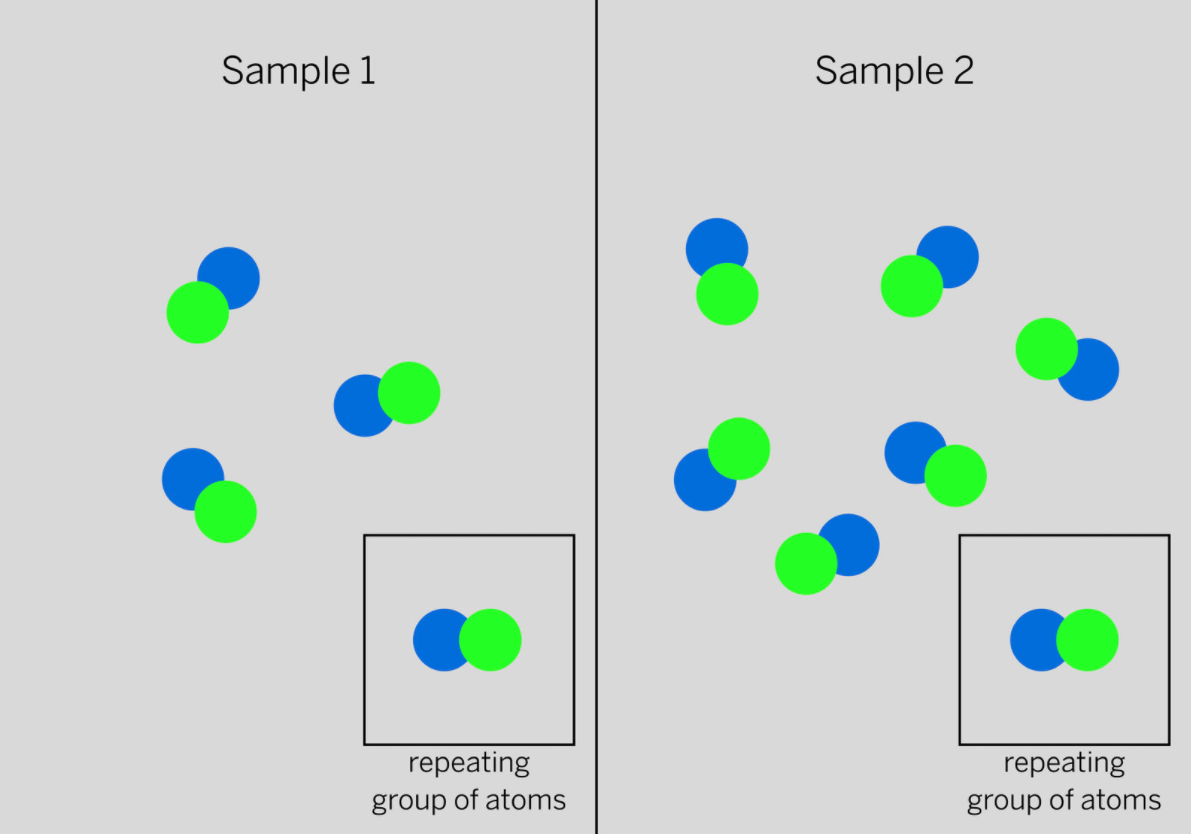
The diagram above shows the repeating groups of atoms that make up two samples. Both samples are green gases at room temperature. Will the other properties of the two samples be the same or different? (Examples of properties are smell, color, and the temperature at which a substance melts.)
The other properties will be the same because the repeating groups of atoms that make up the two samples are the same.
The other properties will be different because there are more repeating groups of atoms in Sample 2.
The other properties will be the same because both samples are green at room temperature.
The other properties will be the same because both samples are gases at room temperature.
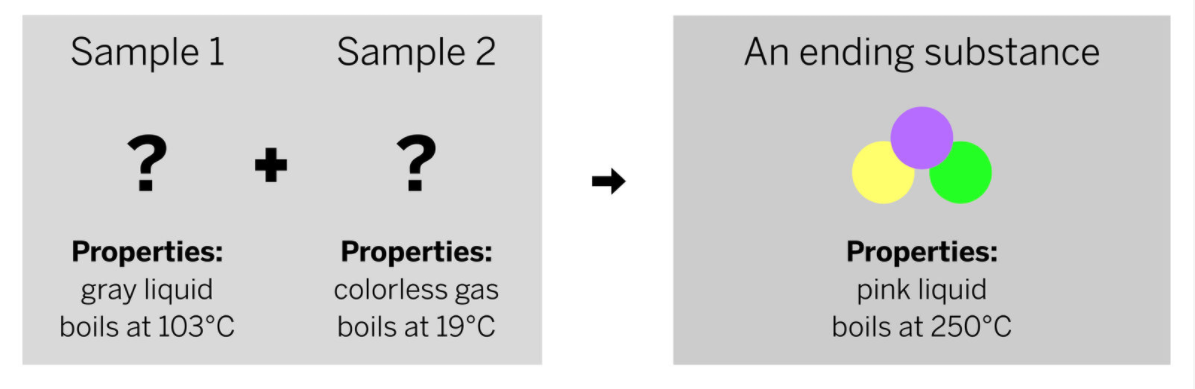
A chemist mixed two samples together: a gray liquid that boils at 103°C and a colorless gas that boils at 19°C. She analyzed the results and found two ending substances. One of the ending substances was a pink liquid. This ending substance is made up of the repeating group of atoms shown above. Which of the diagrams to the left shows the repeating groups of atoms that make up the samples the chemist mixed together?




Patrik works at a company that makes paper and needs a chemical to make the paper brighter. He mixed two colorless substances together in a sealed container. The diagram above shows the repeating groups of atoms that make up the two starting substances.
After mixing, Patrik found two white substances in the sealed container. (Nothing had escaped.) Which of the diagrams to the left shows the repeating groups of atoms that make up the ending substances?




the tiny pieces that all matter—all the stuff in the world—is made of
the temperature at which a substance changes from the liquid phase to the gas phase
letters and numbers showing the types and number of atoms that repeat to make up a substance
a process in which atoms rearrange to form new substances
able to cause damage
corrosive
a structure formed by repeating groups of atoms linked together in a large network
extended structure
a substance that is added to soil to help plants grow
the temperature at which a substance changes from the solid phase to the liquid phase
an object, diagram, or computer program that helps us understand something by making it simpler or easier to see
a group of atoms joined together in a particular way
an ending substance that is made during a chemical reaction
something that can be observed about a substance, such as color, smell, or boiling point
a starting substance that is part of a chemical reaction
to change the order or position of something
the relative size of things
something that is made of all the same atoms or groups of atoms
substance

Is there any visible bacterial growth in the petri dish on day 1?
Yes
No

Is there any visible bacterial growth in the petri dish on day 3?
Yes
No
Why do you think you can see the growth on day 3 but not on day 1?
Microorganisms grew bigger in size on day three
Microorganisms became visible after multiplying and growing in numbers
The growth is visible so there are no microorganisms in the petri dish, it's something else
Microorganisms can not be seen by th enaked eye

This is the same petri dish on day 5, describe what you are seeing in the petri dish.
Microorganisms are visible because they keeps multiplying and growing in numbers
Some sort of growth but not microorganisms because they are visible
They are geting bigger in size

Do you think the microorganisms were present on the first day of plating? Why or why not?

Do you think the fungal growth (Mold) can make you sick on day 5?

Bacteria in the body outnumber the cells of the human body itself
True
False
Which of the following is likely NOT found living on or in humans as part of a microbiome?
bacteria
fungi
microscopic animals
microscopic plants
Which of the following have been linked to the human microbiome? Choose ALL that apply!
diabetes
obesity
digestive issues
ability to swim
Antibacterial hand sanitizers wipe out which kinds of bacteria on your skin?
Only bad!
Only good!
Both!
They don't work, so no bacteria gets wiped out.
The increase in antibiotic use in the US has ______ the diversity of our microbimes.
reduced
increased
bolstered
strengthened
How do the microbes in the intestinal tract benefit us?
produce vitamins
Breaks down undigestable foods to release nutrients
Control metabolism and nutrient storage
All of the above
Gut microbes teach the immune system to recognize and attack forign pathogens
True
False
Broad spectrum antibiotics only target pathogenic bacteria
True
False
What happens to the microbiome from birth to early adulthood
It becomes less diverse
It becomes more diverse
There is no change
How can people that need to take antibiotics keep their healthy bacteria healthy?
Only take antibiotics when absolutely necessary
Take antibiotics often
Take a broad spectrum antibiotic
Eat a lot of processed and fried foods
Are bacteria good or bad?
Good
Bad
Both
The bacteria in my digestive system are extremely harmful and I should take meds to get rid of them.
false
true
Examples of Probiotic foods
Kimchi, some yogurts, saurerkrauts
Hamburgers, hot dogs, and tacos
fruit and vegetables

The modern Western diet contributes to
diabetes
asthma
autism
strong immune system

When we eat processed food it generates a whole lot of bad bacteria in our body that promotes
homeostasis
balanced microbiomes
inflammation
a harmonious ecosystem

Dietary fiber is essential to balance the gut ecosystem because
it generates high numbers of bad bacteria
it is found in processed foods that we consume
fiber is a fundamental food for gut microbiomes
it helps to increase insulin levels

Implanting live donor gut bacteria into another person's system to revert their flora into a healthy state is
fecal transplantation
colorectal surgery
intestine transplant
colostomy
An athlete thinks that she can exercise as long as she eats different types of food because her body just needs different types of food molecules to work properly. Is the athlete correct?
A Yes, her cells only work when they have molecules from different types of food.
B No, her muscles do not need molecules from food because all cells make all the molecules they need.
C No, all cells need molecules from food and molecules from air to work properly.
D No, only her stomach cells need food molecules to work properly.
Marisol has been chewing and swallowing her food, but her digestive system is not doing what it usually does. Why is this a problem for her ability to exercise?
A Her cells will not work well because molecules from her food are not being broken down small enough to get to her cells.
B Her body will run out of energy because molecules from the air are not being combined into larger molecules for the cells.
C Her respiratory system will have to work twice as hard to break down molecules from food.
D Her cells will not work well because the molecules from food will be too small for cells to use.
Doctors tested a patient to find out what molecules were in her cells. Her cells contained normal levels of amino acids, normal levels of oxygen molecules, and low levels of glucose molecules. Will this patient be able to exercise normally?
A Yes, her cells just need to combine amino acids to release energy.
B No, her cells need to combine glucose into starch molecules to release energy.
C No, her cells need glucose to react with oxygen to release energy.
D Yes, her cells just need oxygen to release energy.
An ocean scientist plans to spend several days underwater in a submarine. Doctors on land will monitor her body to make sure she is healthy during her trip. What is one way doctors will be able to tell whether her body is healthy enough to do all her tasks while she is in the submarine?
A The doctors could see if her cells are getting several different types of food molecules.
B The doctors could see if she is getting plenty of sleep so her body can make enough energy.
C The doctors could see if her lung cells have molecules from air, and her stomach cells have molecules from food.
D The doctors could see if her cells are getting the molecules they need from food and air.

The tables below show information about the body systems of three different patients. Which of these patients’ bodies are NOT working well enough to exercise normally?
A R. Frost only
B V. Mistry only
C R. Frost and A. Kim
D A. Kim and V. Mistry
A patient has been eating healthy foods, but his digestive system is not doing what it usually does. Can this patient still exercise normally?
A Yes, as long as he can still breathe, his cells will have all the molecules they need to release energy.
B No, his digestive system is not breaking down oxygen into molecules small enough to get inside his cells.
C No, molecules from food are not combining together to be large enough for his cells to use.
D No, molecules from food are not getting broken down small enough to get inside his cells.
If a person is breathing normally, which of the following could prevent him from using his body to exercise normally?
A Not getting enough sunlight, because cells need sunlight to function
B Not getting enough sleep, because the body only makes energy for exercise while asleep
C Not eating enough food, because cells need molecules from both food and air to work
D Nothing, because he would be able to exercise normally as long as his cells are getting molecules from the air
Raoul ate a meal of oats before seeing his doctor. Oats are made of mostly starch molecules. Raoul feels tired, so his doctor gave him a test and found that Raoul’s cells contained glucose molecules, but they did not contain enough oxygen molecules. Does this explain why Raoul feels tired?
A No, something else must be wrong because his cells have all the molecules they need.
B Yes, his digestive system is breaking down starch molecules, but his respiratory system may not be working properly.
C Yes, his respiratory system is working, but his digestive system is not getting energy from combining glucose molecules.
D Yes, his digestive system is working, but his respiratory system is not breaking down oxygen, so his body stopped making energy.
Doctors tested a patient to find out what molecules were in his cells. His cells contained normal levels of glucose molecules and amino acid molecules, and low levels of oxygen molecules. Will this patient be able to exercise normally?
A Yes, his body is working properly enough to exercise.
B No, his digestive system is not breaking down food molecules; his cells need starch molecules to react with glucose, which releases energy.
C No, his body systems are working, but he needs to eat different food; only proteins can react with glucose to release energy.
D No, his respiratory system is not working; his cells need oxygen to react with glucose, which releases energy.
Rico, a scuba diver, uses breathing gear to help him breathe air underwater. He always gets enough sleep and eats a good breakfast before a dive. What could happen if his breathing gear broke during a dive and he could not breathe as much air as usual?
A It would be difficult to swim, because his cells cannot work without molecules from air.
B It would not affect him because his cells are getting the different types of molecules they need from food to work properly.
C It would not affect him as long as he slept enough.
D It would not affect him because his body can function normally even if his cells do not have molecules from air.

The test report shows the level of molecules in different parts of the patient's body. What does this test indicate about how her body systems are working?
A Her body systems are working properly.
B Her digestive system is not combining molecules together.
C Her digestive system is not breaking down molecules from food.
Two teams of scientists hiked 10 kilometers to different study sites. Before their hike, the Valley team ate a lunch of mostly protein. The Mountain team ate a lunch of a mix of starch and protein, but hiked at high altitude, where there is much less oxygen. Which team probably had an easier time hiking?
A Both teams had an easy time hiking because their digestive systems broke down proteins into amino acids for cells to release energy.
B Neither team had an easy time hiking; the Valley team’s cells needed more glucose from broken-down starch for a reaction, and the Mountain team’s cells needed more oxygen from air.
C The Mountain team had an easier time hiking; their cells released energy from protein reacting with glucose, which was broken down from starch in the digestive system.
D The Valley team had an easier time hiking; their cells released energy from protein breaking down in the digestive system, which then combined with oxygen in cells.
An athlete thinks that she can exercise as long as she eats different types of food because her body just needs different types of food molecules to work properly. Is the athlete correct?
A Yes, her cells only work when they have molecules from different types of food.
B No, her muscles do not need molecules from food because all cells make all the molecules they need.
C No, all cells need molecules from food and molecules from air to work properly.
D No, only her stomach cells need food molecules to work properly.
Doctors tested a patient to find out what molecules were in her cells. Her cells contained normal levels of amino acids, normal levels of oxygen molecules, and low levels of glucose molecules. Will this patient be able to exercise normally?
A Yes, her cells just need to combine amino acids to release energy.
B No, her cells need to combine glucose into starch molecules to release energy.
C No, her cells need glucose to react with oxygen to release energy.
D Yes, her cells just need oxygen to release energy.
Raoul ate a meal of oats before seeing his doctor. Oats are made of mostly starch molecules. Raoul feels tired, so his doctor gave him a test and found that Raoul’s cells contained glucose molecules, but they did not contain enough oxygen molecules. Does this explain why Raoul feels tired?
A No, something else must be wrong because his cells have all the molecules they need.
B Yes, his digestive system is breaking down starch molecules, but his respiratory system may not be working properly.
C Yes, his respiratory system is working, but his digestive system is not getting energy from combining glucose molecules.
D Yes, his digestive system is working, but his respiratory system is not breaking down oxygen, so his body stopped making energy.
Doctors tested a patient to find out what molecules were in his cells. His cells contained normal levels of glucose molecules and amino acid molecules, and low levels of oxygen molecules. Will this patient be able to exercise normally?
A Yes, his body is working properly enough to exercise.
B No, his digestive system is not breaking down food molecules; his cells need starch molecules to react with glucose, which releases energy.
C No, his body systems are working, but he needs to eat different food; only proteins can react with glucose to release energy.
D No, his respiratory system is not working; his cells need oxygen to react with glucose, which releases energy.
Marisol has been chewing and swallowing her food, but her digestive system is not doing what it usually does. Why is this a problem for her ability to exercise?
A Her cells will not work well because molecules from her food are not being broken down small enough to get to her cells.
B Her body will run out of energy because molecules from the air are not being combined into larger molecules for the cells.
C Her respiratory system will have to work twice as hard to break down molecules from food.
D Her cells will not work well because the molecules from food will be too small for cells to use.
Rico, a scuba diver, uses breathing gear to help him breathe air underwater. He always gets enough sleep and eats a good breakfast before a dive. What could happen if his breathing gear broke during a dive and he could not breathe as much air as usual?
A It would be difficult to swim, because his cells cannot work without molecules from air.
B It would not affect him because his cells are getting the different types of molecules they need from food to work properly.
C It would not affect him as long as he slept enough.
D It would not affect him because his body can function normally even if his cells do not have molecules from air.
Raoul ate a meal of oats before seeing his doctor. Oats are made of mostly starch molecules. Raoul feels tired, so his doctor gave him a test and found that Raoul’s cells contained glucose molecules, but they did not contain enough oxygen molecules. Does this explain why Raoul feels tired?
A No, something else must be wrong because his cells have all the molecules they need.
B Yes, his digestive system is breaking down starch molecules, but his respiratory system may not be working properly.
C Yes, his respiratory system is working, but his digestive system is not getting energy from combining glucose molecules.
D Yes, his digestive system is working, but his respiratory system is not breaking down oxygen, so his body stopped making energy.
Doctors tested a patient to find out what molecules were in her cells. Her cells contained normal levels of amino acids, normal levels of oxygen molecules, and low levels of glucose molecules. Will this patient be able to exercise normally?
A Yes, her cells just need to combine amino acids to release energy.
B No, her cells need to combine glucose into starch molecules to release energy.
C No, her cells need glucose to react with oxygen to release energy.
D Yes, her cells just need oxygen to release energy.
Select all that are made up of molecules.
sandwiches
atoms
people
chair
Where do we get glucose molecules from?
Sugars/Starches
Protein
Air
Water
Select all that contain protein.
meat
eggs
beans
candy
Where is the best place to take in oxygen molecules?
Mountains
Beach
Forest
Pool
Amino Acids are....
molecules that are the building blocks of proteins
a molecule made of carbon and oxygen atoms
a molecule that organisms can use to release energy,
a molecule that organisms get from the air or water around them
What is the chemical reaction between oxygen and glucose that releases energy into cells?
Cellular respiration
Glucose
Metabolism
Amino acid
What is the body system that takes in food and breaks it down?
Digestive System
Circulatory System
Respiratory System
Molecule
What is a proposed answer to a question about the natural world?
Claim
Evidence
Reasoning
Organism
What is a molecule that organisms can use to release energy, and that is made of carbon, hydrogen, and oxygen atoms?
Glucose
Oxygen
Amino acid
Metabolism
The circulatory system is ......
the body system that transports molecules to and from all cells of the body
the body system that takes in food and breaks it down
the body system that takes in oxygen and releases carbon dioxide
the body system that is responsible for immunity
What is energy?
the ability to make things move or change
found in a can of Monster energy drink
a group of atoms joined together in a particular way
a set of interacting parts forming a complex whole
What is oxygen?
a molecule that organisms get from the air or water around them and use to release energy
a molecule that organisms can use to release energy, and that is made of carbon, hydrogen,
a molecule made of carbon and oxygen atoms
molecules that are the building blocks of proteins
The process in which atoms rearrange to form new substances
chemical reaction
chemical equation
cellular respiration
digestive system
A molecule made of one atom of carbon and 2 atoms of oxygen
Carbon dioxide
Carbon Trioxide
Carbon Monoxide
Carbonic Acid
Metabolism is......
the body’s use of molecules for energy and growth
the ability to make things move or change
a molecule made of carbon and oxygen atoms
a claim supported by evidence
respiratory system
the body system that takes in oxygen and releases carbon dioxide
the body system that takes in food and breaks it down
the body system that transports molecules to and from all cells of the body
the body system that takes carbon dioxide to all the cells of the body
the process of making clear how your evidence supports your claim
evidence
reasoning
claim
information about the natural world that is used to support or go against (refute) a claim
claim
evidence
scientific reasoning
a group of atoms joined together in a particular way
chemical
molecules
elements
protons
a category of large molecules that perform important functions inside living things
carbon dioxide
protein
water
beans
molecules that are the building blocks of proteins
amino acids
glucose
oxygen
carbon dioxide
What is a set of interacting parts forming a complex whole?
Molecule
System
Metabolism
Digestive System
A type of energy storage molecule made of many glucose molecules connected together
starch
glucose
amino acid
oxygen

What do you do if a fire breaks out during a lab?
Run!
Tell the teacher
Just watch it burn
after completing an experiment, all chemical waste should be
left at your lab station for the next class
disposed of according to your teacher's instructions
dumped in the sink
taken home
You just cut your finger on a piece of broken glass, what should you do?
go see a doctor after school
tell the teacher!
go see the nurse
take care of it by youself
(True or False) It is okay to pick up broken glass with your bare hands as long as the glass is placed in the trash can
true
false
Laboratory work may be started immediately upon entering the laboratory even if the teacher is not yet present
false
true
When it comes to glassware...
don't use it if it's chipped/cracked
don't pick it up if it breaks (let the teacher do it)
dispose of it in the correct container
all of the above
Never work without...
good music
a buddy
adult supervision
a snack
During lab, what do you do first?
read all directions
wash your hands
gather your materials
get the fire extinguisher
When preparing for lab, you should...
tie back long hair
not wear baggy clothes
wear closed-toe shoes
watch the Marvel movies so you know what superpowers to expect if you mess anything up
Never leave ___ unattended.
a dissected pig
a test tube
an active heat source
a freshman
When instructions are being given you should....
listen
inspect your eyelids for holes
ponder one of life's mysteries
practice yoga
Items containing liquid should be placed
at the edge of the table
away from the edge
at the edge of tomorrow
at the edge of darkness


What is the 1st of the scientific method?
observation
question
method
hypothesis
What is the 2nd step of the scientific method?
method
hypothesis
question
observation
What is the 3rd step of the scientific method?
method
result
observation
hypothesis
What is the 4th step of the scientific method?
hypothesis
method
result
observation
What is the 5th step of the scientific method?
result
method
conclusion
question
What is the 6th step of the scientific method?
observation
result
conclusion
hypothesis
give step by step instructions to conduct the experiment
hypothesis
result
method
conclusion
ask questions about what you observed
observation
question
method
hypothesis
record data in a table or graph
result
conclusion
method
hypothesis
form an educated guess to your questions
conclusion
observation
hypothesis
method
summarize your experiment and state whether your hypothesis was correct or incorrect
observation
result
method
conclusion
study something using your five senses
hypothesis
observation
method
question

