Worksheets
First Semester Review Quizziz 8th Science
Total questions: 192
Worksheet time: 2hrs 19mins
A 1,100 kg car comes uniformly to a stop. If the vehicle is accelerating at -1.2 m/s2, which force is closest to the net force acting on the vehicle [F=ma].
-9,600 N
-1,300 N
-900 N
-94 N

The diagram below shows a boat moving north in a river at 3m/s while the current in the river moves south at 1 m/s.
How will the boat be affected if it enters a part of the river where the current is moving south at 3 m/s?
The boat will move slower
The boat will move faster
The boat will stop
The boat will move to the west

Some students measure the acceleration of a wheeled cart being acted on by varying forces. The students recorded their data in the table shown above. According to the data table, how much force is acting on the cart when the students measure an acceleration of 2.6 m/s2?
13 N
7 N
8 N
12 N

For an investigation, a student measures the speed of a art as it rolls down a ramp. The student then records data in the table below.
Which of these best explains the student's data?
the speed of the cart decreases as the cart rolls down the ramp because of friction between the cart and the ramp
the speed of the cart increases as the cart rolls down the ramp because the force acting on the cart is greater than the force of gravity
the speed of the cart increases as the cart rolls down the ramp because the forces acting on the cart are unbalanced
the speed of the cart decreases as the cart rolls down the ramp because the forces acting on the cart are balanced
A push or a pull
speed
acceleration
force
balanced

In the picture shown, the forces are ______.
unbalanced
accelerating
changing
balanced

In the diagram shown, the forces are _____.
unbalanced
balanced
accelerating
stable

What is the net force and direction of the figure shown?
2 N left
2 N right
3 N left
3 N right

What is the direction and net force of the box in the figure shown?
2 N left
2 N right
0 N
1 N right
A car is slowing down before it reaches a stoplight. This is an example of ....
acceleration
distance
constant velocity
balanced force
A planet orbits the Sun at a constant speed while making a circular arc around the star. This is an example of ...
acceleration
unbalanced forces
constant velocity
net force

The diagram below shows a sled moving along a smooth, frictionless track.
In which sections of the track will the sled experience an unbalanced force?
Sections 1 and 3
Sections 2 and 3
Sections 2 and 4
Sections 3 and 4
When a space shuttle was launched, the astronauts on board experienced an acceleration of 29.0 m/s2. If one of the astronauts had a mass of 60.0 kg, what net force in Newtons did the astronaut experience?
2.07 N
31 N
69 N
1740 N

A student used a video camera to record another student dropping a marble through water in a graduated cylinder. The students watched the video in slow motion and made the observations shown below.
During which part or parts of the marble's fall did the marble experience unbalanced forces?
Part 1 only
Parts 1 and 2 only
Part 3 only
Parts 2 and 3 only
A science book is sitting on a table. Which statement best explains why the book remains motionless?
there are no forces acting on the book
the only force acting on the book is directed to the table
the forces acting on the book are all balanced
the table exerts an unbalanced force on the book
The tendency for an object to keep doing what it is already doing is called....
balanced force
unbalanced force
inertia
friction
Someone swerved in front of your mom's car on the freeway. Your mom hit the brakes and you were thrown forward until stopped by the seatbelt. The reason you moved forward when the car was slowing down is due to ...
balanced forces
speed
velocity
inertia
A large truck weighing 8000 kg takes longer to accelerate than a small car weighing 1000 kg. This is due to ...
Newton's 2nd law F=ma
Newton's 1st law Inertia
Newton's 3rd law action/reaction
friction
To throw a basket ball and a bowling ball at the same speed, you would need to use ______
less force on the bowling ball
more force on the bowling ball
the same force for both balls
none of these answers are correct
While skateboarding, you push back on the sidewalk with your right foot and move forward on the skateboard with your left foot. This is due to...
Newton's first law - inertia
Newton's second law - F=ma
Newton's third law - action/reaction
gravity
A hockey player shoots the puck into the goal. As the puck hits the net ...
the puck is stopped by an outside force
the puck was stopped by friction
the puck did not stop
the puck experienced friction on the ice

Which law of motion is demonstrated in this picture?
first
second
third
gravity

What law of motion is demonstrated in this picture?
first
second
third
gravity

Which law of motion is demonstrated by the picture shown?
first
second
third
balanced

Sometimes tectonic plates do not move easily past one another, and the plates become stuck. Forces build up, and when the plates finally move, tension is released, as shown below.
The sudden movement of the plates is caused by -
the mass of the plates
the weight of the plates
unbalanced forces
gravitational force
The distance an object travels per unit of time
inertia
speed
friction
velocity
Speed in a given direction
acceleration
velocity
friction
gravity
The rate at which velocity changes
change
speed
acceleration
balanced
A force of attraction between objects that is due to their masses.
inertia
gravity
net force
friction
A force that opposes motion between two surfaces that are in contact
balanced
unbalanced
forces
friction

Which of these locations on Earth experiences the least change in the number of daylight hours throughout the year?
Equator
North Pole
Tropic of Cancer
Tropic of Capricorn

How long does it take the Earth to move from Point A to Point C?
3 months
6 months
9 months
12 months

Which of these best compares the conditions at location X and location Y?
It is day at location X and night at location Y.
It is winter at location X and night at location Y.
There are more hours of daylight at location X than at location Y.
The moon is brighter when viewed from location X than when viewed from location Y.
What season is the Northern Hemisphere experiencing when it is tilted directly toward the Sun?
fall
winter
spring
summer

In the summer many people enjoy going to the beach. The photograph shows a beach in Argentina, which is in the Southern Hemisphere.
Which diagram shows the position of Earth when it is summer in Argentina?


A student wants to use a spinning basketball to model the day and night cycle on Earth.
What should the student do in order to best model the day and night cycle?
Spin the ball in different directions
Tilt the ball while it is spinning
Paint one half of the ball white and the other half black
Shine a bright light on one side of the ball.

The diagram shows the tilt of Earth as it orbits the Sun.
Which diagram accurately shows Earth’s tilt when the planet reaches Point X on its solar orbit?


Earth’s axis of rotation is tilted relative to the plane of Earth’s orbit.
How many degrees is Earth tilted?
16.5°
23.5°
32.5°
66.5°
If the Earth did not tilt on its axis in relation to the sun, which of the following would also be true?
There would be no seasons.
One Earth-year would be 14% longer.
The Earth would spin at a different rate.
Temperatures at the Earth’s equator would cool.

Earth’s tilt on its axis causes which condition at location X on its surface?
long daylight hours
solar eclipse
low tides
winter

The diagram below shows latitude lines on Earth on a particular day.
Which location in the diagram receives the most direct sunlight?
30° North
the equator
30° South
the South Pole

Regions of Earth experience seasons at different times.
At which position in the orbit of Earth would City X have summer?
1
2
3
4
At the equator, Earth spins at a rate of about 1670 kilometers per hour. The circumference of Earth at the equator is about 40000 kilometers. About how long does it take Earth to make one complete rotation on its axis at the equator?
12 hours
24 hours
29.5 days
365 days
In some years, the month of February has 29 days instead of 28 days. Why is it necessary to sometimes add a day to the calendar?
The speed at which Earth orbits the Sun varies.
It takes the Moon about 27 days to revolve around Earth.
It takes Earth about 365.25 days to revolve around the Sun.
The Moon can complete more than one full cycle in some months.

The length of day in the Northern Hemisphere is shortest when the North Pole is tilting away from the Sun.
During which month of the year does this occur?
April
December
June
September
There are some towns located in the valley of the Alpine mountains. During part of the year, these towns stay dark all day because the mountains block the Sun. During which season would the Sun be low enough in the sky that the village stays in the shadows?
fall
spring
summer
winter

The table shows some sunrise and sunset times for February of 2007 in Miami, Florida.
What causes these sunrise and sunset times to be regular and predictable?
the phases of the Moon
the orbit and rotation of Earth
the rise and fall of the tides of the ocean
the average distance from Earth to the Sun

The model shows Earth in several positions relative to the sun.
In which position is it winter in North America?
Position 1, because North America receives the most direct sun
Position 2, because North America is tilted toward the sun
Position 3, because North America is parallel to the sun
Position 4, because North America is tilted away from the sun
Which of these changes would likely occur if the rate of Earth’s rotation on its axis increased?
The length of the seasons would be shorter.
The length of the seasons would be longer.
The length of a day would be shorter.
The length of a day would be longer.

Earth would not have seasons if it —
no longer tilted on its axis
stopped rotating on its axis
took an additional month to orbit the sun
revolved around the sun in the opposite direction

The diagram below shows four positions in Earth’s orbit around the sun.
The Northern Hemisphere experiences the beginning of spring when Earth is in —
Position 1
Position 2
Position 3
Position 4
Which of the following diagrams illustrates the position of the Sun and Earth on the longest day of the year in the Northern Hemisphere?


At which point on the diagram is the number of hours of daylight shortest in North America?
Point A
Point B
Point C
Point D
The Earth moves in predicable patterns. One of these patterns causes the seasons as the Earth moves around the Sun along its elliptical orbit. This movement is referred to as —
a rotation
a photoperiod
an equinox
a revolution
The Earth moves in predictable patterns. One of these patterns causes approximately 12 hours of daylight and 12 hours of darkness during a 24-hour period in areas around the equator. This movement is referred to as —
a rotation
an equinox
a photoperiod
a revolution


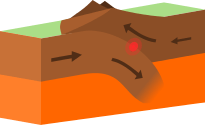

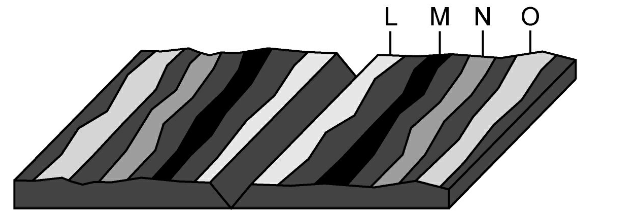
Folded mountains are created when....
Two continental plates collide
Two oceanic plates pull apart
An Oceanic plate subducts under a Continental Plate
Two continental plates pull apart
What are the lines called on topographic map?
Curved lines
Distance lines
Contour lines
Squiggly lines

What is the contour interval in this topographic map?
40 m
20 m
35 m
50 m

What is the highest point on this topo map?
600
400
500
608

What is the contour interval in this topographic map?
275 m
150 m
250 m
300 m


Which topographic map matches this profile?


The topographic map shows a canyon. At which point does the canyon have the least change in elevation?
A
B
C
D
The topographic map shows a canyon. At which point does the canyon have the greatest change in elevation?
A
B
C
D

Which profile best represents the contour map along line AB?


The satellite image below shows a ship channel between South Padre Island and Boca Chica beach in South Texas.
Sand is sometimes removed from the ship channel through a process called dredging to make it easier for ships to travel through. Recently sand from the bottom of the channel was moved to area beaches. Without this transfer of sand, what would most likely occur in this area in the future?
The ship channel would become deeper, and the island would move west toward the mainland.
The ship channel would become shallower, and the beach would become narrower.
The ship channel would become shallower, and the beach would become narrower.
he ship channel would become wider, and the island would sink into the Gulf of Mexico.

A geologic cross section of the Himalayan Mountain Range is shown. This mountain range is the result of which type of boundary interaction?
divergent boundary between two continental plates
convergent boundary between two continental plates
divergent boundary between a continental plate and an oceanic plate
convergent boundary between a continental plate and an oceanic plate

Two tectonic plates are shown. Geologists predict that folded mountains will form in about 10 million years.
Which best explains the motion of the tectonic plates?
Plate 1 and Plate 2 are moving east.
Plate 1 and Plate 2 are moving west.
Plate 1 is moving west and Plate 2 is moving east.
Plate 1 is moving east and Plate 2 is moving west.

The diagram shows two plates of crust on Earth moving away from each other. Which event will most likely occur at Point A?
An eroded mountain will rise.
Magma will form new crust in the form of a mid ocean ridge.
A freshwater lake will develop.
Rivers will form a canyon.

Which profile below reflects this topographic map?


Which profile below reflects this topographic map?

Which profile below reflects this topographic map?

Which profile below reflects this topographic map?

This topographic map represents the elevation of an area a 100 years ago. At that time the highest point had an elevation of 214m. The highest point has since eroded a total of 7m. Which profile most likely represents the landscape today?


The satellite image shows a portion of the Namib Desert in Africa. This is an ancient, sandy desert with dunes that can be up to 305 m tall. The Namib Desert extends inland from the Atlantic Ocean between 80 km and 200 km and receives only 5 mm to 76 mm of rain each year. A satellite picture of this same area taken weeks before shows that the shape and location of some sand dunes have changed. Which of these most likely caused the changes in the dunes?
Ocean waves
Flowing rivers
Blowing wind
Crustal uplift

This satellite photograph shows an area in Alaska after a fire occurred. Which statement best describes the most likely effect the fire had on the river in the 12 months after it occurred?
Less sediment flowed into the river because the fire heated up the soil and made it drier.
The amount of vegetation increased and less sediment flowed into the river because the fire produced ash that mixed with the soil.
More sediment flowed into the river because the fire destroyed most of the vegetation holding the sediment in place.
More sediment flowed into the river because the fire disrupted animal habitats and caused animals ot leave the area.

A student stands at the point marked X on the topographic map below. What height in meters must the student climb in order to reach the top of the hill?
248
253
303
355

The photograph shows mountains in the Andes range in South America. Which statement describes the geologic process that is most likely responsible for the formation of these mountains?
They are along a transform plate boundary that is no longer active, so erosion is creating deep valleys.
They are along a transform plate boundary in which plates are currently moving side by side, causing earthquakes and faults.
They are along a plate boundary in which plates are currently converging, causing uplift and steep slopes.
They are along a plate boundary in which plates diverged in the distant past, allowing new rock to build up.
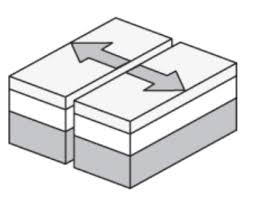
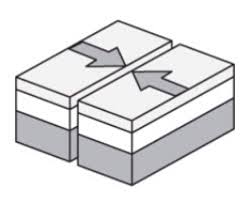
A mid-ocean ridge is located at the boundary of two tectonic plates. Which diagram correctly models the relative plate motion on each side of a mid-ocean ridge?


A mid-ocean ridge is located at the boundary of two tectonic plates. Which diagram correctly models the relative plate motion on each side of a mid-ocean ridge?
Rift valleys can form when fractures in Earth's crust widen. The valley walls slowly move at a rate of only a few millimeters a year. Which of these best describes the type of tectonic activity that forms rift valleys?
Rift valleys form where a continental plate moves under an oceanic plate
Rift valleys form where a plate slides horizontally past another plate
Rift valleys form where two plates move away from each other
Rift valleys form where an oceanic plate moves under another oceanic plate
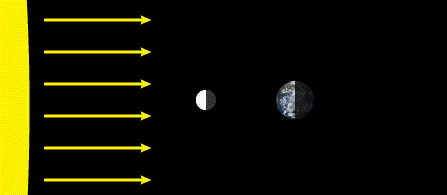
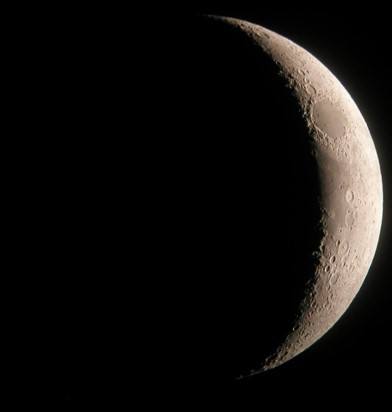
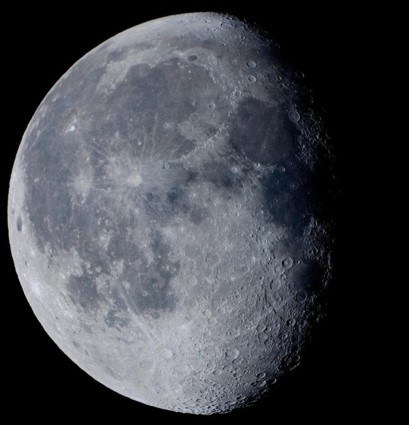
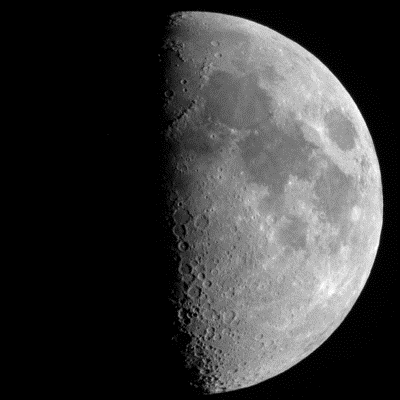
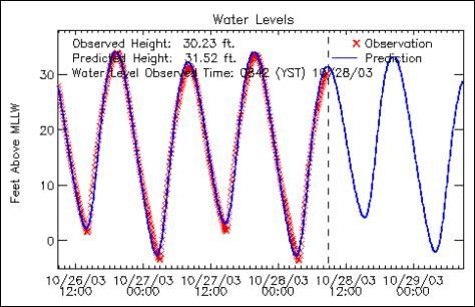
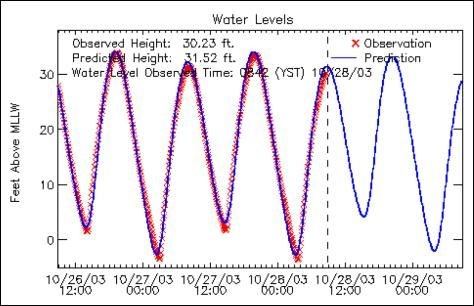
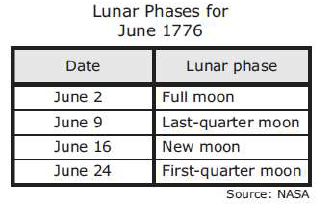
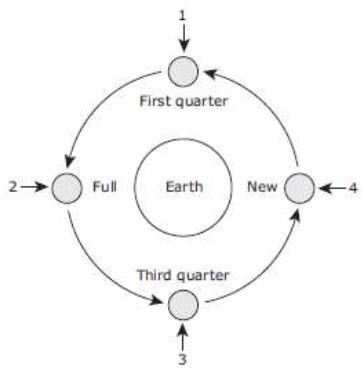
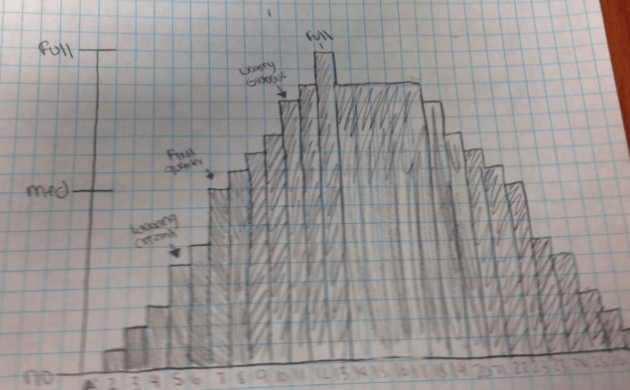
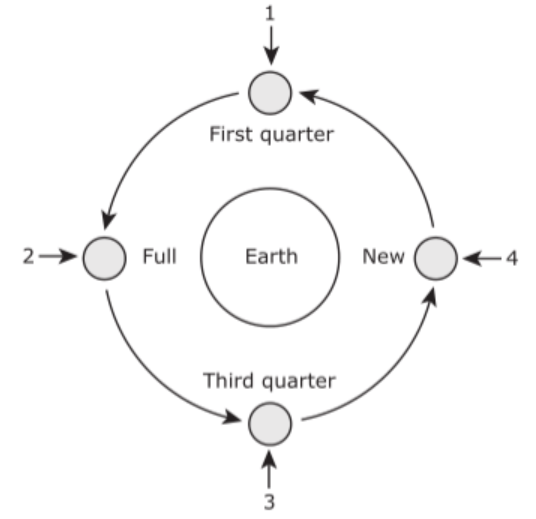
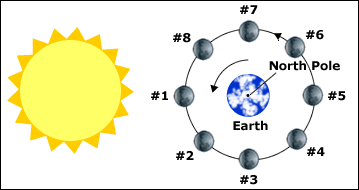
The diagram below shows four phases of the moon as it revolves around Earth.
A student builds a model based on this diagram. The student uses foam balls to represent the moon and Earth and a flashlight to represent the sun. The student should shine the flashlight on the model of Earth from Position—
1
2
3
4
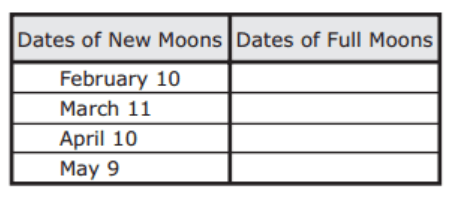
A student must complete the column of the table that lists the dates of the full moons.
What are the most likely dates of the full moons?
February 5, March 7, April 5, May 4
February 15, March 17, April 15, May 14
February 25, March 27, April 25, May 24
February 29, March 31, April 29, May 28
A student uses paper and fasteners to create a model of Earth, the sun, and the moon. The sun and Earth are attached to the paper background, while the moon is free to revolve around Earth.
Which diagram shows the objects arranged so that a third/last quarter moon would be visible from Earth?
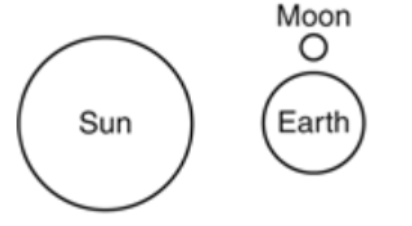

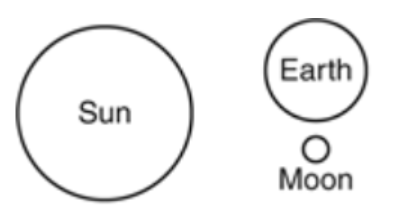
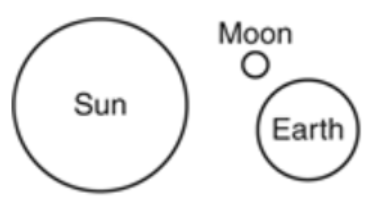
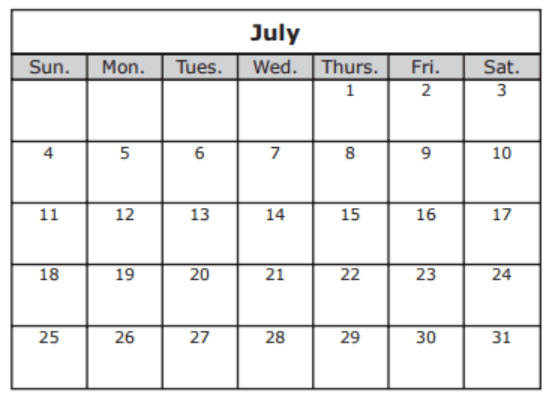
Two friends want to go for a night hike when there is a full moon in July.
If there is a third-quarter moon on July 2, what is the approximate date of the next full moon?
July 9
July 16
July 23
July 30
The appearance of the moon changes in a predictable way in a pattern that lasts approximately 28 days. The changes in appearance are called phases of the moon. What is the main cause of moon phases?
The distance between the Earth and the moon.
The tilt of Earth on its axis compared to the tilt of the moon on its axis.
The amount of sunlight the Earth’s surface is exposed to.
The position of the moon in relationship to the Earth and Sun.
Which diagram BEST represents the relationship of the Earth, moon, and sun during the new moon phase?
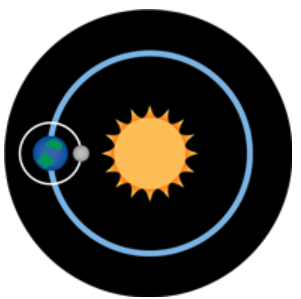
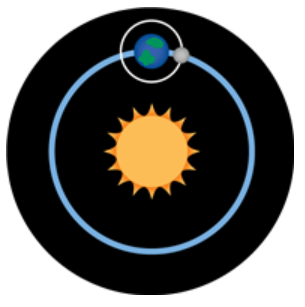
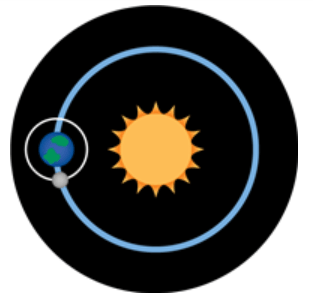
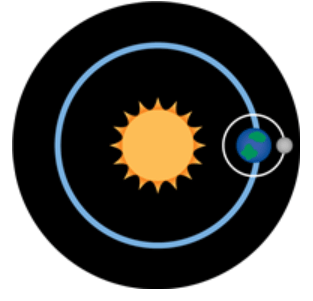

Susan is sketching the appearance of the moon each night. Below is her entry for last night.
What will Susan’s entry look like in 14 days?




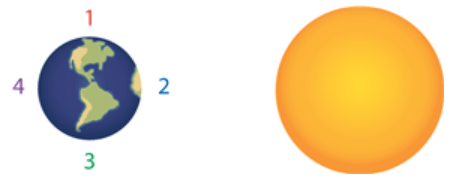
A student is drawing a diagram to show the positions of Earth, the moon, and the sun during a full moon.
Where on the diagram should the student place the moon to accurately show its position relative to the Earth and the sun during a full moon?
1
2
3
4
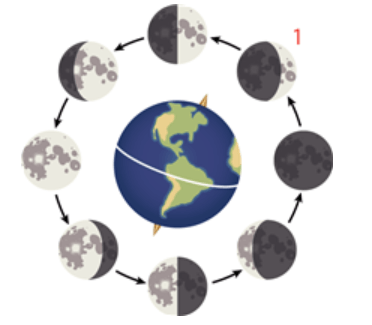
What is the phase of the moon indicated by the 1 in the diagram shown above?
waning crescent phase
waning gibbous phase
waxing crescent phase
waxing gibbous phase
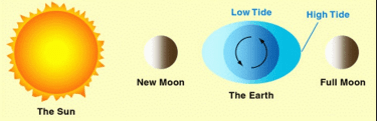
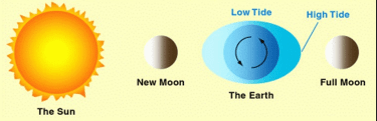
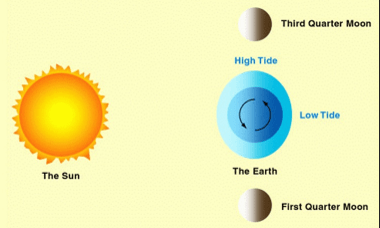
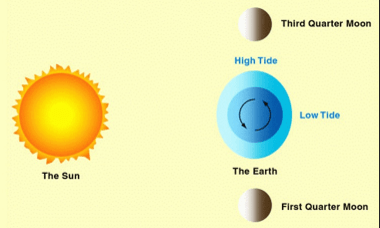
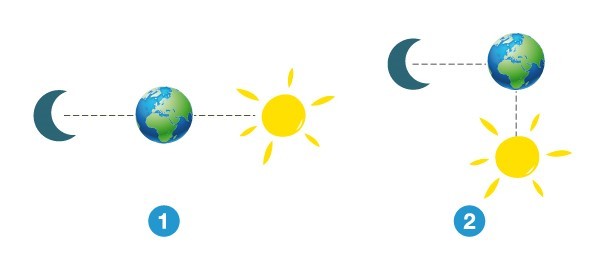
Which moon phases are associated with the highest tides?
full and three quarter
new and first quarter
new and full
first quarter and three quarter
The alignment of the Moon and Sun has an affect on Earth’s ocean tides. What force causes this effect?
sun spots
magnetic fields
gravity
air resistance
The appearance of the moon changes in a predictable pattern that lasts approximately 28 days. The changes in appearance are called phases of the moon. What is the main cause of moon phases?
The distance between the Earth and the moon.
The tilt of Earth on its axis compared to the tilt of the moon on its axis.
The amount of sunlight the moon’s surface is exposed to.
The position of the moon in relationship to the Earth and Sun.
Mrs. Gupta is the Cub Scout den mother. She is taking a troop of boys on a camp out and believes it will be easier if she schedules the outing to happen during the full moon. Last night she observed a waning gibbous moon. Approximately how many days will she have to wait before the next full moon?
7
14
24
28
Which diagram shows the position of the Moon, Earth and Sun, when the Moon appears full on Earth?
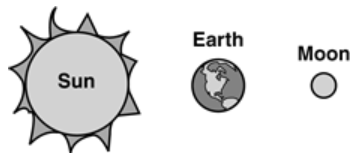
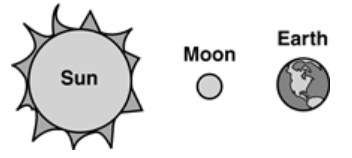
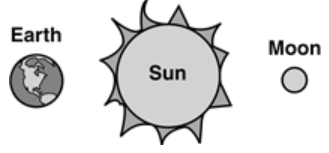
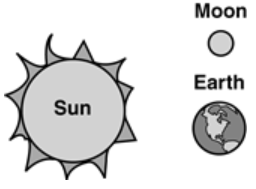
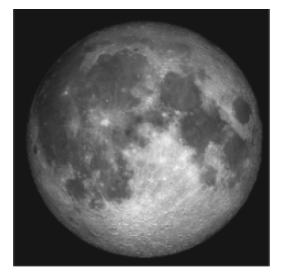
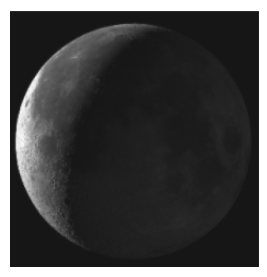
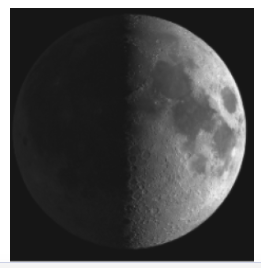
A student viewed the moon through binoculars one week after a new moon. Which image shows the phase of the moon that the student observed?

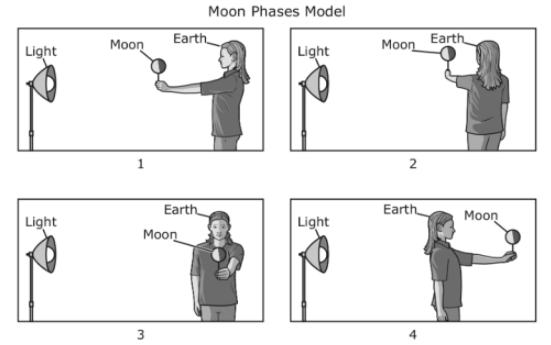
A student models moon phases. She holds a foam ball on a stick in front of her body and then stands in front of a light as shown. The student uses herself to represent Earth. She turns her body slowly to represent four different moon phases.
Which numbered diagram represents the student modeling a full moon?
Diagram 1
Diagram 2
Diagram 3
Diagram 4
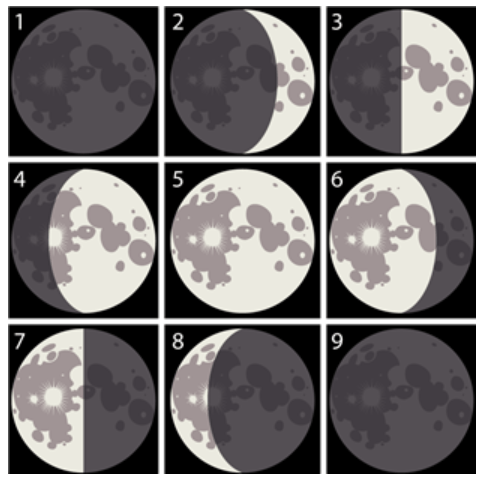
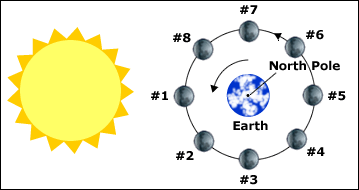
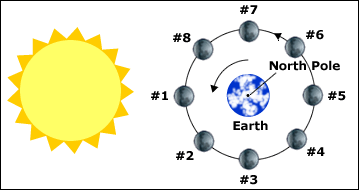
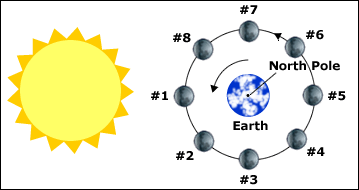
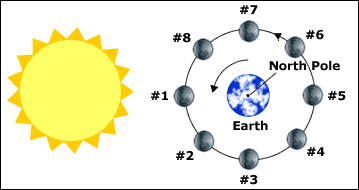
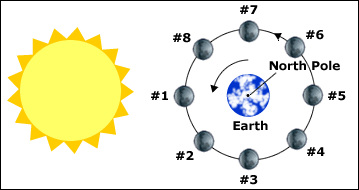
The diagram above represents the phases of the moon. Position 1 represents the new moon. Positions 2 through 8 represent the phases of the moon that follow.
Which phase does position 6 represent?
Full moon
Waning crescent
Waning gibbous
Quarter moon
A father wanted to explain how the moon shines to his five-year-old child by comparing it to an object that the child uses. Which statement below is the best explanation?
The moon is like a flashlight. It produces its own light.
The moon is like a mirror. It reflects light produced by the sun.
The moon is like a glow-in-the-dark sticker. It absorbs light during the day and glows at night.
The moon is like a burner on a stove. When it reaches a certain temperature, it glows.
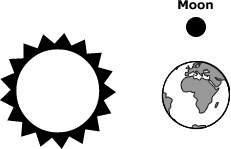
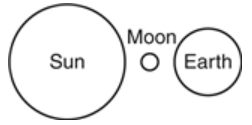
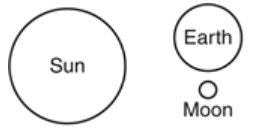
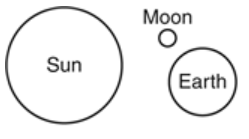
Which model of the Sun, Earth, and the Moon represents the positions that would result in the highest tides occurring on Earth?
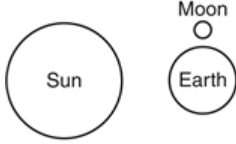
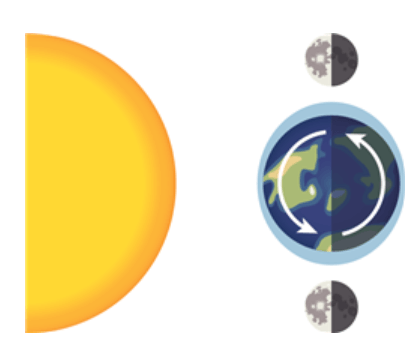
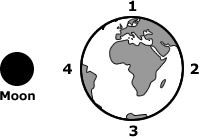
The gravitational impact of the moon and the sun can be seen when observing the Earth’s tides. The diagram shows a snapshot of where the high tides can occur due to the moon's alignment with the Earth at that moment.
Why are the tides more affected by the moon’s gravitational pull than the sun’s?
The moon is larger than the sun, giving it a stronger gravitational pull on the Earth.
The moon is closer to the Earth, giving it a stronger gravitational pull on the Earth.
The sun’s gravitational pull is spread evenly among all planets in the solar system, but the moon’s gravity only affects the Earth.
The rock that composes the moon creates a special gravitational pull that affects the liquids found on the Earth.
The moon phases occur because...
the sun, the earth, and the moon do a dance and create shadows
the moon grows and shrinks
the moon revolves around the earth
the moon produces its own light
The moon goes through every phase..
once a month
twice a month
once a year
the moon doesn't have phases, it has seasons