Font size
 Worksheets
S1 STEM Test
Total questions: 78
Worksheet time: 2hrs 33mins
The variable that is measured throughout the experiment is the ________________

What would the INDEPENDENT variable be in an experiment testing which paper airplane design goes furthest?
Ms. King set up an experiment to see how the weight of a ball affects the distance it rolls off a ramp. What is the dependent variable?

What is the DEPENDENT variable?
water depth
temperature
meters
50

What is the independent variable?
temperature
heart rate
data table
(beats/min)
The independent variable belongs on the
x-axis
y-axis

When writing your hypothesis, what variable follows "IF I..." ?
dependent variable
how you know it will happen
independent variable
anything

When writing a hypothesis, what information do you fill in after THEN...?
dependent variable
independent variable
how you know it will happen
anything good

Choose the correct hypothesis for the question "What effect does studying have on your test grade?"
If I study four hours, then my test grade will improve.
If I have a good test grade, then I will study.
Good grades are from studying.

Choose the correct hypothesis for "How will exercising affect your health?"
If you have better health, then you will exercise.
If you exercise, then you will have better health.
Exercising means you're healthy.
A testable question is...
a bean plant experiment
a possible answer to a testable question
a question that can be answered through an experiment.
a hypothesis
If I ride my bike to school instead of walking then, I will get to school faster. What is the dependent variable?
What is a data table?
It is a visual tool that uses bars to compare data among categories
Its used to compare the parts of a whole
Any display of information in a table with labeled rows and or columns
It is a visual tool that uses that uses lines to compare data among categories
What percentage does a whole pie chart represent?
360%
90%
50%
100%

According to this chart, which country spent the least money on books in 2004?
Germany
France
Italy
Australia
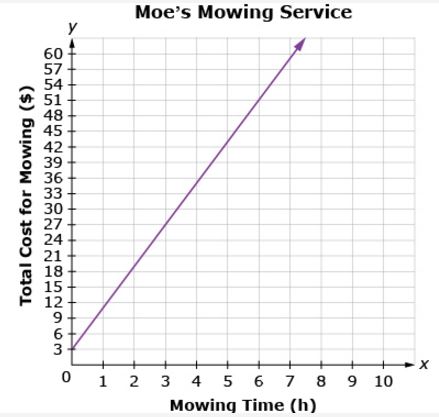
What is the general trend of this line graph?
Why do scientists use graphs?
To communicate data

Which bar graph is the same as the data in the circle graph if 20 people were surveyed?


questions
You want to design an indestructible kite. After doing research, you design several solutions and select the one you want to use. What are the next steps you should do in the design process?
build a prototype and test it
build and finish full-sized kites
patent the design and sell it
evaluate your solutions and communicate results
build a prototype and so more research
What is the equation to calculate speed?
speed = time ÷ distance
speed = distance ÷ time
speed = distance × time
speed = distance × velocity
Bruno ran down the hallway for a science project. He ran a total of 40 meters in 20 seconds. What was his average speed?
2 meters per second
2 meters
20 meters per second
10 meters for second
24 hr
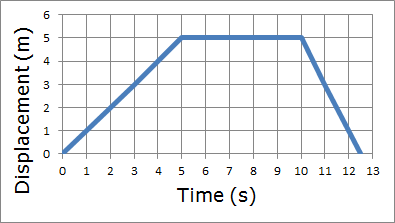


At which point is potential energy greatest?
W
X
Y
Z

What kind of energy is stored in this rock at the edge of a cliff?
None of the above
Can energy be destroyed?
Energy cannot be created but it can be _____________ from one type to another.
How much potential energy is at highest point of a hill on a roller coaster ride?


Hulk Smash

When will the gravity between two objects be the LEAST?
when the masses of both objects is small and the objects are close together
when the masses of both objects is small and the objects are far apart
when the masses of both objects is large and the objects are close together
when the masses of both objects is large and the objects are far apart
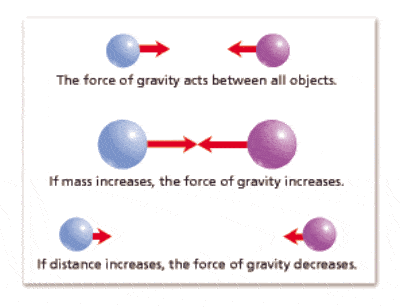
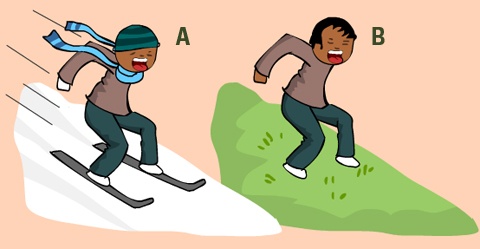
Newton’s 3rd law states that for every action, there is an ________ reaction.
unequal and opposite
equal and similar
stronger and opposite
equal and opposite

The location on the magnet that has the strongest magnetic field is the ___________.
magnetic fields
magnetic poles
magnetic domains
center of the magnet
If two magnets with opposite poles are placed together such as N and S, the two magnets will ______.
have no movement
repel
attract
How do electromagnets differ from regular magnets?
Choose all that apply
It can become taller and shorter
They can be turned on and off
It is weaker then regular magnets
Their strength can be changed
As the distance between magnets increases, the attraction between them will –
Increase
Become stronger
Decrease
Stay the same
Students attached both ends of a long wire to the poles of a battery and wrapped the wire around a nail. In this arrangement, the nail is able to pick up five paper clips.
The students wrap more wire around the iron and wanted to determine if the strength of the magnetic force has increased. Which of the following observations would indicate that wrapping more wire has increased the strength of the electromagnet?
More wire was needed to wrap around the spoon.
The nail now picks up seven paper clips.
Eventually, the battery runs out of energy.
The ends of the wire must touch the battery's poles.
What is the benefit of having a Electromagnet
The power source is larger
You can turn it on and off
It uses conductive wire
I don’t know
What happens when an electric current flows through a wire?
The wire begins to spin.
Nothing happens.
A field of gravity is created around the wire.
A magnetic field is created around the wire.
As the strength of a magnetic field increases, the ability to attract metal objects ____________.
increases
decreases
stays the same
Which of the following electromagnets would have the greatest magnetic field?


The base measurement for mass is...
kilogram
liters
grams
meters
240.0 cm = ___________ m
1000.0 m = ___________ km
330.0 cm = ___________ m
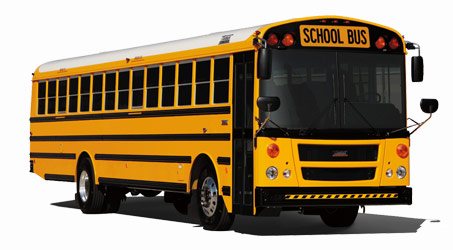
What unit of measurement would you use to measure the length of this bus?
centimeters
milimeters
kilometers
meters

11 m
3 m
5 m
8
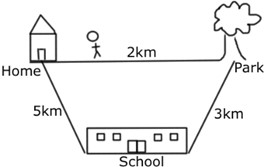


What is the total displacement, in meters, if the person traveled all the way around the rectangle?
3 m
5 m
13 m
0 m
When does an object have no kinetic energy?
When it's at rest.
When it's moving very slowly.
When the only force that's acting on it is gravity.
When it has no electrical charge.
Why do objects at high elevations have more potential energy than objects at low elevations?
Because the thinner air at higher elevations means objects have a greater potential to move very fast
Because objects at high elevations are closer to the sun, which is the source of all energy on earth
Because objects at high elevations tend to move slower than objects at low elevations
Because gravity gives objects at high elevations the potential to fall much further
How could you increase the gravitational potential energy of an object without changing its mass?
Make the object larger
Lower the object towards the ground
Raise the object farther off the ground
Allow the object to roll on the ground

Where would a person have to be located to have the least potential energy?
up on the roof
down in the basement
in the middle
outside
Which object will have the largest value for its potential energy?
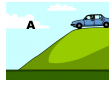
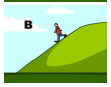
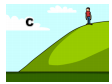
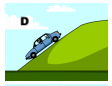

Observe the model to answer the following question: Which of the following statements is true about the skater’s kinetic energy?
The skater gains kinetic energy as he travels down the ramp.
The skater loses kinetic energy as he travels down the ramp.

What is a unit of speed?
Meters per second
Seconds
Meters per second squared
Meters

Lucy the Llama ran 50 meters in 10 seconds. What is Lucy's speed?
50 meters
5 meters per second
1 second per meter
10 seconds

Ms. King drives her race car for 4 hrs at 150 miles/hr. How far will she travel?
A car covers 450 m in 1 minute. A train covers 6900 m in 15 minutes. Which one is travelling faster?
The car
The train