
 Worksheets
Elite Science-Chemistry online competition round 2
Total questions: 101
Worksheet time: 3hrs 39mins

A
B
C
D

A
B
C
D

A
B
C
D

A
B
C
D

A
B
C
D

A
B
C
D

A
B
C
D

A
B
C
D

A
B
C
D

A
B
C
D

A
B
C
D

A
B
C
D

A
B
C
D

A
B
C
D
which element, if any, is oxidized?
2CaO--> 2Ca + O2
What does electrochemistry deal with?
chemical reactions
chemical formulas
electricity
Le Chat's Principle

The diagram shows a failed attempt to copper-plate a pan.
Which action will plate the pan with copper?
cooling the copper sulfate solution in an ice bath
heating the copper sulfate solution to boiling point
increasing the voltage from 3V to 6V
making the pan the cathode and the copper the anode

Which products are formed at the anode and cathode when electricity is passed through molten
lead(II) bromide?
A
B
C
D

The diagram shows an electrolysis circuit.
At which electrode is hydrogen formed?
A
B
C
D
Which of these is an electrolyte? Tick all that apply.
A molten ionic substance
An aqueous solution of an ionic substance
A molten giant covalent lattice
An aqueous solution of a giant covalent lattice
What is the charge on cations?
Positive
Negative
When molten lead bromide is electrolyzed, the products are
lead at the cathode and
bromine at the anode
hydrogen at the cathode and
bromine at the anode
bromine at the cathode and
hydrogen at the anode
Which is the rule for deciding the product at the cathode?
The more reactive metal/hydrogen ion remains in the solution.
The less reactive metal/hydrogen ion remains in the solution.
What is the rule for predicting the product of electrolysis of a solution at the anode?
If a halide ion is present,
the halogen will be produced
Oxygen is always produced
Sodium hydroxide is produced
What is the equation to show what happens to Cl- ions at the anode?
Cl- --> Cl + e-
2Cl- --> Cl2 + 2e-
Cl2 + 2e- --> 2Cl-
Positive ions (cations) will move towards the cathode (-) where they can ____.
break apart
lose electrons
gain electrons
Choose the half-equation that shows the change of an aluminum ion at the cathode.
Al2+ + 3e- --> Al
Al3+ + 3e- --> Al
Al3+ --> Al + 3e-
What type of reactions can able to change products back to the their original form?
Reversible reactions
Irreversible reactions
Combustion reactions
Combination reactions
Which of the following changes is irreversible change?
Melting of ice cube
Heating hydrated CuSO4
Frying an egg
Thermal decomposing NH4Cl
Which of the following combination is correct?
reversible ⇌
irreversible →
reversible ←
irreversible →
reversible ⇌
irreversible ←
irreversible ⇌
reversible →
If a reversible reaction is exothermic in the forward direction, it will be ...
exothermic in the reverse direction
endothermic in the forward direction too
endothermic in the reverse direction
not involve energy in reverse direction
How does a catalyst work in speeding up a reaction?
By lowering the activation energy or reaction
by giving them more energy
by making them more available
Why does a higher concentration increase the rate of reaction?
it increases the amount of reactants
it lowers the activation energy
it increases the energy of particle collisions
it increases the frequency of particle collisions
Why does a higher temperature increase the rate of a reaction?
it increases both the frequency and energy of particle collisions
it only increases the frequency of particle collisions
it only increases the energy of particle collisions
it reduces the activation energy of the reaction
The ______________is required to break the bonds of the reactants.
Carbonic energy
Activation energy
Plutonic energy
Energi Gaib

Which direction does the reaction shift if NH3 was removed?
N2 (g) + 3 H2 (g) <−> 2 NH3 (g)
If the pressure in the system is increased, which substance will increase in concentration?
Which of the following is true about the formation of bonds between molecules?
Energy is given off when bonds are formed between molecules.
Energy is absorbed by the molecule when bonds are formed.
Energy is neither given off nor absorbed when bonds are formed.

Which reaction is endothermic?
acid neutralising alkali causing a temperature increase
adding magnesium to hydrochloric acid
calcium carbonate decomposing when heated combustion of fossil fuels


What type of reaction is this?
Exothermic
Endothermic
Energy Producing
No way to tell

The graph above is from which type of reaction?
Endothermic reaction
Exothermic reaction

Which of the following energy changes corresponds to the activation energy required for the forward reaction to take place?
A
C
B
E
Hydrogen gas burns in air to form water.
2H2 (g) + O2 (g) → 2H2O(I) ΔH= - 572 kJ
How much heat energy (in kJ) is given off if a rocket carrying 200.0 kg of hydrogen gas is burnt in excess oxygen?
1.43 x 10⁷
2.86 x 10⁷
4.92 x 10⁷

A
B
C
D

A
B
C
D

A
B
C
D

A
B
C
D
Using the equations below:
C(s) + O2(g) → CO2(g) ∆H = –390 kJ
Mn(s) + O2(g) → MnO2(s) ∆H = –520 kJ
what is ∆H (in kJ) for the following reaction?
MnO2(s) + C(s) → Mn(s) + CO2(g)
910
130
-130
2 NO ⟶ N2 + O2 (ΔH = -180.5 kJ)
N2 + 2 O2 ⟶ 2 NO2 (ΔH = + 66.36 kJ)
Calculate the entalphy for :
2 NO + O2 ⟶ 2 NO2 (ΔH = ?)
Is the overall process exothermic or endothermic?
-114.14 kJ,
exothermic
+114.14 kJ, endothermic
246.9 kJ, endothermic
-246.9 kJ, exothermic
For the reaction 2H2(g) + O2(g) → 2H2O(g) the bond enthalpies (in kJ/mol) are
H-H = x, O=O = y, O-H = z
Which calculation will give the value, in kJ/mol, of ΔH for the reaction?
2x + y - 2z
4z - 2x - y
2x + y - 4z
2z - 2x - y

When the solids Ba(OH)2 and NH4SCN are mixed, a solution is produced and the temperature drops. Which statement about the energetics of this reaction is correct?
The reaction is endothermic and ΔH is negative
The reaction is endothermic and ΔH is positive
The reaction is exothermic and ΔH is negative
The reaction is exothermic and ΔH is positive

A
B
C
D

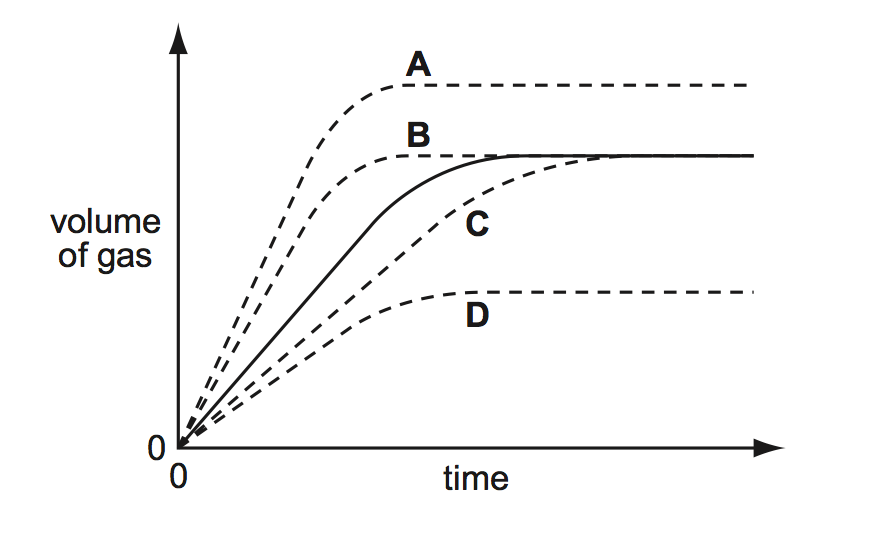
What can be said about the green line?
it is a faster rate of reaction
It produces same volume of product as red line
Half the volume of reactants has been used
Which would not speed up a chemical reaction?
Using a large beaker
Increasing the concentration
Decreasing particle size
adding a catalyst
Which would have the slowest rate of reaction
Magnesium ribbon 1M HCl at 20 degrees
Magnesium powder 1M HCl at 20degrees
Magnesium ribbon 0.5M HCl at 10degrees
Magnesium powder 0.5M HCl at 10degrees
Which graph shows the effect of increasing temperature on the rate of reaction of calcium carbonate with dilute hydrochloric acid?
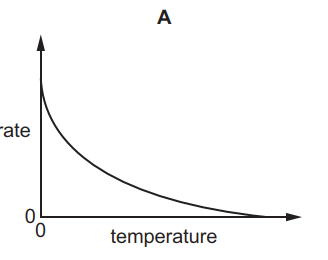
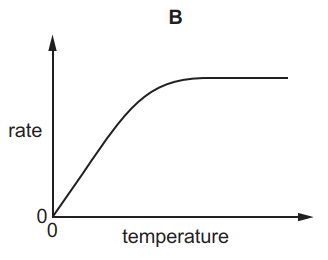
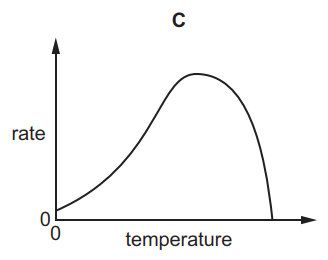
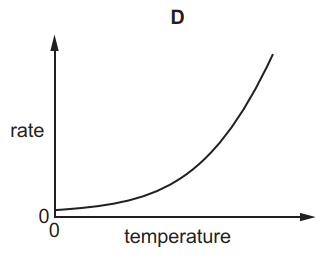

P, Q, R and S are pieces of apparatus.
Which row describes the correct apparatus for the measurement made?
A
B
C
D

A
B
C
D

A
B
C
D

A
B
C
D

A
B
C
D

A
B
C
D

AgNO3 + NaCl → AgCl + NaNO3
What would you expect to happen if we decrease the temperature of this reaction container?
The energy of the reactants would decrease.
The would be more product produced.
The number of particles of
AgNO3 and NaCl would decrease.
The number of collisions in the reactants would increase.

Which of the following is true?
The reaction rate of the diagram on the left would be greater because there are more collisions that will happen because of greater surface area.
The reaction rate of the diagram on the right would be greater because there are more collisions that will happen because of lesser surface area.
The reaction rate of the diagram on the right would be greater because there are more collisions that will happen because of greater surface area.
The reaction rate of the diagram on the left would be greater because there are more collisions that will happen because of lesser surface area.
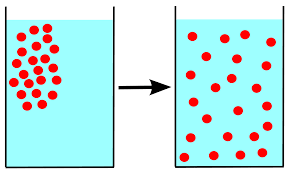
What happens to the reactivity of the alkali metals as you move down the group?
increases
decreases
A(n) ______ is a substance with a pH less than 7
Acid
Alkali
Base
Buffer
The laboratory test for oxygen is that
it relights a glowing splint
it relights a burning splint
it changes lime water to milky
it makes a glowing splint go out

