
 Worksheets
SS2 CHEMISTRY 1ST TERM EXAMINATION 2024/2025
Total questions: 100
Worksheet time: 50mins
Name
Class
Date
1.
The following ions have the same electron configuration
except ₈O, ₁₂Mg, ₁₃Al, ₁₇Cl
a)
Cl⁻
b)
O²⁻
c)
Mg²⁺
d)
Al³⁺
2.
Electrovalent compounds normally
a)
Have low boiling points
b)
have mobile electrons
c)
conduct electricity in the solid state
d)
dissolve in polar solvents
3.
Protons and electrons are called fundamental particles because they
a)
Are indivisible
b)
have different charges
c)
are the lightest particles
d)
are found in all matter
4.
An element, Q, contains 69% of ⁶³Q and 31% of ⁶⁵Q.
What is the relative atomic mass of Q?
a)
63.0
b)
63.6
c)
65.0
d)
69.0
5.
How many coulombs of electricity would liberate 1.08g
of Ag from a solution of silver salt?
[Ag = 108.0, 1F = 96500C]
a)
96500C
b)
9650C
c)
965C
d)
9.65C
6.
The ability of an atom to attract electrons towards itself is called
a)
electron affinity
b)
electronegativity
c)
electropositivity
d)
ionization energy
7.
An increase in the pressure of a gas results in the decrease
of its
a)
concentration
b)
volume
c)
temperature
d)
vapour density
8.
Consider the reaction represented by the equation below:
H₂(g) + I₂(g) ⇌. 2HI(g) Δ= -ve
Which of the following takes place when the temperature
of the reaction vessel is decreased?
a)
More of the hydrogen iodide
b)
The concentration of the reactants remain constant
c)
The gases condense
d)
The yield of hydrogen increases
9.
Chemical change includes the following except
a)
decomposition of green leaves in a compost
b)
dissolution of sugar in water
c)
fading of coloured cloth
d)
fermentation of glucose
10.
Given that 32.0g of Sulphur contains 6.02 x 10²³ atoms,
how many atoms are there in 2.7g of aluminium?
[Al = 27, S = 32]
a)
5.08 X 10²³
b)
6.02 X 10²⁴
c)
3.01 X 10²³
d)
6.02 X 10²²
11.
Which of the following elements is diatomic?
a)
Argon
b)
Carbon
c)
Iron
d)
Oxygen
12.
The chemical process that is represented by the equation
below is: Na₂CO₃.10H₂O(s) ⟶ Na₂CO₃.H₂O(s) + 9H₂O(g)
a)
combustion
b)
deliquescence
c)
efflorescence
d)
hygroscopy
13.
The type of chemical bond that exists between potassium
and oxygen in potassium oxide is
a)
covalent bond
b)
dative bond
c)
hydrogen bond
d)
ionic bond
14.
The elements in Group I of the periodic table are called
a)
Alkaline earth metals
b)
alkali metals
c)
non - metals
d)
reactive metals
15.
An oxide XO₂ has a vapour density of 32,
what is the atomic mass of X?
a)
12
b)
16
c)
32
d)
64
16.
Which of the following is not a normal salt?
a)
KHSO₄
b)
Mg(NO₃)₂
c)
NaCl
d)
ZnCl₂
17.
The products of the electrolysis of dilute sodium chloride
solution with platinum electrodes are
a)
chlorine and water
b)
hydrogen and chlorine
c)
hydrogen and oxygen
d)
sodium amalgam and chlorine
18.
The common feature of reactions at the anode is that
a)
electrons are consumed
b)
ions are reduced
c)
oxidation is involved
d)
the electrode dissolves
19.
A current of 4.0 amperes was passed through copper (II)
tetraoxosulphate(VI) solution for one hour using copper
electrodes. Calculate the mass in grams of copper
deposited. [Cu = 64, 1F = 96500C]
a)
3.2
b)
4.8
c)
6.4
d)
48
20.
Consider the following reaction equation: 2NO(g) + O₂(g) → 2NO₂(g) . What is the change in oxidation number of Nitrogen?
a)
+2 to 0
b)
+2 to -2
c)
+2 to +4
d)
+4 to +2
21.
What percentage by mass of sodium is present in the compound Na₂CO₃.10H₂O? [Na = 23, C =12, O = 16, H = 1]
a)
4.20
b)
8.04
c)
16.08
d)
23.00
22.
Chemical reaction occurs when the colliding reactants have energy that is
a)
less than the activation energy
b)
greater than the activation energy
c)
greater than the energy of the product
d)
less than the energy of effective collusion
23.
An acid is a substance which in the presence of water
produces
a)
carbon (IV) oxide
b)
chlorine gas
c)
hydrogen gas
d)
hydroxonium ions
24.
A hydrocarbon X with a molar mass of 26 consist of 92.3%
carbon. What is its molecular formula? [C = 12, H = 1]
a)
C₂H₂
b)
C₃H₃
c)
C₄H₄
d)
C₅H₅
25.
Which of the following atoms contain the highest number
of electrons in its outermost shell?
a)
₈O
b)
₁₈Ar
c)
₁₅P
d)
₁₉K
26.
How many grams of hydrogen gas will be liberated when
6g of magnesium ribbon dissolves in HCl? [Mg = 24, H = 1,
Cl = 35.5]
a)
0.25
b)
0.50
c)
0.75
d)
1.00
27.
The major constituent of air is
a)
Carbon(IV) oxide
b)
hydrogen
c)
nitrogen
d)
noble gases
28.
When sodium dissolves in water, the resulting solution is
a)
acidic
b)
aerosol
c)
alkaline
d)
neutral
29.
What type of bond would be formed when an element with
high electron affinity combines with another element with
low ionization energy?
a)
Covalent bond
b)
Dative bond
c)
Electrovalent bond
d)
Hydrogen bond
30.
An atom X with the electronic configuration
1s² 2s² 2p⁶ 3s¹ belongs to period
a)
1
b)
2
c)
3
d)
4
31.
Which of the following methods is suitable for separating
petroleum fractions from crude oil?
a)
Chromatography
b)
Evaporation
c)
Fractional crystallization
d)
Fractional distillation
32.
According to Charles’ law, the volume of a gas becomes
zero at
a)
-100°C
b)
-273°C
c)
273°C
d)
0°C
33.
When a solid substance disappears completely as a gas
on heating, the substance is said to have undergone
a)
crystallization
b)
decantation
c)
sublimation
d)
distillation
34.
The position of an element in the periodic table is
determined by its
a)
atomic radius
b)
electron affinity
c)
number of protons on its atom
d)
number of neutrons on its atom
35.
What quantity of current in amperes will deposit 5.4g of
aluminium in 8 hours during electrolysis?
[Al = 27, 1F = 96500C]
a)
2
b)
4
c)
6
d)
8
36.
The volume of a gas at 310K was 200cm³. Determine its
temperature in K if the volume become 250cm³.
a)
116
b)
273
c)
300
d)
388
37.
Calculate the relative molecular mass of calcium hydrogen
tetraoxosulphate (VI) [Ca = 40, H = 1, S = 32, O = 16]
a)
234
b)
136
c)
137
d)
233
38.
Pauli exclusion principle is related to
a)
quantity of electrons in the valence shell
b)
filling the orbitals with lower energy first
c)
the filling of degenerate orbitals
d)
quantum numbers of electrons.
39.
The purity of a solid sample can best be determined by its
a)
boiling point
b)
melting point
c)
conductivity
d)
solubility
40.
The properties of elements which increases down a group
of the Periodic table is
a)
electronegativity
b)
electron affinity
c)
ionic radius
d)
ionization energy
41.
The oxidation number of X in XO₄³⁻ is
a)
+1
b)
+3
c)
+4
d)
+5
42.
The ionization energy is affected by the following factors
except
a)
distance of the outermost electron(s) from the nucleus
b)
size of the positive nuclear charge
c)
ability to attract shared electron(s)
d)
screening effect of the inner electron(s)
43.
Which of the following statements about endothermic reaction is correct?
a)
Activation energy is high
b)
A catalyst is required
c)
It occurs reversibly
d)
Heat energy is absorbed
44.
Which of the following scientists discovered the electrons?
a)
Joseph J. Thompson
b)
James Chadwick
c)
Amedeo Avogadro
d)
Ernest Rutherford
45.
A coordinate covalent bond could be formed between
a)
NH₃ and PCl₃
b)
BCl₃ and AlCl₃
c)
BCl₃ and NH₃
d)
H⁺and AlCl₃
46.
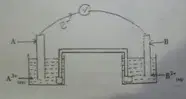
Which of the following cell notations represent the diagram?
a)
B²⁺/B//A/A³⁺
b)
A³⁺/A//B/B²⁺
c)
B/B²⁺//A/A³⁺
d)
A/A³⁺//B²⁺/B
47.
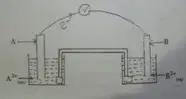
Which of the following half reaction equations represent
the reaction at the cathode?
a)
Al³⁺(aq) +3e- ⟶ A(s)
b)
B²⁺(aq) + 2e- ⟶ B(s)
c)
A(s) ⟶ A³⁺(aq) + 3e-
d)
B(s) ⟶ B²⁺(aq) + 2e-
48.
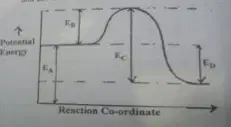
The activation energy of the reaction is
a)
EA
b)
EB
c)
EC
d)
ED
49.
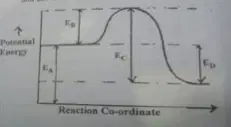
The enthalpy change of the reaction is
a)
EA
b)
EB
c)
EC
d)
ED
50.
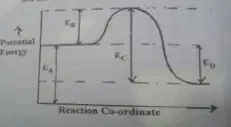
The energy profile diagram illustrates
a)
An endothermic reaction
b)
an exothermic reaction
c)
a spontaneous reaction
d)
a redox reaction
51.
The following ions have the same electron configuration
except ₈O, ₁₂Mg, ₁₃Al, ₁₇Cl
a)
Cl⁻
b)
O²⁻
c)
Mg²⁺
d)
Al³⁺
52.
Electrovalent compounds normally
a)
Have low boiling points
b)
have mobile electrons
c)
conduct electricity in the solid state
d)
dissolve in polar solvents
53.
Protons and electrons are called fundamental particles because they
a)
Are indivisible
b)
have different charges
c)
are the lightest particles
d)
are found in all matter
54.
An element, Q, contains 69% of ⁶³Q and 31% of ⁶⁵Q.
What is the relative atomic mass of Q?
a)
63.0
b)
63.6
c)
65.0
d)
69.0
55.
How many coulombs of electricity would liberate 1.08g
of Ag from a solution of silver salt?
[Ag = 108.0, 1F = 96500C]
a)
96500C
b)
9650C
c)
965C
d)
9.65C
56.
The ability of an atom to attract electrons towards itself is called
a)
electron affinity
b)
electronegativity
c)
electropositivity
d)
ionization energy
57.
An increase in the pressure of a gas results in the decrease
of its
a)
concentration
b)
volume
c)
temperature
d)
vapour density
58.
Consider the reaction represented by the equation below:
H₂(g) + I₂(g) ⇌. 2HI(g) Δ= -ve
Which of the following takes place when the temperature
of the reaction vessel is decreased?
a)
More of the hydrogen iodide
b)
The concentration of the reactants remain constant
c)
The gases condense
d)
The yield of hydrogen increases
59.
Chemical change includes the following except
a)
decomposition of green leaves in a compost
b)
dissolution of sugar in water
c)
fading of coloured cloth
d)
fermentation of glucose
60.
Given that 32.0g of Sulphur contains 6.02 x 10²³ atoms,
how many atoms are there in 2.7g of aluminium?
[Al = 27, S = 32]
a)
5.08 X 10²³
b)
6.02 X 10²⁴
c)
3.01 X 10²³
d)
6.02 X 10²²
61.
Which of the following elements is diatomic?
a)
Argon
b)
Carbon
c)
Iron
d)
Oxygen
62.
The chemical process that is represented by the equation
below is: Na₂CO₃.10H₂O(s) ⟶ Na₂CO₃.H₂O(s) + 9H₂O(g)
a)
combustion
b)
deliquescence
c)
efflorescence
d)
hygroscopy
63.
The type of chemical bond that exists between potassium
and oxygen in potassium oxide is
a)
covalent bond
b)
dative bond
c)
hydrogen bond
d)
ionic bond
64.
The elements in Group I of the periodic table are called
a)
Alkaline earth metals
b)
alkali metals
c)
non - metals
d)
reactive metals
65.
An oxide XO₂ has a vapour density of 32,
what is the atomic mass of X?
a)
12
b)
16
c)
32
d)
64
66.
Which of the following is not a normal salt?
a)
KHSO₄
b)
Mg(NO₃)₂
c)
NaCl
d)
ZnCl₂
67.
The products of the electrolysis of dilute sodium chloride
solution with platinum electrodes are
a)
chlorine and water
b)
hydrogen and chlorine
c)
hydrogen and oxygen
d)
sodium amalgam and chlorine
68.
The common feature of reactions at the anode is that
a)
electrons are consumed
b)
ions are reduced
c)
oxidation is involved
d)
the electrode dissolves
69.
A current of 4.0 amperes was passed through copper (II)
tetraoxosulphate(VI) solution for one hour using copper
electrodes. Calculate the mass in grams of copper
deposited. [Cu = 64, 1F = 96500C]
a)
3.2
b)
4.8
c)
6.4
d)
48
70.
Consider the following reaction equation: 2NO(g) + O₂(g) → 2NO₂(g) . What is the change in oxidation number of Nitrogen?
a)
+2 to 0
b)
+2 to -2
c)
+2 to +4
d)
+4 to +2
71.
What percentage by mass of sodium is present in the compound Na₂CO₃.10H₂O? [Na = 23, C =12, O = 16, H = 1]
a)
4.20
b)
8.04
c)
16.08
d)
23.00
72.
Chemical reaction occurs when the colliding reactants have energy that is
a)
less than the activation energy
b)
greater than the activation energy
c)
greater than the energy of the product
d)
less than the energy of effective collusion
73.
An acid is a substance which in the presence of water
produces
a)
carbon (IV) oxide
b)
chlorine gas
c)
hydrogen gas
d)
hydroxonium ions
74.
A hydrocarbon X with a molar mass of 26 consist of 92.3%
carbon. What is its molecular formula? [C = 12, H = 1]
a)
C₂H₂
b)
C₃H₃
c)
C₄H₄
d)
C₅H₅
75.
Which of the following atoms contain the highest number
of electrons in its outermost shell?
a)
₈O
b)
₁₈Ar
c)
₁₅P
d)
₁₉K
76.
How many grams of hydrogen gas will be liberated when
6g of magnesium ribbon dissolves in HCl? [Mg = 24, H = 1,
Cl = 35.5]
a)
0.25
b)
0.50
c)
0.75
d)
1.00
77.
The major constituent of air is
a)
Carbon(IV) oxide
b)
hydrogen
c)
nitrogen
d)
noble gases
78.
When sodium dissolves in water, the resulting solution is
a)
acidic
b)
aerosol
c)
alkaline
d)
neutral
79.
What type of bond would be formed when an element with
high electron affinity combines with another element with
low ionization energy?
a)
Covalent bond
b)
Dative bond
c)
Electrovalent bond
d)
Hydrogen bond
80.
An atom X with the electronic configuration
1s² 2s² 2p⁶ 3s¹ belongs to period
a)
1
b)
2
c)
3
d)
4
81.
Which of the following methods is suitable for separating
petroleum fractions from crude oil?
a)
Chromatography
b)
Evaporation
c)
Fractional crystallization
d)
Fractional distillation
82.
According to Charles’ law, the volume of a gas becomes
zero at
a)
-100°C
b)
-273°C
c)
273°C
d)
0°C
83.
When a solid substance disappears completely as a gas
on heating, the substance is said to have undergone
a)
crystallization
b)
decantation
c)
sublimation
d)
distillation
84.
The position of an element in the periodic table is
determined by its
a)
atomic radius
b)
electron affinity
c)
number of protons on its atom
d)
number of neutrons on its atom
85.
What quantity of current in amperes will deposit 5.4g of
aluminium in 8 hours during electrolysis?
[Al = 27, 1F = 96500C]
a)
2
b)
4
c)
6
d)
8
86.
The volume of a gas at 310K was 200cm³. Determine its
temperature in K if the volume become 250cm³.
a)
116
b)
273
c)
300
d)
388
87.
Calculate the relative molecular mass of calcium hydrogen
tetraoxosulphate (VI) [Ca = 40, H = 1, S = 32, O = 16]
a)
234
b)
136
c)
137
d)
233
88.
Pauli exclusion principle is related to
a)
quantity of electrons in the valence shell
b)
filling the orbitals with lower energy first
c)
the filling of degenerate orbitals
d)
quantum numbers of electrons.
89.
The purity of a solid sample can best be determined by its
a)
boiling point
b)
melting point
c)
conductivity
d)
solubility
90.
The properties of elements which increases down a group
of the Periodic table is
a)
electronegativity
b)
electron affinity
c)
ionic radius
d)
ionization energy
91.
The oxidation number of X in XO₄³⁻ is
a)
+1
b)
+3
c)
+4
d)
+5
92.
The ionization energy is affected by the following factors
except
a)
distance of the outermost electron(s) from the nucleus
b)
size of the positive nuclear charge
c)
ability to attract shared electron(s)
d)
screening effect of the inner electron(s)
93.
Which of the following statements about endothermic reaction is correct?
a)
Activation energy is high
b)
A catalyst is required
c)
It occurs reversibly
d)
Heat energy is absorbed
94.
Which of the following scientists discovered the electrons?
a)
Joseph J. Thompson
b)
James Chadwick
c)
Amedeo Avogadro
d)
Ernest Rutherford
95.
A coordinate covalent bond could be formed between
a)
NH₃ and PCl₃
b)
BCl₃ and AlCl₃
c)
BCl₃ and NH₃
d)
H⁺and AlCl₃
96.
Which of the following cell notations represent the diagram?
a)
B²⁺/B//A/A³⁺
b)
A³⁺/A//B/B²⁺
c)
B/B²⁺//A/A³⁺
d)
A/A³⁺//B²⁺/B
97.
Which of the following half reaction equations represent
the reaction at the cathode?
a)
Al³⁺(aq) +3e- ⟶ A(s)
b)
B²⁺(aq) + 2e- ⟶ B(s)
c)
A(s) ⟶ A³⁺(aq) + 3e-
d)
B(s) ⟶ B²⁺(aq) + 2e-
98.
The activation energy of the reaction is
a)
EA
b)
EB
c)
EC
d)
ED
99.
The enthalpy change of the reaction is
a)
EA
b)
EB
c)
EC
d)
ED
100.
The energy profile diagram illustrates
a)
An endothermic reaction
b)
an exothermic reaction
c)
a spontaneous reaction
d)
a redox reaction
100 %

