
 Worksheets
EFM - 1- 8
Total questions: 147
Worksheet time: 1hrs 14mins
Econometrics is the branch of economics that
studies the behavior of individual economic agents in making economic decisions
develops and uses statistical methods for estimating economic relationships
deals with the performance, structure, behavior, and decision-making of an economy as a whole
applies mathematical methods to represent economic theories and solve economic problems.
What is the estimated value of the slope parameter when the regression equation, y = β0 + β1x1 + u passes through the origin?


A natural measure of the association between two random variables is the correlation coefficient.
True
False
In a regression model, if variance of the dependent variable, y, conditional on an explanatory variable, x, or Var(y|x), is not constant,
the t statistics are invalid and confidence intervals are valid for small sample sizes
the t statistics are valid and confidence intervals are invalid for small sample sizes
the t statistics confidence intervals are valid no matter how large the sample size is
the t statistics and confidence intervals are both invalid no matter how large the sample size is
If estimated (Bj) is an OLS estimator of a regression coefficient associated with one of the
β explanatory variables, such that j= 1, 2, …., n, asymptotic standard error of^ j
will refer to the:
estimated variance of estimated(Bj) when the error term is normally distributed.
estimated variance of a given coefficient when the error term is not normally distributed.
square root variance of estimated(Bj) when the error term is normally distributed.
square root variance of estimated(Bj) when the error term is not normally distributed.
The sample covariance between the regressors and the Ordinary Least Square (OLS) residuals is always positive.
True
False
Nonexperimental data is called
cross-sectional data
time series data
observational data
panel data
Nonexperimental data is called
cross-sectional data
time series data
observational data
panel data
In a multiple regression model, the OLS estimator is consistent if:
there is no correlation between the dependent variables and the error term.
there is a perfect correlation between the dependent variables and the error term.
the sample size is less than the number of parameters in the model.
there is no correlation between the independent variables and the error term.
Which of the following is true of dummy variables?
A dummy variable always takes a value less than 1.
A dummy variable always takes a value higher than 1.
A dummy variable takes a value of 0 or 1.
A dummy variable takes a value of 1 or 10.
The following simple model is used to determine the annual savings of an individual on the basis of his annual income and education.
Savings = β0+∂0 Edu + β1Inc+u
The variable ‘Edu’ takes a value of 1 if the person is educated and the variable ‘Inc’ measures the income of the individual.
Refer to the model above. The inclusion of another binary variable in this model that takes a value of 1 if a person is uneducated, will give rise to the problem of
omitted variable bias
self-selection
dummy variable trap
heteroskedastcity
The following simple model is used to determine the annual savings of an individual on the basis of his annual income and education.
Savings = β0+∂0 Edu + β1Inc+u
The variable ‘Edu’ takes a value of 1 if the person is educated and the variable ‘Inc’ measures the income of the individual.
Refer to the model above. The benchmark group in this model is
the group of educated people
the group of uneducated people
the group of individuals with a high income
the group of individuals with a low income
The following simple model is used to determine the annual savings of an individual on the basis of his annual income and education.
Savings = β0+∂0 Edu + β1Inc+u
The variable ‘Edu’ takes a value of 1 if the person is educated and the variable ‘Inc’ measures the income of the individual.
Refer to the above model. If ∂0 > 0, .
uneducated people have higher savings than those who are educated
educated people have higher savings than those who are not educated
individuals with lower income have higher savings
individual with lower income have higher savings
The income of an individual in Budopia depends on his ethnicity and several other factors which can be measured quantitatively. If there are 5 ethnic groups in Budopia, how many dummy variables should be included in the regression equation for income determination in Budopia?
1
5
6
4
If the error term is correlated with any of the independent variables, the OLS estimators are:
biased and consistent.
unbiased and inconsistent.
biased and inconsistent.
unbiased and consistent.
If δ1 = Cov(x1/x2) / Var(x1) where x1 and x2 are two independent variables in a regression equation, which of the following statements is true?
If x2 has a positive partial effect on the dependent variable, and δ1 > 0, then the inconsistency in the simple regression slope estimator associated with x1 is negative.
If x2 has a positive partial effect on the dependent variable, and δ1 > 0, then the inconsistency in the simple regression slope estimator associated with x1 is positive.
If x1 has a positive partial effect on the dependent variable, and δ1 > 0, then the inconsistency in the simple regression slope estimator associated with x1 is negative.
If x1 has a positive partial effect on the dependent variable, and δ1 > 0, then the inconsistency in the simple regression slope estimator associated with x1 is positive.
If OLS estimators satisfy asymptotic normality, it implies that:
they are approximately normally distributed in large enough sample sizes.
they are approximately normally distributed in samples with less than 10 observations.
they have a constant mean equal to zero and variance equal to σ2.
they have a constant mean equal to one and variance equal to σ.
The quarterly increase in an employee’s salary depends on the rating of his work by his employer and several other factors as shown in the model below:
Increase in salary= β0+∂0Rating + other factors. The variable ‘Rating’ is a(n)
dependent variable
ordinal variable
continuous variable
Poisson variable
Which of the following is true of experimental data?
Experimental data are collected in laboratory environments in the natural sciences.
Experimental data cannot be collected in a controlled environment.
Experimental data is sometimes called observational data.
Experimental data is sometimes called retrospective data.
An empirical analysis relies on _____________ to test a theory.
common sense
ethical considerations
data
customs and conventions
The term ‘u’ in an econometric model is usually referred to as the
error term
paramete
hypothesis
dependent variable
The parameters of an econometric model
include all unobserved factors affecting the variable being studied
describe the strength of the relationship between the variable under study and the factors affecting it
refer to the explanatory variables included in the model
refer to the predictions that can be made using the model
Which of the following is the first step in empirical economic analysis?
Collection of data
Statement of hypotheses
Specification of an econometric model
Testing of hypotheses
A data set that consists of a sample of individuals, households, firms, cities, states, countries, or a variety of other units, taken at a given point in time, is called a(n) .
cross-sectional data set
Cross-sectional data
longitudinal data set
time series data set
experimental data set
Data on the income of law graduates collected at different times during the same year is .
panel data
experimental data
time series data
cross-sectional data
A data set that consists of observations on a variable or several variables over time is called a________data set.
binary
cross-sectional
time series
experimental
Which of the following is an example of time series data?
Data on the unemployment rates in different parts of a country during a year.
Data on the consumption of wheat by 200 households during a year.
Data on the gross domestic product of a country over a period of 10 years.
Data on the number of vacancies in various departments of an organization on a particular month.
Which of the following refers to panel data?
Data on the unemployment rate in a country over a 5-year period
Data on the birth rate, death rate and population growth rate in developing countries over a 10-year period
Data on the income of 5 members of a family on a particular year.
Data on the price of a company’s share during a year.
Which of the following is a difference between panel and pooled cross-sectional data?
A panel data set consists of data on different cross-sectional units over a given period of time while a pooled data set consists of data on the same cross-sectional units over a given period of time
A panel data set consists of data on the same cross-sectional units over a given period of time while a pooled data set consists of data on different cross-sectional units over a given period of time
A panel data consists of data on a single variable measured at a given point in time while a pooled data set consists of data on the same cross-sectional units over a given period of time
A panel data set consists of data on a single variable measured at a given point in time while a pooled data set consists of data on more than one variable at a given point in time.
_____________ has a causal effect on _______________.
Income; unemployment
Height; health
Income; consumption
Which of the following is true?
A variable has a causal effect on another variable if both variables increase or decrease simultaneously.
The notion of ‘ceteris paribus’ plays an important role in causal analysis.
Difficulty in inferring causality disappears when studying data at fairly high levels of aggregation.
The problem of inferring causality arises if experimental data is used for analysis.
Experimental data are sometimes called retrospective data.
True
False
Nonexperimental data are sometimes called retrospective data.
True
False
An economic model consists of mathematical equations that describe various relationships between economic variables.
True
False
A cross-sectional data set consists of observations on a variable or several variables over time.
True
False
A time series data is also called a longitudinal data set.
True
False
A dependent variable is also known as a(n)
explanatory variable
control variable
predictor variable
response variable
If a change in variable x causes a change in variable y, variable x is called the
dependent variable
explained variable
explanatory variable
response variable
Which of the following is a statistic that can be used to test hypotheses about a single population parameter?
F statistic
t statistic
χ2 statistic
Durbin Watson statistic
Consider the equation, Y = β1 + β2X2 + u. A null hypothesis, H0: β2 = 0 states that:
X2 has no effect on the expected value of β2.
X2 has no effect on the expected value of Y.
β2 has no effect on the expected value of Y.
Y has no effect on the expected value of X2.
In the equation y = β0 + β1 x + u, β0 is the .
dependent variable
independent variable
slope parameter
intercept parameter
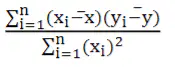
In the equation y = β0 + β1 x + u, what is the estimated value of β0 ?
Mean (y)−β^1 Mean (x)
Mean (y) + β1 Mean (x)

In the equation c = β0 + β1 i + u, c denotes consumption and i denotes
income. What is the residual for the 5th observation if c5 =$500 and estimated c(5) = 475
$975
$300
$25
$50
What does the equation Estimated (y) =β^0 + β^1 x denote if the regression equation is y = β0
+ β1x1 + u?
The explained sum of squares
The total sum of squares
The sample regression function
The population regression function
Consider the following regression model: y = β0 + β1x1 + u. Which of the following is a property of Ordinary Least Square (OLS) estimates of this model and their associated statistics?
The sum, and therefore the sample average of the OLS residuals, is positive
The sum of the OLS residuals is negative.
The sample covariance between the regressors and the OLS residuals is positive.
The point {Mean (x), Mean(y)] always lies on the OLS regression line.
The explained sum of squares for the regression function, yi=β0 + β1 x1+ u1 , is defined as

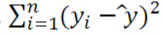
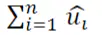
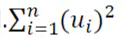
If the total sum of squares (SST) in a regression equation is 81, and the residual sum of squares (SSR) is 25, what is the explained sum of squares (SSE)?
64
56
32
18
If the residual sum of squares (SSR) in a regression analysis is 66 and the total sum of squares (SST) is equal to 90, what is the value of the coefficient of determination?
0.73
0.55
0.27
1.2
Which of the following is a nonlinear regression model?
y = β0 + β1x1/2 + u
log y = β0 + β1log x +u
y = 1 / (β0 + β1x) + u
y = β0 + β1x + u
Which of the following is assumed for establishing the unbiasedness of Ordinary Least Square (OLS) estimates?
The error term has an expected value of 1 given any value of the explanatory variable.
The regression equation is linear in the explained and explanatory variables
The sample outcomes on the explanatory variable are all the same value
The error term has the same variance given any value of the explanatory variable
The error term in a regression equation is said to exhibit homoskedasticty if
it has zero conditional mean
it has the same variance for all values of the explanatory variable.
it has the same value for all values of the explanatory variable
if the error term has a value of one given any value of the explanatory variable.
In the regression of y on x, the error term exhibits heteroskedasticity if .
it has a constant variance
Var(y|x) is a function of x
x is a function of y
y is a function of x
R2 is the ratio of the explained variation compared to the total variation.
True
False
There are n-1 degrees of freedom in Ordinary Least Square residuals.
True
False
In the equation, y=β0 + β1 x1 + β2 x2+ u , β2 is a(n) .
independent variable
dependent variable
slope parameter
intercept parameter
Consider the following regression equation: y=β1 + β2
x1+ β2 x2+u . What does β1 imply ?
β1 measures the ceteris paribus effect of x1 on x2.
β1 measures the ceteris paribus effect of y on x1.
β1 measures the ceteris paribus effect of x1 on y.
β1 measures the ceteris paribus effect of x1 on u.
If the explained sum of squares is 35 and the total sum of squares is 49, what is the residual sum of squares?
10
12
18
14
Which of the following is true of R2?
R2 is also called the standard error of regression.
A low R2 indicates that the Ordinary Least Squares line fits the data well
R2 usually decreases with an increase in the number of independent variables in a regression.
R2 shows what percentage of the total variation in the dependent variable, Y, is explained by the explanatory variables.
The value of R2 always________________
lies below 0
lies above 1
lies between 0 and 1
lies between 1 and 1.5
If an independent variable in a multiple linear regression model is an exact linear combination of other independent variables, the model suffers from the problem of
perfect collinearity (multicollinearity)
homoskedasticity
heteroskedasticty
omitted variable bias
The assumption that there are no exact linear relationships among the independent variables in a multiple linear regression model fails if , where n is the sample size and k is the number of parameters.
n>2
n=k+1
n>k
n<k+1
Exclusion of a relevant variable from a multiple linear regression model leads to the problem of ________
misspecification of the model (omitted variable bias)
multicollinearity
perfect collinearity
homoskedasticity
The significance level of a test is:
the probability of rejecting the null hypothesis when it is false.
one minus the probability of rejecting the null hypothesis when it is false
the probability of rejecting the null hypothesis when it is true.
. one minus the probability of rejecting the null hypothesis when it is true
Suppose the variable x2 has been omitted from the following regression equation,
y=β0+ β1 x1+ β2 x2+ u. ~β1 is the estimator obtained when x2 is omitted from the equation. The bias in ~β1 is positive if
β2 >0 and x 1 and x 2 are positively correlated
β2 <0 and x 1 and x 2 are positively correlated
β2 >0 and x 1 and x 2 are negatively correlated
β2 = 0 and x 1 and x 2 are negatively correlated
Suppose the variable x2 has been omitted from the following regression equation,
y=β0+ β1 x1+ β2 x2+ u. ~β1 is the estimator obtained when x2 is omitted from the equation. The bias in ~β1 is negative if
β2 >0 and x 1 and x 2 are positively correlated
β2 <0 and x 1 and x 2 are positively correlated
β2 =0 and x 1 and x 2 are negatively correlated
β2 = 0 and x 1 and x 2 are negatively correlated
Suppose the variable x2 has been omitted from the following regression equation,
y=β0+ β1 x1+ β2 x2+ u. If E(B) > B1, B1 is said to
have an upward bias
have an downward bias
be unbiased
be biased toward zero
High (but not perfect) correlation between two or more independent variables is called___________________
heteroskedasticty
homoskedasticty
multicollinearity
micronumerosity
The term ___________ refers to the problem of small sample size.
micronumerosity
multicollinearity
homoskedasticity
heteroskedasticity
Find the degrees of freedom in a regression model that has 10 observations and 7 independent variables
17
2
3
4
The Gauss-Markov theorem will not hold if .
the error term has the same variance given any values of the explanatory variables
the error term has an expected value of zero given any values of the independent variables
the independent variables have exact linear relationships among them
the regression model relies on the method of random sampling for collection of data
The general t statistic can be written as:




Which of the following statements is true of confidence intervals?
Confidence intervals in a CLM are also referred to as point estimates.
Confidence intervals in a CLM provide a range of likely values for the population parameter.
Confidence intervals in a CLM do not depend on the degrees of freedom of a distribution.
Confidence intervals in a CLM can be truly estimated when heteroskedasticity is present
The term “linear” in a multiple linear regression model means that the equation is linear in parameters.
True
False
The key assumption for the general multiple regression model is that all factors in the unobserved error term be correlated with the explanatory variables.
True
False
The coefficient of determination (R2) decreases when an independent variable is added to a multiple regression model.
True
False
An explanatory variable is said to be exogenous if it is correlated with the error term.
True
False
Which of the following statements is true?
When the standard error of an estimate increases, the confidence interval for the estimate narrows down.
Standard error of an estimate does not affect the confidence interval for the estimate.


Which of the following tools is used to test multiple linear restrictions?
t test
z test
F test
Unit root test
An explanatory variable is said to be edogenous if it is correlated with the error term.
True
False
Which of the following statements is true of hypothesis testing?
The t test can be used to test multiple linear restrictions.
A test of single restriction is also referred to as a joint hypotheses test.
A restricted model will always have fewer parameters than its unrestricted model.
OLS estimates maximize the sum of squared residuals
Which of the following correctly defines F statistic if SSRr represents sum of squared residuals from the restricted model of hypothesis testing, SSRur represents sum of squared residuals of the unrestricted model, and q is the number of restrictions placed?
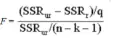
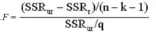
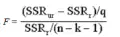
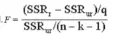
Which of the following statements is true?
If the calculated value of F statistic is higher than the critical value, we reject the alternative hypothesis in favor of the null hypothesis.
The F statistic is always nonnegative as SSRr is never smaller than SSRur.
Degrees of freedom of a restricted model is always less than the degrees of freedom of an unrestricted model.
The F statistic is more flexible than the t statistic to test a hypothesis with a single restriction.
The normality assumption implies that:
the population error u is dependent on the explanatory variables and is normally distributed with mean equal to one and variance σ2.
the population error u is independent of the explanatory variables and is normally distributed with mean equal to one and variance σ.
the population error u is dependent on the explanatory variables and is normally distributed with mean zero and variance σ.
the population error u is independent of the explanatory variables and is normally distributed with mean zero and variance σ2.
Which of the following statements is true?
Taking a log of a nonnormal distribution yields a distribution that is closer to normal.
The mean of a nonnormal distribution is 0 and the variance is σ2.
The CLT assumes that the dependent variable is unaffected by unobserved factors.
OLS estimators have the highest variance among unbiased estimators.
A normal variable is standardized by:
subtracting off its mean from it and multiplying by its standard deviation.
adding its mean to it and multiplying by its standard deviation.
subtracting off its mean from it and dividing by its standard deviation.
adding its mean to it and dividing by its standard deviation.
If estimated(βj), an unbiased estimator of βj, is consistent, then the:
distribution of estimated(βj) becomes more and more loosely distributed around βj as the sample size grows.
distribution of estimated(βj) becomes more and more tightly distributed around βj as the sample size grows.
distribution of size estimated(βj) tends toward a standard normal distribution as the sample
distribution of estimated(βj) remains unaffected as the sample size grows
If estimated(βj), an unbiased estimator of βj, is consistent, then when the sample size tends to infinity:
the distribution of estimated(βj) collapses to a single value of zero
the distribution of estimated(βj) diverges away from a single value of zero
the distribution of estimated(βj) collapses to a single point of βj
the distribution of estimated(βj) diverges away from βj
If R2 (UR) = 0.6873, R2 = 0.5377, number of restrictions = 3, and n – k – 1 = 229, F statistic equals:
21.2
28.6
36.5
42.1
Which of the following correctly identifies a reason why some authors prefer to report the standard errors rather than the t statistic?
Having standard errors makes it easier to compute confidence intervals.
Standard errors are always positive.
The F statistic can be reported just by looking at the standard errors.
Standard errors can be used directly to test multiple linear regressions.
Which of the following statements is true?
The standard error of a regression, σ^, is not an unbiased estimator for σ, the standard deviation of the error, u, in a multiple regression model.
In time series regressions, OLS estimators are always unbiased.
Almost all economists agree that unbiasedness is a minimal requirement for an estimator in regression analysis.
All estimators in a regression model that are consistent are also unbiased.
Whenever the dependent variable takes on just a few values it is close to a normal distribution.
True
False
If the calculated value of the t statistic is greater than the critical value, the null hypothesis, H0 is rejected in favor of the alternative hypothesis, H1.
True
False
H1: βj ≠ 0, where βj is a regression coefficient associated with an explanatory variable, represents a one-sided alternative hypothesis.
True
False
The LM statistic requires estimation of the unrestricted model only.
True
False
A change in the unit of measurement of the dependent variable in a model does not lead to a change in:
the standard error of the regression.
the sum of squared residuals of the regression.
the goodness-of-fit of the regression.
the confidence intervals of the regression.
Changing the unit of measurement of any independent variable, where log of the dependent variable appears in the regression:
affects only the intercept coefficient.
affects only the slope coefficient.
affects both the slope and intercept coefficients
affects neither the slope nor the intercept coefficient.
A variable is standardized in the sample
by multiplying by its mean.
by subtracting off its mean and multiplying by its standard deviation.
by subtracting off its mean and dividing by its standard deviation.
by multiplying by its standard deviation
Standardized coefficients are also referred to as:
beta coefficients.
y coefficients.
alpha coefficients.
j coefficients
If a regression equation has only one explanatory variable, say x1, its standardized coefficient must lie in the range:
-2 to 0.
-1 to 1.
0 to 1.
0 to 2.
In the following equation, gdp refers to gross domestic product, and FDI refers to foreign direct investment.
log(gdp) = 2.65 + 0.527log(bankcredit) + 0.222FDI (0.13) (0.022) (0.017)
Which of the following statements is then true?
If gdp increases by 1%, bank credit increases by 0.527%, the level of FDI remaining constant.
If bank credit increases by 1%, gdp increases by 0.527%, the level of FDI remaining constant.
If gdp increases by 1%, bank credit increases by log(0.527)%, the level of FDI remaining constant.
If bank credit increases by 1%, gdp increases by log(0.527)%, the level of FDI remaining constant.
In the following equation, gdp refers to gross domestic product, and FDI refers to foreign direct investment.
log(gdp) = 2.65 + 0.527log(bankcredit) + 0.222FDI (0.13) (0.022) (0.017)
Which of the following statements is then true?
If FDI increases by 1%, gdp increases by approximately 22.2%, the amount of bank credit remaining constant.
If FDI increases by 1%, gdp increases by approximately 26.5%, the amount of bank credit remaining constant.
If FDI increases by 1%, gdp increases by approximately 52.7%, the amount of bank credit remaining constant.
If FDI increases by 1%, gdp increases by approximately 24.8%, the amount of bank credit remaining constant.
Which of the following statements is true when the dependent variable, y > 0?
Taking log of a variable often expands its range.
Models using log(y) as the dependent variable will satisfy CLM assumptions more closely than models using the level of y.
Taking log of variables make OLS estimates more sensitive to extreme values.
Taking logarithmic form of variables make the slope coefficients more responsive to rescaling.
Which of the following correctly identifies a limitation of logarithmic transformation of variables?
Taking log of variables make OLS estimates more sensitive to extreme values in comparison to variables taken in level.
Logarithmic transformations cannot be used if a variable takes on zero or negative values.
Logarithmic transformations of variables are likely to lead to heteroskedasticity.
Taking log of a variable often expands its range which can cause inefficient estimates.
Which of the following models is used quite often to capture decreasing or increasing marginal effects of a variable?
Models with logarithmic functions
Models with quadratic functions
Models with variables in level
Models with interaction terms
Which of the following correctly represents the equation for adjusted R2?

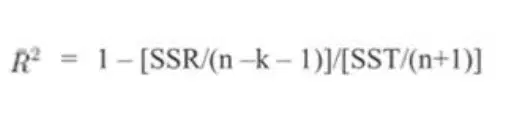

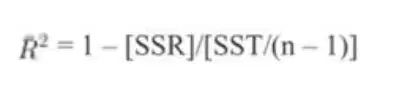
Which of the following correctly identifies an advantage of using adjusted R2 over R2?
Adjusted R2 corrects the bias in R2.
Adjusted R2 is easier to calculate than R2
The penalty of adding new independent variables is better understood through adjusted R2 than R2.
The adjusted R2 can be calculated for models having logarithmic functions while R2 cannot be calculated for such models.
Two equations form a nonnested model when:
one is logarithmic and the other is quadratic
neither equation is a special case of the other.
each equation has the same independent variables.
there is only one independent variable in both equations.
Residual analysis refers to the process of:
examining individual observations to see whether the actual value of a dependent variable differs from the predicted value.
calculating the squared sum of residuals to draw inferences for the consistency of estimates.
transforming models with variables in level to logarithmic functions so as to understand the effect of percentage changes in the independent variable on the dependent variable
sampling and collection of data in such a way to minimize the squared sum of residuals.
Beta coefficients are always greater than standardized coefficients.
True
False
If a new independent variable is added to a regression equation, the adjusted R2 increases only if the absolute value of the t statistic of the new variable is greater than one.
True
False
F statistic can be used to test nonnested models.
True
False
Predictions of a dependent variable are subject to sampling variation.
True
False
To make predictions of logarithmic dependent variables, they first have to be converted to their level forms.
True
False
A predicted value of a dependent variable:
represents the difference between the expected value of the dependent variable and its actual value.
is always equal to the actual value of the dependent variable.
is independent of explanatory variables and can be estimated on the basis of the residual error term only.
represents the expected value of the dependent variable given particular values for the explanatory variables.
If ^β 1 and ^β 2 are estimated values of regression coefficients associated with
two explanatory variables in a regression equation, then the standard error (
β1 –β2) = standard error ( β1) – standard error ( β2).
True
False
A variable is used to incorporate qualitative information in a regression model.
dependent
continuous
binomial
dummy
Standard errors must always be positive.
True
False
In a regression model, which of the following will be described using a binary variable?
Whether it rained on a particular day or it did not
The volume of rainfall during a year
The percentage of humidity in air on a particular day
The concentration of dust particles in air
A useful rule of thumb is that standard errors are expected to shrink at a rate that is the inverse of the:
square root of the sample size.
product of the sample size and the number of parameters in the model.
square of the sample size.
sum of the sample size and the number of parameters in the model.
An auxiliary regression refers to a regression that is used:
when the dependent variables are qualitative in nature.
when the independent variables are qualitative in nature.
to compute a test statistic but whose coefficients are not of direct interest.
to compute coefficients which are of direct interest in the analysis.
The n-R-squared statistic also refers to the:
F statistic.
t statistic.
z statistic.
LM statistic.
The LM statistic follows a:
t distribution.
f distribution
χ 2 distribution.
binomial distribution.
Which of the following statements is true?
In large samples there are not many discrepancies between the outcomes of the F test and the LM test.
Degrees of freedom of the unrestricted model are necessary for using the LM test.
The LM test can be used to test hypotheses with single restrictions only and provides inefficient results for multiple restrictions.
The LM statistic is derived on the basis of the normality assumption.
Which of the following statements is true under the Gauss-Markov assumptions?
Among a certain class of estimators, OLS estimators are best linear unbiased, but are asymptotically inefficient.
Among a certain class of estimators, OLS estimators are biased but asymptotically efficient.
Among a certain class of estimators, OLS estimators are best linear unbiased and asymptotically efficient.
The LM test is independent of the Gauss-Markov assumptions.
If variance of an independent variable in a regression model, say x1, is greater
than 0, or Var(x1) > 0, the inconsistency in β^ 1 (estimator associated with x1) is negative, if x1 and the error term are positively related.
True
False
Which of the following is true of Chow test?
It is a type of t test.
It is a type of sign test.
It is only valid under homoskedasticty.
It is only valid under heteroskedasticity.
Which of the following is true of dependent variables?
A dependent variable can only have a numerical value.
A dependent variable cannot have more than 2 values.
A dependent variable can be binary.
A dependent variable cannot have a qualitative meaning.
In the following regression equation, y is a binary variable:
y= β0+β1x1+…βk xk+ u
In this case, the estimated slope coefficient,
^β1 measures .
the predicted change in the value of y when x1 increases by one unit, everything else remaining constant
the predicted change in the value of y when x1 decreases by one unit, everything else remaining constant
the predicted change in the probability of success when x1 decreases by one unit, everything else remaining constant
the predicted change in the probability of success when x1 increases by one unit, everything else remaining constant
Even if the error terms in a regression equation, u1, u2,….., un, are not normally distributed, the estimated coefficients can be normally distributed.
True
False
A normally distributed random variable is symmetrically distributed about its mean, it can take on any positive or negative value (but with zero probability), and more than 95% of the area under the distribution is within two standard deviations
True
False
The F statistic is also referred to as the score statistic.
True
False
In the following regression equation, y is a binary variable:
y= β0+β1x1+…βk xk+ u
In this case, the estimated slope coefficient,
estimated(β1) measures .
the predicted change in the value of y when x1 increases by one unit, everything else remaining constant
the predicted change in the value of y when x1 decreases by one unit, everything else remaining constant
the predicted change in the probability of success when x1 decreases by one unit, everything else remaining constant
the predicted change in the probability of success when x1 increases by one unit, everything else remaining constant
Consider the following regression equation: y = β0+β1x1+…βk xk+ u In which of the following cases, the dependent variable is binary?
y indicates the gross domestic product of a country
y indicates whether an adult is a college dropout
y indicates household consumption expenditure
y indicates the number of children in a family
A problem that often arises in policy and program evaluation is that individuals (or firms or cities) choose whether or not to participate in certain behaviors or programs
True
False
Which of the following is true of the OLS t statistics?
heteroskedasticity-robust t statistics are justified only if the sample size is large.
The heteroskedasticty-robust t statistics are justified only if the sample size is small
The usual t statistics do not have exact t distributions if the sample size is large.
In the presence of homoscedasticity, the usual t statistics do not have exact t
distributions if the sample size is small.
The heteroskedasticity-robust is also called the heteroskedastcity-robust Wald statistic.
t statistic
F statistic
LM statistic
z statistic
A test for heteroskedasticty can be significant if
the Breusch-Pagan test results in a large p-value
the White test results in a large p-value
the functional form of the regression model is misspecified
the regression model includes too many independent variables
Which of the following is a difference between the White test and the Breusch- Pagan test?
The White test is used for detecting heteroskedasticty in a linear regression model while the Breusch-Pagan test is used for detecting autocorrelation.
The White test is used for detecting autocorrelation in a linear regression model while the Breusch-Pagan test is used for detecting heteroskedasticity. .
The number of regressors used in the White test is larger than the number of regressors used in the Breusch-Pagan test.
The number of regressors used in the Breusch-Pagan test is larger than the number of regressors used in the White test.
Which of the following is true of the White test?
The White test is used to detect the presence of multicollinearity in a linear regression model.
The White test cannot detect forms of heteroskedasticity that invalidate the usual Ordinary Least Squares standard errors.
The White test can detect the presence of heteroskedasticty in a linear regression model even if the functional form is misspecified.
The White test assumes that the square of the error term in a regression model is uncorrelated with all the independent variables, their squares and cross products.
Consider the following regression model: log(y) = β0 + β1x1 + β x 2 + β3x3 + u. This model will suffer from functional form misspecification if
u is heteroskedastic
β0 is omitted from the model
x 2 is omitted from the model
x3 is a binary variable
Which of the following Gauss-Markov assumptions is violated by the linear probability model?
The assumption of constant variance of the error term.
The assumption of zero conditional mean of the error term.
The assumption of no exact linear relationship among independent variables.
The assumption that none of the independent variables are constants.
Which of the following problems can arise in policy analysis and program evaluation using a multiple linear regression model?
There exists homoscedasticity in the model.
The model can produce predicted probabilities that are less than zero and greater than one.
The model leads to the omitted variable bias as only two independent factors can be included in the model.
The model leads to an overestimation of the effect of independent variables on the dependent variable.
Consider the following regression equation: y = β0+β1x1+…βk xk+ u In which of the following cases, is ‘y’ a discrete variable?
y indicates the gross domestic product of a country
y indicates the total volume of rainfall during a year
y indicates household consumption expenditure
y indicates the number of children in a family
A binary variable is a variable whose value changes with a change in the number of observations.
True
False
A dummy variable trap arises when a single dummy variable describes a given number of groups.
True
FAlse
The dummy variable coefficient for a particular group represents the estimated difference in intercepts between that group and the base group.
True
False
The multiple linear regression model with a binary dependent variable is called the linear probability model.
True
False

