
 Worksheets
Unit 7- Chemical Reactions Review
Total questions: 100
Worksheet time: 3hrs 42mins

What type of reaction involves the breaking down of a substance into simpler substances?
Single Displacement Reaction
Double Displacement Reaction
Synthesis Reaction
Decomposition Reaction

What type of reaction involves 2 substances combining to form 1 new compound?
Decomposition Reaction
Single Displacement Reaction
Double Displacement Reaction
Synthesis Reaction

What type of reaction involves one element replacing another element in a compound?
Single Displacement Reaction
Double Displacement Reaction
Synthesis Reaction
Decomposition Reaction
What type of reaction involves ions from 2 compounds exchanging places to form 2 completely new compounds?
Single Displacement Reaction
Double Displacement Reaction
Synthesis Reaction
Decomposition Reaction
What type of reaction involves one element replacing another element in a compound?
Single Displacement Reaction
Double Displacement Reaction
Synthesis Reaction
Decomposition Reaction

What are the reactants in the chemical equation pictured?
CH4 and CO2
CH4 and O2
CO2 and H2O
O2 and H2O

What are the products of the chemical reaction pictured?
CH4 and CO2
CH4 and O2
CO2 and H2O
O2 and H2O
What type of chemical reaction is this one?
Al(OH)3 --> Al2O3 + H2O
Decomposition
Combustion
Synthesis
Single Replacement
What type of chemical reaction is this one?
CuO + CO2 --> CuCO3
Decomposition
Combustion
Synthesis
Single Replacement
What type of chemical reaction is this one?
Ca + MgCl2 --> CaCl2 + Mg
Decomposition
Combustion
Synthesis
Single Replacement
What type of reaction is illustrated below?
2HI --> H2 + I2
synthesis
decomposition
single replacement
double replacement
What type of reaction is illustrated below?
Zn + H2S --> ZnS + H2
synthesis
decomposition
single replacement
double replacement
3KOH + H3PO4 --> K3PO4 + 3H2O
Combination
Decomposition
Single replacement
Double replacement
2Na +S → Na2S
Double Replacement
Decomposition
Combustion
Synthesis
2 NO2 ---> 2 O2 + N2
Synthesis
Single Replacement
Decomposition
Combustion
What reaction has the following general formula:
A + CD --> C + AD
Combination
Decomposition
Single Replacement
Double Replacement
Combustion
What reaction has the following general formula:
AB --> A + B
Combination
Decomposition
Single Replacement
Double Replacement
Combustion
What reaction has the following general formula:
AB + CD --> CB + AD
Combination
Decomposition
Single Replacement
Double Replacement
Combustion
What reaction has the following general formula:
A + B --> AB
Combination
Decomposition
Single Replacement
Double Replacement
Combustion
What type of reaction is the following:
BaCl2+2KI −> 2KCl + BaI2
Combination
Decomposition
Single Replacement
Double Replacement
Combustion
What type of reaction is the following:
2KI −> 2K + I2
Combination
Decomposition
Single Replacement
Double Replacement
Combustion
What type of reaction is the following:
2NaHCO3−> Na2CO3+CO2+H2O
Combination
Decomposition
Single Replacement
Double Replacement
Combustion
What type of reaction is the following:
Zn + 2HCl −> ZnCl2+H2
Combination
Decomposition
Single Replacement
Double Replacement
What type of reaction is the following:
3CuS +2Al −> Al2S3+3Cu
Combination
Decomposition
Single Replacement
Double Replacement
What type of reaction is the following:
Na2S +2HCl −> H2S+2NaCl
Combination
Decomposition
Single Replacement
Double Replacement
What type of reaction is the following:
Ag3N + 3HBr−>3AgBr+H3N
Combination
Decomposition
Single Replacement
Double Replacement

CoCO3 → CoO + CO2
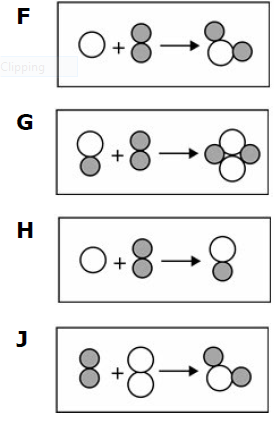
What type of reaction is shown in all four models?
synthesis
decomposition
single replacement
double replacement
Ca + AlCl3→ CaCl2 + Al

Identify the type of chemical reaction
Synthesis
Decomposition
Single replacement
Double replacement
Combustion

Identify the type of chemical reaction
Synthesis
Decomposition
Single replacement
Double replacement
Combustion
a different way to say Law of Conservation of Matter
Law of Conservation of Volume
Law of Conservation of Energy
Law of Conservation of Mass
Law of Conservation of Environment
a way to describe a chemical reaction using chemical formulas and other symbols
mathematical formula
mathematical equation
chemical formula
chemical equation
a substance that takes part in and undergoes change during a reaction
coefficient
subscript
reactant
product
a new material formed in a chemical reaction
coefficient
subscript
reactant
product
Suppose you have 15g of baking soda and mix it with 15g of vinegar. When they are combined they bubble and fizz a lot. The final solution has a mass of 25g. What happened to the "lost" 5g?
it dissappears
it is still there just not weighted
it is in the gas that is formed
nothing happened
Balance this equation:
MgCl2 --> Mg4 + Cl2
It's already balanced.
4 MgCl2 --> Mg4 + 4 Cl2
4 MgCl2 --> Mg4 + 5 Cl2
How many atoms of aluminum are on each side of the following equation?
4Al + 3O2 --> 2Al2 O3
2
6
4
1
The Law of Conservation of Mass States
Energy cannot be created nor destroyed, it can only change form.
Mass cannot be created nor destroyed, it can only change form.
Mass can be created or destroyed, it cannot change form.

Which of the models of a chemical reaction best represents the Law of Conservation of Mass?
A
B
C
D

Which of the models of a chemical reaction best represents the Law of Conservation of Mass?
A
B
C
D

A student pours hydrochloric acid (HCl) into an open beaker that contains a piece of magnesium (Mg). A chemical reaction occurs, and the data for the reaction is shown in the image. Which of the following answer choices best identifies a possible explanation for the change in mass? SELECT TWO.
There was a increase in mass.
There was a decrease in mass.
There was no change in mass.
Because the reaction occurred in an open container, a gas that was produced was able to escape
Because the reaction occurred in an open container, a gas in the air was able to react with the other chemicals
A student heated a 10 gram sample of a chemical in an open container. A chemical reaction occurred, and the mass of the sample was measured again. The mass of the sample was found to be less than before the reaction. Which of the following best explains the decrease in mass of the sample?
The heat caused the chemical to become less dense.
The reaction gave off more heat than was added.
Some of the lighter particles were destroyed.
Some of the particles escaped as a gas formed.
A student measures the mass of an iron nail to be 25 grams. The student heats the nail over a bunsen burner and measures the mass of the nail afterwards. The mass of the nail is found to be greater after burning. Which of the following best explains the increase in mass of the nail?
The heat caused the compound to become more dense.
The reaction gave off less heat than was added.
Some of the heavier particles multiplied inside the nail.
Extra particles from the air were added to the nail during burning.
How many oxygen atoms are in the products for the chemical reaction below?
4Fe + 3O2 → 2Fe2O3
2
3
5
6
H2 + O2 --> H2O
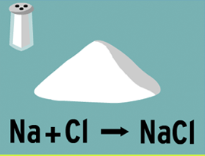
When sodium and chlorine combine to form sodium chloride, sodium chloride is the:
Originator
Reactant
Product
Produce
What coefficients are needed to balance the equation?
__ SiCl4 + __ H2O → __ H4SiO4 + __ HCl
(a)
What coefficients are needed to balance the equation?
__ Al + __ HCl → __ AlCl3 + __ H2
(a)
__ KClO3 → __ KClO4 + __ KCl
(a)
__ H2SO4 + __ HI → __ H2S + __ I2 + __ H2O
(a)
What is the left part of a chemical equation called?
2H2 + O2 ---> 2H2O
Reactants
Yields
Products
Chemical equation
What is the right part of a chemical equation called?
2H2 + O2 ---> 2H2O
Reactants
Yields
Products
Chemical Equation
What is the total number of atoms present in 5Na3PO4?
5
55
40
8
Is the following equation balanced?
Al + O2 ---> 2Al2O3
YES
NO
What is the number before a chemical formula called?
Example: 2H2 + O2 ---> 2H2O
Coefficient
Atom
Subscript
Equation
Which of the following equations are correctly balanced?
12CO2 + H2O ---> C6H12O6 + O2
CO2 + H2O ---> 3C6H12O6 + O2
CO2 + 9H2O ---> C6H12O6 + O2
6CO2 + 6H2O ---> C6H12O6 + 6O2
Balance this equation:
H2 + Cl2 ---> HCl
It is balanced.
H2 + Cl2 ---> 2HCl
3H2 + Cl2 ---> 6HCl
H2 + 3Cl2 ---> 6HCl
SO2 + H2O --> H2SO4
Balance this equation
__ Zn+ __ HCl--> __ ZnCl2 + __ H2
(a)
_Mg + _Cl2 --> _MgCl2
1, 2, 1
Balance this equation
__P4 + __O2 --> __P2O3
(a)
Fill in the blanks with coefficient:
PCl5+_ H2O→_ HCl+H3PO4
4, 5
1, 6
3, 8
2,2
P4+O2 --> P2O3
Balance the following equation:
___ Mg+ ___ O2→___ MgO
1, 1, 3
2, 1, 2
1, 2, 1
2, 2, 2
Select all of the reactants in the following reaction:
Hydrogen + Oxygen --> Water
Hydrogen
Oxygen
Water
Select all of the reactants in the following reaction:
Barium carbonate + Nitric acid --> Barium nitrate + Water + Carbon dioxide
Barium carbonate
Nitric acid
Barium nitrate
Water
Carbon dioxide
Select all of the reactants in the following reaction:
Sodium hydroxide + Hydrochloric acid --> Sodium chloride + Water
Sodium hydroxide
Hydrochloric acid
Sodium chloride
Water


When hydrogen reacts with sulfur, a smelly gas, dihydrogen monosulfide, is produced.
H2 + S → HS
H2 + S → H2S
H + S→ HS
H + S→ H2S
Hydrogen gas and nitrogen monoxide gas forms water and nitrogen gas.
H2 + NO --> H2O + N2
H + NO --> H2O + N
H2 + N2O3 --> H2O + N2
H + NO --> H2O + N2
Aluminum bromide and chlorine gas produce aluminum chloride and bromine gas.
AlBr3 + Cl2 --> AlCl3 + Br2
AlBr3 + Cl --> AlCl3 + Br
Al3Br + Cl --> Al3Cl + Br2
AlBr3 + Cl2 --> AlCl3 + Br
Hydrogen gas and chlorine gas produce hydrogen chloride
H2 + Cl2 --> HCl
H + Cl --> HCl
H2 + Cl2 --> H2Cl2
H + Cl --> H2Cl
Aluminum and oxygen produces aluminum oxide
Al + O2 --> Al2O3
Al + O --> Al2O3
Al3 + O2 --> Al2O3
Al + O --> AlO
If the mass of a chemical reaction's product is 15 grams, what would the mass of the reactants be?
20 g
15 g
10 g
3 g

Why does this picture demonstrate the Law of Conservation of Matter?
the number of atoms of each element are the same on both sides
they start out separate and end up combined
the same elements are used
it doesn't demonstrate the Law of Conservation of Matter
If a chemical reaction occurs in a closed system (no way for any part of the reaction to escape), how does the product mass compare to the reactant mass?
the mass would decrease
the mass would increase
the mass would stay the same
it depends on the type of reaction
If a chemical reaction occurs in an open system (not contained), what might happen to the measurable mass of the products when compared to the reactants?
the measurable mass might decrease because any gas produced can escape (the actual mass would stay the same)
the mass would increase because mass was created
the measurable mass would stay the same because nothing would be able to leave the system.
it depends on the type of reaction

Which picture below would correctly demonstrate the Law of Conservation of Matter if this picture is the reactants?


In a reaction A + B ----> C.
Reactant A has 5g and product C has 9g.
How many grams does reactant B should have?
4g
5g
9g
14g
In a chemical equation, is it true that -
the reactant side and product side can have different numbers of atoms for each element
there can be different elements on the reactant side and the product side
the reaction must always take place in a closed system in order for it to work
the coefficients indicate the number of molecules of each reactant used and the number of molecules of each product made
Which of the following is a common sign that a chemical change has occurred?
A chemical has turned a different color, bubbled, and/or changed temperature.
A chemical has changed to a different state of matter, such as a liquid to a solid.
A chemical has changed size.
A chemical has become a different shape.
When heated, mercuric oxide decomposes to form liquid mercury and oxygen. A scientist heated 10 grams (g) of mercuric oxide and formed 9.3 grams of liquid mercury. How many grams of oxygen were formed?
0.7 g
9.3 g
10.0 g
19.3 g

Sodium sulfate and barium chloride react with each other to form sodium chloride and barium sulfate as shown. Which statement MOST accurately describes the mass of the reactants compared to the mass of the products?
The mass of the reactants is the same as the mass of the products.
The products have a greater mass because matter was created during the reaction.
The reactants have a greater mass because some of the mass was converted to heat.
The reactants have a greater mass because some matter was destroyed by the reaction.

When a mixture of oxygen and hydrogen is ignited in a test tube, the reaction shown occurs. What happens to the total mass of the contents of the test tube?
The total mass increases.
The total mass decreases.
The total mass remains the same.
Part of the mass is changed to heat energy.
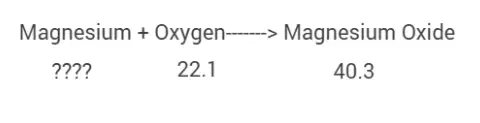
Based on the Law of Conservation of Matter, predict the minimum amount of magnesium that will react with all 22.1 grams of oxygen to produce 40.3 grams of magnesium oxide.
18.2
62.4
22.1
40.3
A lab group reacts Na2O with HCl to produce NaCl and H2O. When writing their lab report, they came up with the following equation to represent the reaction:
Na2O + HCl → NaCl + H2O
Does this equation satisfy the Law of Conservation of Matter? Why or why not?
Yes, since there are 5 reactant atoms and 5 product atoms
Yes, since there is a subscript of 2 on both sides of the equation.
No, since there are two sodium atoms as reactants, but only one sodium atom as a product.
No, since there is a liquid and a solid as reactants, but a gas and a solid as a product
A flask with vinegar in it has a mass of 160 grams. A balloon with baking soda in it has a mass of 40 grams. The balloon is attached to the flask to seal the opening and the vinegar and baking soda mixes. The balloon inflates to a large volume. What will the total mass of the balloon and flask be after the balloon inflates and why?
Less than 200 grams because the solid baking soda disappears
200 grams, because all the atoms remain in the balloon or flask.
More than 200 grams because the size of the balloon is so much larger

