wayground logo

Free Printable Worksheets

Font size

S
M
L
XL
Worksheets

sound 9th

Total questions: 56

Worksheet time: 41mins

Name
Class
Date
1.
An ________ is a reflected sound.
a)
Vibration
b)
Echo
c)
Pitch
d)
Volume
2.
__________ is the loudness or softness of a sound. 
(Hint: Think about our sound song.)
a)
Echo
b)
Volume
c)
Pitch
d)
Vibration
3.
__________ means to move back and forth quickly.
a)
Pitch
b)
Amplitude
c)
Vibration
d)
Echo
4.
______________ is the amount of energy in a sound wave.
a)
Amplitude
b)
Echo
c)
Volume
d)
Vibration
5.
Sound is a form of energy produced by ______________.
a)
vibrations
b)
distances
c)
prisms
d)
Ms. Crews
6.
Your ear changes the vibration of sound waves into signals. The signals are then interpreted by your brain.
a)
True
b)
False
7.
Sound waves travel the FASTEST through _____________.
a)
gases
b)
liquids
c)
solids
8.
If a sound has a high amplitude then it also has a ____________!!!
a)
fast echo
b)
slow pitch
c)
high volume
d)
low volume
9.
Sound waves travel the SLOWEST through _____________.
a)
gases
b)
solids
c)
liquids
10.
Sound moves in a _________.
a)
Transverse wave
b)
Longitudinal wave
11.
How is sound produced?
a)
By the vibration of particles
b)
By the transfer of particles 
12.
Area of a longitudinal wave where particles are CLOSE together.
a)
Compression
b)
Rarefaction
13.
Area of a longitudinal wave where particles are APART. 
a)
Compression
b)
Rarefaction
14.
Which device measures sound waves?
a)
Oscilloscope
b)
Stethoscope 
c)
Radio
d)
I don't know
15.
The reflection of sound waves off of a hard surface can create ______.
a)
A wave
b)
An echo 
16.
Soft surfaces _______ sound waves. 
a)
Reflect
b)
Absorb
17.

wavelength is measured in

a)

seconds

b)

cycles/ second

c)

metre

d)

Hz

18.
How does sound travel?
a)
Sounds travels in waves
b)
sound travels slow
c)
sound travels fast
d)
sound doesn't travel
19.
What is a larynx?
a)
It is animal is Africa
b)
It is sound waves
c)
It is a a muscle that holds vocal cords
20.
The rate in which sound waves occur is?
a)
vibration
b)
echo
c)
frequency
21.
What is vibration?
a)
the rate at which sound waves occur
b)
movement back and forth
c)
how high or low a sound is
22.
Why can't we hear sound in space?
a)
can't take our helmet off to hear
b)
Space has no mass / no gas/ solids/ liquids
c)
because it's dark
d)
Don't know, I've never been to space
23.
Why do we see lightning before we hear the thunder?
a)
Our eyes trick us
b)
Light travels faster than sound
c)
they're two separate things
24.
What happens to our hearing if we listen to loud noises all the time?
a)
We appreciate music better
b)
we get a ringing in our ears
c)
we start to experience hearing loss
25.
How can we protect our ears from hearing loss?
a)
wear ear plugs
b)
put our fingers in our ears
c)
Try not to listen to loud things
d)
All of the above
26.
A sound with a high frequency has a _____ pitch. A sound with a ____ frequency has a low pitch.
a)
high, low
b)
low, high
c)
medium, high
d)
high, medium
27.
Matter that carries sound waves is called a _________
a)
low
b)
high
c)
medium
d)
surface
28.
Sound is a form of? 
a)
energy
b)
pitch
c)
volume
29.
Why is sound able to travel faster through a solid than a gas?
a)
Gas molecules are packed tightly.
b)
Sound does not travel faster through a solid than a gas.
c)
Solid molecules are packed tightly.
d)
Gas molecules move slowly.
30.
Why is the school library covered with carpet?
a)
So everyone can make a lot of noise
b)
to help absorb sounds to keep it quiet
c)
because it looks good
d)
to help absorb sounds so it can stay noisy
31.

Pitch describes human perception of which property?

a)

resonance

b)

frequency

c)

amplitude

d)

overtones

32.
Sound travels FASTEST through which of these materials?
a)
Air
b)
Empty space
c)
Metal
d)
Water
33.
To make a sound from a stringed instrument louder you must
a)
hit it
b)
pluck it harder
c)
hold it higher
d)
pluck it softer
34.
A longer string makes a _______ pitch than a short string.
a)
louder
b)
softer
c)
higher
d)
lower
35.
An object that does not vibrate cannot produce
a)
sound
b)
light
c)
heat
d)
electricity
36.
What is frequency?
a)
the number of vibrations per second
b)
how high or low a sound is
c)
the loudness or softness of a sound
d)
the back and forth movement of matter
37.

Which of these sound waves has the highest frequency?

a)
b)
c)
38.

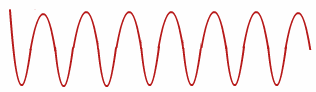
Which sound wave has the lowest pitch?
a)
b)
c)
39.

What part of the wave are the arrows pointing to?

a)

Crest

b)

Trough

c)

Amplitude

d)

Origin

40.
a)
Trough
b)
Crest
c)
Amplitude
d)
Wavelength
41.
What unit of measure is used for volume?
a)
frequency
b)
pitch
c)
decibel
d)
wavelength
42.

which part of the wave is labelled ?

a)

Amplitude

b)

Crest

c)

Trough

d)

Wavelength

43.
If you want to change the pitch of a sound, you have to change the ___
a)
frequency
b)
amplitude
c)
speed
d)
volume
44.

This is the unit used to measure the Frequency of a sound.

a)

Decibel

b)

Hertz

c)

metre

d)

second

45.

Bats use ________ to locate mosquitoes in air.

a)

solar

b)

ecology

c)

echolocation

d)

evolution

46.

Frequency range of infrasound is:

a)

20 Hz to 20,000 Hz

b)

0 Hz to 20 kHz

c)

0 Hz to 20 Hz

d)

more than 20,000 Hz

47.

Audible frequency range in human is

a)

0 Hz to 20, 000 Hz

b)

15 Hz to 25000 Hz

c)

20 Hz to 20,000 Hz

d)

20 Hz to 40,000 Hz

48.

which of the following are mechanical waves?

a)

water waves, light waves

b)

sound wave, water waves

c)

light waves, sound waves

d)

radio waves , ultrasonic waves

49.

__________________________ is the distance between two consecutive crests or compressions of the wave.

a)

frequency

b)

pitch

c)

wavelength

d)

crest

50.
How are sound and light similar?
a)
Both are forms of energy.
b)
Sound and light waves can curve around solid objects.
c)
Both can be transformed into heat energy.
d)
Sound and light are made up of vibrations.
51.

The _______ and the ________ suspend equal angles with the normal.

a)

Incident ray, reflected ray

b)

Incident angle, reflected angle

c)

Incident ray, reflected angle

d)

Incident angle, reflected ray

52.

What type of obstacle is needed for the reflection of sound?

a)

Polished or rough

b)

Only polished

c)

Only rough

d)

None of the above

53.

The reflected sound is referred to as an

(a)  

54.

For hearing distinct echoes, the minimum distance of the obstacle from the source of sound must be

a)

18.9 m

b)

17.2 m

c)

34.4 m

d)

21.6 m

55.

In stethoscopes the sound of the patient’s heartbeat reaches the doctor’s ears due to

(a)  

56.

Generally the ceilings of concert halls, conference halls and cinema halls are (a)   so that sound after reflection reaches all corners of the hall