wayground logo

Free Printable Worksheets

Font size

S
M
L
XL
Worksheets

Quiz #10 - Soil Properties (Unit 4)

Total questions: 36

Worksheet time: 45mins

Name
Class
Date
1.
What soil type is typically found on the top of soil?
a)
Humus because it made up of dead, organic matter
b)
Loam because it is lighter than the other layers
c)
Clay because it is not able to fit through the finer particles
d)
Rock because the other layers are more dense
2.
What was one of the major causes of the Dust Bowl?
a)
Cold and windy weather
b)
Increasing prices and demand for crops
c)
Removal of grasses and overfarming
d)
Sandy soil composition that would not stay in place
3.
The two main agents of erosion are...
a)
wind and flowing water
b)
gravity and frost wedging
c)
oxygen and water
d)
carbon dioxiede and wind
4.
Which layer in the soil will have the greatest concentration of organic nutrients?
a)

0

b)
B
c)
C
d)

A

5.
Which of the following is the correct order of soil particles in order of increasing particle size?
a)
clay-sand-silt
b)
sand-clay-silt
c)
silt-clay-sand
d)
clay-silt-sand
6.
Soil sample that is 60% clay, 30% silt, and 10% sand has which texture? 
a)
clay
b)
clay loam
c)
sandy loam
d)
silt 
7.
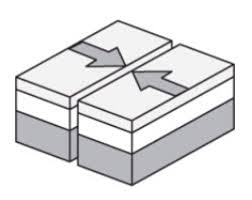
Name the boundary
a)
convergent boundary
b)
divergent boundary
c)
transform boundary
d)
sergent boundary
8.
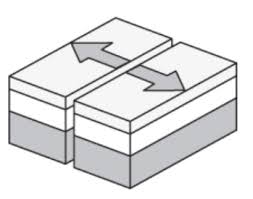
Name the boundary
a)
convergent boundary
b)
divergent boundary
c)
transform boundary
d)
sergent boundary
9.
Name the boundary
a)
convergent boundary
b)
divergent boundary
c)
transform boundary
d)
sergent boundary
10.
Which type of soil is best for growing plants?
a)
clay
b)
sand
c)
dirt
d)
loam
11.
Which type of soil is best for growing plants?
a)
clay
b)
sand
c)
dirt
d)
loam
12.
Which statement BEST summarizes the Tragedy of the Commons?
a)
Self-interests outweigh public interest
b)
Public interests outweigh self-interest
c)
It is all right to be selfish as long as you think of the big picture.
d)
It is a tragedy when biodiversity disappears.
13.
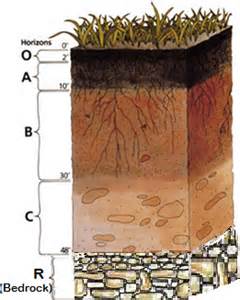
Which is the correct order of soil horizons starting at the surface?
a)
A, B, E,C, O
b)
O, A, B, C, E
c)
O, E, A, B, C
d)
O, A, E, B, C
14.
Silt and sand are concentrated here
a)
A horizon
b)
B horizon
c)
E horizon
d)
O horizon
15.
Liter layer, mostly undecided materials
a)
A horizon
b)
B horizon
c)
O horizon
d)
E horizon
16.
The deep, underlying non-soil materials
a)
B horizon
b)
E horizon
c)
O horizon
d)
Bedrock
17.
The layer where minerals that were leached out of layers above accumulate
a)
A horizon
b)
B horizon
c)
E horizon
d)
O horizon
18.
The layer where minerals that were leached out of layers above accumulate
a)
A horizon
b)
B horizon
c)
E horizon
d)
O horizon
19.
A mixture of soil, loam, and detritus; the topsoil
a)
A horizon
b)
B horizon
c)
E horizon
d)
O horizon
20.
Soil rich in organic matter
a)
clay
b)
humus
c)
loam
d)
sand
21.
Soil composed of the finest particles
a)
clay
b)
silt
c)
humus
d)
loam
22.
Soil with the largest pores
a)
clay
b)
humus
c)
sand
d)
silt
23.

Porosity is a measure of void space in a soil sample. Larger soil particles have larger void spaces. Smaller soil particles have smaller pore spaces, but a greater number of them, which leads to higher surface tension and higher % porosity. With this is mind, which statement is true:

a)

Sandy soil has a higher porosity than clay soil

b)

Sandy soil has a higher porosity than silty soil

c)

Clay soil has a higher porosity than sandy soil

d)

Porosity is directly proportional to soil particle size

24.

The rate at which water flows through the soil is called soil percolation or ______.

a)

Groundwater

b)

Permeability

c)

Soil Pores

d)

Porosity

25.
Which soil component has the least capacity for holding water?
a)
silt
b)
clay
c)
sand
d)
humus
26.
_______ is the type of soil used most often with plants and on farms. It is a mixture of clay, sand, and silt.
a)
loam
b)
humus
c)
soil
d)
dirt
27.
You dig a small hole in the soil and the next day it rains. The hole fills with water, but does not empty even after several days of dry weather. What is the soil mostly made of?
a)
clay
b)
sand
c)
humus
d)
silt
28.
Water gets into the cracks of rock and freezes, causing the rock to break.  What is this an example of?
a)
erosion
b)
weathering
29.
Soil is made of
a)
weathered rocks and minerals
b)
dead plants and animals
c)
air and water
d)
all of the above
30.

Sedimentary rocks are changed to sediments by ________ .

a)

compaction

b)

weathering and erosion

c)

cementation

d)

heat and pressure

31.

What are the proportions of sand, silt, and clay for the soil at point X ?

a)

5% Sand, 95% Silt, 5% Clay

b)

5% Sand, 20% Silt, 5% Clay

c)

65% Sand, 30% Silt, 10% Clay

d)

60% Sand, 30% Silt, 10% Clay

32.

The type of plate boundary where two plates come together is a .....

a)

Convergent Boundary

b)

Divergent Boundary

c)

Transform Boundary

d)

Plate Boundary

33.

What type of event will occur at this boundary?

a)

Earthquake

b)

Volcano Eruption

c)

Tornado

d)

Mountain Building

34.

A divergent boundary occurs when plates ....

a)

Pull apart

b)

Come together

c)

Slide past each other

d)

subducting

35.
Which horizon is made up of partially weathered rocks?
a)
Horizon A
b)
Horizon B
c)
Horizon C
d)
Horizon D or R
36.

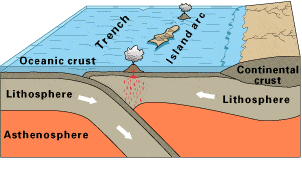
Observe this diagram of a plate boundary. One statement BEST describes what is happening. It is that

a)

the oceanic crust is melting.

b)

the denser ceanic crust is subducting under the less dense oceanic crust

c)

volcanic islands are forming.

d)

the tectonic plates are moving away from each other.