
Font size
 Worksheets
UNIT 6 - NUCLEIC ACID & PROTEIN SYNTHESIS
Total questions: 45
Worksheet time: 27mins
DNA makes RNA, which is in turn makes proteins.
True
False
Protein synthesis occurs in two stages. Check all that applies below.
replication
transcription
mutation
translation
This sequence from the DNA will from this pattern of mRNA. ACT --> ___
TGA
UGA
GAU
UAA
The formed mRNA travels outside the nucleus and will bind with a ....
mitochondrion
ribosome
endoplasmic reticulum
golgi body
Protein synthesis read in triplet codes.
True
False
The primary structure of protein is simply the sequence of amino acids.
True
False
The amino acid that codes for START is ....
valine
phenylalanine
methionine
none of the above
How many bases are needed to form an amino acid?
20
2
3
5
DNA replication is basically DNA cloning itself.
True
False
The quarter moon shaped RBCs is an indicative of what disease?
anaemia
sickle cell anemia
blood cancer
leukemia
Which of the following mainly causes the change of RBC shape?
from hydrophilic, it becomes hydrophobic
from hydrophobic, it becomes hydrophilic
Check the boxes of the basic structure that makes up nucleotides.
phosphate group
nitrogenous base
disaccharide sugar
pentose sugar
DNA and RNA are examples of macromolecules.
True
False
Check the boxes of the polymers.
proteins
nucleic acids
carbohydrates
monosaccharides
nucleotides
Which is NOT a nitrogenous base of RNA.
thymine
adenine
guanine
cytosine
uracil
Check the boxes of pyrimidines below.
cytosine
guanine
thymine
uracil
Which of the following is paired correctly?
thymine - adenine
cytosine - thymine
thymine - guanine
Purines have a double ring structure.
True
False
An adenosine with only one phosphate group is called..
AMP
ADP
ATP
What bonds the sugar and phosphate group in a DNA helix?
hydrogen bonds
phosphodiester bonds
antiparallel bonds
Check the boxes of what makes up the backbone of a DNA helix.
sugar
base
phospate group
Which of the following is NOT found in the structure of a nucleotide?
phosphate group
ribose sugar
hydroxyl group
nitrogenous base
Which is correct about the base adenine?
it has hexose sugar
double ring
attached to the phosphate group
complementary with cytosine
Which of the following is bound by 2 hydrogen bonds?
A and T
C and T
C and G
G and T
In DNA replication, what comes first?
translation
transcription
hydrogen bond
peptide bonding
With 5 amino acids, how many bases are expected to be there?
10
15
9
25
What is the tRNA anticodon of this mRNA codon, CUG?
GAC
ATU
GTC
TAG

What will be the complementary DNA sequence resulting from the following:
GAT-TAC-AGA-TTA-CAT?
CTA-ATG-TCT-AAT-GTA
GAU-UAG-UGA-UUA-GUT
CUA-AUG-UCU-AAU-GUA
CAT-ACA-TAC-ATA-TAG
mRNA codon is UAG, what is the DNA sequence?
ATC
AUC
TAC
AAC

Translate the following:
TACCAAGTACGTACT
Methionine-valine-glycine-alanine-stop
methionine-valine-histidine-alanine-stop
ATGGTTCATGCATCA
ACCGUUCAUGCA
Which component of DNA determines the traits of an organism?
Nitrogen Bases
Sugar-Phosphate Backbone
Hydrogen bonds
Covalent bonds
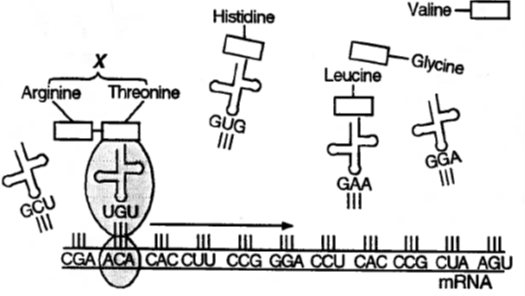

What is #2?
amino acid
ribosome
mRNA
codon
Proteins are made from ____.
nucleic acids
nucleotides
fatty acids and glycerol
amino acids

What are the three parts of a nucleotide?
a base
a protein
5-carbon sugar
a phosphate group
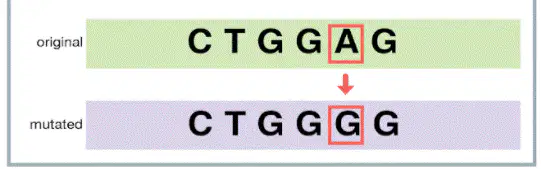
What mutation type is shown in the picture?
substitution
deletion
insertion
frame shift

