
 Worksheets
Hydrosphere
Total questions: 108
Worksheet time: 4hrs 36mins
The combined mass of water
Atmosphere
Hydrosphere
Troposphere
The fall of sea water and its movements towards the sea is called
ebb
low tide water
high tide water
When the sun, the earth and the moon is in the same line
ebb
low tide
high tide
When the sun and the moon are at the position of right angles.
ebb
low tide
high tide
When the sun and the moon are at the position of right angle with reference to the earth, the gravitational force s of the sun and the moon
work against each other
work towards each other
remains neutral
The surface of the earth facing the moon experiences_______gravitational force of the moon.
maximum
minimum
remains neutral
The opposite surface of the earth facing the moon experiences_______gravitational force of the moon.
maximum
minimum
remains neutral
The difference between high tide water and low tide water is called
perigee
ebb
tide range
The period of the farthest distance between the moon and the earth is called
perigee
ebb
apogee
The period of the nearest distance between the moon and the earth is called
perigee
ebb
apogee
The ocean currents which flow from the low latitudes in tropical zones towards the high latitudes in the temperate zones and sub polar zones
surface ocean currents
Warm ocean currents
cold ocean currents
The ocean currents flow in the high latitudes from the polar regions towards the low latitudes in the warm Equator region.
surface ocean currents
Warm ocean currents
cold ocean currents
Given below is the example of the flow of oceanic currents
Atlantic water flows into Mediterranean sea's surface
Mediterranean water flows into Atlantic
Canary current and the Gulf stream
Given below is the example of the flow of oceanic currents caused by the earth's rotation.
Atlantic water flows into Mediterranean sea's surface
Mediterranean water flows into Atlantic
Canary current and the Gulf stream
The Gulf stream influences the climate of the east coast of
North America
South America
The Gulf stream
warm current
cold current
The Labrador current
warm current
cold current
It is sometimes also known as the Black stream
The Kuroshio current
The Labrador current
The Oyashio current
How many types of ocean currents are there?
Warm ocean currents and cold ocean currents
High current and low current
none of these
What are the effects of ocean currents?
Climate change
Helps in trade
Marine organism
All of the above
What are tides?
Alternate fall and rise of water
Alternate rise and fall of water
Alternate rise and fall of sea water
Name the cold current originates from Arctic Ocean.
North Atlantic drift
Labrador cold current
What are the effects of tides?
Tides helps fishermen in sailing
it harnessed to generate electricity
it keep Barbour clean
All of the above
Which warm current crosses Japan island?
Gulf stream
North Atlantic drift
KuroShio current
Why there's thick fog in New Found land all the year round?
Warm Gulf stream and cold Labrador current meet
Cold Oya Ship current and warm Kuro Ship current meet
What do you mean by Perigee?
The period of nearest distance between the Moon and the Earth
The period of farthest distance between the Moon and the Earth
What do you mean by apogee?
The period of nearest distance between the Moon and the Earth
The period of farthest distance between the Moon and the Earth

Which tide occurred at point B?
Neap tide
low tide
Spring tide

Which type of tides is formed?
Spring tide
Neap tide
___ percent of the water on the planet earth is saline ocean water.
96
35 ppt
25
2
Millions of years ago, there was a single super ocean called ___.
Pangaea
Tethys
Panthalassa
Gondwana
_____________ is the deepest trench in the ocean.
java trench
Philippine Trench
Kermadec Trench
Mariana trench
The average salinity of the ocean water is ______PPT.
25
35
45
55
The lowest salinity of the water is found in _______.
Mediterranean sea
Baltic sea
Arabian sea
Aral sea
The lines that connect the points with the same degree of salinity in the ocean/sea are called ____.
Isobars
Isopleths
Isobaths
Isohaline
The slow-moving ocean current is known as _____.
Gair
Drift
stream
channel
The ocean floor is mined for the ____.
vegetable oil
petrol
diesel
crude oil
The ___ is the largest ocean on the planet. It covers more than 30% of the earth's surface.
Indian ocean
Arctic ocean
Pacific Ocean
Antarctic ocean
Which type of ocean movement is a large-scale pattern that can circulate across all the oceans?
Current
Wave
Tide
Which type of ocean movement is a repeated up and down motion, generally caused by wind?
Current
Wave
Tide
Which type of ocean movement varies depending on the current moon phase?
Current
Wave
Tide
Which type of ocean movement can be caused by wind or differences in density and can also be diverted by the Coriolis effect?
Current
Wave
Tide
What part of the wave is also known as the "peak?"
Amplutide
Crest
Trough
Wavelength
TRUE or FALSE: The Gulf Stream carries cool water toward the North Atlantic, causing the weather in Great Britain to be colder.
TRUE
FALSE
Which type of tides have a smaller change in sea level due to the Earth, Moon, and Sun forming a right angle?
High/Low
Spring
Neap
Which type of tides have a larger tidal range due to the Earth, Moon, and Sun forming a line?
High/Low
Spring
Neap
A tsunami is a large __________ typically caused by a shallow seafloor earthquake.
Current
Wave
Tide
The distance between one crest and the next (or one trough and the next) is known as the ______________.
Amplitude
Wave Height
Wavelength
What 2 factors largely impact the density of ocean water?
Density and Pressure
Temperature and Coriolis Effect
Temperature and Salinity
Pressure and Salinity
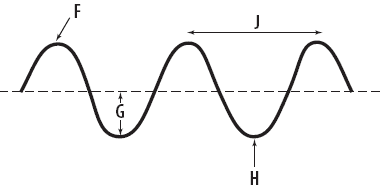
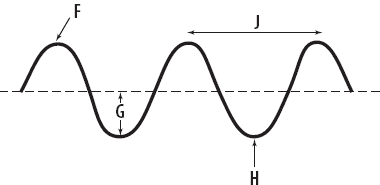
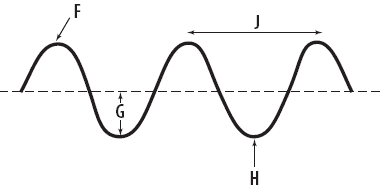
What kind of tidal patterns have 2 high tides and 2 low tides at different heights on a the same day?
Semidiurnal
Mixed Semidirunal
Diurnal
Mixed Diurnal
Which of the following generating forces can cause Tsunamis?
Wind
Earthquakes
Landslides
Volcanic Eruptions
Approximately how many hours will pass between high tide and the following low tide? (Think about the rotation of the Earth between high tides.)
6 hours
12 hours
18 hours
24 hours
How does water move when interacting with ocean waves?
back and forth (see-saw)
up and down
moves in same direction of wave
circular motion
Decreasing ocean temperature causes the density of the water to ______.
decrease
increase
stay the same
fluctuate
_______ causes the Coriolis Effect
Earth's rotation
gravity
wind
density
The more scientific name of the Global Conveyor Belt is _____.
halinethermal circulation
thermohaline circulation
thermodensity circulation

Temperature and salinity differences in ocean water cause:
Mid-ocean ridges
Deep Currents
Surface Currents
High tide and low tide

When surface currents meet continents they ___?
Stop moving
Are deflected (change paths)
Continue in the direction they were going
The Gulf Stream carries warm water to the North Atlantic Ocean, which contributes to
a mild climate for the British Isles.
a harsh winter in the British Isles.
a cold-water surface current that flows to the British Isles.
a warm-water surface current that flows along the coast of California.

Ocean currents affect climates around the world. Based on the map, which area MOST likely has a warmer climate than expected?
1
2
3
4
The ________ winds move the South Equatorial Current towards the Eastern Australian Coast
The Westerlies
North-east Trade
South east Trade
Monsoon winds
The Trade winds move ocean currents towards the ________ coasts of continents
Southern
Northern
Eastern
Western
The Westerlies deflect the Ocean currents towards the _________ coasts of continents
Northern
Southern
Eastern
Western
The Kuroshio current along the east coast of Japan is moving under the influence of
The North-east Trade Winds
The South-east Trade Winds
The Westerlies
The Monsoon Winds
The air over cold currents
carry huge amounts of water vapour
carry less amounts of water vapour
is cold and dry
is warm and saturated with water vapour
The Peruvian current is a _____________ current resulting in the formation of the Atacama Desert.
Warm
Cold
The ____________ causes the West Wind drift to move along the west coast of Africa causing the formation of the Namib and Kalahari deserts
North East Trade Winds
South East Trade Winds
Easterlies
Westerlies

What does the blue line represent in the Thermohaline circulation?
Warm salty water
Warm water
Cold water
Cold salty water

What does the red line represent?
Warm water
Warm salty water
Cold water
Cold salty water
Thermohaline circulation distributes which of the following?
heat
nutrients
carbon dioxide
all of the above
Oceans are important for which of the following reasons?
(Tick 4 correct options).
Ocean gives carbon di oxide
Oceans give us SALT, MARINE ANIMALS and MINERALS
Oceans affect climate
Oceans are the source of RAIN
Oceans are an important means of transport.
Which of these reasons cause the Ocean water to be salty?
(Tick 3 correct options).
Dead remains of aquatic animals
Mixing of SEDIMENTS because of RAINWATER
Cutting of trees
Oil spills
Underwater Volcanic eruptions
IMPORTANT QUESTION
Winds that blow due to pressure difference in the belts, throughout the planet are called ______________.
Oceanic winds
Planetary winds
Monsoon winds
IMPORTANT QUESTION
Regions that are closed to the oceans have __________ climate.
very hot
very cold
EQUABLE
high temperature
low temperature
Choose all the correct reasons that are responsible for pollution of oceanic waters.
Waste thrown from ships, industries & cities
Traffic on roads
Oil spills
Exploitative (too much) fishing
Cutting of mangrove forests in coastal areas
What pattern does Long Shore Drift create?
Zig-Zag
Ripple
Circular
Straight Lines
The movement of material along a coast by waves that approach at an angle to the shore but recede directly away from it.
swash
storm surge
longshore drift
breakwater
A current that runs parallel to the shoreline.
longshore current
rip current
density current
breakwater
Rip currents are
areas of rapid seaward flowing water.
hazardous to swimmers.
narrow currents in the surf zone.
areas of water that flows towards the shore
A current that flows outward from the beach, perpendicular to the shoreline.
rip current
longshore current
swash
breakwater
The movement of deep, cold, nutrient filled water to the surface of the ocean is..
Ocean Current
Upwelling
Deep Currents
Surface Currents
Why is upwelling important?
Upwelling regulates ocean temperature
Upwelling provides nutrient rich water that sustains life
Upwelling controls the tides
Upwelling helps sailors to navigate the seas

