
 Worksheets
driver license part 6
Total questions: 50
Worksheet time: 25mins
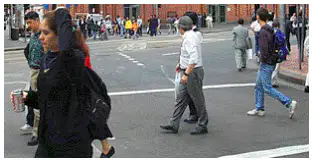
Which statement is true?
- You must give way to pedestrians if there is any danger of hitting them.
- Pedestrians have no special rights on the roads.
- You must give way to pedestrians only at marked crossings.

You drive towards these people on the road. What should you do?
- You must give way to pedestrians if there is any danger of hitting them.
- Pedestrians have no special rights on the roads.
- You must give way to pedestrians only at marked crossings.
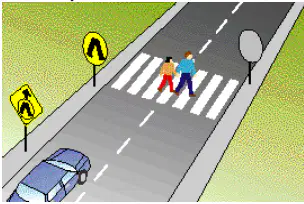
You drive towards these people on the road. What should you do?
- Stop and give way if there is any danger of hitting them.
- Continue at the same speed and sound the horn
- Slow down until they are half way through the crossing and drive on.
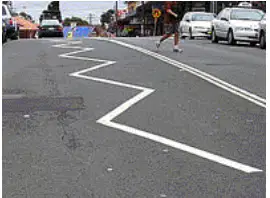
You see these zig-zag markings on the road in front of you. What do they mean?
- Take care and look out for pedestrians at a crossing.
- Look out for animals on the side of the road.
- Be careful because the road ahead is slippery.
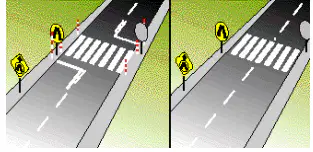
These markings on the road indicate -
- Places where pedestrians have special rights.
- Places where you can park.
- Places where special speed limits apply.
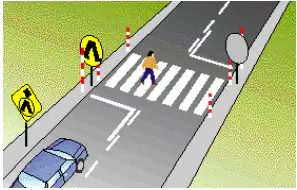
You approach a person crossing the road. You should -
- Slow down or stop to avoid hitting the person.
- Slow down and sound your horn to hurry up the person.
- Maintain your speed and swerve around the person.
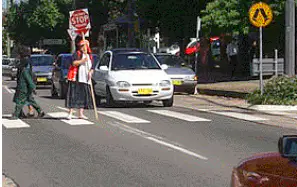
You approach a crossing and see the scene in the picture. You should -
- Slow down and stop until the supervisor takes down the sign.
- Slow down and drive through giving way to the children.
- Stop and wait for the children until your lane is clear
At a pedestrian crossing with traffic lights, when the lights change to red you should -
- Stop, wait for pedestrians to cross and for the green light to come on.
- Slow down and give way to pedestrians.
- Stop and continue after the pedestrians have crossed.
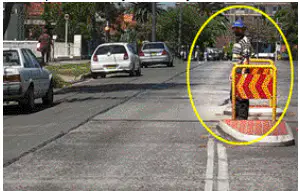
This person is standing on a pedestrian refuge. If he steps out onto your lane you should -
- Give way to the person if there is any danger of colliding.
- Slow down and sound the horn to warn the person to move back.
- Maintain your speed so you do not hold up the traffic.
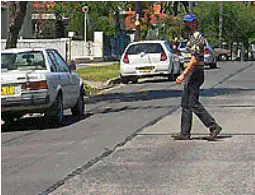
Which of the following statements is correct?
- You must give way to pedestrians if there is a danger of a collision.
- Pedestrians must cross the road only at marked crossings and intersections.
- You do not have to give way to adults crossing at children's crossings.
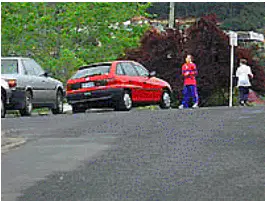
When you see children on or near the road -
- You should slow down and be more careful because they may move suddenly
- You should reduce your speed by 5 km/h.
- You should ignore them and pay attention to the rear vision mirror.
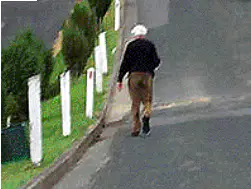
When you see older people on or near the road, you should -
- Slow down and take extra care because they may not see you until you are very close.
- Drive around them to keep the traffic moving.
- Sound your horn and keep going at the same speed so you do not hold up the traffic.
You must give way to pedestrians if there is a risk of hitting them. When driving in poor light, you should -
- Look more carefully for pedestrians because they are hard to see.
- Keep your headlights on high beam all the time.
- Always drive in the right hand lane so you can be away from pedestrians.
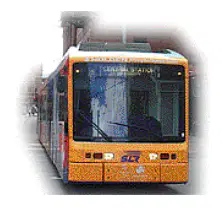
You drive up to a Light Rail vehicle that has just stopped at a tram stop. What is the most important thing you should do?
- Take extra care, slow down and give way to the pedestrians.
- Keep a look out for traffic coming in the opposite direction.
- Slow down, but keep moving so you do not delay other drivers.
You must give way to pedestrians -
-. At all times, if there is any danger of colliding with them, even if there is no marked crossing.
-.Only on marked foot crossings.
- Only on marked foot crossings and traffic light pedestrian crossings.
A car is carrying a driver and 3 adult passengers. There are seat belts in all seating positions. By law, seat belts must be worn by -
- All four people.
- Only the driver.
- Only the driver and front seat passenger.
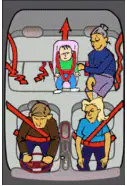
The adult passenger in the rear is breaking the law because she is -
- Not wearing the available seat belt.
- Sitting in the back seat.
- Distracting the driver.
The most effective device for protecting passengers when in an accident is –
- Seat belts.
- Safety door latches.
- Padded instrument panels.
Which one of the following statements is correct? Seat belts -
- Save lives and prevent injury.
- Do not have to be used in the rear seat.
- Are not necessary for good drivers.
Seat belts and child restraints (eg baby capsules and child seats) -
- Must always be worn properly, and adjusted tightly.
- Are only needed on long trips.
- Are only needed on short trips.
Child restraints (eg, baby capsules and child seats) -
- Should be fitted according to the manufacturers' instructions.
- Are not as safe as holding a child in your arms.
- Need only be used if the child wants to sleep.
You are driving a vehicle that only has a seat belt for the driver. To reduce the danger of being in a vehicle without a seat belt, where is the best place for passengers to sit?
- In the back seat.
- In the front seat.
- In the front seat sharing your seat belt.
When passengers get in the car and do not put their seat belts on, the safest thing to do is -
- Tell them the car has seat belts and they should wear them.
- Say nothing because it's the passengers' responsibility to wear their seat belts.
- Drive slower than you normally would so the passengers are safe.
You want to give a lift to a friend and his four month old baby. Before you do, you need to make sure -
- You have a baby restraint properly fitted to your vehicle.
- You have enough seat belts for all the passengers, including the baby.
- Your driver's licence permits you to carry children under the age of twelve months.
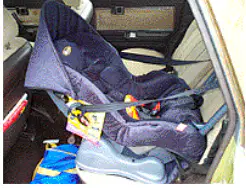
You want to fit a baby restraint to your car. What should you secure the restraint to?
- An anchorage point designed for a baby restraint.
- Any seat belt in the back or front of the car.
- Only at the back using the seat belt provided.
You give a friend and her 12 year old son a lift. Your friend sits in the front and her son gets in the back. The boy does not put his seat belt on. By law, who has to make sure the child wears his seatbelt?
- You do, because you are the driver.
- Your friend does because she is the parent.
- The child does because it is always the passenger's responsibility.
Which of the following statements is correct?
- By law, all occupants of a car (unless exempt) need to be restrained by a properly fitted and adjusted seat belt or a child restraint.
- Occupants in a car fitted with airbags are not required to wear a seat belt.
- Seat belts and child restraints are only required on short trips.
Driving faster than the maximum speed limit is -
- Never legally permitted.
- Permitted only when passing another vehicle.
- Only permitted when other vehicles are going faster than the speed limit.
A Shared Traffic Zone, where pedestrians and other road users can share the road safely has a speed limit of -
- 10 Km/h.
- 20 Km/h.
- 50 Km/h.
You are driving in busy traffic in an 80 km/h zone. It begins to rain lightly. What should you do?
- Slow down to a speed that suits the conditions better.
- Keep going at the same speed because that's how fast the signs tell you to drive.
- Pull over and wait till it stops raining.
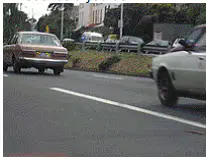
You are driving in a 70 km/h zone, keeping to the limit. Several vehicles pass you. One of your passengers suggests you should keep up with the other traffic. What should you do?
- Decide your speed yourself, based on the speed limit and the conditions.
- Follow the suggestions and keep up with the traffic.
- Speed up to a little bit over the speed limit, because everyone does it.
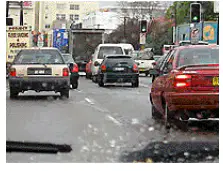
You are driving in busy traffic in a 60 km/h zone. You feel 60 km/h is a bit too fast for the conditions. What should you do?
- Slow down to a speed that suits the conditions.
- Keep up with the other traffic because it's probably safe if the sign says 60 km/h.
- Turn off the busy street and wait for traffic to clear.
What could be the penalties for driving over the speed limit -
- Fines, demerit points and possibly loss of licence.
- Fines only.
- A letter of warning and a small fine.
Having a radar detector or jammer in your car is against the law -
- No matter what your reason is.
- Only if it is turned on.
- If you purchased it after 1998.
Where there are no speed limit signs, the speed limit is 100 km/h, unless -
- There are street lights along the road.
- The road you are driving on is gravel.
- There's an emergency, which mean speed limits don't apply.
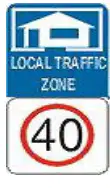
When you see this sign you must -
- Not exceed 40 km/h and keep a special lookout for bicycle riders, pedestrians and children.
- Only enter the street if you live in the local zone.
- Drive at a speed less than 40 km/h if you are not a resident of the local zone.
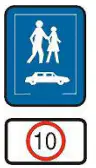
This sign means you must -
- Share this road with other people and vehicles and not exceed 10 km/h.
- Drive at 10 km/h if there are pedestrians around.
- Reduce your speed to what you think is safe but never below 10 km/h.
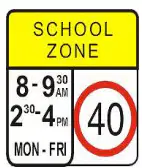
It is 9.20am on a school day. You are driving at 60 km/h, the same speed as traffic around you. You pass this sign but the other cars do not slow down much. What should you do?
- Slow down immediately to 40 km/h or less even though other drivers want to go faster.
- Drive at the speed of the other drivers because it is safer to go with the flow of traffic than slow others up.
- Stay at 60 km/h because it is nearly 9.30am and the times on the school sign are only advisory.
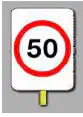
Speed limit signs (such as the one shown) tell drivers -
- The maximum speed they are allowed to drive.
- The minimum speed they are allowed to drive.
- The recommended speed they are allowed to drive.
If you are driving along the highway and come across road works with a reduced speed zone, you must -
- Slow down to the new speed limit.
- Drive through the road works zone as fast as you can to get past it.
- Drive at the same speed as other vehicles.
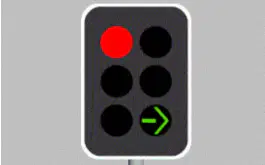
You are facing traffic lights (as shown). What do they mean?
- You may proceed only in the direction of the green arrow.
- You may proceed only in the direction of the green arrow when the red light has changed to green.
- You must give way to oncoming traffic.
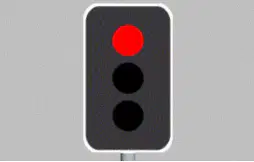
At traffic lights what is meant when a red light appears?
- Stop, wait behind the stop line until the lights change to green.
- Stop, wait behind the stop line until the lights change to yellow.
- Stop, make sure there is no traffic, then drive straight ahead.
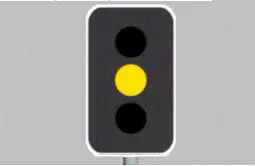
What should you do when approaching traffic lights which change from green to yellow?
- Stop at the stop line unless you are so close that sudden or sharp braking might cause an accident.
- Speed up to clear the intersection before the lights change to red.
- Stop, only if a red light camera is in use.
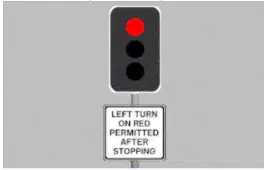
What may you do at an intersection with traffic lights at which this sign is displayed?
- If the lights are red you must first stop, then you may turn left if it is safe to do so.
- You should slow down and check if anyone is coming before turning left.
- You may turn left only if a green arrow is shown.
Are you permitted to make a U-Turn at traffic lights?
− No, unless there is a U-TURN PERMITTED sign at the intersection.
− Yes, at all times.
− Yes, if there is no danger of colliding with another vehicle.

These lights mean that you -
- Can turn left, but not go straight ahead.
- Can turn left or go straight ahead.
- Can turn left only if a sign 'TURN LEFT AT ANY TIME WITH CARE' is displayed.
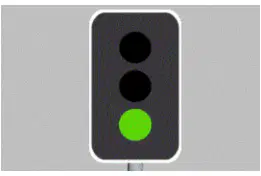
This light means, you -
- Can go straight ahead, or turn left or turn right, if it is safe to do so.
- Must stop and wait for the red light before proceeding.
- Can make a U turn provided it is safe to do so.
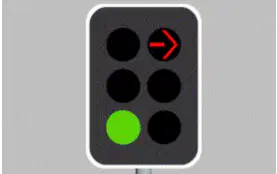
It is 3 o'clock in the morning. You cannot see any other traffic. You want to turn right. You may --
- Not turn right while the arrow is red.
- Turn right when you have waited one minute.
- Turn right if it is safe to do so.
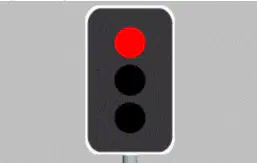
As you approach an intersection with traffic lights, the yellow light turns to red. You must -
- Stop and wait for the green light.
- Speed up to avoid traffic from the left and right.
- Sound your horn and proceed through the red light.

You approach an intersection showing a red light and the sign shown. You wish to turn left. You must -
- Stop and turn left only if it is safe.
- Stop and wait for a green light.
- Slow down and turn left or right if it is safe.

