wayground logo

Free Printable Worksheets

Font size

S
M
L
XL
Worksheets

Inertia & Newton's first law, and Momentum

Total questions: 60

Worksheet time: 1hrs 25mins

Name
Class
Date
1.

What is the unit to MEASURE force?

a)

Kilogram

b)

Meter

c)

Pounds

d)

Newton

2.

A ____________ is a push or a pull on an object.

a)

friction

b)

force

c)

magnet

d)

gravity

3.
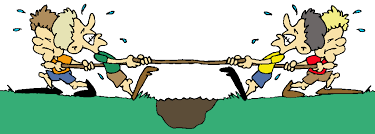
If these teams are pulling with the same amount of force what will happen?
a)
The boy in blue will win.
b)
They will not move at all.
c)
The boy in red will win.
d)
Both will fall down.
4.
What force holds the planets in motion around the sun?
a)
Magnetic
b)
Electrical
c)
Gravitational
d)
Air Resistance
5.
All objects in the universe have a gravitational attraction to each other. 
a)
True
b)
False
6.
An _______ force must act on an object for it to CHANGE it's motion
a)
balanced
b)
unbalanced
c)
gravitational
d)
electrical
7.
A force that results from two objects rubbing past each other.
a)
Gravity
b)
Friction
c)
Inertia
d)
Force
8.
The scientist who is most famous for developing the Laws of Motion is _____.
a)
Albert Einstein
b)
Stephen Hawking
c)
Sir Isaac Newton
d)
Galileo Galilei
9.

What happens if forces are balanced?

a)

The object will move left

b)

The object will move right

c)

The object will keep moving at the same speed in the same direction

d)

The object will keep moving in the same direction but slow down

10.

What happens if forces are unbalanced?

a)

The object will changed direction, shape or speed

b)

It will move left

c)

It will move right

d)

It will only slow down

11.

What can we say about the forces of an object that is not moving?

a)

there must only be one force acting on it

b)

The forces must be balanced

c)

the forces must be unbalanced

d)

it must be very heavy

12.

Gravity and friction are two types of

a)

inertia

b)

masses

c)

speed

d)

forces

13.
What is Newton's First Law known as? The Law of
a)
Friction
b)
Mass
c)
Inertia
d)
Gravity
14.
The tendency of an object to resist a change in its motion
a)
acceleration
b)
inertia
c)
mass
d)
frame of reference
15.
What is Newton's First Law
a)
F=ma
b)
Every action has an equal and opposite reaction
c)
An object at rest stays at rest, an object in motion stays in motion. 
d)
Friction 
16.
What kind(s) of objects have inertia?
a)
all objects with mass
b)
only objects at rest
c)
only objects in motion
d)
only objects whose motion is being changed
17.
If one object has twice as much mass as another object, it also has twice as much...
a)
inertia
b)
velocity
c)
acceleration due to gravity
d)
DO NOT PUSH ME
18.
The law of inertia (Newton’s First Law) applies
a)
to both moving and nonmoving objects
b)
only to moving objects
c)
only to objects that are not moving
19.
You push on a car and it does not move.  What is true about the inertia?
a)
The inertia is changing
b)
The inertia of the car is too great 
c)
The inertia of the person is equal to the car
d)
There is not inertia because of no movement
20.

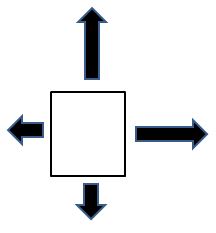
This object would be moving (pick all that are correct):

a)

up

b)

down

c)

left

d)

right

21.

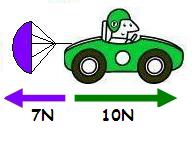
What is the net force?

a)

3 N

b)

3 N, right

c)

17 N, right

d)

3 N, left

22.
The sum of all forces acting on an object.
a)
Contact Force
b)
Balanced Force
c)
Unbalanced Force
d)
Net Force
23.
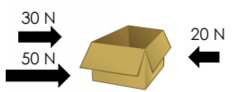
Calculate the Net Force. 
a)
60N, Left 
b)
40N, Right 
c)
0N
d)
60N, Right
24.

Inertia is a force

a)

True

b)

False

25.

Suppose that an astronaut throws a baseball in outer space at a location far from significant influences of gravity and air resistance. One would expect that the baseball would ____.

a)

eventually stop since all objects ultimately "lose their steam"

b)

eventually stop as its inertia slowly becomes used up

c)

continue in motion with the same speed and direction

d)

either a, b, or c -- depending on whether the astronaut continues to push it

26.

Inertia is a force that keeps stationary objects at rest and moving objects in motion at a constant velocity.

a)

True

b)

False

27.

When all individual forces acting on an object are balanced, it is the natural tendency of an object to _____. List all that apply in alphabetical order with no spaces between letters.

a)

maintain its state of motion

b)

eventually stop

c)

accelerate

d)

either speed up, slow down or keep the same speed

e)

keep its velocity constant (either at a zero or non-zero value)

28.

The law of inertia (Newton's first law) applies _____.

a)

to moving objects only

b)

only to objects that are not moving

c)

to both moving and nonmoving objects

29.

Inertia refers to _____

a)

the tendency of moving objects to remain in motion

b)

the force which keeps moving objects in motion with a constant velocity

c)

the force that keeps stationary objects at rest

d)

the tendency of stationary objects to remain at rest

30.

A skateboard rolls down a hill, reaches the level surface and eventually comes to a stop. The fact that the skateboard ultimately stops is best explained by ____.

a)

an unbalanced force would be required to keep the sled moving forward at constant speed

b)

the presence of an unbalanced force (e.g., friction) can cause a moving object to stop

c)

the presence of inertia causes it to stop

d)

the natural tendency of any object is to ultimately stop

31.

Inertia depends on ______

a)

Velocity

b)

Speed

c)

Distance

d)

Mass

32.

All objects have inertia

a)

True

b)

False

33.

List the objects in order from least to greatest inertia.

a)

CDBA

b)

ABCD

c)

BCDA

d)

CBAD

34.

Mac and Tosh are arguing in the cafeteria. Mac says that if he flings the jello with a greater speed it will have a greater inertia. Tosh argues that inertia does NOT depend upon speed, but rather upon mass. Who is correct?

a)

Mac

b)

Tosh

c)

Neither

d)

Both

35.

An astronaut kicks a soccer ball in outer space at a location far from significant influences of gravity and air resistance. The soccer ball will _________.

a)

continue in motion with the same speed and direction

b)

eventually stop as its inertia slowly becomes used up

c)

eventually stop since all objects ultimately "lose their steam"

d)

either a, b, or c -- depending on whether the astronaut continues to kick it

36.

An object at rest stays at rest and an object in motion stays in motion with the same speed and in the same direction unless acted upon by a(n) ____________________.

a)

unbalanced force

b)

inertia

c)

mass

d)

balanced force

37.

A rightward-moving object would naturally and ultimately come to rest in the absence of forces. A rightward force is required to keep such an object moving rightward. Inertia is the general name given to that force.

a)

True

b)

False

38.

More mass = More inertia

a)

True

b)

False

39.

Rank these objects in order of their inertia, from greatest to least.

a)

ABCD

b)

DABC

c)

DCBA

d)

CBAD

40.
Momentum is a ____________________ quantity
a)
science
b)
scalar
c)
vector
d)
energy
41.

The momentum of an object depends upon the object's ___________&_____________.

a)

size and shape

b)

mass and speed

c)

mass and veloctiy

d)

mass and energy

42.
Determine the momentum of 1000-kg car moving northward at 20 m/s......... 
a)
20000 N
b)
20000 Joules
c)
20000 Kg * m/s
d)
20000 kg * m/s north
43.
The definition of momentum is
a)
Mass in Motion
b)
The size of an object
c)
The velocity of an object
d)
A comparison between two objects
44.
The equation to calculate momentum is
a)
p=mv
b)
p=1/2mv2
c)
p=mgh
d)
p=mg
45.
In any collision (crash) the ______ is ALWAYS constant
a)
Total Momentum
b)
total speed
c)
total Velocity
d)
Energy
46.
What is the net force?
a)
40 N left
b)
0 N Balalnced
c)
400 N right
d)
40 N right
47.
A 0.250 kg cart moving at 0.400 m/s has how much momentum?
a)
0.1 kg-m/s
b)
1 kg-m/s
c)
10 kg-m/s
d)
100 kg-m/s
48.
When the speed of an object is doubled, its momentum
a)
remains unchanged in accord with the conservation of momentum.
b)
doubles
c)
quadruples
d)
decreases
49.
Which object listed below has the greatest momentum?
a)
A 0.05 kg object rolling at 0.2 m/s.
b)
A 0.15 kg object rolling at 2 m/s.
c)
A 0.15 kg object rolling at 1 m/s
d)
A 0.4 kg object rolling at 2 m/s.
50.
A runner has a momentum of 670 kg m/s and is traveling at a velocity of 9 m/s. What is his mass?
a)
74.4 kg
b)
6030 kg
c)
0.0134 kg
d)
80 kg
51.
A 2 kg cart has a momentum of 16 kg m/s. What is its velocity?
a)
8 m/s
b)
32 m/s
c)
0.125 m/s
d)
18 m/s
52.
What are the units of Force?
a)
kg m/sec
b)
kg m
c)
N
d)
N sec
53.
The total momentum before a collision is _________ the total momentum after a collision.
a)
equal to 
b)
less than 
c)
more than
d)
It depends on the type of collision
54.
Both mass and velocity are _______________ proportional to momentum.
a)
Directly
b)
Inversely
55.
Which of the following has the least amount of momentum?
a)
An ant walking along the ground
b)
An ant at rest
c)
An elephant walking
d)
An elephant running
56.
Which of the following images has more momentum?
a)
Object A
b)
Object B 
c)
They are the same
57.
If two objects have the same mass, then the faster moving object has ____________ momentum.
a)
more 
b)
less
c)
the same
58.
20 N is the
a)
mass
b)
weight
c)
force
d)
acceleration 
59.
45 m/s2 is the... 
a)
Mass
b)
Force 
c)
Acceleration
d)
weight
60.
Which law best explains why the coin sitting on top of the ring falls directly into the jar below because it wants to remain at rest?
a)

Law of Inertia

b)

Law of Acceleration

c)

Law of Action - Reaction

d)

Law of Gravitation