
 Worksheets
CP CHEM MIDTERM EXAM REVIEW 25-26
Total questions: 80
Worksheet time: 3hrs 32mins


Match the following number with the correct amount of sig figs.
1 sig fig
500
2 sig figs
0.0025
3 sig figs
0.0600
4 sig figs
5689
5 sig figs
50,000.
Round 0.005478923 to 4 sig figs.
0.005
0.00548
0.00547900
0.005479
Round 3,456,098 to 2 sig figs.
3,500,000
35
3,400,000
3,500,000.
3,500
What is the charge of a proton?
Negative
Positive
Neutral
What is the charge of a neutron?
Negative
Positive
Neutral
These are found in the nucleus and have a neutral charge.
proton
electron
neutron

How many protons does sulfur have?
32
16
48
12
Al+3
The +3 tell you the
number of protons.
atomic mass.
charge of the atom.
Cations have what charge?
+
-
Valence electrons means..
Electrons inside the atoms
Electrons on the outer most energy level
Electrons with no charge
Electrons that are stable

Element Chlorine [Cl] at group #17 have how many valence electrons?
6
7
17
5
Cations will
Lose electrons
Gain electrons

This isotope have how many neutrons?
26
12
14
16

Which is true about the following chlorine atom?
17 protons and 36 neutrons
17 protons and 19 electrons
17 protons and 19 neutrons
36 protons and 17 neutrons

Which is true of the following beryllium atom?
4 protons and 9 neutrons
5 neutrons and 4 electrons
9 protons and 4 neutrons
4 protons and 2 electrons
The majority of an atom's mass comes from which particle(s)?
Protons
Protons + electrons
Electrons
Protons + neutrons
Why are atoms electrically neutral?
The neutrons balance out any charge.
There are more neutrons than protons or electrons.
Protons and electrons cancel each other out because they have opposite charges.
Neutrons have no charge which makes the who atom neutral.

1s22s22p63s23p64s23d10


Choose the correct shortcut configuration for iodine.
[Ar]4s24d104p5
[Kr]5s24d105p5
[Xe]5s25d105p5
none of the above
A hydrogen atom is in a ground state when its electron:
Remains at the lowest energy level.
Has moved away from the atom to the ground.
Is moving back and forth through the nucleus.
Has stopped moving.
When an electron in a hydrogen atom jumps from an orbit farther from the nucleus to an orbit closer to the nucleus, it:
emits four photons, one for each of the color lines observed in the line spectrum of hydrogen
emits a single photon with an energy equal to the energy difference of the two orbits
emits a number of photons dependent on the number of energy levels jumped over
none of the above
If you view sunlight through a spectroscope you will see:
You cannot look at sunlight through a spectroscope, it is too dangerous for your eyes
An emission line spectrum of hydrogen
An ultraviolet spectrum
A continuous spectrum
The general relationship between energy and wavelength of an electromagnetic wave can be described as:
indirect
constant
disproportional
direct
Which of the following types of radiation has the highest frequency (look at the back of your periodic table)?
ultraviolet rays
microwaves
X-rays
infrared radiation
How does an atom give up excessive energy when dropping from a higher energy state to a lower state?
a photon
a positron
an electron is expelled.
a neutron is expelled.
In order to go from ground state to an excited state, an electron must
emit energy
absorb energy
rotate
wiggle
Which color has the highest frequency?
green
blue
red
yellow
Which color has the longest waves?
red
orange
yellow
green
Frequency of light is ___ proportional to wavelength.
directly
inversely
The only type of electromagnetic waves you can see are
infrared waves
ultraviolet waves
visible light waves
When wavelength increases...
energy decreases
energy increases
the distance between peaks of adjacent electromagnetic waves is called:
wavelength
frequency
energy
amplitude
An _____ is the smallest unit of an element that maintains the chemical identity of that element.
Atom
Element
Matter
Particle
Which atom has the largest atomic radius?
potassium
rubidium
francium
cesium
What is a cation?
A negative ion formed from the gaining of electrons.
A positive ion formed from the gaining of electrons.
A negative ion formed from the loss of electrons.
A positive ion formed from the loss of electrons.
What is an anion?
A negative ion formed from the gaining of electrons.
A positive ion formed from the gaining of electrons.
A negative ion formed from the loss of electrons.
A positive ion formed from the loss of electrons.
Which is larger:
P or P-3 ?
P because it is the neutral atom.
P-3 because it lost 3 electrons.
P-3 because it gained 3 electrons.
They are the same size since they are both P.
A sodium atom (Na) loses an electron to form a sodium ion (Na+1). Which statement is correct in regards to describing the ionic radius.
The sodium ion (Na+1) has a larger radius than the neutral sodium atom (Na).
The sodium ion (Na+1) has a smaller radius than the neutral sodium atom (Na).
The sodium ion (Na+1) and the neutral sodium atom (Na) are the same size because they are both sodium.
The sodium ion (Na+1) has twice the radius of the neutral sodium atom (Na).
Which is the smaller atom: Mg or Mg+2?
Mg because it gains an energy level since it gains 2 electrons.
Mg due to extra electron repulsion created by gaining 2 electrons.
Mg+2 because of extra electron repulsion created by gaining 2 electrons.
Mg+2 because it loses an energy level since it loses 2 electrons.
In a larger atom, the attractive force between the valence electrons and the nucleus
remains the same
is larger
is smaller
is not affected

Select the element that has the strongest Coulombic attraction.
O
F
N
C

Select the element that has the strongest Coulombic attraction.
O
S
Se
Te

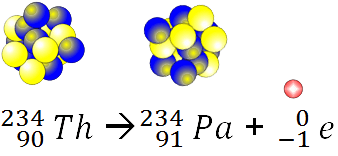
Complete the nuclear reaction
85209At = ___ + 24He
83205Bi
86209Rn
81207Tl
85208At
20985At = ___ + 42He
Which reaction represents fusion?




Which reaction represents fission?





Beta

Alpha

Neutron

Gamma

Positron

