
 Worksheets
Mendelian and Non-Mendelian Genetics Quiz
Total questions: 38
Worksheet time: 1hrs 16mins
The blending of two traits in which one is not completely dominant over the other is known as ---
incomplete dominance
codominance
An inheritance pattern in which both alleles for a gene are expressed in the offspring so that both traits show up on its body is known as ---
Codominance
Incomplete dominance

What type of inheritance pattern is shown here?
Codominance
Incomplete dominance

A calico cat shows both the traits for orange fur and black fur. What kind of allele expression is this?
Incomplete dominance
Codominance

If you cross a black chicken with a white chicken and only black AND white feathered chickens are produced, then feather color follows the inheritance pattern of ---
Incomplete dominance
Codominance

The green fish offspring in this image is an example of ---
Incomplete dominance
Codominance

A red flowered plant (RR) is crossed with a white flowered plant (WW). The gene for petal color in these plants expresses incomplete dominance. What percentage of the offspring will have pink (RW) flowers?
0%
25%
50%
100%

A red flowered plant (RR) is crossed with a white flowered plant (WW). The gene for petal color in these plants expresses incomplete dominance. What percentage of the offspring will have red (RR) flowers?
0%
25%
50%
100%
The hair form gene shows incomplete dominance. If your genotype is SS, you will have straight hair. If your genotype is CC, you will have curly hair. If your genotype is SC, you will have wavy hair. Mr. and Mrs. Anderson both have wavy hair (SC). What percentage of their children will also have wavy hair (SC)?
25%
50%
75%
100%

Codominance occurs in calico cats, which allows for the Black and Tan colors to show. What percentage of the offspring represented in this P square will be calico (black and tan spotted)?
25%
50%
75%
100%
Some flowers are controlled by codominance. Red flowers (RR), blue flowers (BB) and Speckled flowers (RB).
Cross a red flower with a speckled flower. What is the phenotypic ratio?
2 red, 2 speckled
2 red, 2 blue
2 blue, 2 speckled
Some flowers are controlled by codominance. Red flowers (RR), blue flowers (BB) and Speckled flowers (RB).
Cross two speckled flowers.
1 red, 2 speckled, 1 blue
2 red, 2 blue
2 blue, 2 speckled
1 red, 1 speckled, 2 blue
Radish color is completely dominant, red and white are pure breeding colors. While heterozygous are purple.
Cros a red radish with a white.
4 purple
1 red, 2 purple, 1 white
2 red, 2 white
1 red, 1 purple, 2 white
Radish color is completely dominant, red and white are pure breeding colors. While heterozygous are purple.
Cros a red radish with a purple.
4 purple
1 red, 2 purple, 1 white
2 red, 2 purple
1 red, 1 purple, 2 white
Incomplete
Dominance
Partial dominant trait
Codominance
Get to see both dominant traits at the same time
A blending
Incomplete dominance
strips and spots
Codominance

What trait is being shown?
Incomplete
Codominance

What trait is being shown?
Incomplete
Codominance


In the punnett square below, what belongs in the missing square
75% purple, 25% white


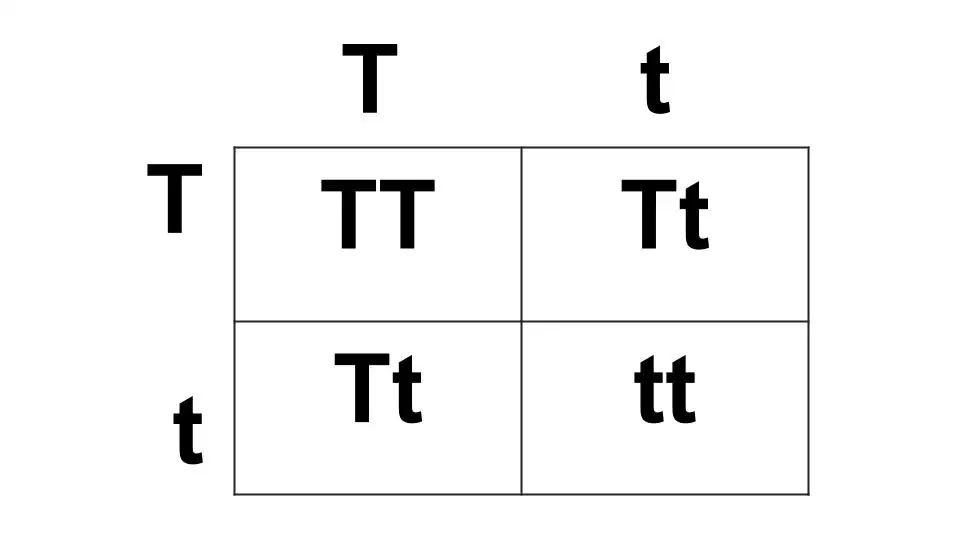
what is the phenotypic ratio?
1:2:1
3:1
1:1
phenotype examples
green round, yellow wrinkled
genotype examples
GgRr, GGRr, ggrr
phenotype definition
physical or "expressed" traits
genotype definition
allele (letter) combinations

what is the genotypic ratio?
1:2:1
3:1
1:1
homozygous dominant
GG
heterozygous
Gg
homozygous recessive
gg

What goes in box 15
aabb
AABB
aaBB
AAbb



