wayground logo

Free Printable Worksheets

Font size

S
M
L
XL
Worksheets

Unit 4 Review

Total questions: 85

Worksheet time: 2hrs 41mins

Name
Class
Date
1.
For the formula:
 Q= m c ∆T
The  units for specific heat are:
a)
g /J C
b)
°C/g J
c)
kJ/g
d)
J/g°C
2.

If two objects have different temperatures when they come in contact, heat will flow from the warmer object to the cooler one UNTIL ____________

a)

one reaches a temperature of zero

b)

they both have an equal temperature

c)

one runs out of energy

3.
What is the specific heat of an unknown substance if 100.0 g of it at 200.0 °C reaches an equilibrium temperature of 27.1 °C when it comes in contact with a calorimeter of water.  The water weighs 75. g and had an initial temperature of 20.00 °C?  (Specific heat of water is 4.18 J/g°C) (show your work)
a)
0.111 J/g°C
b)
1.29 J/g°C
c)
0.129 J/g°C
d)
22225.85 J
4.
The SI unit of heat and energy is the __________.
a)
calorie
b)
heat
c)
joule
d)
watt
5.
A sample of iron receives 50.J of heat energy that raises the temperature of the iron by 25.0°C. If iron has a specific heat of 0.10 J/g°C, what is the mass of the iron sample?  (show your work)
a)
25g
b)
30g
c)
20g
d)
50g
6.
A reaction is performed in a beaker with a temperature probe recording the temperature changes of the reaction.  If the temperature began at 15.0 degrees Celsius and ended at 27.5 degrees Celsius. Is the reaction endothermic or exothermic?
a)
Exothermic
b)
Endothermic
7.
In an exothermic process, the surroundings are gaining energy.
a)
True
b)
False
8.

What does "q" mean?

a)

A measure of heat energy

b)

A change in heat energy

c)

A measure of kinetic energy

d)

A change in temperature

9.
A metal cube at temperature of 10°C immersed in a liquid at temperature of 70°C.
What is the temperature of the metal cube when thermal equilibrium is achieved between the cube and the liquid?
a)
Between 10°C and 70°C
b)
More than 70°C
c)
Less than 10°C
d)
Same as the room temperature
10.
What line segment represents only the solid state?
a)
A-B
b)
B-C
c)
C-D
d)
D-E
11.
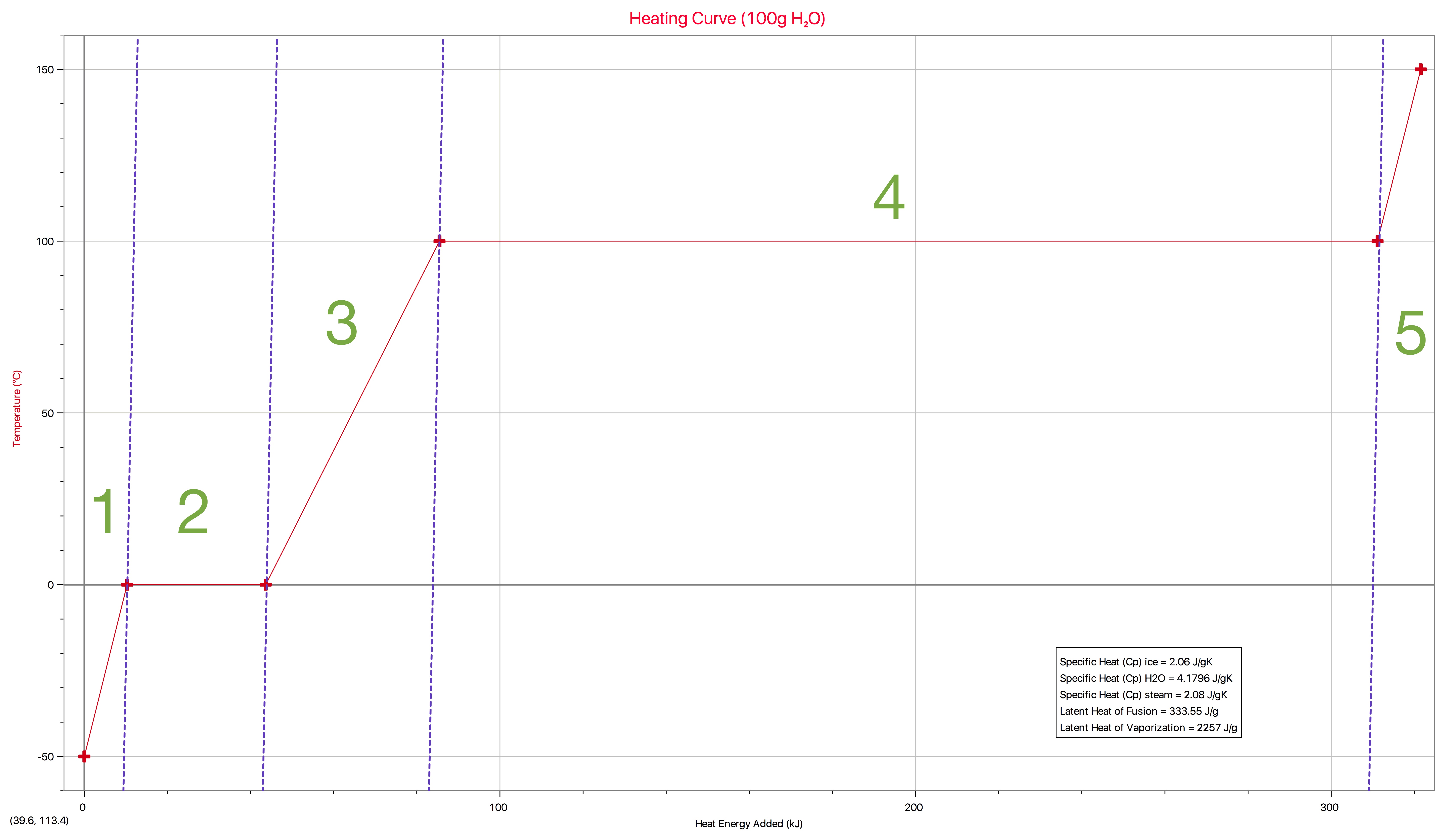
A substance's heating curve is shown in the graph.  What is its boiling point?
a)
100 C
b)
60 C
c)
80 C
d)
20 C
12.
In which region(s) does temperature remain constant?
a)
Region 1, 3, & 5
b)
Region 2 & 4
c)
Region 1 only
d)
Region 1 & 2
13.
In which region(s) of the graph would the substance be a solid and a liquid?
a)
Region 1
b)
Region 2
c)
Region 3
d)
Region 4
14.
Which of the following terms identifies the change from a liquid to gas?
a)
Vaporization
b)
Condensation
c)
Deposition
d)
Sublimation
15.

Describe the substance at letters D.

a)

Gas

b)

Liquid

c)

Melting

d)

Evaporating

16.
During an endothermic reaction in a beaker if we are part of the surroundings and touched the beaker, it would feel _______. 
a)
Warm
b)
Cold
17.
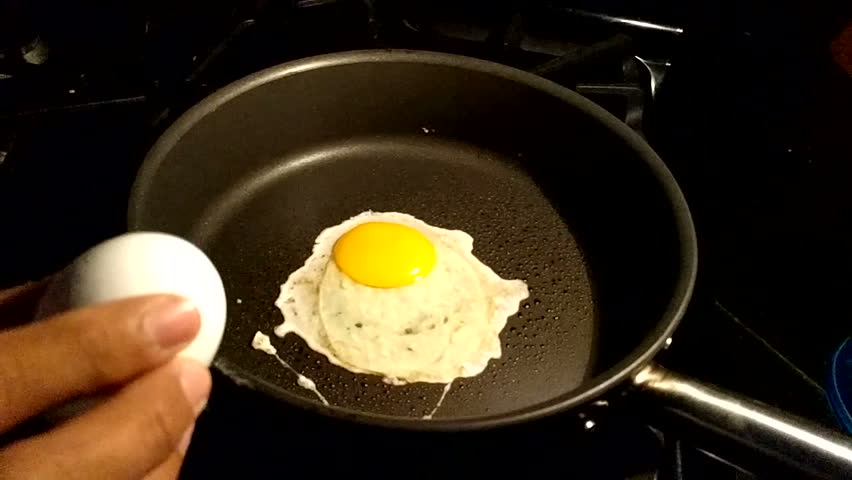
Baking bread and cooking an egg are examples of....?
a)
Endothermic processes
b)
Exothermic processess
c)
None of these 
18.
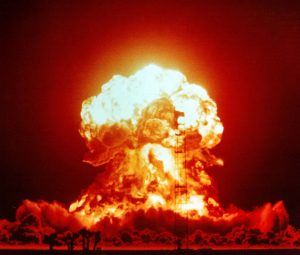
What type of reaction is shown in the photo?
a)
Exothermic
b)
Isothermic
c)
Endothermic
d)
None of the  above
19.

O2(g) + 2 H2 (g)  2 H2O (g) + EnergyO_2\left(g\right)\ +\ 2\ H_2\ \left(g\right)\ \rightarrow\ 2\ H_2O\ \left(g\right)\ +\ Energy  

a)

endothermic

b)

exothermic

20.

6 CO2+ 6 H2O + Energy  C6H12O6 + 6 O26\ CO_2+\ 6\ H_2O\ +\ Energy\ \rightarrow\ C_6H_{12}O_6\ +\ 6\ O_2

a)

endothermic reaction

b)

exothermic reaction

21.

When heat is released it is an

a)

exothermic reaction

b)

endothermic reaction

c)

both

d)

none

22.

A melting ice cube is an example of

a)

exothermic

b)

endothermic

c)

none

d)

both

23.
How many liters would you need to make a 1 M solution if you have 6 mol of Sodium Hydroxide? 
a)
2
b)
3
c)
4
d)
24.
What is the molarity of 4 g of NaCl (MM=58.45) in 3,800 mL of solution?
a)
0.018 M
b)
0.0011 M
c)
1.052 M
d)
0.062 M
25.
How many grams of solute are dissolved in 125.0 mL of 5.00 M NaCl (MM = 58.45)?
a)
0.625 g NaCl
b)
625 g NaCl
c)
36.5 g NaCl
d)
0.04 mol NaCl
26.
Find the molarity of 186.55 g of sucrose, C12H22O11 (MM = 342) in 250 mL of water.
a)
2.18 M
b)
0.746 M
c)
1.18 M
d)
0.545 M
27.
How many moles of NaCl are present in a solution with a molarity of 8.59 M and a volume of 125 mL?
a)
1074 mol
b)
0.069 mol
c)
1.07 mol
d)
62.7 mol
28.
Which sweet tea would you expect to taste the sweetest?
a)
1M
b)
3M
c)
3.1M
d)
2.5M
29.
True or False? The higher the concentration of a solution the less solutes it has in it.
a)
True
b)
False
30.
How many grams of AgNO3 (MM = 169.87) are needed to prepare 0.125M solution in 250 mL of water? 
a)
.03g
b)
0.5g
c)
5.3g
d)
84.9g
31.
Calculate the molarity of the following solution:  1.0 mole of KCl in 750.0 mL of solution.
a)
0.750 M
b)
99 M
c)
1.3 M
d)
2.0 M
32.
What is the molarity of a solution made by adding 1.565 moles of PbNO3 to 500 mL?
a)
300. M
b)
31.3 M
c)
3.13 M
d)
1.56 M
33.
What is the universal solvent?
a)
salt
b)
sugar
c)
water
d)
ice
34.

A mixture with more solute dissolved in the solvent than is usually soluble is called:

a)

concentrated

b)

supersaturated

c)

saturated

d)

unsaturated

35.
What is the universal solvent?
a)
salt
b)
sugar
c)
water
d)
ice
36.

A mixture with more solute dissolved in the solvent than is usually soluble is called:

a)

concentrated

b)

supersaturated

c)

saturated

d)

unsaturated

37.

When you have added as much solute as can dissolve in the solvent, the solution is called:

a)

concentrated

b)

supersaturated

c)

saturated

d)

unsaturated

38.

Which of the following is NOT a unit used to express concentration?

a)

Molality

b)

Molarity

c)

Mass percent

d)

Density

39.

The moles of solute can be determined by multiplying the molarity of the solute by the volume of solvent.

a)

True

b)

False

40.
The pH of a solution is tested, and it is found to be a basic solution. Of the following choices, what could the pH have been?
a)
3
b)
9
c)
7
d)
5
41.

Human blood has a pH between 7.35 and 7.45. Which of the following best describes human blood?

a)

strongly acidic

b)

slightly acidic

c)

strongly basic

d)

slightly basic

42.

Which of these pH values would indicate that a solution is a weak base?

a)

4

b)

5.6

c)

8

d)

13

43.
When dissolved in water, acids produce:
a)
bases
b)
salts
c)
hydrogen ions
d)
hydroxide ions
44.

Explain what happens when a strong acid and a strong base are poured into the same container.

a)

they form separate layers

b)

they mix physically but not chemically

c)

they break apart into separate elements

d)

they react to form a salt and water

45.

The formula M1V1 = M2V2 is used when:

a)

dissolving a solute in a solvent

b)

diluting a solution

c)

reacting an acid with a base

d)

determining the pH of an acid

46.

The pH actually measures:

a)

the strength of an acid.

b)

the strength of hydrogen ions.

c)

the concentration of hydrogen ions.

d)

the strength of a base.

47.
How many grams of K2Cr2O7, are soluble in 100 g of water at 95 ºC?
a)
83 grams
b)
75 grams
c)
40 grams
d)
12 grams
48.
Which substance is MOST soluble at 0 ºC?
a)
KI
b)
NaNO3
c)
NaCl
d)
Ce2(SO4)3
49.

How does a solution become supersaturated?

a)

Vigorous stirring to dissolve more solute than usual.

b)

Heat the solution to increase the solute then let it cool.

c)

Add more solvent to lower the concentration.

d)

Keep pouring solute in the solvent until it goes in.

50.
When 50 grams of KCl is dissolved in 100 grams of water at 50 ºC, the solution can be correctly described as:
a)
supersaturated
b)
unsaturated
c)
saturated
51.
When 20 grams of KNO3 is dissolved in 100 grams of water at 80 ºC, the solution can be correctly described as:
a)
supersaturated
b)
saturated
c)
unsaturated
52.
The amount of solute actually dissolved in a given amount of solvent.
a)
dilution
b)
concentration
c)
saturated solution
d)
supersaturated mixture
53.
__________ are made up of solutes and solvents.
a)
Solutions
b)
Suspensions
c)
Heterogeneous Mixtures
d)
Pure Substances
54.
What does it mean to dilute a solution?
a)
lower the concentration of solute per solvent
b)
increase the concentration of solute per solvent
55.

Antimony tribromide

a)

AnBr3

b)

AtBr3

c)

Sb1Br3

d)

SbBr3

56.

Hexaboron monosilicide

a)

B5S

b)

B6S

c)

B6Si

d)

Br6Si1

e)

Br6Si

57.

Chlorine dioxide

a)

Cl1O2

b)

CO2

c)

ClO2

d)

CrO2

58.

Hydrogen iodide

a)

H1I1

b)

HI

c)

HyIo

d)

HIo1

59.

Iodine pentafluoride

a)

I1P6

b)

I1F5

c)

IF5

d)

IFl5

60.

Dinitrogen trioxide

a)

NO3

b)

N2O3

c)

N4O6

d)

2N3O

61.

Ammonia

a)

NH2

b)

NH3

c)

NH4

d)

NH4+

62.

Methane

a)

CH2

b)

CH3

c)

CH4

d)

CH5

63.

Phosphorus triiodide

a)

KI3

b)

P1I3

c)

PhI3

d)

PI3

64.

Pentaphosphorus hexasulfide

a)

K5S6

b)

P5S6

c)

P6S5

d)

6P5S

65.

NH3

a)

Mononitrogen trihydrogen

b)

Nitrogen trihydride

c)

Ammonia

d)

Ammonium

66.

CH4

a)

monocarbon quadhydride

b)

carbon tetrahydride

c)

methane

d)

carbon tetrahydrogen

67.

P4S5

a)

phosphorus sulfide

b)

quadphosphorus hexasulfide

c)

tetraphosphorus pentasulfur

d)

tetraphosphorus pentasulfide

68.

SeF6

a)

silicon fluoride

b)

selenium fluoride

c)

selenium hexafluoride

d)

selenium heptafluoride

69.

Si2Br6

a)

silicon bromide

b)

disilicide bromide

c)

disilicon hexabromide

d)

disilicide hexabromide

70.

SF4

a)

sulfur quadchloride

b)

sulfur tetrafluoride

c)

monosulfur tetrafluoride

d)

sulfide tetrafluoride

71.

CCl4

a)

Methane

b)

carbon tetrachloride

c)

carbon quadchloride

d)

monocarbon tetrachloride

72.

B2Si

a)

dibromine silicon

b)

diboron monosilicide

c)

diboron monosulfide

d)

dibromine monosilicide

73.

NF3

a)

mononitrogen trifluorine

b)

mononitrogen trifluoride

c)

nitrogen trifluoride

d)

ammonia

74.

Se5I9

a)

hexasilicon nonaiodide

b)

pentaselenium noniodide

c)

heptaselenium noniodine

d)

pentasilicon noniodide

75.
Which of the following is an ionic compound:
a)
CH4
b)
I2
c)
LiBr2
d)
CO
76.
Name the following ionic compound: BeCl2
a)
beryllium chlorine
b)
beryllium II chloride
c)
beryllium chloride
d)
beryllium dichloride
77.
name the following ionic compound: NaF
a)
nitrogen fluorine
b)
sodium fluoride
c)
nitrogen fluoride
d)
sodium fluorine
78.
Which of these combinations is an ionic compound made of?
a)
Metal and Metal
b)
Nonmetal and Nonmetal
c)
Metal and Nonmetal
d)
Cation and Cation
79.
Name this compound: 
KF
a)
Potassium fluoride
b)
Potassium fluorite
c)
Fluorine potasside 
d)
Potassium fluorate
80.
What would be the proper chemical formula for combining Al3+ and Cl- :
a)
AlCl3
b)
Al3Cl
c)
AlCl
d)
Al3Cl3
81.
What formula results when Ca+2  and  Br- ions bond?
a)
Ca2Br2
b)
CaBr
c)
Ca(br)2
d)
CaBr2
82.

NaCl

a)

Sodium monochlorine

b)

Sodium chloride

c)

Sodium monochloride

d)

Sodium chlorine

83.

MgI2

a)

Magnesium Iodine

b)

Monomagnesium di-iodide

c)

Magnesium iodide

d)

Magnesium tetraiodide

84.

N2O

a)

Nitrogen Oxide

b)

Dinotrogen dioxide

c)

Nitrous dioxide

d)

Nitrogen Oxygen

85.

AlCl3

a)

Aluminum dichlorine

b)

Aluminum trichlorine

c)

Monoaluminum chloride

d)

Aluminum chloride