
 Worksheets
Atom models and quantum numbers, electron config
Total questions: 82
Worksheet time: 5hrs 40mins
There are ____ p orbital orientations
2
6
3
8
The spin of an electron is represented by this variable:
n
m
L
ms

This is the shape of ____ orbital
s
d
p
d
Orbital sublevels, or l, represents:
orbital color
orbital shape
electron spin
energy level
Which of the following shows a proper pair of the l value with the orbital shape.
0=f
3=p
1=s
2=d
As the energy level goes higher, the electrons
have lower in energy
are more stable
are weaker
are farther from the nucleus
How many electrons total are found in the f orbital?
2
6
10
14
Which of the following is INCORRECT about the quantum variable m, or ml?
m = -l...l
the value for p is -1, 0, 1
when l is 2, there are 5 values for m
the value is either +1/2 or -1/2
What is the correct representation for an orbital which has an "n" value of 4 and an "L" value of 2?
4d
4s
4f
4p
What does the 1 in "1s" stand for?
energy level
s orbitals
p orbitals
the number of electrons
How many electrons are in 1s2 2s2 2p4?
5
6
8
13
Which of the following sets of quantum numbers (n, l, ml, and ms) describes the valence electron of Na?
2, 1, 0, -½
2, 0, 0, -½
3, 1, 1, +½
3, 0, 0, +½
n=4, l=3?
4f
4d
3s
3p
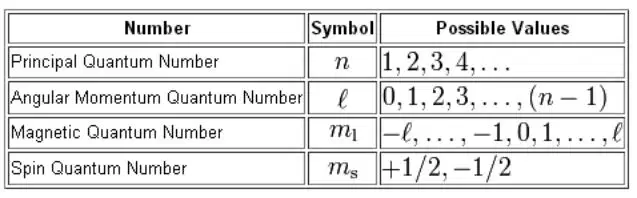
What are the possible values of ms? Select all that apply.
-1
-1/2
0
1/2
1
n = 3
l = 2
m = -1
s = +1/2
What could the element be?
Sc
Ti
Y
Zr

This could be the dot diagram of
Mg
Cl
C
O
What is the goal of the Lewis Dot Structure?
To determine the electron position.
To show the element's valence electrons & bonding capabilities.
To find the atomic mass of an element.
To search for the number of electrons in an individual atom.
How many valence electrons should Lithium have in its Lewis dot model?
1
2
3
4

This is a correct dot diagram for neon (Ne)
true
false
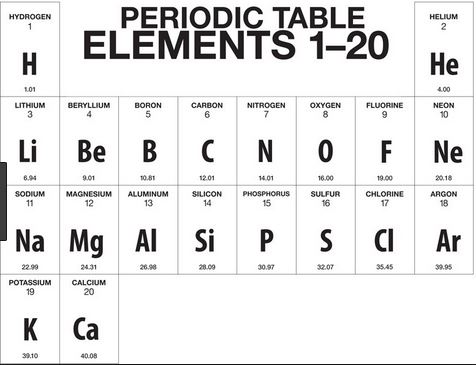
How many valence electrons does Aluminum Have?
1 Valence electron
2 Valence electron
3 Valence electron
4 Valence electron
5 Valence electron
How would you draw a Lewis dot diagram for Magnesium?


How many valence electrons does this element have?
2
3
5
10
How many electrons can go in the first energy level?
2
8
18
32

Why do carbon, silicon, and tin all react similarly?
They are located in the same period
They have an even atomic number
They have the same number of energy levels
They are located in the same group
Which of these is in group 2?


Choose the correct Lewis dot structure for Fluoride ion.


What element does this Lewis Dot Digram represent?
Li
Al
C
Be

What is the oxidation number for elements in Group 2?
+1
+2
-1
-2
What is the oxidation number of elements in Group 18?
-1
-2
0
+1
What is the oxidation number of elements in the Halogen family?
+1
+2
-1
-2
What is the oxidation number for Oxygen?
+1
+2
-1
-2

What is a negative ion called?
anion
cation
covalent
isotope
How many electrons would a Nitrogen ion gain/lose? If it has 5 valence electrons.
lose 5
gain 5
lose 3
gain 3
What is the ion formed from Sulfur? If it has 6 valence electrons.
S+2
S-2
S+6
S-6
How many electrons would a Calcium ion gain/lose? If it has 2 valence electrons.
lose 1
gain 1
lose 2
gain 2
A Bromine ion gains 1 electron, which of the following is the correct symbol for a Bromine ion?
Br-1
Br+1
Br+7
Br-7
An atom with 2 protons, 3 neutrons, and 4 electrons has a charge of ____.
+2
-2
+3
0
If an element has 3 valence electrons, what charge will likely form on its ion ?
+3
+5
-3
-5
P has 5 valence electron. It will have a charge of _______
+3
-3
+2
-2
S has 6 valence electron. It will have a charge of _______
-2
-1
+1
+2
F has 7 valence electron. It will have a charge of _______
-2
-1
+1
+2
Which element has two valence electrons?
Helium (He)
Neon (Ne)
Argon (Ar)
Krypton (Kr)
Based on the trends we learned, which has the lowest ionization energy?
phosphorus (P)
sulfur (S)
arsenic (As)
selenium (Se)
Based on the trends we learned, which has the highest electronegativity?
phosphorus (P)
sulfur (S)
arsenic (As)
selenium (Se)
Which element has an atomic radius that is SMALLER than boron?
beryllium (Be)
aluminum (Al)
carbon (C)
Gallium (Ga)
Which element has an atomic radius that is LARGER than sodium?
Lithium (Li)
Hydrogen (H)
Magnesium (Mg)
Potassium (K)
Of the elements given, which one has the highest ionization energy?
lithium (3)
cesium (55)
oxygen (8)
oganesson (118)

What is the name of this group?
alkali metals
alkaline earth metals
transition metals
halogens
noble gases

How many valence electrons does this group have?
1
2
7
8
The Bohr model atom places electrons by energy level, called electron shells. The period number of an element corresponds to the number of electron shells an element has. How many electron shells calcium atom has?
1
2
3
4
What is the significance of Neil Bohr's model of an atom?
It places the total electrons of an atom by energy level, called electron shells.
It places the total protons of an atom by energy level, called proton shells.
It shows the positively charged center of an atom, called nucleus.
The second group of elements are called_________. These elements have TWO valence electrons, the reason they are in group 2(or column 2) in the periodic table.
alkali metals
alkaline earth metals
transition metals
lanthanides and actinides
The most highly reactive nonmetal group that tend to form "salts" with metals and are found in group/column 17 are called
metals
halogens
noble gases
alkaline earth metals
The elements in the middle of the periodic table, in groups 3-12, are called
metals
nonmetals
alkali metals
transition metals
Elements that touch the zigzag lines in the periodic table are half-metals and half-nonmetals and are called
metals
metalloids
nonmetals
halogen gas
How many periods are there in the periodic table?
18
10
7
3
Elements arranged in vertical columns are called
groups
period
metals
nonmetals

What charge do ions of this group have?
+1
+2
-2
-1
0

Based on the trends we learned, which has the lowest ionization energy?
phosphorus (P)
sulfur (S)
arsenic (As)
selenium (Se)
This element does not match the properties of any other group so it stands alone. It is placed above Group 1 but it is not part of that group. It is very reactive, colorless, odorless, and a gas at room temperature.
Hydrogen
Helium
Nitrogen
Oxygen
The elements on the right side of the Periodic Table are classified as ________________.
Metals
Nonmetals
The elements on the left side of the periodic table are classified as ________________.
metals
nonmetals
Which of the following is an Alkali Metal?
Magnesium
Chromium
Sodium
Fluorine
Which of the following is a transition metal?
Iron
Oxygen
Neon
Barium
What element has 5 electron shells and 2 valence electrons?
Vanadium (V)
Strontium (Sr)
Phosphorous (P)
Boron (B)
Which element has the same number of energy levels as Potassium (K)?
Sodium (Na)
Vanadium (V)
Mangesium (Mg)
Strontium (Sr)
Who invented the Periodic Table?
Mendeleev
Bohr
Lewis
Democritus
Fill in the blank. The Periodic Table is organized by _____, which have similar physical and chemical properties, shown in different colors.
groups
families
periods
shells
Which family is made up of elements that are 1) most gases 2) good insulators 3) are not malleable and ductile?
metals
nonmetals
semimetals
The Periodic Table is organized by increasing
charges
atomic number
mass number
electronegativity
What was Dmitri Mendeleev's greatest contribution to the history of the periodic table?
He arranged all of the known elements by their atomic number
He realised that there was a pattern of reactivity which repeated every 8 elements
He predicted the existence (and properties) of new elements
He identified the "law of triads" which became the groups
which of the following best describes isoelectric?
electron configurations that look the same because one is for an element and the other are for ions
electron configuration that is missing an orbital and does not seem complete
orbital filling diagram that does not have the right amount of valence electrons
orbital filling diagram that accurately matches the bohr model of the same atom
which of the following is isoelectric
As3-, Kr, Rb1+
S2+, Ar, K1-
S2+, Ar, K1-
Al3+, F1+, Ne

