
 Worksheets
Sem I Exam Review w/ answers
Total questions: 175
Worksheet time: 3hrs 8mins
Researchers have found that a local squirrel population fluctuates from year to year, increasing one year and decreasing the next. Which of the following factors would cause the squirrel population to grow?
the birth rate is equal to the death rate
emigration is greater than immigration
the death rate is higher than the birth rate
the birth rate is greater than the death rate
Populations do not continue to grow to an unlimited size. Their environment, including food and other natural resources, limits their size eventually. This limit is called the
differential population
carrying capacity
prey maximum
predator limit

Which of the following phrases best describes line K in the graph above?
The rate of population growth
The carrying capacity of the environment
The time it takes for the population to double in size
The number of individuals in the population at the beginning of the study
1What might cause the position of the dashed line K to be moved from its current position to a lower point in the Y-axis?
the birthrate of the rabbit population was equal to the death rate of the rabbit population
there was a decrease in the number of rabbit predators and an increase in the availability of plants
there was a decrease in the availability of food, minerals, water, and shelter
the birthrate of the rabbit population was greater to the death rate of the rabbit population
A population of flat-tailed horned lizards was found in a geographically isolated area. In 2002, the size of the population was about 25,500. In 2004, the size of the population was about 32,800. Which of the following statements explains the change in the size of the lizard population from 2002 to 2004?
The birth rate was greater than the death rate.
The emigration rate was greater than the birth rate.
The death rate was greater than the immigration rate.
The emigration rate was greater than the immigration rate.
Number of individuals per unit area or volume.
denisty
dispersion
survivorship
immigration
New individuals move into a population.
immigration
emigration
migration
survivorship
When individuals in a population move out or away.
emigration
immigration
migration
dispersion
Processes that remove individuals from a population.
death and emigration
birth and immigration
Study of the vital statistics of a population and how they change over time.
demography
ecology
biology
archaeology
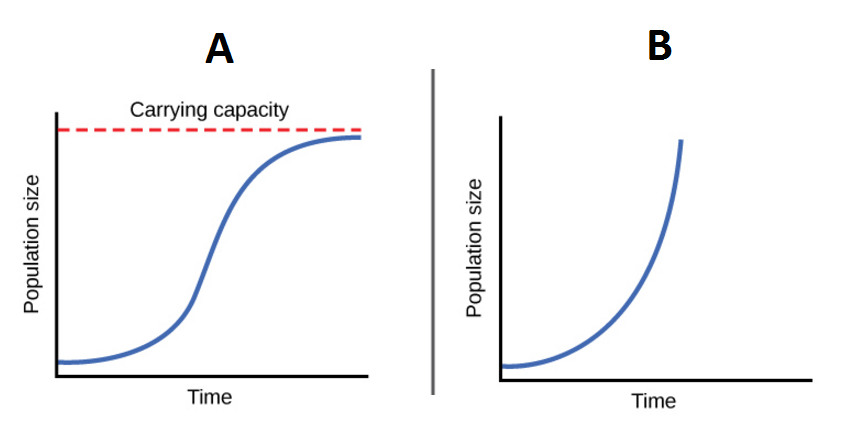
What type of growth model is shown in image B?
Exponential
Logistic
What type of growth model is shown in image A?
Exponential
Logistic
Which of the following are density dependent factors?
competition for resources
predation
disease
natural disasters
Which of the following are examples of a density independent factors?
forest fire
seasonal cycles
storms
disease
Emigration is
the movement out of an area
the movement into an area
movement in and out of an area
migration
Why don't populations grow indefinitely?
limiting factors
only biotic factors
only abiotic factors
none of the above

What is an example of a density-independent (Abiotic) limiting factor?
food
parasites
disease
pollution

What is the carrying capacity mean?
The number of individuals an area can carry
the number of births
The number of deaths an area has
not sure
The exponential graph is a graph that shows us population size increasing quickly, which one below shows us that


If a species goes over carrying capacity, what happens to the population?
Decreases
Increases
Levels out
There are approximately 17,620 people per square mile in New York City. If New York City is 468 square miles, approximately how many people live in New York City?
10,000,000
8,246,160
4,365,111
56,778,112
A city has a population of 8792 people. The area of the city is approximately 6.5 square miles. Approximately, how many people per square mile live in the city?
208
1000
1353
2000

On Black Friday (the day after Thanksgiving) the population density at many stores and shopping malls was...
low
high
The reactants of photosynthesis are
sugar and water
sugar and oxygen
carbon dioxide and water
carbon dioxide and oxygen
Which statement about photosynthesis is correct?
Plants get the energy they need for photosynthesis from water.
Plants get the energy they need for photosynthesis from soil.
Plants get the energy they need for photosynthesis from sunlight.
Plants do not require energy to perform photosynthesis.
What are the products of photosynthesis?
carbon dioxide and water
carbon dioxide and oxygen
glucose and oxygen
glucose and water
Which of the following is the correct equation for PHOTOSYNTHESIS?
6CO2 + 6H2O → 6O2 + C6H12O6
6CO2 + C6H12O6 + 6H2O → O2
6O2 +6H2O → 6CO2 +C6H12O6
C6H12O6 + 6O2 → 6H2O + 6CO2
Which gas is removed from the atmosphere during photosynthesis?
hydrogen
oxygen
nitrogen
carbon dioxide
What gas is released by plants during photosynthesis?
nitrogen
carbon dioxide
oxygen
hydrogen
What is the purpose of photosynthesis?
make glucose
make ATP
make light
release carbon dioxide
What is one of the reactants of cellular respiration?
energy
glucose
carbon dioxide
water
What are the reactants in the equation for cellular respiration?
oxygen and lactic acid
carbon dioxide and water
glucose and oxygen
water and glucose
What is the correct equation for cellular respiration?
6O2 + C6H12O6 → 6CO2 + 6H2O + Energy
6O2 + C6H12O6 + Energy → 6CO2 + 6H2O
6CO2 + 6H2O → 6O2 + C6H12O6 + Energy
6CO2 + 6H2O + Energy → 6O2 + C6H12O6
Organism that makes its own food
consumer
producer
decomposer
predator
Organism that eats other things for food
consumer
producer
decomposer
prey
Passing of energy, in the form of food, from one organism to another
food cycle
food network
food chain
food system
Overlapping food chains
food cycle
food network
food system
food web
Representation of the feeding relationships & flow of energy in a food chain
food pyramid
food network
food system
food assembly
Consumer that eats only plants
omnivore
insectivore
carnivore
herbivore
Consumer that eats only other animals
omnivore
frugivore
carnivore
herbivore
Consumer that eats both plants and animals
omnivore
fungivore
carnivore
herbivore
Amount of energy in a food pyramid transferred from one level to the next
0%
10%
78%
100%

If a disease strikes the snakes the rabbits will
increase
decrease
not be affected
If a disease strikes the snakes the grass will
increase
decrease
not be affected


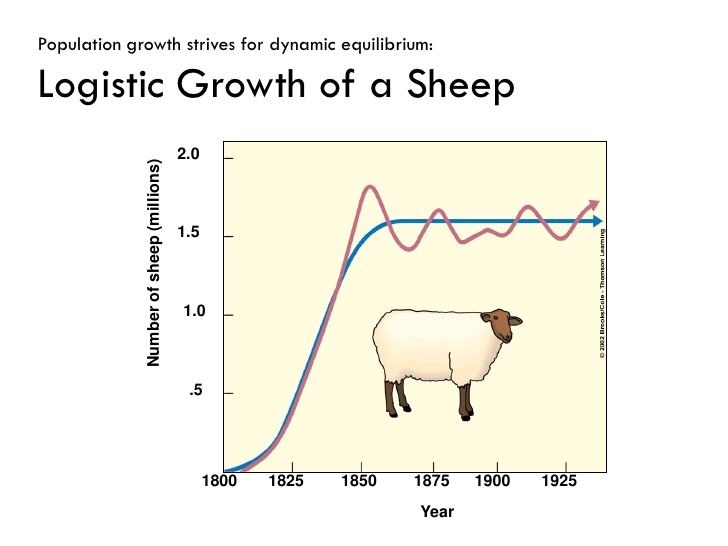
What does the graph represent?
Emigration
Exponential growth and Logistic Growth
Immigration
Logistic Growth
A population’s emigration in one month totaled 2 individuals. During the same period, immigration was 12 individuals. Natality (births) was 8, and mortality was 15 due to a parasite infection. What was the net effect on the population size?
+5
+3
0
-4
What type of factor has an increasing impact as the population size increases?
density-independent
density-dependent
cohort effect
survivorship factor
Which of the following are density dependent factors?
competition for resources
predation
disease
natural disasters
Which of the following are examples of a density independent factors?
forest fire
seasonal cycles
storms
disease
Factors like predation can have a positive benefit to the population of prey organisms because predators tend to keep prey populations below their ___________.
carrying capacity
sustainibility number
exponential growth point
competition level
What type of growth model is shown in image B?
Exponential
Logistic
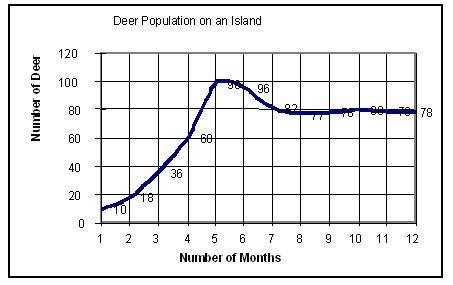
Which choice most closely approximates the deer population's carrying capacity based on the graph?
100
80
60
10
What is the measurement of population per unit area or unit volume?
Capacity
Population Density
Size
Capacity
What is the movement of individuals into a population called?
Immigration
Emigration
Migration
Capacity
What are the biotic factors in the environment that have an effect on populations called?
Density-Independent Factors
Density-Dependent Factors
Carrying Capacity
Living Things
What are two ways to add to a population's growth rate?
Mortality and Emigration
Mortality and Natality
Immigration and Emigration
Natality and Immigration
What are two ways do decrease a population's growth rate?
Mortality and Natality
Mortality and Emigration
Natality and Immigration
Immigration and Emigration
What term describes the spacing of organisms relative to each other?
Density
distribution/range
Size
Population
Which feature of deforestation has the greatest effect on the atmosphere?
A extinction of forest animal species
B increased risk of flooding
C reduction of photosynthesis
D soil erosion
The fluid that surrounds the organelles is... (hint... "Try to pull a fast one and..."
chloroplast
cytoplasm
vacuole
cell wall
Which statement was NOT included in cell theory?
All living things are composed of cells.
Living cells come only from other living cells.
Each cell contains a cell membrane, cytoplasm, nucleus, mitochondria, and endoplasmic reticulum.
Cells are the smallest structure of living things that can perform the functions necessary for life.
Who discovered and named cells while looking at cork?
Captain Hook
Robert Hooke
Matthais Schleiden
Rudolf Virchow
In passive transport, the concentration gradient goes from..
Low to low
High to low
Low to high
High to high


Which organelle is found inside the nucleus and produces ribosomes
Nucleolus
Cell Membrane
Lysosome
Golgi Bodies

What is the function of the Vacuoles
Store food, water and waste
Receive proteins
Assembles amino acids
Found inside the nucleus

The organelle that assembles proteins in the cytoplasm:
Ribosome
Nucleus
Mitochondrion
Rough Endoplasmic Reticulum

The organelle where lipids are synthesized along with proteins and other materials that are exported from the cell:
Endoplasmic Reticulum
Golgi Apparatus
Vacuoles & vesicles
Nucleus

The organelle that breaks down lipids, carbohydrates, and proteins into small molecules that can be used by the rest of the cell:
Lysosome
Cytoskeleton
Golgi Apparatus
Chloroplast

The organelle that converts the chemical energy stored in food molecules into compounds that are more convenient for the cell to use:
Cell Wall
Cell Membrane
Mitochondrion
Centrioles

The organelle that organizes cell division:
Nucleus
Centrioles
Cytoskeleton
Ribosome


After examining this diagram showing the concentration of water inside and outside of the cell, identify the tonicity of the solution.
hypertonic
hypotonic
isotonic

After examining this diagram showing the concentration of water inside and outside of the cell, identify the tonicity of the solution.
isotonic
hypotonic
hypertonic

The solution surrounding the cell in Diagram C, would be defined as
hypertonic
isotonic
hypotonic
After examining this diagram showing the concentration of water inside and outside of the cell, identify the tonicity of the solution.
hypertonic
hypotonic
isotonic

The solution surrounding the cell in Diagram B, would be defined as:
hypertonic
hypotonic
isotonic
The solution surrounding the cell in Diagram C, would be defined as
hypertonic
isotonic
hypotonic


This egg has shrunk, what type of solution was it placed in?
hypotonic solution
hypertonic solution
isotonic solution


If the dots represent sugar what direction will the water flow?
Into the cell
Out of the cell
Both equally (equilibrium)

What will happen to the cell in the given solution?
Swell up
Shrink
Stay the same


Movement of SOLUTE through the cell membrane from high to low concentration is called.....
diffusion
active transport
facilitated diffusion
osmosis

Nemo and other ocean dwelling fish cannot survive in freshwater because......
freshwater is hypertonic to Nemo's cells and will result in water leaving them causing the cells to shrink
freshwater is hypotonic to Nemo's cells and will result in water leaving them causing the cells to shrink
freshwater is hypertonic to Nemo's cells and will result in water entering them causing the cells to swell and burst
freshwater is hypotonic to Nemo's cells and will result in water enter them causing the cells to swell and burst

Elodea is a freshwater plant. When it is placed in saltwater what will happen to its cells?
They will become turgid because water is entering the cell, making them firm
They will become flaccid because water is entering and leaving the cell at equal rates, making them a little soft
They will be plasmolyzed because water is leaving the cell, making them shrink significantly
When a polysaccharide is formed, what is released?
Starch
Fatty acid
Water
Monosaccharide
Which of the following is NOT a polysaccharide?
Glycogen
Cellulose
Ribose
Starch
Fats containing at least one double or triple bond are called
Trans fats
Saturated fats
Hydrogenated fats
Unsaturated fats

A ______________ is a large molecule.
Micromolecule
Polymer
Amino Acid
Macromolecule
Which of the following elements are found in all macromolecules? (Select all that apply).


Which of the following is not one of the four major classes of macromolecules?
Lipids
Carbon
Protein
Carbohydrates
Nucleic Acid
Which macromolecule is used as our main source of energy?
Lipids/Fats
Nucleic Acids
Proteins
Carbohydrates
Which of the following are examples of carbohydrates? (Select all that apply).
Bread
Pasta
Olive Oil
Cheese
Which macromolecule stores energy?
Carbohydrates
Proteins
Lipids/Fats
Nucleic Acids
Nucleic acids make up which of the two molecules listed below?
FDA
RNA
DNA
FDR
Which type of fat is considered healthier than others?
Saturated Fat
Unsaturated Fat
Monounsaturated Fats
Trans Fat

Enzymes belong to which class of macromolecules?
lipids
carbohydrates
proteins
nucleic acids
DNA belongs to which class of macromolecules?
proteins
nucleic acids
carbohydrates
lipids
Macromolecules are made of repeating subunits called
monomers
monosaccharides
polymers
polysaccharides
A __________ consists of many monomers bonded together.
monomer
hydrocarbon
peptide
polymer
A _________ reaction removes a molecule of water to bond molecules together to create a polymer.
hydrolysis
water
dehydration synthesis
magical
C6H12O6 is the chemical formula for
water
methane
glycogen
glucose

What type of reaction is shown?
Dehydration synthesis
Hydrolysis

Which type of reaction is shown?
Dehydration Synthesis
Hydrolysis
Amino Acids
carbohydrates
lipids
proteins
nucleic acids

This molecule is a(n) ____________.
nucleic acid
lipid
protein
carbohydrate

What biomolecule is pictured here?
protein
lipid
carbohydrate
nucleic acids

Which biomolecule is this a picture of ?
carbohydrate
Lipid
protein
nucleic acids
Which biomolecule helps form muscles?
Nucleic Acid
Carbohydrate
Protein
Lipids

Sucrose is an example of a
Monosaccharide
Disaccharide
Polysaccharide

This fat has a kinked structure and is liquid at room temperature so it is a
Saturated Fat
Unsaturated Fat
An example of a Saturated Fat is
Vegetable Oil
Canola Oil
Butter
Avocado Oil
The monomer of a Lipid is
monosaccharide
amino acid
fatty acid
nucleotide
Carbohydrates are composed
C, H, O
C, H, N, O
C, H, N, O, P
C, H, N, O, P, S
The building blocks of proteins are called
Nucleic Acids
Monosaccharides
Amino Acids
Fatty Acids
The specific reactants that enzymes act on are called SUBSTRATES.
True
False
Amino acid is to protein as
Complex sugar is to monosaccharide.
DNA is to RNA.
Sugar is to fat.
Nucleotide is to nucleic acids.

Which macromolecule is shown?
lipid
protein
nucleic acid
carbohydrate
This complex carbohydrate makes up the leaves and stems of plants.
chitin
glycogen
cellulose
starch
What is the polysaccharide used by animals to store glucose?
glycogen
fructose
starch
cellulose
Which polysaccharide makes up the exoskeleton of insects?
cellulose
starch
chitin
glycogen
Giant molecule
micromolecule
macromolecule
The four groups of organic compounds are
sugar, salt, water, oxygen
proteins, carbohydrates, lipids, nucleic acids
carbon dioxide, methane, proteins, lipids
oxygen, proteins, nucleic acids, lipids

What is this molecule called?
nucleotide
fatty acid
amino acid
monosaccharide
glycerol

