wayground logo

Free Printable Worksheets

Font size

S
M
L
XL
Worksheets

KMT, Phase Changes, & Gas Laws

Total questions: 173

Worksheet time: 5hrs 40mins

Name
Class
Date
1.

According to the kinetic molecular theory, a gas consists of molecules in constant fixed motion.

a)

True

b)

False

2.

According to kinetic molecular theory-Gas molecules influence each other only by collision; they exert no other forces on each other.

a)

True

b)

False

3.

According to the kinetic molecular theory, all collisions between gas molecules are inelastic; all kinetic energy is lost.

a)

True

b)

False

4.

According to the kinetic molecular theory, the volume actually occupied by the molecules of a gas is negligibly small; the vast majority of the volume of the gas is empty space through which the gas molecules are moving.

a)

True

b)

False

5.

In the KMT, pressure is the force exerted against the wall of a container by the continual collision of molecules against it.

a)

True

b)

False

6.

The total kinetic energy of a collection of gas molecules is inversely proportional to the absolute temperature of the gas.

a)

True

b)

False

7.

Real gases (in real life), like to have high temperatures and low pressures. They like to be warm and free flowing.

a)

True

b)

False

8.

Ideal gases (best conditions) are light molecules such as hydrogen and helium. Heavier gases do not follow this rule.

a)

True

b)

False

9.

Real gases have attraction to other gas molecules which is opposite of the kinetic molecular theory. This way they can have a chemical reaction with each other.

a)

True

b)

False

10.

Gases like to be in very cold conditions and highly pressurized (just like you).

a)

True

b)

False

11.

The first postulate of the KMT is that all matter is made up of

a)

tiny particles

b)

molecules

c)

cells

d)

mass

12.
In a solid, the particles
a)
vibrate in place
b)
slide past one another
c)
overcome the strong attraction
13.
At higher temperatures
a)
particles in an object have less energy
b)
particles in an object move faster
c)
a gas contracts
14.
What is the phase change of a solid to a liquid?
a)
freezing
b)
melting
c)
boiling
d)
condensation
15.
2. A change of state from a liquid to a solid is called....
a)
Melting
b)
Freezing
c)
Evaporation
16.
5. What is it called when a solid turns directly into a gas?
a)
Sublimation
b)
Condensation
c)
Liquid
17.
Change from Gas to Solid is called........
a)
Sublimation
b)
Deposition
c)
Fusion
d)
condensation
18.
Change from gas to liquid...
a)
condensation
b)
evaporation
c)
expansion
d)
movement
19.
change from liquid to gas is called....
a)
expansion
b)
evaporation
c)
condensation
d)
sublimation
20.

The particles in a solid are...

a)

Far Apart

b)

Packed Together

c)

Spread Out

d)

Not Moving

21.

The particles in a liquid...

a)

are fixed in place

b)

move in a straight line

c)

can move past one another

d)

vibrate in place

22.

The particles in a gas...

a)

are packed together

b)

don't move

c)

can't move past each other

d)

move in a straight line

23.

Matter is made up of...

a)

Cells

b)

Atoms

c)

Dots

d)

Electrons

24.

What state of matter is pictured?

a)

Solid

b)

Liquid

c)

Gas

d)

Plasma

25.

What state of matter can no longer hold on to its electrons?

a)

Solid

b)

Liquid

c)

Gas

d)

Plasma

26.

According the KMT, the particles are in

a)

different states

b)

organized patterns

c)

constant motion

d)

various containers

27.

In which state of matter are the particles the farthest apart?

a)

gas

b)

liquid

c)

solid

28.

Indefinite shape and definite volume:

a)

solid

b)

liquid

c)

gas

d)

plasma

e)

no such state

29.

Definite shape and definite volume:

a)

solid

b)

liquid

c)

gas

d)

plasma

e)

no such state

30.

Indefinite shape and indefinite volume:

a)

solid

b)

liquid

c)

gas

d)

plasma

e)

no such state

31.
7. All phase changes (changing states) requires energy to be added or taken away.
a)
True
b)
False
32.

What phase change is happening to the picture?

a)

freezing

b)

melting

c)

evaporation

d)

condensation

33.

It is a change from solid to gas.

a)

condensation

b)

evaporation

c)

sublimation

d)

melting

34.

When heat is added to water, it turns into __________.

a)

solid

b)

liquid

c)

water vapor

d)

precipitate

35.

What phase change is evident in the picture?

a)

melting

b)

freezing

c)

evaporation

d)

condensation

36.

It is a phase change from liquid to gas.

a)

melting

b)

freezing

c)

evaporation

d)

condensation

37.

What phase change must take place in order to make ice cubes?

a)

melting

b)

freezing

c)

evaporation

d)

condensation

38.

The tiny water vapor in the air accumulates together as clouds. What phase change took place during the process?

a)

melting

b)

freezing

c)

evaporation

d)

condensation

39.

What phase change is evident in the picture?

a)

evaporation

b)

condensation

c)

melting

d)

freezing

40.

When dry ice gets smaller, the ice changes from _________.

a)

solid to liquid

b)

liquid to gas

c)

gas to liquid

d)

solid to gas

41.

When clothes dry, water changes from ____________.

a)

solid to liquid

b)

liquid to gas

c)

liquid to solid

d)

solid to gas

42.

Car air fresheners do not evaporate directly in the air.

a)

TRUE

b)

FALSE

43.

Gulaman jelly changes from solid to liquid when stored inside the refrigerator for about an hour.

a)

True

b)

False

44.

Melting is a change from solid to liquid when the temperature is ___________.

a)

increased

b)

lowered

c)

constant

45.

The following are examples of materials that undergo sublimation except for:

a)

mothballs

b)

dry ice

c)

air freshener

d)

soap

46.

Which is not true about dry ice?

a)

It is solidified carbon dioxide.

b)

It is a cooking agent commonly used for packing frozen goods.

c)

It becomes water when it melts.

d)

It evaporates directly into the air.

47.

It is a phase change from gas to liquid.

a)

melting

b)

freezing

c)

condensation

d)

evaporation

48.

It is a phase change from solid to liquid.

a)

melting

b)

freezing

c)

condensation

d)

evaporation

49.

It is a phase change from liquid to solid.

a)

melting

b)

freezing

c)

condensation

d)

evaporation

50.

What is happening to the butter in the picture?

a)

It changes from solid to gas.

b)

It changes from liquid to solid.

c)

It changes from liquid to gas.

d)

It changes from solid to liquid.

51.

What is the reason for the droplets of water on plants early in the morning?

a)

The water vapor in the air condenses during the night.

b)

The water content of the plant evaporates.

c)

The plant changes from solid to liquid.

d)

The water in the plants changes to solid.

52.

Deposition is the phase change in which a gas turns straight into a ____________ without first turning into a liquid.

a)

liquid

b)

gas

c)

solid

53.

What phase change is occurring when substances like dry ice turn straight from a solid to a gas?

a)

sublimation

b)

deposition

c)

evaporation

d)

freezing

54.

What phase change takes place when a liquid turns into a gas?

a)

melting

b)

sublimation

c)

condensation

d)

evaporation

55.

What phase change takes place when a liquid turns into a solid?

a)

melting

b)

freezing

c)

deposition

d)

condensation

56.

Walking outside on a hot day and having your solid popsicle turn into a liquid is an example of ______________ .

a)

deposition

b)

evaporation

c)

freezing

d)

melting

57.

When you see drops of liquid water on your cold soda can caused by cooling of the water vapor in the air, ______________ has occurred.

a)

freezing

b)

condensation

c)

sublimation

d)

melting

58.

When you boil water and it turns to steam, you are seeing an example of ________________ occur.

a)

evaporation

b)

melting

c)

condensation

d)

sublimation

59.

Which of the following phase changes is a result of removing heat energy?

a)

melting

b)

evaporation

c)

freezing

d)

sublimation

60.

When the temperature of matter increases, the particles...

a)

speed up and move closer

b)

speed up and move farther apart

c)

slow down and move closer together

d)

slow down and move farther apart

61.

Which state of matter has NO definite shape and NO definite volume?

a)

gas

b)

liquid

c)

solid

62.

Which state of matter has a definite shape and a definite volume?

a)

gas

b)

liquid

c)

solid

63.

Which state of matter has NO definite shape, but does have a definite volume?

a)

gas

b)

liquid

c)

solid

64.

When the temperature of matter decreases, the particles...

a)

speed up and move farther apart

b)

speed up and move closer together

c)

slow down and move farther apart

d)

slow down and move closer together

65.

A gas...

a)

has a definite shape but no definite volume

b)

has a definite volume but no definite shape

c)

has fast-moving molecules

66.

The phase opposite phase of melting is...

a)

freezing

b)

melting

c)

condensation

d)

evaporation

67.

All changes in the state of matter of a substance requires...

a)

vibration

b)

water

c)

permission

d)

energy

68.

In a solid, the molecules...

a)

vibrate in place

b)

slide past one another

c)

move quickly all over the place

69.

All phase changes requires energy to be added or taken away.

a)

True

b)

False

70.

Molecules are closest together in a...

a)

liquid

b)

solid

c)

gas

71.

Which phase change of matter is occurring in this image?

a)

freezing

b)

melting

c)

deposition

d)

evaporation

72.

Which phase change is occurring in this image?

a)

melting

b)

evaporation

c)

condensation

d)

freezing

73.

What phase change is taking place in this image?

a)

melting

b)

freezing

c)

condensation

d)

evaporation

74.

What phase change is taking place in this image?

a)

evaporation

b)

melting

c)

condensation

d)

freezing

75.

The molecules in this state of matter are showing what phase?

a)

solid

b)

liquid

c)

gas

76.

The molecules in this state of matter are showing what phase?

a)

solid

b)

liquid

c)

gas

77.

The state of matter being demonstrated in this phase is a...

a)

solid

b)

liquid

c)

gas

78.

Matter is _______________________________.

a)

The amount of matter in an object.

b)

The amount of space an object occupies.

c)

Anything that has mass and volume.

79.

Mass is ________________________________.

a)

The amount of matter in an object.

b)

Anything that has Mass and volume.

c)

The amount of space an object occupies.

80.

Volume is _______________________.

a)

the amount of matter an object has.

b)

the amount of space an object occupies.

c)

anything that mass and volume.

81.

Watch this video. Which state of matter has the least amount of energy?

a)

Solid

b)

Liquid

c)

Gas

82.
What does Boyle's law relate to?
a)
Temperature and Volume
b)
Volume and Pressure
c)
Temperature and Pressure
83.
When the temperature of matter increases the particles...
a)
speed up and move closer
b)
speed up and move farther apart
c)
slow down and move closer together
d)
slow down and move farther apart
84.
How do gas molecules move? 
a)
in an orderly fashion 
b)
constantly and randomly
c)
in straight line paths
d)
in a circular motion
85.
In Charles' Law the pressure remains constant.
a)
True
b)
False
86.
What type of relationship is Charles' Law?
a)
Inverse
b)
Direct
c)
Not enough information
d)
#goals
87.
True or False: Gases can be compressed. 
a)
True
b)
False
88.
What is the formula for Boyle's Law?
a)
P1V1=P2V2
b)
P1V1/P2V2
c)
P1V2=P2V1
d)
P1/V1=P2/V2
89.
When Pressure increases then the Volume must...
a)
Increase
b)
decrease
90.
When Volume increases then Pressure must...
a)
Increase
b)
Decrease
91.
What type of relationship to pressure and volume have?
a)
direct
b)
inverse
c)
no relationship
d)
I don't know
92.
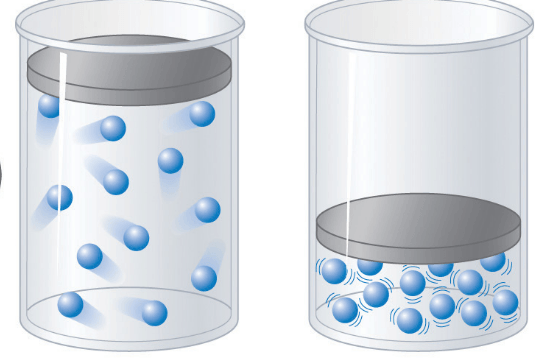
Which container will have a lower pressure?
a)
left
b)
right
c)
they both have the same pressure
d)
I don't know
93.
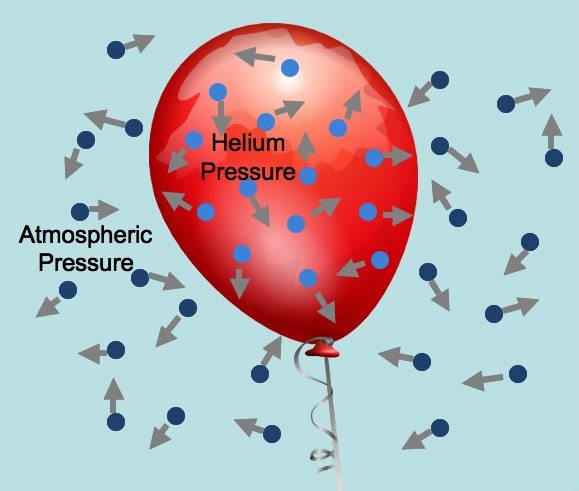
What causes pressure?
a)
The walls of the container
b)
The vacuum in the container
c)
The collisions of the particles
d)
Atmospheric pressure acting on the outside walls
94.
The relationship of which two variables are compared in Boyle's Law?
a)
pressure & volume
b)
volume & temperature
c)
temperature & pressure
d)
volume & moles (amount of gas)
95.
Boyle's law : When _______ is held constant, the pressure and volume of a gas are ________  proportional
a)
temperature,  equally
b)
mass, inversely
c)
temperature, inversely
d)
mass, equally
96.
What type of relationship is Charles' Law?
a)
Inverse
b)
Direct
c)
Not enough information
d)
#goals
97.
What is the formula Charles' Law?
a)
V = T
b)
VT = VT
c)
T1 / V1 = T2 / V2
d)
V1 / T1 = V2 / T2
98.
This variable in an experiment is the one being deliberately changed by the scientist. 
a)
dependent variable
b)
independent variable
c)
data
d)
control group
99.
Should experiments be repeated over and over to see if the results are the same each time?
a)
yes
b)
no
100.
A series of steps used by scientists to solve a problem or answer a question
a)
scientific method
b)
recipe
c)
data collection
d)
metric system
101.
TRUE/ FALSE: Science is a continually ongoing process.
a)
True
b)
False
102.
Gases have...
a)
A definite shape and volume
b)
A definite shape but no definite volume
c)
No definite shape but a definite volume
d)
No definite shape or volume
103.
What is the variable for this number 22.4 L
a)
P
b)
T
c)
n
d)
V
104.
What is the variable for this number 32oC
a)
P
b)
T
c)
n
d)
V
105.
What is the variable for this number 9.10 atm
a)
P
b)
T
c)
n
d)
V
106.
What is the variable for this number 122 K
a)
P
b)
T
c)
n
d)
V
107.
What is the variable for this number 1.5 mol
a)
P
b)
T
c)
n
d)
V
108.
PV=nRT
a)
Charles Law
b)
Boyle's Law
c)
Combined Gas Law
d)
Ideal Gas Law
109.
Which law helps us find the moles of gas in a sample?
a)
Charles Law
b)
Boyle's Law
c)
Combined Gas Law
d)
Ideal Gas Law
110.
Calculate the volume that a 0.323-mol sample of a gas will occupy at 265 K and a pressure of 0.900 atm.
a)
7.18 L 
b)
7.81 L
c)
4.63 L
d)
4.36 L
111.
Determine the Kelvin temperature required for 0.0470 mol of gas to fill a balloon to 1.20 L under .998 atm pressure. 
a)
0 K 
b)
107 K 
c)
207 K 
d)
307 K 
112.

What does R stand for

a)

Ideal gas constant

b)

Real gas constant

c)

Temperature constant

d)

Ideal gas law

113.

Which is a correct unit for R?

a)

L.atm/mol.k

b)

L.atm

c)

mmHg/mol.K

d)

L.atom/mol

114.
Determine the Celsius temperature of 2.49 moles of gas contained in a 1.00-L vessel at a pressure of 143 kPa. 
a)
-266 degrees C
b)
-622 degrees C
c)
622 degrees C 
d)
266 degrees C
115.
What pressure, in atm, is exerted by 2.50 L of gas containing 1.35 mol at 320 K?
PV=nRT
a)
14.19 atm
b)
16.53 atm
c)
18.42 atm
d)
22.54 atm
116.
The ideal gas law is an equation that relates the  what  variables to a constant of R.
a)
volume, pressure, temperature
b)
volume, temperature, pressure, amount of gas particles
c)
volume, pressure
d)
volume, temperatue
117.
If n and T are held constant, the ideal gas law reduces to 
a)
Charles' law
b)
Boyle's law
c)
Avogadro's principle
d)
zero
118.
In the ideal gas law, which variable represents the gas constant?
a)
n
b)
R
c)
T
d)
V
119.
Molar volume of any gas at STP
a)
22.4 L
b)
2.24 L
c)
6.02 x 10²³ L
d)
224 L
120.
If 3.25 mol of Ar occupies 100. L at a particular temp and pressure, what volume does 14.15 mol of Ar occupy under same condition?
a)
435 L
b)
225 L
c)
100 L
d)
522 L
121.
A 2.00 L sample of pure oxygen gas (O2) is measured at STP.  How many moles of oxygen is this?
a)
24.4 mol
b)
0.007 mol
c)
1.44 mol
d)
0.09 mol
122.
How many molecules are there in a 110 L sample of gas at STP?
a)
8 x 10²³ molecules
b)
8 x 1024  molecules
c)
3 x 1024 molecules
d)
3 x 10²³ molecules
123.
A sample of pure oxygen gas at STP measures out to be 2.00 L.  How many moles of oxygen is this?
a)
24.4 mol
b)
0.007 mol
c)
1.44 mol
d)
0.09 mol
124.
Gases of the same volume contain the same number of molecules.  This is the description of:
a)
Boyle's law
b)
Dalton's law
c)
Charles' law
d)
Avogadro's law
125.
A sample of carbon dioxide at STP is 0.50 L.  How many grams of carbon dioxide do we have?
a)
0.48 g
b)
0.49 g
c)
1.96 g
d)
0.98 g
126.

What is the value of STP?

a)

0 K and 1 atmosphere

b)

0 C and 1 atmosphere

c)

32 F and 1 atmosphere

d)

100 C and 1 atmosphere

127.

To convert from Celsius to Kelvin you must...

a)

Subtract 273

b)

Multiply 273

c)

Divide 273

d)

Add 273

128.

Which is NOT a unit of Pressure

a)

atm

b)

mmHg

c)

Liters

d)

kPa

129.

The following graph illustrates what kind of RELATIONSHIP between pressure and temperature?

a)

Direct

b)

Inverse

c)

Indirect

d)

Negative Slope

130.

Which gas law involves only Pressure and Temperature?

a)

Avogadro's Law

b)

Boyle's Law

c)

Charle's Law

d)

Lussac's Law

131.

Convert 30 degree Celsius to Kelvin

a)

303 K

b)

-243 K

c)

8190 K

d)

9.1 K

132.

Standard Temperature and Pressure STP has what qualities?

a)

1 atm, 0oC

b)

0 atm, 1oC

c)

1 torr, 0oC

d)

1 atm, 0K

133.

Guy-Lussac's Law

a)

P1V1=P2V2

b)

V1/T1=V2/T2

c)

PV=nRT

d)

P1/T1=P2/T2

134.

A water bottle at STP is cooled to -155°C. What is the new pressure?

a)

3.2 atm

b)

0.43 atm

c)

1.8 atm

d)

0.27 atm

135.

What is the pressure of a car tire that had an initial pressure of 1.8 atm but was heated from 38°C to 123°C?

a)

0.9 atm

b)

2.1 atm

c)

1.6 atm

d)

3.4 atm

136.

If a hairspray can is heated, what can be expected of the pressure of the gas inside the can?

a)

The pressure will increase

b)

The pressure will decrease

c)

The pressure will remain constant

d)

The pressure will equalize

137.

A gas has a pressure of 98kPa at 30 degrees Celsius. What will be the new pressure if the temperature is increased to 35 degrees Celsius. Round answer to one decimal place.

(a)  

138.

Hydrogen gas has a pressure of 14.2 psi at a temperature of 28 degrees Celsius. If the pressure is increased to 18.4 psi, what will be the new temperature in degrees Celsius? Round answer to one decimal place.

(a)  

139.
When heat is added to a sample of gas sealed in a container, which of the following will most likely happen?
a)
The temperature of gas will increase because the gas molecules will move much more slowly.
b)
The temperature of gas will decrease because the gas molecules will move faster
c)
The temperature of gas will increase because the gas molecules will move faster. 
d)
Temperature of gas will decrease because the gas molecules will stop moving
140.

The pressure of the gas in the balloon in the ice water will be:

a)

Greater than that of the balloon in the boiling water.

b)

Less than that of the balloon in the boiling water.

c)

The same as that of the balloon in the boiling water.

d)

Not enough information to answer the statement.

141.
If the temperature of a gas increase, the pressure...
a)
Decreases
b)
Increases
c)
Does not change
142.
Directly proportional means that as one value increases ....................
a)
the other stays the same 
b)
the other increases as well
c)
the other decereases
d)
the other goes to zero
143.
If you increase the pressure, what will happen to the temperature, if volume is constant?
a)
Increase
b)
Decrease
c)
Stay the same
d)
It will Blow Up
144.

Which of these is a unit of measure of pressure?

a)

kilometers

b)

Joules

c)

Pascals

d)

watts

145.
The gas in an aerosol can exerts a pressure of 3.00 atm at 25°C. Directions on the can warn the user not to keep the can in a place where the temperature exceeds 100°C. What would the gas pressure in the can be at 100°C?
a)
3.76 atm
b)
2.40 atm
c)
12 atm
d)
0.75 atm
146.

Pressure is

a)

defined as the mass that an object exerts when at rest.

b)

not a measurable in gases.

c)

defined as the number of moles of substance divided by the mass of the substance.

d)

created by the force of the gas particles impacting the walls of the container.

147.

A gas has a pressure of 699.0 mmHg at 40.0 °C. What is the temperature at standard pressure?

(a)  

148.

If a gas is cooled from 323.0 K to 273.15 K and the volume is kept constant what final pressure would result if the original pressure was 750.0 mmHg?

(a)  

149.

If a gas in a closed container is pressurized from 15.0 atmospheres to 16.0 atmospheres and its original temperature was 25.0 °C, what would the final temperature of the gas be in degrees Celsius?

(a)  

150.
What is the formula Charles' Law?
a)
V = T
b)
VT = VT
c)
T1 / V1 = T2 / V2
d)
V1 / T1 = V2 / T2
151.
What is 50 C in Kelvin?
a)
223
b)
323
c)
100
d)
50
152.

(Charles Law) There are 65 liters of helium in a balloon at 35 K. If the temperature of the balloon is increased to 40 K, what will the new volume of the balloon be?

a)

40 L

b)

70 L

c)

74.3 L

d)

75.9 L

153.

(Charles Law) There are 40 liters of helium in a balloon at 100 K. If the temperature of the balloon is increased to 200 K, what will the new volume of the balloon be?

a)

80 L

b)

45 L

c)

54 L

d)

45.33 L

154.
Tom Brady enjoys balloon animals from the carnival. He just received a balloon giraffe that has an initial temperature of 39.0°C and a volume of 1.28 L. If Gronkowski plays a trick on Tom, and puts his balloon giraffe into the freezer, what would be the new volume of the balloon if the temperature drops down to 8.0°C?
(Don’t forget about what must be done to temperatures!)
a)
1.42 L
b)
6.85 x 10⁴ L
c)
3.78 L
d)
1.15 L
155.
Tom wants his balloon back to normal size so he decides to put it on a heating vent. If the balloon initially has a volume of 0.6 L and a temperature of 293 K, what will the volume of the balloon be when it heats up to a temperature of 176°C?
a)
0.39 L
b)
0.92 L
c)
0.78 L
d)
0.92 K
156.
Edelman and Gronkowski want to play a game of beach volleyball. If the beach ball has a volume of  261 L at a temperature of 502 K, what will the temperature of the balloon be if the volume decreases to 176 L?
a)
744 K
b)
0.0030 K
c)
339 K
d)
512 K
157.
If 200 mL of a gas at 27°C is cooled to -33°C at a constant pressure, the volume will be
a)
250 mL
b)
204 mL
c)
196 mL
d)
160 mL
158.
The volume of a sample of a gas at 273 oC is 200 liters. If the volume is decreased to 100 liters at constant pressure, what will be the new temperature of the gas?
a)
0 K
b)
546 K
c)
273 K
d)
100 K
159.
A sample of oxygen gas in a closed system has a volume of 200 milliliters at 600 K. If the pressure is held constant and the temperature is lowered to 300 K, the new volume of the gas will be -
a)
400 milliliters.
b)
300 milliliters.
c)
100 milliliters.
d)
200 milliliters.
160.
The volume of a gas at 25ο C is 3.8 L.  What will be the volume of that gas at 57 ο C if the pressure is held constant?
a)
8.66 L
b)
4.21 L
c)
6.34 L
d)
3.46 L
161.
A gas with a volume of 400 mL at 120 οC is heated until its volume is 700 mL.  What is the new temperature ( in degree Celsius) of the gas if the pressure is constant?
a)
4 14.75 οC
b)
687.75 οC
c)
210 οC
d)
68.57 οC
162.
What is the formula for Boyle's Law?
a)
P1V1=P2V2
b)
P1V1/P2V2
c)
P1V2=P2V1
d)
P1/V1=P2/V2
163.
When Pressure increases then the Volume must...
a)
Increase
b)
decrease
164.
When Volume increases then Pressure must...
a)
Increase
b)
Decrease
165.
What is the new volume of the gas if the pressure on 350 L of oxygen at 720 mm Hg is decreased to 600 mm Hg?
a)
420 L
b)
29.16 L
c)
4200.0 L
d)
291.6 L
166.
A gas occupies 4.98 L at 2.6 atm of pressure. What volume does it occupy at 1.8 atm pressure?
a)
12.9 L
b)
0.72 L
c)
7.2 L
d)
3.44 L
167.
A gas at a volume of 4 liters is at a pressure of 2 atm. The volume is changed to 16 Liters, what must the new pressure be?
a)
2 atm
b)
12 atm
c)
10 atm
d)
0.5 atm
168.
The pressure on a sample of gas is increased from 1.0 atm to 3.0 atm. If the new volume is 0.52 L, find the original volume.
a)
0.52 L
b)
1.56 L
c)
0.173 L
d)
1.00 L
169.
Which container will have a lower pressure?
a)
left
b)
right
c)
they both have the same pressure
d)
I don't know
170.
True or False: Gases can be compressed. 
a)
True
b)
False
171.
For the problem below, what is the value for the final pressure?
A gas with a volume of 4.0 L at 90.0 kPa expands until the pressure drops to 20.0 kPa. What is its new volume if the temperature doesn’t change?

a)
4.0 L
b)
20.0 kPa
c)
90.0 kPa
d)
18.0 L
172.
On the sidelines at the game, a container filled with oxygen for the players has a volume of 0.03 L and a pressure of 4.00 atm. If the pressure of the oxygen gas is reduced to 2.71 atm and the temperature is kept constant, what is the new volume of the oxygen gas?
a)
0.32 L
b)
361 L
c)
0.9 L
d)
0.04 L
173.
For a teammate’s birthday party, Martellus Bennett needs to buy a helium tank to fill up all of the balloons. If the helium must be compressed from an original volume of 27.0 L at 14.7 psi, down to a volume of 3.00 L, what would be the final pressure of the helium?
a)
132.3 psi
b)
1.63 psi
c)
5.51 psi
d)
132.3 L