wayground logo

Free Printable Worksheets

Font size

S
M
L
XL
Worksheets

Electrons in Atoms (Chapter 5)

Total questions: 170

Worksheet time: 2hrs 8mins

Name
Class
Date
1.

It is the quantum number that describes the energy of an orbital and its atomic size.

a)

Azimuthal Quantum Number

b)

Principal Quantum Number

c)

Spin Quantum Number

d)

Magnetic Quantum Number

2.

What is the maximum allowable number of electrons that a d orbital can hold?

a)

2

b)

6

c)

10

d)

14

3.

What is the n quantum number for Li?

a)

0

b)

1

c)

2

d)

3

4.

What is the l quantum number for Li?

a)

0

b)

1

c)

2

d)

3

5.

What is the ml quantum number for Li?

a)

0

b)

1

c)

2

d)

3

6.

Quantum numbers are used to describe______.

a)

Proton

b)

Nucleus

c)

Electron

d)

Positron

7.

For the principal quantum number n = 4, it is possible to have____.

a)

Only s orbital

b)

Only s ,p orbital

c)

Only s and f orbital

d)

Only s, p, d, f orbitals

8.
What atom matches this electron configuration?
1s22s22p63s23p64s23d10
a)
Zinc
b)
Copper
c)
Nickel
d)
Germanium
9.

How many electrons can the d sublevel (the d orbitals) hold?

a)

14

b)

10

c)

2

d)

6

10.
What electron configuration matches an oxygen atom?
a)
1s22s22p63s2, 3p64s23d104p5
b)
1s22s22p4
c)
1s22s22p6
d)
1s22s22p63s23p64s23d1
11.

Each row on the periodic table represents:

a)

an energy level

b)

a sublevel

c)

an electron

d)

an orbital

12.
How many electrons can the first energy level hold?
a)
1
b)
2
c)
8
d)
0
13.

Each orbital can hold how many electrons?

a)

5

b)

4

c)

8

d)

2

14.

In an electron configuration, what follows 4s?

a)

4p

b)

3d

c)

4s

d)

2f

15.
The electron configuration of an atom is 1s22s22p6.  The number of electrons in the atom is 
a)
3
b)
6
c)
8
d)
10
16.
Which electron configuration belongs to Chlorine (Cl)?
a)
1s2s2p3s3p5
b)
1s2s2p3s3p6
c)
1s2s2p3s3p7
17.
What's a valence electron?
a)
electrons in the second energy level
b)
electrons in the outermost energy level
c)
the atomic number
d)
electrons in the first level
18.
How many valence electrons are in Phosphorus?
a)
15
b)
4
c)
5
d)
31
19.
How are electrons arranged in an atom?
a)
In groups of five
b)
In energy levels
c)
By color
d)
By shape
20.
What does the nucleus of an atom contain?
a)
Electrons and neutrons
b)
Protons and neutrons
c)
Neutrinos and positrons
d)
DNA and RN
21.

What do electrons in the same shell have in common?

a)

They have the same amount of energy

b)

They are all positively charged

c)

They are all made up of atoms

d)

They all have neutral charges

22.
How many electrons can the first energy level hold?
a)
1
b)
2
c)
8
d)
0
23.
The energy of an electron __________ as it moves further away from the nucleus
a)
increases
b)
decreases
c)
remains the same
24.
What are Valence electrons defined as ?
a)
as electrons in the atom's outermost orbitals. 
b)
as electrons in the atom's innermost orbitals.
25.
What is electron configuration ?
a)
the arrangement of protons in an atom.
b)
the arrangement of electrons in an atom.
26.
What does Hund's rule states ?
a)
states that single electrons electrons with the same spin must occupy each-energy orbital before additional electrons with opposite spins can occupy the same orbitals
b)
states that each electron occupies the lowest energy orbital available
c)
states that a maximum of two electrons can occupy a single atomic orbital, but if only if the electros have opposite spins
27.
What does the aufbau principle state.
a)
states that a maximum of two electrons can occupy a single atomic orbital, but if only if the electros have opposite spins
b)
states that each electron occupies the lowest energy orbital available
c)
states that single electrons electrons with the same spin must occupy each-energy orbital before additional electrons with opposite spins can occupy the same orbitals
28.
What does Pauli exclusion principle state ?
a)
states that each electron occupies the lowest energy orbital available
b)
states that a maximum of two electrons can occupy a single atomic orbital, but if only if the electros have opposite spins
c)
states that single electrons electrons with the same spin must occupy each-energy orbital before additional electrons with opposite spins can occupy the same orbitals
29.
The _______________ determines the color of visible light. 
a)
wavelength
b)
speed
c)
amplitude
d)
light
30.
Lowest energy state of an atom
a)
Ground
b)
Excited
31.

The correct electron configuration for Chlorine is

a)

1s22s22p5

b)

1s22s22p63s2

c)

1s22s22p63s23p4

d)

1s22s22p63s23p5

32.
What atom matches this electron configuration?
1s22s22p63s2
a)
Neon
b)
Magnesium
c)
Aluminum
d)
Potassium
33.
How many electrons does Si contain? (click to see image)
a)
14
b)
28
c)
2
d)
4
34.
The electron configuration of an atom is 1s22s22p6.  The number of electrons in the atom is 
a)
3
b)
6
c)
8
d)
10
35.
Which electron configuration belongs to Chlorine (Cl)?
a)
1s2s2p3s3p5
b)
1s2s2p3s3p6
c)
1s2s2p3s3p7
36.
Electrons occupy orbitals of lowest energy first is part of what electron configuration rule?
a)
Hund’s Rule
b)
Aufbau Principle
c)
Pauli Exclusion Principle
37.

What does Pauli exclusion principle state ?

a)

states that each electron occupies the lowest energy orbital available

b)

states that -no two electrons in the same orbital can have the same spin

c)

states that single electrons electrons with the same spin must occupy each-energy orbital before additional electrons with opposite spins can occupy the same orbitals

38.
What atom matches this electron configuration?
1s2s2p3s2
a)
Neon
b)
Magnesium
c)
Aluminum
d)
Potassium
39.

What is the maximum number of electrons that an S orbital can have?

a)

1 electron

b)

2 electrons

c)

3 electrons

d)

4 electrons

40.
How many valence electrons are represented here?
a)
7
b)
5
c)
2
d)
8
41.

How many electrons can the d sublevel(orbital) hold?

a)

8

b)

10

c)

2

d)

4

42.
How many valence electrons does Chlorine have?
a)
5
b)
2
c)
7
d)
5
43.
Which of the following is a p block element?
a)
Ca
b)
Ar
c)
Re
d)
Au
44.

There are 4 different types of subshells(orbitals) s,p,d,f

a)

true

b)

false

45.
Which electron configuration belongs to Copper (Cu)?
a)
1s2 2s2 2p6 3s2 3p6 4s2 3d8
b)
1s2 2s2 2p6 3s2 3p6 4s2 3d9
c)
1s2 2s2 2p6 3s2 3p6 4s2 3d10
46.
How many electron can be found in a p orbital?
a)
2
b)
3
c)
4
d)
6
47.
What is the electronic configuration of iron?
a)
1s22s22p63s23p64s23d6
b)
1s22s22p63s23p63d8
c)
1s22p63s23p64s23d6
d)
1s22s22p63s23p64s13d6
48.
What is the maximum number of electrons that an orbital can have?
a)
1 electron
b)
2 electrons
c)
3 electrons
d)
4 electrons
49.
What atom matches this electron configuration?
[Xe] 6s2 4f14 5d9
a)
Mercury
b)
Gold
c)
Platinum
d)
Thallium
50.
What noble gas should be used to write the shorthand configuration for Te?
a)
Ar
b)
Kr
c)
Xe
d)
Sb
51.
What element in Period 4 has 5 valence electrons?
a)
Zr
b)
As
c)
V
d)
Sb
52.
Electron arrangement that uses arrows
a)
Electron configuration
b)
Shorthand configuration
c)
Lewis dot structure
d)
Orbital diagram
53.
What is the noble gas shorthand electron for Sulfur atom?
a)
[Ar] 3p4
b)
[He] 3s23p4
c)
[Ne] 3s23p4
d)
[Na] 3s23p4
54.
What atom matches this electron configuration?
[Xe] 6s25d9
a)
Mercury
b)
Gold
c)
Platinum
d)
Thallium
55.

What is the shape of a p orbital?

a)

sphere

b)

it's just too complex to think about it

c)

dumbbell

d)

I don't know this stuff.

56.

What is the shape of an s orbital?

a)

sphere

b)

dumbbell

c)

double dumbbell

d)

TOO COMPLEX TO KNOW IT.

57.

Which two would have the same shape?

a)

2p

b)

2s

c)

3d

d)

1s

58.
An orbital can at most hold how many electrons?
a)
1 electron
b)
2 electrons
c)
3 electrons
d)
4 electrons
59.
What is the highest occupied energy level?
a)
4
b)
5
c)
6
d)
7
60.
This orbital diagram represents:  
a)
C
b)
B
c)
N
d)
O
61.

How many electrons can the d sublevel (the d orbitals) hold?

a)

14

b)

10

c)

2

d)

6

62.

Each row on the periodic table represents:

a)

an energy level

b)

a sublevel

c)

an electron

d)

an orbital

63.

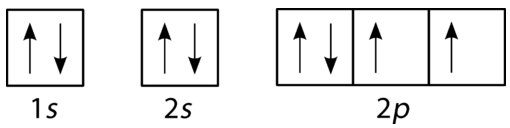
What is incorrect about this orbital diagram?

a)

Both arrows in the 2p box should be pointing up

b)

There is nothing incorrect with this diagram

c)

In the 2p box there should only be 1 electron in the first 2p box and one in the 2nd 2p box pointing in the same direction.

d)

All the arrows should be pointing up.

64.
What's a valence electron?
a)
electrons in the second energy level
b)
electrons in the outermost energy level
c)
the atomic number
d)
electrons in the first level
65.
What is the noble gas configuration for beryllium?
a)
[He]1s2
b)
[He]2s2
c)
[Li]2s1
d)
[Li]2s2
66.
What is the abbreviated electron configuration for barium?
a)
[Xe] 6s2
b)
[Rn] 6s2
c)
[Ar] 4s2 3d10 4p5
d)
[He] 2s2 3p1
67.

Choose the Noble Gas that you would use to begin the shorthand configuration of the following element.

Iron

a)

[He]

b)

[Ne]

c)

[Ar]

d)

[Kr]

68.

Choose the Noble Gas that you would use to begin the shorthand configuration of the following element.

Plutonium (Pu)

a)

[Xe]

b)

[Ne]

c)

[Rn]

d)

[Kr]

69.
a)

10

b)

2

c)

8

d)

18

70.
a)

14

b)

4

c)

3

d)

28

71.

This is a correct dot diagram for fluorine (F)

a)

true

b)

false

72.

This is a correct dot diagram for oxygen (O)

a)

true

b)

false

73.

The elements in this group all have 5 valance electrons.

a)

Group 5

b)

Group 15

c)

Group 3

d)

Group 18

74.
How many electrons can the s sublevel hold?
a)
14
b)
10
c)
2
d)
6
75.

Energy levels are denoted by:

a)

letters

b)

numbers

c)

a combination of letters and numbers

d)

subscripts

76.

Which of the following is not a correct designation for a sublevel?

a)

zz

b)

p

c)

d

d)

f

77.
How many electrons are in the outer shell of Sodium (Na)?
a)
3
b)
1
c)
2
d)
4
78.

This could be the dot diagram of

a)

Mg

b)

Cl

c)

C

d)

O

79.

Identify the rule that is being violated

a)

Aufbau's Principle

b)

Hund's Rule

c)

Pauli's Exclusion Principle

d)

Heisenberg uncertainty principle

80.

What is incorrect about this orbital diagram?

a)

Both arrows in the filled 2p box should be pointing the same direction

b)

There is nothing incorrect with this diagram

c)

In the there should only be 1 arrow in the first 2p box and one in the 2nd 2p box

d)

All the arrows should be pointing the same direction.

81.

All orbitals of equal energy (degenerate orbitals) are occupied by one electron before any single orbital is occupied by a second electron.

a)

Aufbau Principle

b)

Pauli's Exclusion Principle

c)

Hund’s Rule

d)

Core Notation

82.

No two electrons in the same atom can have the same four quantum numbers.

a)

Aufbau Principle

b)

Pauli's Exclusion Principle

c)

Hund’s Rule

d)

Noble gas notation

83.

Which rule is violated in the following orbital diagrams?

a)

Hund's Rule

b)

Aufbau Principle

c)

Pauli's Exclusion Principle

84.

Which rule is violated in the following orbital diagrams?

a)

Aufbau Principle

b)

Hund's Rule

c)

Pauli's Exclusion Principle

85.

There are __ energy levels

a)

1

b)

2

c)

7

d)

8

86.
What noble gas should be used to write the shorthand configuration for Te?
a)
Ar
b)
Kr
c)
Xe
d)
Sb
87.

Each row on the periodic table represents:

a)

an energy level

b)

a sublevel

c)

an electron

d)

an orbital

88.
This orbital diagram represents:  
a)
C
b)
B
c)
N
d)
O
89.
This orbital diagram represents:  
a)
C
b)
B
c)
N
d)
O
90.

Which of the following states that electrons occupy orbitals of lowest energy first?

a)

Hund’s Rule

b)

Aufbau Principle

c)

Pauli Exclusion Principle

91.

This orbital diagram represents

a)

Sodium

b)

Magnesium

c)

Aluminum

d)

Iron

92.
The maximum number of electrons that can be placed in an f orbital.  
a)
2
b)
6
c)
10
d)
14
93.
In an orbital diagram,  an arrow represents: 
a)
an electron
b)
an orbital
c)
an element
94.

What element has this electron configuration?

a)

hydrogen

b)

helium

c)

lithium

d)

beryllium

95.

What element has this orbital notation?

a)

lithium

b)

beryllium

c)

boron

d)

carbon

96.

What element has this electron configuration?

a)

helium

b)

lithium

c)

beryllium

d)

boron

97.

What element has this electron configuration?

a)

boron

b)

carbon

c)

nitrogen

d)

oxygen

98.

Which element is represented by this orbital notation?

a)

carbon

b)

nitrogen

c)

oxygen

d)

fluorine

99.

Which element is represented by this electron configuration?

a)

neon

b)

sodium

c)

magnesium

d)

aluminum

100.

Which element is represented by this orbital notation?

a)

neon

b)

sodium

c)

magnesium

d)

aluminum

101.

Which of the following is the electron configuration for Fluorine

a)
b)
c)
d)
102.

Which of the following is the electron configuration for neon?

a)
b)
c)
d)
103.

Which of the following is the electron configuration for silicon?

a)
b)
c)
d)
104.

Which of the following is the orbital notation for oxygen?

a)
b)
c)
d)
105.
No two electrons in the same atom can have the same four quantum numbers.
a)
Aufbau principle
b)
Pauli exclusion principle
c)
Hund’s rule
d)
Noble gas notation
106.
All orbitals of equal energy are occupied by one electron before any single orbital is occupied by a second electron.
a)
Aufbau principle
b)
Pauli exclusion principle
c)
Hund’s rule
d)
Core Notation
107.
An electron occupies the lowest energy orbital that can receive it.
a)
Hund’s rule
b)
Pauli exclusion principle
c)
Bohr model of the atom
d)
Aufbau principle
108.

What is the element?

a)

Neon

b)

Chlorine

c)

Aluminum

d)

Argon

109.

What is the element?

a)

sulfur

b)

chlorine

c)

phosphorus

d)

silicon

110.

Which is the electron configuration for beryllium?

a)
b)
c)
d)
111.
What is the name of this element?
a)
Lithium
b)
Boron
c)
Carbon
d)
Neon
112.
How many valence electrons?
a)
2
b)
3
c)
5
d)
10
113.
Which orbital has the least amount of energy? 
a)
p orbital
b)
d orbital
c)
s orbital 
d)
What is an orbital?
114.
What is the maximum capacity for an orbital?
a)
2
b)
8
c)
6
d)
10
115.

True or False: The ground state is the highest energy state of an atom.

a)

True

b)

False

116.

The unknown emissions spectra belongs to the element

a)

Hydrogen

b)

Mercury

c)

Neon

d)

Sodium

117.

The unknown emissions spectra belongs to the element

a)

Hydrogen

b)

Mercury

c)

Neon

d)

Sodium

118.
What gases are in the unknown mixture?
a)
Gas B & Gas D
b)
Gas C & Gas B
c)
Gas A & Gas D
d)
Gas D & Gas C
119.

Which element(s) is/are found in the star's spectra below?

a)

Hydrogen only

b)

Hydrogen & Helium

c)

Calcium only

d)

Hydrogen & Calcium

120.
How often a wave occurs is the wave's __________________
a)
crest
b)
frequency
c)
wavelength
d)
resting point
121.
The distance between 2 corresponding parts of a wave  (example- crest to crest) is its _____________________
a)
trough
b)
frequency
c)
amplitude
d)
wavelength
122.
What are the highest parts of a transverse wave called?
a)
amplitude
b)
trough
c)
resting point
d)
crest
123.
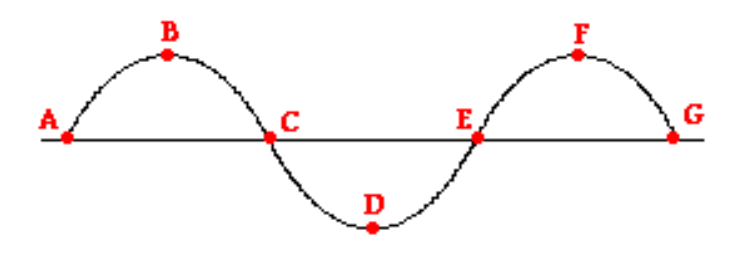
What number represents the wavelength?
a)
1
b)
2
c)
3
d)
4
124.
As the frequency of a wave increases, the __________________ decreases.
a)
amplitude
b)
resting point
c)
wavelength
d)
crest
125.
What number represents the amplitude?
a)
1
b)
2
c)
3
d)
4
126.
regular disturbances that carry energy through matter or space
a)
crest
b)
energy
c)
wave
d)
trough
127.

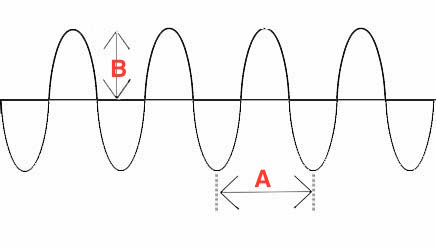
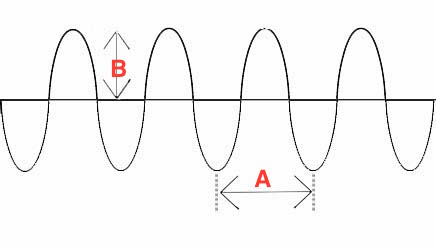
What property of this wave is represented by the letter "A"

a)

amplitude

b)

crest

c)

trough

d)

wavelength

128.
When the frequency of a wave increases, what happens to the wavelength?
a)
The wavelength is not directly affected by the frequency of a wave.
b)
The wavelength increases.
c)
The wavelength decreases.
d)
More specific information is needed to form a conclusion about the wavelength.
129.
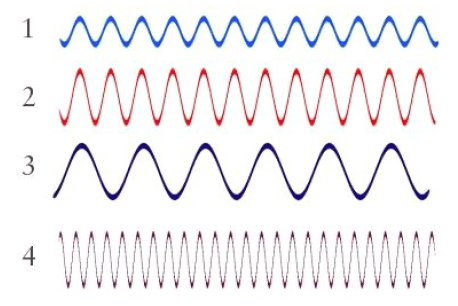
Which wave in the diagram has the greatest frequency?
a)
1
b)
2
c)
3
d)
4
130.
The number of wavelengths that pass a point each per second is:
a)
frequency
b)
period
c)
longitudinal 
d)
transverse wave 
131.
The distance from one point to the next corresponding point on a wave is called the ________________.
a)
waveform
b)
peak
c)
amplitude
d)
wavelength
132.
What property of the wave is represented by the letter "B"?
a)
amplitude
b)
crest
c)
trough
d)
wavelength
133.
The highest point on a wave is:
a)
the crest
b)
the trough
c)
the top
d)
the coast 
134.
The lowest point on a wave is the:
a)
Amplitude
b)
Crest
c)
Trough
d)
Wavelength
135.
The number of wavelengths that pass a point each per second is:
a)
frequency
b)
period
c)
longitudinal 
d)
transverse wave 
136.
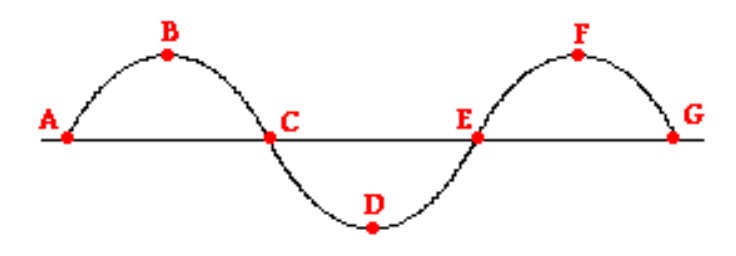
Which letter(s) represent the trough of the wave?
a)
A
b)
B & D
c)
D
d)
C & G
137.
Which letter(s) represent the crest of the wave?
a)
A
b)
B & D
c)
B & F
d)
F
138.
Which wave in the diagram has the greatest wavelength?
a)
1
b)
2
c)
3
d)
4
139.
crest to crest or trough to trough
a)
crest
b)
trough
c)
amplitude
d)
wavelength
140.

What is the amplitude of a wave?

a)

how often a wave passes a certain point

b)

the distance from the middle of the wave to a crest or a trough

c)

the highest point of a wave

d)

chick-fil-a

141.

What is the visible light spectrum in order?

a)

red, orange, yellow, green, blue, indigo, violet

b)

orange, blue, green, yellow, red, violet, indigo

c)

red, green blue, orange, violet, yellow, indigo

d)

McDonald's is gross

142.

What is the light that you can see called?

a)

observatory light

b)

ultraviolet light

c)

visible light

d)

infrared light

143.
Why are line emission spectra of elements called "atomic fingerprints"?
a)
They are all the same
b)
They are all unique
c)
They are all similar
d)
They all contain colored light
144.

What is the cause of atomic spectra? Changes in the energy of ______________.

a)

protons

b)

neutrons

c)

elctrons

d)

positron

145.

What can a flame test distinguish?

a)

calcium chloride and barium chloride

b)

calcium chloride and calcium nitrate

c)

ethanoic acid and propanoic acid

d)

any two metals

146.

What particle moves around the nucleus of an atom?

a)

proton

b)

neutron

c)

electron

d)

positron

147.

What subatomic particle is responsible for the spectral lines seen in emission spectra diagrams?

a)

electrons

b)

protons

c)

neutrons

148.

In order to go from ground state to an excited state, an electron must

a)

emit energy

b)

absorb energy

c)

wiggle

149.

When an electron returns to ground state from an excited state, the atom will

a)

emit energy

b)

absorb energy

c)

rotate

d)

wiggle

150.

A wave with a large wavelength will have a ______ frequency and _____ energy

a)

high, low

b)

high, high

c)

low, high

d)

low, low

151.

What is the speed of light?

a)

3.0x10⁸ ms

b)

3.0x10⁸ m/s

c)

6.626x10⁻³⁴ Js

d)

6.626x10⁻³⁴ J/s

152.
High frequency waves have _________ wavelength.
a)
varying
b)
high
c)
the same
d)
low
153.

The number of waves that pass a fixed point in a given amount of time is...

a)

frequency

b)

wave speed

c)

amplitude

d)

wavelength

154.

Violet light has a wavelength of

4.10 x 10⁻¹² m. What is the frequency?

a)

1.23E-3 Hz

b)

7.31E19 Hz

c)

1.37E12 Hz

d)

3.0E12 Hz

155.
A certain photon of light has a wavelength of 4.22x10⁻⁷nm. What is the frequency? (v=c/λ)
a)
7.11x10¹⁴ Hz
b)
7.11Hz
c)
1.41x10⁻¹⁵
d)
-1.41x10¹⁵
156.
Select the correct order of waves on the EMS 
a)
Radio, Micro, Infra, Visible, Ultra, X-ray, Gamma
b)
Gamma, X-ray, Ultra, Vis, Infra, Micro, Radio
c)
Vis, Micro, Infra, Ultra, X-ray, Gamma, Radio
d)
Micro, Radio, Vis, Infra, Ultra, X-ray, Gamma
157.
Which has the LONGEST wavelength and, therefore, the lowest frequency/energy
a)
Gamma Rays
b)
Radio Waves
c)
Visible Light
d)
Infrared rays
158.
Which has the SHORTEST wavelength and, therefore, the highest frequency/most energy
a)
Radio waves
b)
Ultraviolet Rays
c)
Gamma Rays
d)
X-rays
159.
What is a photon?
a)
When radiation burst through electric waves
b)
The emission of electrons from a metal caused by light striking the metal
c)
The rate at which a waves energy flows through a given unit of area.
d)
packets of electromagnetic energy
160.
What does the letter 'h' represent in the formula E = hv?
a)
Planck's constant
b)
Hydrogen
c)
Energy
161.

Certain blue lights have a frequencey of 6.91x10¹⁴Hz. What is the wavelength?

a)

4.34x10²¹

b)

4.34x10⁻²¹

c)

4.34x10⁻⁷

d)

2.07x10²³

162.

What is the energy of a quantum of light with a frequency of 7.39x10¹⁴Hz.

a)

4.88x10¹⁹

b)

4.88x10⁻¹⁹

c)

2.22x10²³

d)

2.22x10⁻²³

163.

A light emits energy that has a wavelength of 5.06x10⁻⁷m. What is the frequency of the light? What is the color of light?

a)

16.87Hz, Red

b)

5.93Hz, Orange

c)

5.93x10⁻¹⁴Hz, Blue

d)

5.93x10¹⁴Hz, Green

164.

What is the Energy of a blue light with the frequency of 6.91x10¹⁴Hz?

a)

4.56x1049J

b)

9.55x10-49J

c)

4.56x10⁻¹⁹J

d)

5.82x10¹⁹J

165.

What is the frequency of a light that has the Energy of 2.84x10⁻¹⁹.

a)

4.30x10¹⁴Hz

b)

4.30x10⁻¹⁴Hz

c)

4.30x10-54Hz

d)

4.30x1054Hz

166.
High frequency waves have _________ wavelength.
a)
varying
b)
high
c)
the same
d)
low
167.
Solve this problems using the equation: C = λ  x  ν
If an AM radio station broadcasts at 9.95 x 10⁵ Hz, what is the wavelength of this radiation?
a)
6.59 x 10⁻²⁸ m
b)
1.01 x 10⁻⁶ m
c)
3.32 x 10⁻³ m
d)
301 m
168.
Solve this problems using the equation: C = λ  x  ν
A microwave oven emits radiation at a wavelength of 5.00 x 10⁻³cm. What is the frequency of this radiation?
(Convert to m first).
a)
6.67 x 10⁻⁷ Hz
b)
2.00 Hz
c)
1.50 x 10⁶ Hz
d)
6.00 x 10¹⁰ Hz
169.
What color has the shortest wavelength, or the highest frequency?
a)
yellow
b)
blue
c)
red
d)
violet
170.
Which of the following types of radiation has the shortest wavelength and the highest frequency?
a)
Radio Waves
b)
Infrared
c)
Visible
d)
X-Rays